Ukraine Once Had The World’s Largest Tu-160 Blackjack Bomber Fleet乌克兰曾拥有世界上最大的图-160“海盗旗”轰炸机机队
On the 40th anniversary of its first flight, we look back to when Ukraine possessed an entire regiment of Tu-160 strategic bombers.
Updated Dec 17, 2021 1:30 PM EST
The Tupolev Tu-160 Blackjack strategic bomber, which first took to the air 40 years ago tomorrow, is an impressive symbol of Russia’s Long-Range Aviation force, a Cold War-era design that’s now being modernized and is back in production in updated form . What’s less well known is that, at one time, the vast majority of the Tu-160 force was not in Russian hands. Instead, it belonged to Ukraine, a country whose relationship with Moscow has steadily deteriorated since it gained independence from the Soviet Union.
As the last strategic bomber to be introduced during the Cold War era, the variable-geometry Tu-160 was planned as the spearhead of the separate Long-Range Aviation branch within the Soviet Air Force, and the most prestigious. It had the task of delivering nuclear missiles against high-profile NATO targets if a conflict were to break out. The four-engine bomber can hit a maximum speed of 1,243 miles per hour and can fly over 7,500 miles without in-flight refueling while carrying a payload of six cruise missiles, while a maximum of 12 missiles is also possible.
A Tu-160 launches from Pryluky in 1996, during one of the rare flights made by the type in Ukrainian Air Force service. , Igor Bubin/Wikimedia Commons
The Tu-160 program dates back to 1967, with a competition for a long-range supersonic bomber that would be armed with supersonic strategic missiles . Inspired by developments in the United States , the decision was eventually made to equip it with subsonic air-launched cruise missiles.
The first prototype Blackjack, known as 70-1, took to the air on December 18, 1981, and the first production aircraft was flown in October 1984. This was followed by initial deliveries of two aircraft to a Long-Range Aviation unit in April 1987. This unit, the 184th Heavy Bomber Aviation Regiment, was located in Pryluky, Ukraine, then a part of the Soviet Union, which would turn out to be problematic. All production aircraft came off the line at the factory in Kazan in Russia.
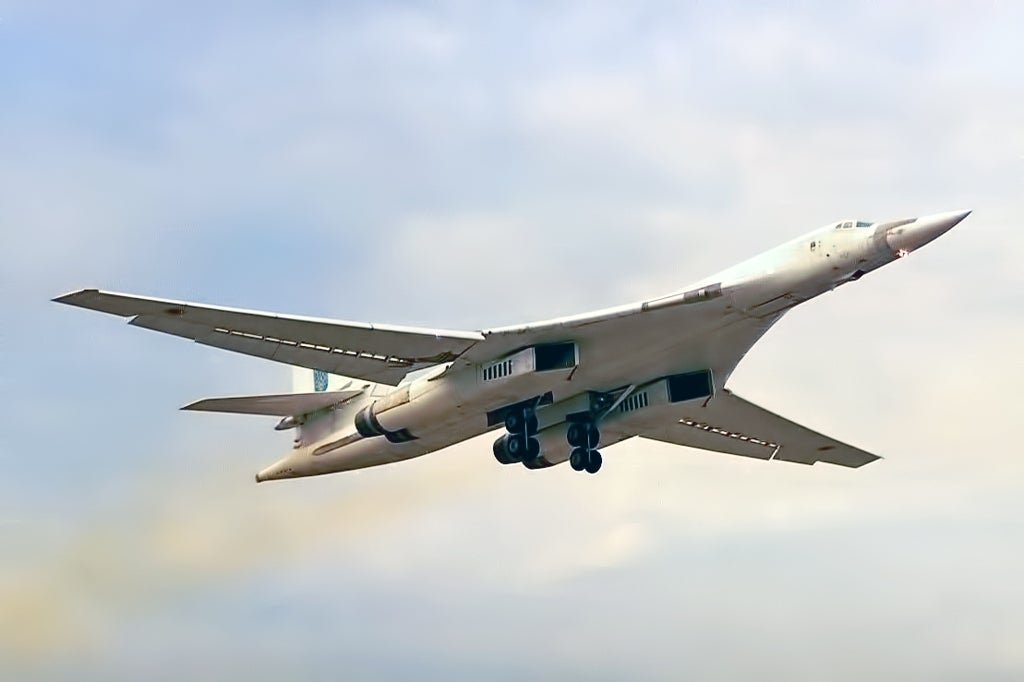
As the Soviet Union collapsed at the end of 1991, the Pryluky regiment had two squadrons of Tu-160s, for a total of 19 aircraft. These were now in the hands of independent Ukraine, together with their nuclear armament. These aircraft were soon repainted in Ukrainian Air Force markings, as seen in the photo at the top of this article, but the newly independent country had no use for a strategic bomber force and no plans to field any kind of nuclear deterrent.
With the demise of the Soviet Union, Ukraine had been left with around a third of the Soviet nuclear arsenal, which, as well as bombers and their munitions, included silo-based SS-19 and SS-24 intercontinental ballistic missiles (ICBMs), for a total of around 1,700 warheads. In 1994 Ukraine agreed to destroy the weapons and join the Treaty on the Non-Proliferation of Nuclear Weapons (NPT).
Moreover, Ukraine lacked the funds to fly its Blackjacks regularly. Without the required technical support, spare parts, and fuel, the Ukrainian Tu-160s rapidly became dormant.
A satellite photo of Pryluky Air Base dated 2020. The base has been abandoned since the Tu-160 fleet was removed., Google Earth
In Russia, meanwhile, production of the Blackjack continued, at a modest tempo, and in the early 1990s, six more Tu-160s were delivered to the Long-Range Aviation unit at Engels, near Saratov in the southwest Volga region. Nevertheless, the Russian fleet remained much smaller.
By 1999, the Long-Range Aviation branch, now part of the Russian Air Force, was at perhaps its lowest point. As well as having just half-a-dozen Tu-160s available, flying hours were slashed to just over 20 per year for each crew member. Long-distance ‘patrol’ missions by Blackjacks, as well as Tu-22M3 and Tu-95MS aircraft, had become a rare occurrence.
Reportedly, it was the NATO Allied Force bombing campaign against the Federal Republic of Yugoslavia during the Kosovo War in 1999 that prompted Moscow to address its bomber shortcomings. Earlier talks about Moscow buying the Tu-160s from Ukraine had broken down amid disagreements over price and in January 1999 Ukraine had scrapped a first Tu-160.
U.S. Senator Richard Lugar (right) and Ukrainian Gen. Vladimir Mityuk in front of a Tu-160 at Pryluky in November 1998. A proponent of nuclear arms reduction in Europe, Lugar was in Ukraine on a weapons inspection trip., Office of Senator Richard Lugar
Finally, in October 1999, an agreement was signed in Yalta, in Crimea — then still Ukrainian territory — under which Russia purchased eight Tu-160s from Ukraine, finally giving Moscow control of the majority of the aircraft.
Of the 19 Ukrainian Tu-160s, the eight judged to be in the best condition were prepared for transfer to Russia, while another 10 were scrapped. The sole surviving Tu-160 in Ukraine was donated to an aviation museum in Poltava.
Members of the U.S. Defense Threat Reduction Agency observe the scrapping of a Ukrainian Tu-160 in June 2000., National Archives
Former Soviet Tu-95MS Bear-H bombers had been inherited by Ukraine, too, with 24 examples left at Uzin Air Base. This compared with 22 Tu-95MS in Russia and 40 more in newly independent Kazakhstan. The Kazakh Bears were transferred to Russia in exchange for tactical aircraft that went in the other direction. Meanwhile, the three most modern Ukrainian Tu-95MS were sold to Russia as part of the Tu-160 deal, the remainder being scrapped.
The sole Tu-160 remaining in Ukraine is preserved at the aviation museum in Poltava:
The former Ukrainian Tu-160s were flown to Engels between November 1999 and February 2000, finally providing Russia with a meaningful fleet of these bombers. Equally importantly, the Kremlin had also secured 575 Kh-55SM nuclear-armed cruise missiles from Ukraine — weapons that arm both the Tu-160 and Tu-95MS — in exchange for debt relief related to the supply of Russian gas.
A Kh-55 cruise missile test round at the Ukrainian Air Force Museum in Vinnytsia., George Chernilevsky/Wikimedia Commons
Russian Blackjack numbers continued to be boosted through low-scale production, another new bomber being delivered in May 2000, although it wouldn’t be until 2008 that the next example arrived. In the meantime, the demand for Tu-160s was such that a former Tupolev trials aircraft was also refurbished and handed over to the Russian Air Force in a operational configuration.
A Russian Air Force Tu-160 in 2006. This example is named Valentin Bliznyuk after one of the designers who worked on the Blackjack program., Dmitriy Pichugin/Wikimedia Commons
The Tu-160’s Ukrainian interlude was quickly forgotten, as the Blackjack established itself in Russian service and the bombers — now wearing the names of Russian heroes, both mythic and military — began to fly more long-range missions as part of a rejuvenated strategic flying branch. The protracted path to getting meaningful numbers of Tu-160s into Russian service meant it wasn’t until December 2005 that the type was actually officially commissioned into frontline service.
The Russian Aerospace Force, or VKS, as the Russian Air Force was renamed in 2015, is today a proud operator of the Tu-160. The revived Blackjack fleet has seen combat during Moscow’s campaign in Syria and made high-profile visits to South Africa and Venezuela.
As well as introducing new armament, including stealthier and conventionally armed cruise missiles, there are greater ambitions for the Tu-160.
As you can read about in detail here , Russia has been conducting a mid-life upgrade program for its Tu-160s, adding new mission systems and avionics. A first “deeply modernized” Tu-160M based on an aircraft from the original production series performed its maiden flight in February 2020. It was powered by new-production NK-32-02 engines, the most powerful combat aircraft engine on earth , which replace the NK-32s used in the original production aircraft.
At the same time, work is underway to resume production of the Blackjack, to help bolster the bomber fleet pending the possible arrival of a new-generation successor, under the secretive — and delayed — PAK DA program . The new-build aircraft were once to be designated Tu-160M2 but will now also be known as Tu-160Ms. Plans call for up at least 50 new-build Tu-160Ms to remain in service until the 2050s or even the 2060s. Late last year it was reported that the first of the next batch of new-build Tu-160Ms was expected to fly in the fourth quarter of 2021, but so far there have been no signs of preparations.
With the continued resurgence of Long-Range Aviation, ongoing Blackjack upgrades, and new production plans, the 40th anniversary of the Tu-160 sees the strategic bomber in good shape.
Meanwhile, current tensions between Russia and Ukraine mean that a similar kind of transfer of military assets from one country to the other is now unthinkable. The years since the sale of the Tu-160s have seen Moscow’s seizure of the Crimean Peninsula in 2014 and active support of ostensibly local ‘separatist’ groups in eastern Ukraine.
The Tu-160’s interlude with the Ukrainian Air Force now seems an ever more bizarre throwback to a very different period in history.
Contact the author: thomas@thedrive.com
Comments couldn’t be loaded. Please refresh the page.
更新于美国东部时间2021年12月17日下午1:30
图波列夫Tu-160“海盗旗”战略轰炸机,明天就是它首飞40周年纪念日了。这款冷战时期设计的战机如今正在进行现代化改造,并以升级后的型号重新投入生产。鲜为人知的是,曾经绝大多数的Tu-160并不在俄罗斯手中,而是属于乌克兰。自乌克兰脱离苏联独立以来,它与莫斯科的关系一直在持续恶化。
作为冷战时期最后一款投入使用的战略轰炸机,可变后掠翼的图-160被规划为苏联空军远程航空兵的先锋机型,也是其中最负盛名的机型。它的任务是在冲突爆发时向北约的重要目标投掷核导弹。这款四引擎轰炸机的最大速度可达每小时1243英里,无需空中加油即可携带6枚巡航导弹飞行超过7500英里,最多可携带12枚导弹。
1996年,一架图-160从普里卢基机场起飞,这是乌克兰空军该机型为数不多的几次飞行之一。图片来源:Igor Bubin/Wikimedia Commons
图-160项目可以追溯到1967年,当时正在进行一场远程超音速轰炸机的竞标,该轰炸机将配备超音速战略导弹。受美国相关发展的启发,最终决定为其配备亚音速空射巡航导弹。
第一架“海盗旗”原型机,编号70-1,于1981年12月18日首飞,首架量产型飞机于1984年10月试飞。随后,1987年4月,首批两架飞机交付给驻扎在乌克兰普里卢基(当时属于苏联)的第184重型轰炸航空团。这支部队后来被证明存在诸多问题。所有量产型飞机均在俄罗斯喀山的工厂下线。
1991年底苏联解体时,普里卢基团拥有两个中队的图-160轰炸机,共计19架。这些飞机连同其核武器一起落入了独立的乌克兰手中。这些飞机很快被重新涂装成乌克兰空军的标志,正如本文顶部照片所示。但这个新独立的国家并不需要战略轰炸机部队,也没有部署任何核威慑力量的计划。
随着苏联解体,乌克兰继承了苏联约三分之一的核武库,其中包括轰炸机及其弹药,以及井基SS-19和SS-24洲际弹道导弹(ICBM),总计约1700枚核弹头。1994年,乌克兰同意销毁这些武器并加入《不扩散核武器条约》(NPT)。
此外,乌克兰缺乏资金来维持其“海盗旗”战机的正常飞行。由于缺乏必要的技术支持、备件和燃料,乌克兰的图-160战机很快就陷入了闲置状态。
一张摄于2020年的普里卢基空军基地卫星照片。自图-160机队撤离后,该基地已被废弃。(谷歌地球)
与此同时,俄罗斯仍在以较为缓慢的速度生产图-160“海盗旗”轰炸机。20世纪90年代初,又有6架图-160交付给位于伏尔加河西南部萨拉托夫附近的恩格斯远程航空兵部队。尽管如此,俄罗斯的图-160机队规模仍然小得多。
到1999年,隶属于俄罗斯空军的远程航空兵部队或许正处于其最艰难的时期。当时,该部队仅剩六架图-160飞机可用,每位机组人员的飞行小时数也被削减至每年仅20小时出头。“海盗旗”以及图-22M3和图-95MS飞机执行的远程“巡逻”任务已变得极为罕见。
据报道,1999年科索沃战争期间北约盟军对南斯拉夫联盟共和国的轰炸行动促使莫斯科开始重视其轰炸机的不足。此前,莫斯科与乌克兰就购买图-160轰炸机进行的谈判因价格分歧而破裂,乌克兰于1999年1月报废了第一架图-160轰炸机。
1998年11月,美国参议员理查德·卢格(右)与乌克兰将军弗拉基米尔·米丘克在普里卢基的一架图-160轰炸机前合影。卢格是欧洲核裁军的倡导者,当时他正在乌克兰进行武器核查访问。(图片来源:参议员理查德·卢格办公室)
最终,在 1999 年 10 月,双方在克里米亚雅尔塔(当时仍是乌克兰领土)签署了一项协议,根据该协议,俄罗斯从乌克兰购买了 8 架图-160 飞机,最终使莫斯科控制了大部分飞机。
乌克兰的19架图-160飞机中,8架状况最佳的飞机被准备移交给俄罗斯,另外10架被拆解。乌克兰境内唯一幸存的图-160飞机被捐赠给了波尔塔瓦的一家航空博物馆。
2000年6月,美国国防威胁降低局成员观摩一架乌克兰图-160轰炸机的拆解过程。(美国国家档案馆)
乌克兰也继承了前苏联的图-95MS“熊-H”轰炸机,其中24架仍驻扎在乌津空军基地。相比之下,俄罗斯拥有22架图-95MS,而新独立的哈萨克斯坦则拥有40架。哈萨克斯坦的“熊”式轰炸机被移交给俄罗斯,换取了俄罗斯的战术飞机。与此同时,乌克兰最先进的三架图-95MS作为图-160交易的一部分出售给了俄罗斯,其余的则被拆解报废。
乌克兰仅存的一架图-160飞机保存在波尔塔瓦航空博物馆:
1999年11月至2000年2月间,原乌克兰的图-160轰炸机被运往恩格斯,最终使俄罗斯拥有了一支规模可观的图-160轰炸机队。同样重要的是,克里姆林宫还从乌克兰获得了575枚Kh-55SM核巡航导弹——这些导弹可用于装备图-160和图-95MS轰炸机——作为交换,乌克兰同意减免与俄罗斯天然气供应相关的债务。
文尼察乌克兰空军博物馆进行的 Kh-55 巡航导弹试射。乔治·切尔尼列夫斯基/维基共享资源
俄罗斯的“海盗旗”轰炸机数量通过小规模生产持续增长,2000年5月又交付了一架新型轰炸机,但下一架直到2008年才交付。与此同时,对图-160的需求如此之大,以至于一架原图波列夫试验机也被翻新并以作战配置交付给俄罗斯空军。
2006年俄罗斯空军的一架图-160轰炸机。这架飞机以参与“黑杰克”项目的设计人员之一瓦伦丁·布利兹纽克的名字命名。(图片来源:Dmitriy Pichugin/Wikimedia Commons)
图-160在乌克兰的短暂经历很快就被人们遗忘,因为“海盗旗”轰炸机在俄罗斯空军站稳了脚跟,这些轰炸机——如今披上了俄罗斯英雄(包括神话人物和军事英雄)的战袍——开始执行更多远程任务,成为重振旗鼓的战略航空兵部队的一部分。由于图-160进入俄罗斯空军服役的进程漫长,直到2005年12月,该机型才正式列装一线部队。
俄罗斯空天军(VKS,即俄罗斯空军在2015年更名后的名称)如今是图-160战机的骄傲用户。这支重振旗鼓的“海盗旗”机队曾在莫斯科入侵叙利亚的军事行动中参与战斗,并高调访问了南非和委内瑞拉。
除了引入新型武器装备,包括更隐蔽、配备常规武器的巡航导弹之外,图-160还有更大的雄心壮志。
正如您在此处可以详细阅读到的那样,俄罗斯一直在对其图-160战机进行中期升级改造,为其增加新的任务系统和航空电子设备。首架基于原生产系列飞机进行“深度现代化”改造的图-160M于2020年2月首飞。该机配备了新生产的NK-32-02发动机,这是目前世界上动力最强劲的战斗机发动机,取代了原生产系列飞机上使用的NK-32发动机。
与此同时,为了在新一代后继机型(根据神秘且已延期的PAK DA项目)到来之前补充轰炸机机队,黑杰克轰炸机的生产工作正在恢复中。这些新造飞机原计划被命名为图-160M2,但现在也将被称为图-160M。计划至少有50架新造的图-160M服役至2050年代甚至2060年代。去年年底有报道称,下一批新造图-160M的首架预计将于2021年第四季度首飞,但迄今为止尚未有任何准备工作的迹象。
随着远程航空的持续复兴、黑杰克轰炸机的不断升级以及新的生产计划,在图-160战略轰炸机诞生40周年之际,这款战略轰炸机依然保持着良好的状态。
与此同时,鉴于俄乌两国目前的紧张局势,类似军事资产的国与国之间的转移已不再可能。自图-160战机售出以来,莫斯科于2014年吞并了克里米亚半岛,并积极支持乌克兰东部一些表面上是地方性的“分离主义”团体。
图-160与乌克兰空军的这段插曲,如今看来越来越像是对一段截然不同的历史时期的怪诞回溯。
联系作者:thomas@thedrive.com
评论加载失败,请刷新页面。