Delivery riders welcome guidelines for dedicated condo parking spots and collection lockers外卖骑手欢迎有关公寓专用停车位和取货柜的指导方针
Delivery riders welcomed new guidelines that call for dedicated parking spaces and collection points in condominiums and malls, but experts and condo management said cost, security and residents’ expectations could be stumbling blocks.Delivery riders The Straits Times spoke to said the latest guidelines issued by the Land Transport Authority (LTA) and Urban Redevelopment Authority (URA) will help ease the hassles...
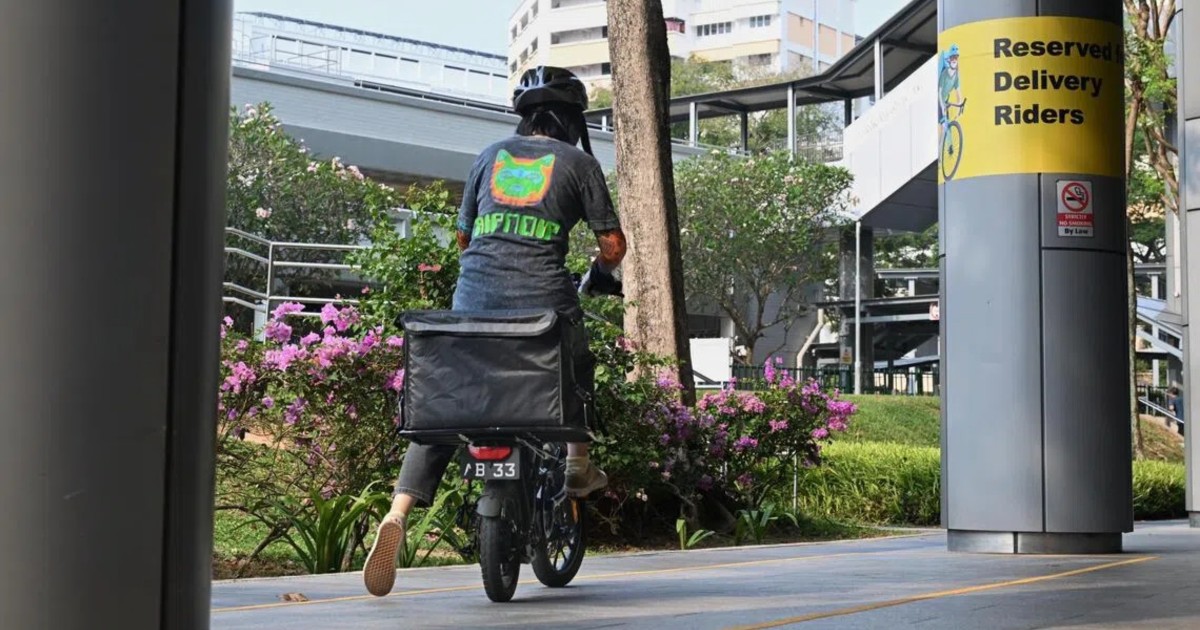
Delivery riders welcomed new guidelines that call for dedicated parking spaces and collection points in condominiums and malls, but experts and condo management said cost, security and residents’ expectations could be stumbling blocks.
Delivery riders The Straits Times spoke to said the latest guidelines issued by the Land Transport Authority (LTA) and Urban Redevelopment Authority (URA) will help ease the hassles they face when they go to condos to deliver food or drop off parcels.
For instance, delivery rider Mika Khor, 34, said she often parks her e-bike – or power-assisted bicycle – on public paths outside condos whenever she makes deliveries.
Despite fears of incurring a fine for parking illegally, it is a risk she takes, even if it is more troublesome and takes more time – up to eight minutes – to walk up to the customer’s doorstep.
And many customers often do not pick up when she buzzes them on the condo intercom system, leaving her stranded outside. She has no choice but to wait and tailgate a resident entering or leaving the block – which in turn, wastes her time, Khor said.
That is why collection points can be helpful, unless security guards make it tough for riders to enter the condo, she added.
In early September, LTA and URA issued a fresh set of recommendations to building owners, managers and developers in a bid to smoothen last-mile food and parcel deliveries in malls, offices and condos.
The guidelines include providing facilities like delivery waiting bays where riders can park their vehicles for free within a grace period of at least 15 minutes, and setting up collection points near guardhouse entrances.
Alex Seow, 26, who has been making food deliveries for five years, said he often worries about having to pay for parking at malls when picking up orders from vendors.
If dedicated parking areas are set up at more malls, Seow said it would help ease his worries.
But such parking spaces for e-bikes and motorcycles are better if under shelter to prevent incidents of vehicles catching fire in the sweltering heat or exploding, he added.
Implementing new building guidelines like allocated parking spaces and collection points in condos is likely to vary across developments, said management corporation strata titles (MCST) and experts.
Any change is likely to be “gradual and uneven” because estates differ in their layouts and residents’ expectations, said Samuel Chng, head of the urban psychology lab in the Lee Kuan Yew Centre for Innovative Cities at the Singapore University of Technology and Design.
Older developments with limited space and residents who cannot agree on how to divvy up common spaces to mark out new parking spaces for delivery riders can also pose a problem, he added.
Clearer signs and simpler security registration procedures – among the guidelines issued by the authorities – could be some of the easier options to get condos to adopt.
Winnie Wong, senior managing director for property management at Savills Singapore, said the roll-out of the new guidelines is likely to differ between new and existing developments.
Some measures – like clearer wayfinding signs and dedicated delivery facilities – are likely easier to implement when a project is still in the planning or development stage, she added.
If it involves a completed condominium, the MCST needs to work with existing physical constraints, while considering factors such as space, cost, security and residents’ needs, said Wong.
For instance, smaller condos might have less flexibility to carve out additional space for dedicated parking spots, she added.
Dennis Tan, president of the MCST Association of Singapore, said condos near MRT stations that might have less space and need for carpark spaces, and those with features like multiple-basement carparks, could face challenges in creating dedicated parking bays for delivery riders.
As for delivery lockers or collection points, MCSTs would need to consider if there is suitable space, and how much it will cost to install and maintain the facilities, said Wong.
Chng said the suitability of collection points depends on the type of delivery and the needs of residents.
For instance, food deliveries require timely collection, and self-collection can be difficult for residents with limited mobility or for caregivers who cannot leave their homes most times.
In the end, for collection points to work, a change in customers’ mindsets is needed, said industry research director Mark Goh, from the Logistics Institute - Asia Pacific at the National University of Singapore.
Doorstep deliveries also should cost more, he added. The idea of making a delivery to the nearest locker also needs to be embraced as the new norm, he said.
While the new guidelines set by the authorities are not mandatory, Tan said condos that do not look into solutions to improve deliveries will inconvenience residents and tenants.
This article was first published in The Straits Times . Permission required for reproduction.
外卖骑手们对要求在公寓和商场设立专用停车位和取货点的新准则表示欢迎,但专家和公寓管理人员表示,成本、安全和居民的期望可能会成为绊脚石。
《海峡时报》采访的外卖骑手表示,陆路交通管理局 (LTA) 和市区重建局 (URA) 发布的最新指南将有助于减轻他们在前往公寓送餐或递送包裹时遇到的麻烦。
例如,34 岁的送货员 Mika Khor 表示,她经常把电动自行车(或称助力自行车)停放在公寓楼外的公共道路上进行送货。
尽管担心会因违章停车而被罚款,但她还是冒了这个风险,即使走到顾客家门口会更麻烦、更费时(最多八分钟)。
科尔说,很多住户在她按公寓对讲机门铃时无人应答,让她被困在外面。她别无选择,只能等住户进出大楼时尾随其后——这无疑浪费了她的时间。
她补充说,这就是为什么集合点会很有帮助,除非保安人员阻挠骑车人进入公寓。
9月初,陆路交通管理局和市区重建局向楼宇业主、管理人员和开发商发布了一系列新的建议,旨在改善商场、办公楼和公寓的最后一公里食品和包裹配送。
指导方针包括提供送货等候区等设施,骑手可以在至少 15 分钟的宽限期内免费停车,并在警卫室入口附近设立收货点。
26 岁的 Alex Seow 从事外卖送餐工作已有 5 年,他说他经常担心在商场取餐时需要支付停车费。
Seow表示,如果更多商场设立专用停车场,将有助于减轻他的担忧。
但他补充说,如果电动自行车和摩托车的停车位能有遮挡物,那就更好了,这样可以防止车辆在酷热天气下起火或爆炸。
物业管理公司(MCST)和专家表示,在公寓中实施新的建筑准则(如分配停车位和收款点)可能会因开发项目而异。
新加坡科技设计大学李光耀创新城市中心城市心理学实验室主任张胜宇表示,任何变化都可能是“渐进且不均衡的”,因为各个住宅区的布局和居民的期望各不相同。
他还补充说,空间有限的老旧住宅区,以及居民无法就如何划分公共空间为送货骑手划出新的停车位达成一致意见,也可能造成问题。
更清晰的标志和更简单的安全登记程序——这些是当局发布的指导方针中的一些更容易让公寓采纳的措施。
新加坡第一太平戴维斯物业管理高级董事总经理黄慧敏表示,新规的推行在新开发项目和现有开发项目之间可能会有所不同。
她补充说,一些措施——例如更清晰的导向标志和专用交付设施——在项目仍处于规划或开发阶段时更容易实施。
黄先生表示,如果涉及已建成的公寓,MCST 需要在现有物理限制条件下工作,同时考虑空间、成本、安全和居民需求等因素。
她补充说,例如,较小的公寓可能没有那么大的灵活性来腾出额外的空间作为专用停车位。
新加坡MCST协会主席陈丹尼斯表示,地铁站附近的公寓可能空间较小,对停车位的需求也较低,而那些拥有多层地下停车场的公寓,在为外卖骑手创建专用停车位方面可能会面临挑战。
黄先生表示,至于送货柜或取货点,市政服务信托基金需要考虑是否有合适的空间,以及安装和维护这些设施需要多少成本。
Chng表示,收货点的适宜性取决于配送类型和居民的需求。
例如,食品配送需要及时领取,但对于行动不便的居民或大部分时间无法出门的护理人员来说,自行领取可能很困难。
新加坡国立大学亚太物流研究所行业研究总监 Mark Goh 表示,归根结底,要让提货点发挥作用,需要改变顾客的思维方式。
他还补充说,送货上门的价格也应该上涨。他表示,将商品送到最近的自提柜的做法也应该成为新的常态。
Tan表示,虽然当局制定的新准则并非强制性的,但那些不寻求改善配送解决方案的公寓将会给居民和租户带来不便。
本文最初发表于《海峡时报》。转载需获得许可。