This Ghost Of A Helicopter Likely Had A Secret Role In Reagan’s ‘Tear Down This Wall’ Speech这架直升机的幽灵很可能在里根的“推倒这堵墙”演讲中扮演了秘密角色
All the available information we've uncovered indicates that this helicopter was assigned to a top-secret covert aviation unit called Seaspray.
新闻视频
By Joseph Trevithick
Updated May 3, 2019 4:12 PM EDT
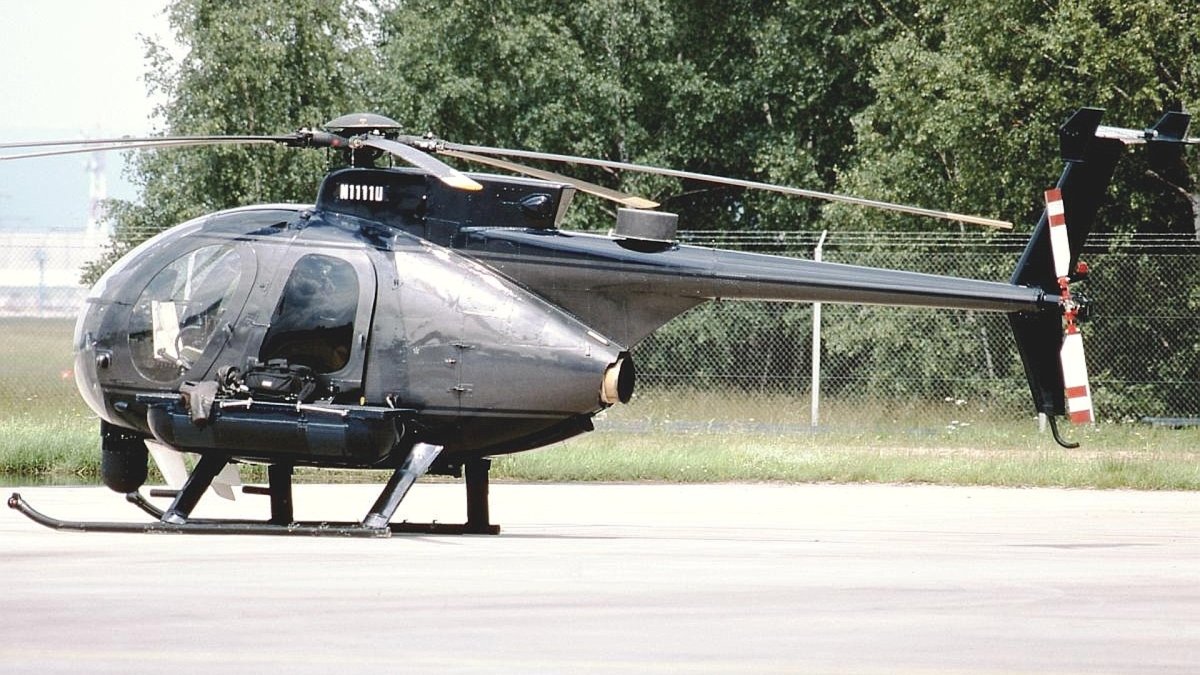
Just days after then-U.S. President Ronald Reagan made his famous “ Tear down this wall! ” speech in West Berlin in June of 1987, German photographer Manfred Faber took a picture of a uniquely modified helicopter wearing an unassuming civilian paint job and carrying a U.S. civil registration code at Frankfurt Airport. Documents we have obtained via the Freedom of Information Act, along with information from other sources, point to this particular Hughes Little Bird being a part of one of the U.S. military’s most top-secret aviation units ever, formally called the 1st Rotary Wing Test Activity, but better known as Seaspray .
We reached out to Mr. Faber, who was gracious enough to let us use his photograph for this story. You can find more of his work here . Unfortunately, he had no additional information on the helicopter, which had the registration N1111U at the time, or why it might have been in Frankfurt.
Per information we obtained from the Federal Aviation Administration (FAA), the aircraft started life as a Hughes Model 369D, the manufacturer’s name for the OH-6D helicopter. This was an improved version of the Vietnam War-era OH-6A Cayuse light scout helicopter. The most obvious external improvements were the addition of a new five-blade main rotor in place of the original four-blade design and new T-shaped tail assembly. It also featured an improved Allison turboshaft engine.
The resulting variant was significantly faster and more powerful than its predecessors. N1111U clearly took advantage of that additional capability to carry a variety of cutting edge equipment, turning it into something of a real-life analog to the fictional helicopter in the television show Airwolf .
N1111U, a highly modified Hughes 369D., Manfred Faber
A night-flying, covert transport
Under the nose, N1111U has what appears to be a Hughes AN/AAQ-16 forward-looking infrared (FLIR) turret, which can capture infrared full motion video during the day and night and in most any weather conditions. After acquiring the rights to the design, Raytheon Systems Company continued producing versions of this system into the 1990s and it was a standard feature on early U.S. Army special operations MH-47 Chinooks and MH-60 Black Hawks , as well as U.S. Air Force HH-60G Pave Hawk rescue helicopters.
The helicopter also has a plank on the side that special operators could ride on, which also doubles as an extended range fuel tank. A center spar running through the small rear cabin would connect this assembly to another plank on the opposite side of the aircraft.
There are also three large blade antennas under the nose, which are typically associated with high-frequency radios and other communications systems. A round “cake pan” antenna on the helicopter’s boom is indicative of an early satellite communications system or satellite navigation system. There are also missile approach warning detectors on the nose. These are typically found on aircraft meant to fly into or through contested airspace. There may be additional internal components, including in the exhaust system, to dampen the aircraft’s infrared signature to help protect it from short-range heat-seeking surface-to-air missiles, but the area where a side-mounted infrared-dampening exhaust port would be is blanked off on this aircraft.
There are various other less obvious specialized features on N1111U, including “slime lights” and a small infrared light on the tail for night formation flying. The helicopter also has the mounting points above the rear door for the Fast Rope Insertion Extraction System, or FRIES , which would allow individuals on the planks to quickly rappel into an area if the helicopter could not find a suitable landing spot.
An MH-6 Little Bird from the US Army’s 160th Special Operations Aviation Regiment carries special operators on side-mounted planks and has the FRIES equipment installed to allow them to rappel down once the helicopter reaches its objective. In 1987, N1111U was configured for similar operations., US Army
We can’t say for sure whether N1111U had a night vision goggle compatible cockpit configuration or not. Given the helicopter’s other night-flying features and the experience the U.S. military had gained from its abortive attempt to rescue American hostages in Iran in 1980, it seems more than plausible that the pilots would have trained to fly it while using NVGs by 1987.
Taken together, the helicopter looks state-of-the-art for its time and particularly well configured to insert small numbers of special operators discreetly, even in the dead of night, into very confined spaces. Its civilian style paint job would have helped it avoid unwanted attention and allowed it to hide in plain sight to some degree, especially at busy major airports such as the one in Frankfurt.
These are all features that one might also expect to find on early MH-6 Little Birds that the U.S. Army’s elite Task Force 160 operated after its activation in 1981. That unit eventually evolved into the 160th Special Operations Aviation Regiment we know today.
The Hughes 369D also benefited from improvements Hughes had developed for the commercial Model 500, which McDonnell Douglas produced after acquiring Hughes in 1984 as the MD 500 or Defender. Further improved variants of the Little Bird design continue to serve with the 160th . Except we know that this helicopter wasn’t part of the 160th.
The video below of an MH-6 from the US Army’s 160th Special Operations Aviation Regiment shows off the speed and agility of the Little Bird platform.
Corporate shell-game and a top secret unit
Around the same time that the Army created Task Force 160 in 1981, in cooperation with the Central Intelligence Agency, it formed Seaspray. This organization’s mission was specifically to carry out “black” covert and clandestine missions, often in cooperation with equally top-secret Army units such as Delta Force and the Intelligence Support Activity . An organization that officials referred to broadly as the “Special Operations Division” oversaw all of these units.
Journalist Steven Emerson, in his 1988 book Secret Warriors : Inside the Covert Military Operations of the Reagan Era , describes the formation of Seaspray in this way:
“The [Special Operations] Division’s final step in creating Seaspray was to establish a commercial ‘cover,’ so that it could fly classified missions without being recognized as part of the U.S. military. Seaspray became integrated into a CIA proprietary company. Aviation Tech Services, that allowed Seaspray helicopters to appear to be part of a private company. Aviation Tech Services also provided liability protection for Seaspray.”
Because the military is severely restricted in setting up incorporated proprietaries, it turned to the CIA, which is not encumbered by such Congressional restrictions. Seaspray itself was headquartered at Fort Eustis, Virginia, and innocuously named the First Rotary Wing Test Activity as an internal Army cover. Another secret Seaspray headquarters was located in Tampa, in order to support Central American operations.”
According to the documents we obtained from the FAA, in February 1981, none other than Aviation Technical Services purchased N1111U direct from Hughes. The registration was originally linked to an address in Miami, Florida, further south of Tampa.
In September 1981, the address of the registration changed to a location in Rocky Mount, North Carolina. This city sits 80 miles west of the Harvey Point Defense Testing Activity, a collection of facilities commonly associated with the CIA and covert U.S. military operations. Before setting out on the raid that ultimately killed Osama Bin Laden in May 2011, SEAL Team Six operators trained on a full-scale mockup of the Al Qaeda leader’s compound in Abbottabad, Pakistan at Harvey Point.
One of N1111U registration’s, showing Aviation Technical Services’ address in Rocky Mount, North Carolina., FAA via FOIA
In October 1981, Aviation Technical Services changed the address on the helicopter’s registration yet again, this time to Fort Eustis proper. That was still the case when Manfred Faber caught a glimpse of N1111U in Germany on June 18, 1987. We, unfortunately, have no idea what the helicopter might have been doing in the interim. The existence of Seaspray came out in 1985 as a result of the Iran-Contra scandal and the unit reportedly had conducted missions in El Salvador, Honduras, and Nicaragua in support of various covert activities in Central America.
Seaspray also reportedly used one of its Little Birds to ferry Lebanese Christian leader Bashir Gemayel from Beirut to a secondary location as part of a secret trip to Washington, D.C. in 1981. As part of their efforts to neutralize the Palestinian Liberation Organization and other terrorist groups in Lebanon, the United States and Israel supported Gamayel and his organization, known as the Phalange . This group subsequently became infamous for massacring hundreds of Palestinian and Lebanese Shia Muslims in the Sabra and Shatila refugee camps in 1982.
A copy of N1111U registration when Aviation Technical Services listed the address as being at Fort Eustis, Virginia., FAA via FOIA
While we don’t have any specific information as to what this Seaspray helicopter was doing in Germany in 1987, it’s highly probable that it, along with other U.S. military forces and elements of the U.S. Intelligence Community, was supporting Reagan’s historic trip. Making his speech in Berlin, then a divided city deep inside East Germany, which had been a playground for espionage and other clandestine activities for decades, was a major security risk in of itself.
The U.S. government would have been concerned, at least at some level, that the Soviets or the East Germans might seek to assassinate the president or otherwise violently disrupt his speech, potentially seeking out proxies to try to do so in a more deniable fashion. West German leftist groups had organized to oppose Reagan’s visit and thousands of protesters descended on West Berlin to demonstrate. Militant organizations such as the Red Army Faction remained active and there was the growing threat of international terrorism, as well.
On top of that, the Reagan administration had blamed Libyan leader Muammar Gaddafi and his government directly for a bombing in West Berlin in 1986 that killed three people, including two U.S. Army soldiers. That incident led to punitive air strikes, nicknamed Operation El Dorado Canyon , against Libya later in the year.
The Libyan dictator survived those strikes, but he claimed that his adoptive infant daughter Hana had died in the raid, which remains a source of controversy . Regardless, Gaddafi vowed to continue supporting terrorist groups, such as the Red Army Faction, and pursue retaliatory action against the United States himself.
All told, it is not hard to imagine that U.S. officials decided to keep Seaspray helicopters and a team of Delta Force operators, in addition to various other forces, on standby in West Germany. If any crisis had erupted, Reagan could have ended up effectively stranded inside East Germany and this helicopter and other assets could have rushed in to extract him if necessary.
Of course, Frankfurt is more than 250 miles southwest of Berlin, so it is possible that N1111U wasn’t staged there during the actual speech, though the extended range fuel tanks would have helped the small helicopter cover that distance if necessary. In addition, Faber did take his picture four days after the speech, so it’s also possible that the force that included elements from Seaspray was in the process of redeploying back to the United States.
Where is the helicopter now?
We don’t know what has happened to N1111U since it appeared in Germany. It is possible that the entire operation raised the profile of the helicopter, and others that participated in the mission, whatever it actually was, to the point of needing a new cover story.
In August 1987, Aviation Technical Services sold the aircraft, along with two other Hughes Model 369Ds, to Atlantic Air Associates. The company re-registered N1111U as N9159A to an address in Arlington Virginia, within spitting distance of CIA headquarters. The other two Little Birds had the N-numbers N7299A and N9166A.
The August 1987 letter from Atlantic Air Associates informing the FAA that it had purchased three Hughes 369Ds, including N9159A, the ex-N1111U., FAA via FOIA
In August 1991, Atlantic Air Associates sold the helicopter again, to a company called the Franklin Air Company in Baltimore, Maryland. It changed registration numbers in the process, becoming N26RV.
In January 1992, Franklin Air sent the helicopter to Summit Aviation in Delaware, another company with long-standing links to the CIA, to receive a Robertson Aviation HA-010 Range Extension Fuel Tank System, according to an airworthiness notice the company sent to the FAA. Then, in August 1992, the firm reassigned the N26RV N-number to a Hughes Model 369F, suggesting it had converted the helicopter to a more modern version entirely. In 2013, it disappears from the U.S. civil register altogether.
Atlantic Air Associates and Franklin Air Company have zero formal web presence. The Atlantic Air Associates address the FAA had on file points to a nondescript office building. Franklin Air Company was supposedly running its operations out of a strip mall.
A description of the work that Summit Aviation performed on N26RV in 1992., FAA via FOIA
What happened to Seaspray?
Seaspray no longer exists under that name, either. The unit eventually came under the direct control of the Intelligence Support Activity, becoming known as the Flight Concepts Division (FCD). In 1989, the Army officially stopped using the Intelligence Support Activity moniker for that organization, which has reportedly taken on a number of other cover designations since then.
You can read more about how the FCD fits into the U.S. military’s top-secret special operations aviation communities here , but suffice to say, it remains one of the U.S. military’s most closely guarded secrets. An undated job posting for a position at Fort Eustis noted that the base fire chief couldn’t even get into the organization’s main hangar – which sits behind two layers of fencing and has its own gate to the taxiway – for emergency planning purposes.
“Research activities are also conducted by the Flight Concepts Division that is highly secret and access for pre-planning purpose is non-existent” the same notice explained. “Nature of their work is known to be hazardous.”
Images of flooding inside FCD’s offices at Felker Army Airfield, at left, and outside, at right, during Hurricane Isabel in 2003. These may be the only official publicly available official photographs of any of the unit’s facilities., US Army
The unit has reportedly flown a wide variety of U.S.- and foreign-made aircraft over the years and has been involved in modifying those aircraft for highly specialized missions. The most notable that the FCD has reportedly had a direct hand in the development of the famous “Stealth Hawk,” a heavily updated MH-60 Black Hawk with various stealthy features, one of which crashed during the Bin Laden raid in Pakistan in 2011. The unit’s pilots may have actually flown that mission and they maintain a very close working relationship with the 160th Special Operations Aviation Regiment.
Publicly available satellite imagery of Fort Eustis’ Felker Army Airfield has long been devoid of Little Birds and there is evidence FCD might have traded them for Bell 407 helicopters , or another type of helicopter with only four blades on its main rotor, for unknown reasons in recent years. This might help explain the departure of N26RV from the civil register in 2013.
A satellite image showing a portion of Felker Army Airfield at Fort Eustis in 2015, with a number of small helicopters with four-blade main rotors at the lower left that appear to be Bell 407 helicopters. There is also a pair of CH-47 Chinooks above and a Russia-made Mi-17 helicopter at right., Google Earth
It is possible that FCD is itself a cover name. In his book Relentless Strike : The Secret History of Joint Special Operations Command , journalist Sean Naylor says that some or all of that entity eventually turned into E Squadron, Delta Force.
The FCD remained in existence at Fort Eustis’ Felker Army Airfield publicly until at least 2016 and is in the process of getting a number of new facilities, including a new main hangar and a completely separate ramp. The Army has reportedly now renamed it the Aviation Technology Office , or ATO.
An annotated satellite map showing the planned expansion of FCD’s presence at Felker Army Airfield as of 2014., US Army
Depending on where the ATO is still using Little Birds at all, and what condition N26RV might be in after more than three decades of covert operations, Manfred Faber’s picture may turn out to be one of, if not the only image of this extremely rare helicopter to ever emerge into the public eye.
Contact the author: jtrevithickpr@gmail.com
Comments couldn’t be loaded. Please refresh the page.
作者:约瑟夫·特雷维西克
更新于美国东部时间2019年5月3日下午4:12
1987年6月,时任美国总统罗纳德·里根在西柏林发表了著名的“推倒这堵墙!”演讲后几天,德国摄影师曼弗雷德·法贝尔在法兰克福机场拍到了一架经过独特改装的直升机,它涂装成普通的民用涂装,并挂有美国民用注册代码。我们通过《信息自由法》获取的文件,以及其他来源的信息表明,这架休斯“小鸟”直升机隶属于美国军方历史上最机密的航空部队之一,该部队正式名称为“第一旋翼机测试活动”,但更为人熟知的名称是“海浪”(Seaspray)。
我们联系了法贝尔先生,他非常慷慨地允许我们使用他拍摄的照片。您可以在这里查看他的更多作品。遗憾的是,他没有关于这架当时注册号为N1111U的直升机的更多信息,也不知道它为什么会出现在法兰克福。
根据我们从美国联邦航空管理局(FAA)获得的信息,这架飞机最初是一架休斯369D型直升机,也就是制造商对OH-6D直升机的命名。它是越战时期OH-6A“卡尤斯”(Cayuse)轻型侦察直升机的改进型。最明显的外部改进是将原有的四叶主旋翼更换为五叶主旋翼,并采用了新的T型尾翼组件。此外,它还配备了一台改进型的艾利逊涡轴发动机。
改进后的机型比之前的型号速度更快、动力更强。N1111U 显然充分利用了这一额外能力,搭载了各种尖端设备,使其在某种程度上成为了电视剧《飞狼》中虚构直升机的现实版。
N1111U,一架经过高度改装的休斯369D型飞机,曼弗雷德·法伯
一种夜间飞行、隐蔽的运输工具
N1111U 的机头下方似乎装有休斯公司生产的 AN/AAQ-16 前视红外 (FLIR) 转塔,该转塔可在白天和夜间以及几乎任何天气条件下拍摄红外全动态视频。雷神系统公司在获得该设计专利后,一直生产该系统的各种版本,直至 20 世纪 90 年代。该系统曾是美国陆军早期特种作战直升机 MH-47“支奴干”和 MH-60“黑鹰”以及美国空军 HH-60G“铺路鹰”救援直升机的标准配置。
直升机侧面还有一个可供特种作战人员乘坐的平台,该平台同时也是一个增程油箱。一根贯穿小型后舱的中心梁将这个平台与飞机另一侧的另一个平台连接起来。
机头下方还有三根大型叶片天线,通常与高频无线电和其他通信系统相关。直升机尾梁上的圆形“蛋糕盘”天线表明其可能搭载早期的卫星通信系统或卫星导航系统。机头上还装有导弹逼近告警探测器,这些探测器通常用于飞入或穿越敌对空域的飞机。飞机内部可能还有其他组件,例如排气系统,用于降低飞机的红外特征,以抵御短程红外制导地对空导弹的攻击,但这架飞机上原本应该安装侧面红外抑制排气口的区域已被封堵。
N1111U还有一些不太明显的特殊功能,例如尾部的“粘液灯”和用于夜间编队飞行的小型红外灯。此外,直升机后舱门上方还设有快速绳索插入撤离系统(FRIES)的安装点,该系统可以让站在跳板上的人员在直升机找不到合适的着陆点时快速绳降到指定区域。
美国陆军第160特种作战航空团的一架MH-6“小鸟”直升机,侧面装有跳板,搭载特种作战人员,并配备了FRIES设备,以便在直升机到达目标后进行绳降。1987年,N1111U被改装用于类似行动。
我们无法确定N1111U是否配备了兼容夜视镜的驾驶舱。考虑到该直升机的其他夜间飞行功能,以及美军在1980年营救伊朗美国人质行动失败后积累的经验,飞行员在1987年之前接受过使用夜视镜驾驶该直升机的训练似乎是完全合理的。
总的来说,这架直升机在当时堪称一流,其配置尤其出色,即使在深夜,也能将少量特种作战人员秘密送入极其狭小的空间。其民用涂装有助于避免引起不必要的注意,使其能够在一定程度上隐蔽起来,尤其是在像法兰克福机场这样繁忙的大型机场。
这些特点也同样适用于美国陆军精锐部队第 160 特遣队在 1981 年成立后使用的早期 MH-6 小鸟直升机。该部队最终发展成为我们今天所知的第 160 特种作战航空团。
休斯369D也受益于休斯公司为商用500型直升机开发的改进技术。麦克唐纳·道格拉斯公司在1984年收购休斯后,将500型直升机命名为MD 500或“捍卫者”(Defender)。“小鸟”(Little Bird)设计的进一步改进型继续在第160战斗机联队服役。但我们知道,这架直升机并不属于第160战斗机联队。
下面这段视频展示了美国陆军第 160 特种作战航空团的一架 MH-6 直升机,展现了“小鸟”平台的速度和敏捷性。
公司骗局和绝密部门
大约在1981年,陆军与中央情报局合作组建了第160特遣队的同时,也成立了“海浪行动”(Seaspray)。该组织的任务是专门执行“黑色”的秘密行动,通常与同样高度机密的陆军部队(例如三角洲部队和情报支援活动处)合作。一个被官方统称为“特种作战处”的机构负责监督所有这些部队。
记者史蒂文·埃默森在他 1988 年出版的《秘密战士:里根时代的秘密军事行动内幕》一书中,是这样描述“海浪行动”的组建过程的:
“特种作战部门创建‘海浪’直升机的最后一步是建立一个商业‘掩护’,使其能够在不被识别为美国军方一部分的情况下执行机密任务。‘海浪’直升机被整合到中央情报局旗下的一家公司——航空技术服务公司(Aviation Tech Services)——旗下,这使得‘海浪’直升机看起来像是属于一家私营公司。航空技术服务公司还为‘海浪’直升机提供了责任保护。”
由于军方在设立法人实体方面受到严格限制,因此转而求助于不受国会此类限制的中央情报局。Seaspray公司总部设在弗吉尼亚州尤斯蒂斯堡,并以“第一旋翼机测试活动”这一看似无害的名称作为陆军内部掩护。Seaspray公司还在坦帕设有另一个秘密总部,以支持其在中美洲的行动。
根据我们从美国联邦航空管理局(FAA)获得的文件,1981年2月,正是航空技术服务公司(Aviation Technical Services)直接从休斯公司(Hughes)购得了N1111U飞机。该注册号最初与佛罗里达州迈阿密的一个地址关联,该地址位于坦帕以南。
1981年9月,注册地址变更为北卡罗来纳州落基山市。该市位于哈维角国防试验场以西80英里处,哈维角国防试验场是一系列与中央情报局和美国秘密军事行动密切相关的设施。在2011年5月最终击毙奥萨马·本·拉登的突袭行动之前,海豹突击队第六分队的队员们曾在哈维角的基地组织头目位于巴基斯坦阿伯塔巴德的住所模型上进行过全尺寸训练。
N1111U 注册号之一,显示航空技术服务公司地址位于北卡罗来纳州落基山,信息来源:美国联邦航空管理局 (FAA) 通过《信息自由法》提供。
1981年10月,航空技术服务公司再次更改了直升机注册地址,这次改到了尤斯蒂斯堡。1987年6月18日,曼弗雷德·法贝尔在德国瞥见N1111U时,地址依然如此。遗憾的是,我们无从得知这架直升机在此期间的行动。由于伊朗门事件,海浪特遣队(Seaspray)的存在于1985年曝光。据报道,该部队曾在萨尔瓦多、洪都拉斯和尼加拉瓜执行任务,以支持中美洲的各种秘密行动。
据报道,1981年,Seaspray公司还曾使用其“小鸟”运输机将黎巴嫩基督教领袖巴希尔·杰马耶勒从贝鲁特秘密运送至华盛顿特区。为了削弱巴勒斯坦解放组织和黎巴嫩其他恐怖组织的势力,美国和以色列支持杰马耶勒及其领导的“长枪党”。该组织随后因在1982年于萨布拉和沙提拉难民营屠杀数百名巴勒斯坦和黎巴嫩什叶派穆斯林而臭名昭著。
根据《信息自由法》,美国联邦航空管理局(FAA)获得了N111U注册文件的副本,该文件显示航空技术服务公司(Aviation Technical Services)当时将地址列为弗吉尼亚州尤斯蒂斯堡。
虽然我们没有关于这架“海浪”直升机1987年在德国执行何种任务的具体信息,但它极有可能与其他美国军事力量和美国情报机构一起,为里根的历史性访问提供支持。当时的柏林是东德境内一座分裂的城市,几十年来一直是间谍活动和其他秘密活动的温床,因此,里根在柏林发表讲话本身就是一个巨大的安全隐患。
美国政府至少在某种程度上会担心,苏联或东德可能会试图刺杀总统或以其他暴力手段干扰他的演讲,甚至可能寻找代理人以更隐蔽的方式实施这些行动。西德左翼团体组织起来反对里根的访问,数千名抗议者涌入西柏林举行示威游行。诸如红军派之类的激进组织仍然活跃,国际恐怖主义的威胁也日益加剧。
此外,里根政府曾直接指责利比亚领导人穆阿迈尔·卡扎菲及其政府应对1986年发生在西柏林的爆炸事件负责,该事件造成包括两名美国陆军士兵在内的三人死亡。这一事件导致当年晚些时候对利比亚发动了惩罚性空袭,代号为“黄金峡谷行动”。
利比亚独裁者卡扎菲在空袭中幸存下来,但他声称他的养女哈娜在袭击中丧生,这一说法至今仍存在争议。尽管如此,卡扎菲仍誓言继续支持恐怖组织,例如红军派,并亲自对美国采取报复行动。
总而言之,不难想象,美国官员决定在西德部署“海浪”直升机和一支三角洲特种部队,以及其他各种部队,以备不时之需。一旦爆发危机,里根总统可能被困在东德境内,而这架直升机和其他资源可以在必要时迅速进入西德营救他。
当然,法兰克福位于柏林西南方向250多英里处,因此N1111U直升机在演讲期间可能并未部署在那里,尽管其配备的远程油箱确实可以帮助这架小型直升机在必要时飞越这段距离。此外,法贝尔是在演讲四天后才拍摄的照片,因此也有可能当时包括“海浪行动”部分人员在内的部队正在撤回美国。
直升机现在在哪里?
我们不知道N1111U自出现在德国后发生了什么。有可能整个行动提高了这架直升机以及其他参与任务的直升机的知名度,以至于需要一个新的掩盖故事。
1987年8月,航空技术服务公司将这架飞机连同另外两架休斯369D型飞机一起出售给了大西洋航空联合公司。该公司将注册号为N1111U的飞机重新注册为N9159A,注册地址位于弗吉尼亚州阿灵顿,距离中央情报局总部仅咫尺之遥。另外两架“小鸟”飞机的注册号分别为N7299A和N9166A。
1987年8月,大西洋航空联合公司致函美国联邦航空管理局(FAA),告知其已购买三架休斯369D型飞机,其中包括注册号为N9159A的飞机(原注册号为N1111U)。(信息自由法案)
1991年8月,大西洋航空联合公司再次将这架直升机出售给了位于马里兰州巴尔的摩的富兰克林航空公司。在此过程中,它的注册号也发生了变化,变成了N26RV。
1992年1月,富兰克林航空公司将这架直升机送往位于特拉华州的萨米特航空(Summit Aviation)——另一家与中央情报局(CIA)有着长期联系的公司——安装罗伯逊航空(Robertson Aviation)的HA-010型增程燃油箱系统。这一信息来自该公司提交给美国联邦航空管理局(FAA)的适航通知。随后,在1992年8月,该公司将N26RV的注册号重新分配给了休斯369F型直升机,这表明该公司已将这架直升机完全改装成了更现代化的型号。2013年,这架直升机从美国民用航空器登记册中彻底消失。
Atlantic Air Associates 和 Franklin Air Company 均无任何正式的网站信息。美国联邦航空管理局 (FAA) 存档的 Atlantic Air Associates 地址指向一栋毫不起眼的办公楼。Franklin Air Company 据称在一家小型购物中心内运营。
根据《信息自由法》,美国联邦航空管理局 (FAA) 提供了 Summit Aviation 公司 1992 年对 N26RV 飞机所做工作的描述。
Seaspray 怎么了?
“海浪”部队也已不再以这个名字存在。该部队最终归入情报支援活动部(Intelligence Support Activity)的直接管辖,并更名为飞行概念部(Flight Concepts Division,简称FCD)。1989年,陆军正式停止使用“情报支援活动部”这一名称来指代该机构,据报道,此后该机构曾使用过多个其他代号。
您可以点击此处阅读更多关于FCD如何融入美国军方绝密特种作战航空体系的信息,但总而言之,它仍然是美军严守的秘密之一。一份日期不详的尤斯蒂斯堡招聘启事指出,基地消防队长甚至无法进入该机构的主机库——该机库位于两层围栏之后,并设有通往滑行道的独立大门——进行应急预案制定。
“飞行概念部门也开展着高度机密的研究活动,事先规划所需的信息一概无法获取,”同一份通知解释道。“他们的工作性质已知具有危险性。”
左图为2003年伊莎贝尔飓风期间,费尔克陆军机场FCD办公室内部被洪水淹没的照片,右图为办公室外部的照片。这些可能是该部队所有设施唯一公开的官方照片。(美国陆军)
据报道,该部队多年来驾驶过各种美国和外国制造的飞机,并参与了对这些飞机进行改装,以执行高度专业化的任务。最引人注目的是,据称该部队直接参与了著名的“隐形鹰”直升机的研发。“隐形鹰”是在MH-60黑鹰直升机的基础上进行了大幅改进,具备多种隐形功能,其中一架在2011年巴基斯坦击毙本·拉登的行动中坠毁。该部队的飞行员可能参与了那次任务,并且他们与第160特种作战航空团保持着非常密切的合作关系。
尤斯蒂斯堡费尔克陆军机场的公开卫星图像长期以来都没有“小鸟”直升机的踪迹,有证据表明,FCD公司近年来可能出于不明原因,用这些直升机换购了贝尔407直升机或其他主旋翼只有四片桨叶的直升机。这或许可以解释N26RV号飞机为何在2013年从民用航空器登记册中移除。
这张卫星图像显示了2015年尤斯蒂斯堡费尔克陆军机场的一部分,左下方可以看到几架小型直升机,它们都配备四叶主旋翼,看起来像是贝尔407直升机。上方还有两架CH-47“支奴干”直升机,右侧则是一架俄罗斯制造的米-17直升机。(图片来自谷歌地球)
FCD本身可能就是一个掩护名称。记者肖恩·内勒在其著作《无情打击:联合特种作战司令部的秘密历史》中指出,该机构的部分或全部最终演变成了三角洲部队E中队。
联邦航空发展中心(FCD)在尤斯蒂斯堡的费尔克陆军机场一直公开运作到至少2016年,目前正在建设一系列新设施,包括一个新的主机库和一个完全独立的停机坪。据报道,陆军现已将其更名为航空技术办公室(ATO)。
一张带注释的卫星地图,显示了截至2014年FCD在费尔克陆军机场的计划扩张情况。(美国陆军)
根据英国空中交通管制局 (ATO) 是否仍在使用“小鸟”直升机,以及 N26RV 在经过三十多年的秘密行动后可能处于何种状态,曼弗雷德·法贝尔拍摄的照片可能会成为这架极其罕见的直升机出现在公众视野中的唯一照片,甚至可能是唯一照片。
联系作者:jtrevithickpr@gmail.com
评论加载失败,请刷新页面。