The Strike On Saudi Oil Facilities Was Unprecedented And It Underscores Far Greater Issues对沙特石油设施的袭击史无前例,它凸显了更为严重的问题。
Air defense systems aren't magic and many currently have serious limitations when it comes to spotting and engaging drones and cruise missiles.
Updated Dec 1, 2019 6:00 AM EST
I don’t know how better to say it—there was some really shoddy and downright reckless reporting over the weekend on the Saudi oil infrastructure attacks. After catching our readers up with what is going on regarding this developing situation in a post that you need to read here for proper background, I wanted to take the time to talk about some of the inaccurate analysis being cast around in the media and about some of the larger and very pressing issues surrounding the attacks and its aftermath.
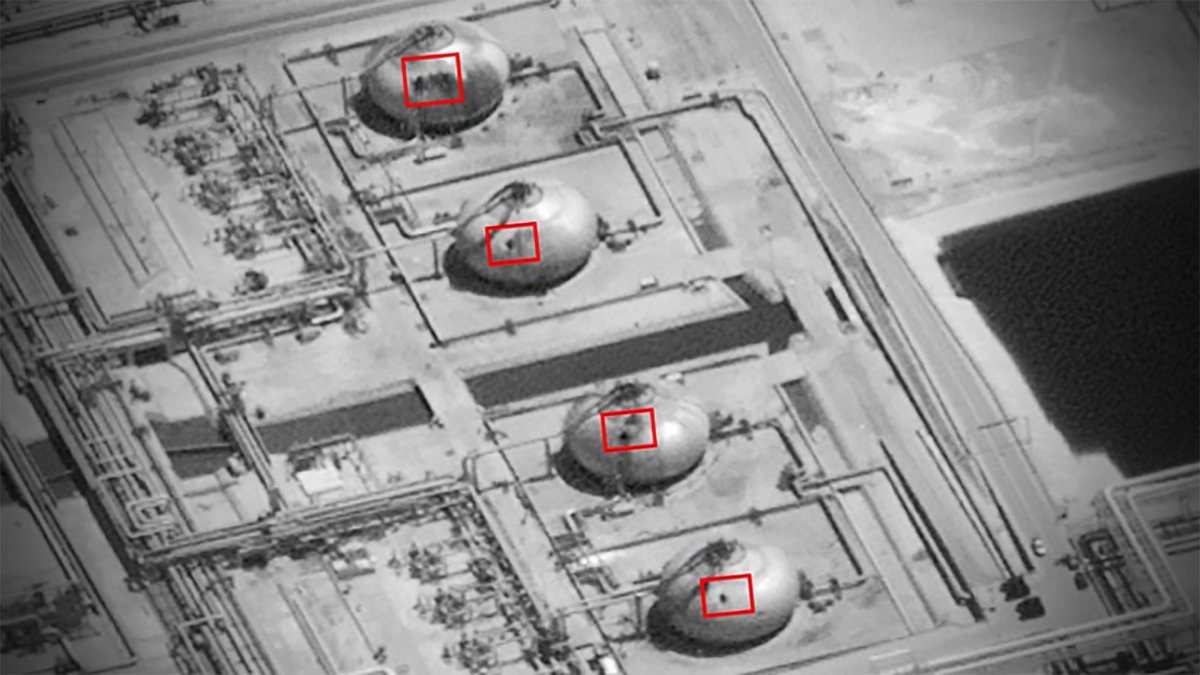
Away from the office this weekend, I took to Twitter to make a few key points about what I was seeing regarding the strikes. I want to solidify those more completely here. First off, no, the direction of impacts seen in satellite photos is not any sort of conclusive evidence as to where these weapons originated from. I saw this parroted all over the place, from cable and network news to blogs over the weekend. We are talking about what are clearly extremely precise weapons here that are capable of being effectively employed at long standoff ranges.
US Government handout
The post-strike satellite images provided by the U.S. Government clearly show just how precise the weapons used were, punching near-identical placed holes into major components of Saudi Arabia’s oil apparatus. The idea that these same weapons, which have to use some form of autopilot to accurately fly to their target area over long distances, can’t simply hit an offset waypoint away from the target before making their final attack run is laughable. In other words, this is not unguided artillery here, it can maneuver dynamically to approach a target from a direction that its targeters find most advantageous—either for kinetic effects, survivability, or deniability reasons.
With that in mind, the attacks could have come from any vector-based on impact information alone—Iraq, Yemen, Iran, or even a boat in the Persian Gulf. The weapons could even have been launched from within a nearby friendly country by clandestine forces, although that is quite unlikely. And who is to say they all came from just one locale? Multiple types of weapons —cruise missiles, suicide drones, or even larger low observable drones capable of dropping their own weapons—could have been launched from completely different locations in a coordinated, multi-layer assault. This would have been particularly useful for ensuring some of the weapons make it to their targets and for overwhelming or confusing Saudi air defenses—that is if they are detected and successfully tracked at all.
Regardless of their origin, when I first saw the damage, I felt like drones were potentially part of the attack, but likely not the only weapons employed. In fact, it looked a lot like a cruise missile strike with some of those weapons being equipped with shaped charges for penetrating fortified structures and others being equipped with general high explosives warheads for greater effects against unfortified structures. Whoever planned the strike had a very good understanding of the facilities targeted and what their components do, as well as their vulnerabilities and propensity for secondary effects. In other words, it wasn’t just showering a target area with explosive-laden drones or even picking some important-looking structures targeting those. The targeting was systemic in nature and high in quality.
That brings us to my next point, one you probably also thought to yourself when this happened—this was an unprecedented attack. Welcome to the murky world of unmanned warfare that I have been warning about for many years. I almost take this issue personally because people use to blow it off or even snicker at it. Now all the predictions I wish were wrong are coming true and at an alarming pace .
The Department of Defense was ridiculously asleep at the wheel regarding this threat and is now scrambling to play catchup . Anyone who says differently is straight-up lying. It’s well established what non-state actors can already do with relatively low-end unmanned aircraft technology—Houthi rebels alone have been using suicide drones for two and a half years —just imagine what a peer state will be able to do in the very near future. Instead of a mass of individual suicide drones layered in with other weapons, like cruise missiles, attacking a target simultaneously, imagine a swarm that is fully networked and works cooperatively to best achieve their mission goals, including jamming or killing air defenses in order for the swarm to make it to its final destination. America’s adversaries are all too aware of this game-changing potential and the lack of defenses to counter it in any robust manner.
Here’s a cold hard reality that most people just don’t understand, including many defense sector pundits—air defense systems, no matter how advanced and deeply integrated, aren’t magic. They have major limitations, especially considering most primarily rely on ground-based sensors.
This is true for the upper end of the envelope, such as ballistic missile defense, and also for the very low end, such as drones and cruise missile defense . In fact, I wrote a piece all about the ‘missile shield’ myth, which mirrors the realities of defending against drones and cruise missiles. I suggest you give it a read.
The vast majority of these air defense systems were built to counter higher-end threats, like combat aircraft and ballistic missiles. Low-flying cruise missiles and slow-flying drones with small radar cross-sections remain a very problematic vulnerability to even the best integrated air defense systems on the planet. Short-range air defenses (SHORADs) are currently the most reliable way to effectively deal with these threats, but these systems have a very short reach and are traditionally only used at strategic locations and to protect other high-value target areas. The U.S., and the western world to some degree, has lagged behind pathetically when it comes to fielding SHORAD capabilities and now the Pentagon is scrambling to catch up . Even those systems that do exist were largely designed to shoot down a single target, such as a jet, helicopter, or missile, at a time, not rapidly or even simultaneously engage a swarm of them. You can read all about this issue in this past feature of mine , where I literally predict this exact type of attack.
The biggest problem with most SHORAD concepts being pushed forward today—from lasers to missile interceptors—is that they still emanate from a mindset in which the threat is limited in volume. In other words, they can engage a few drones or missiles fairly quickly, but a dozen or dozens descending onto the target area suddenly is far beyond their capabilities. This is why electronic warfare—from jamming to microwave directed energy weapons —is so attractive for dealing with this threat. These systems have the potential to drop a whole swarm or large swathes of it in a way that kinetic systems cannot. The other alternative is something like Israel’s Iron Dome , which is expensive to acquire and deploy, with each Tamir interceptor costing over $50K per round fired (two usually being fired at each target), while also being restricted to a fairly short range. Other more promising and more mobile systems are in the works, and as I have said repeatedly, the best thing to knock down a drone outside of electronic warfare, is probably another drone. This concept is also finally being explored.
Beyond SHORAD systems, integrated air defense networks, like Saudi Arabia’s, would benefit greatly from airborne netted sensors that are specifically designed to detect low and/or slow-flying targets with small radar cross-sections. The Army’s long-troubled JLENS blimp is just one concept that exists, although it is attractive because it is very persistent. Smaller aerostats with radars that can cover a smaller area, but still provide ample early warning of approaching drones and cruise missiles, could be another, more scalable option for high-value locales.
High-altitude, long-endurance (HALE) unmanned aircraft can also lug radars aloft that are especially adept at looking-down and detecting these types of targets. In fact, the Block 40 RQ-4B Global Hawk’s Multi-Platform Radar Technology Insertion Program (MP-RTIP) gives that aircraft a very sensitive Active Electronically Scanned Array radar that is capable of rapidly scanning huge volumes of airspace for hard to detect threats as well as taking synthetic aperture radar images and tracking moving vehicles on the ground. This latent air-to-air capability has not been developed by the USAF, but it probably should be in light of recent events. A country like Saudi Arabia may find either of these concepts to be a worthy investment going forward, especially considering how much money is being lost in oil production after this strike. There is no doubt about it, Global Hawk isn’t cheap to keep overhead, but considering they can stay up there for nearly a day and a half at a time and they can cover a huge area from their perch at 60,000 feet, they are better adapted to the role than traditional aircraft.
Block 40 Global Hawk with MR-RTIP., Northrop Grumman
The big takeaway is that this is just the beginning. You are getting a glimpse at the future of warfare in these satellite photos and quite honestly, considering how omnipresent this threat has become , we are lucky a couple busted up oil production facilities were the only result of such an eye-opening attack.
The cold hard truth is that counter-unmanned aircraft and counter-cruise missile capabilities are not ‘sexy’ to develop, field, and maintain operationally, but it will increasingly become absolutely essential to divert more funds in this direction. And no, I am not talking about some guys running around with wonky, sci-fi looking electronic warfare rifles. I am saying dense and layered counter-UAS capabilities will be required to even counter domestic threats in the years to come, especially against VIPs and critical infrastructure.
We live in an age where everyone has access to high-resolution satellite imagery of nearly any point on the globe. This is something that was unthinkable even following the end of the Cold War. A single individual now has the capabilities that entire government intelligence agencies were built to produce, all on their smartphone or laptop computer. And it’s entirely free!
GPS is even more of a revolutionary capability. It’s incredible pinpoint accuracy really has become more concerning since the hobby drone industry exploded and now components to control drones via GPS are somewhat off-the-shelf in nature and are supplied from manufacturers around the globe. With these two things combined, a bad actor has both the targeting intelligence and the precision targeting capabilities available for a minuscule fraction of what they cost in the past and without any major barriers of entry.
These types of strikes don’t have to originate beyond a border, they can even originate from anywhere, including right here in the U.S. against U.S. targets. We must change our way of thinking when it comes to precision munitions and drones, and especially the imaginary line that still seems to separate them. In addition, confronting this issue just won’t be about fielding near and very costly military gear, it will also be about implementing, regulations, working with the global community, and a lot of intelligence gathering. The best and cheapest way to stop any attack is to do so before they start.
As far as Iran’s involvement in this, that seems pretty damn clear, at least on some level, and I wouldn’t be surprised if they launched some or all of these weapons themselves. The thing is that they have created a unique situation in which they have literally bought deniability via furnishing a rebel force with ‘ indigenous ‘ weapons that are distinct, but similar to their own. Yet there is nothing to say Iran couldn’t use those same “off-brand” weapons themselves. In fact, doing so makes total sense in this case as their Houthi partners were ready and willing to accept responsibility. In the end, the effects are what really matters, not who owns the operation publicly. When it comes to responding to such an act, that certainly isn’t the case.
I have to stress that I am not saying they definitely originated from Iranian territory or vessels, although I think that is very possible, but that this unique situation Iran has built for itself must be taken into account going forward. They literally constructed an elaborate deniability mechanism for themselves.
I hope this event is a wakeup call for the powers that be that counter-UAS and cruise missile defense gets more investment, especially in an era of murky hybrid warfare . The startling reality is that this attack could have come by ballistic missile —weapons that cost hundreds of thousands or even millions of dollars—and it would have had a far lesser chance of succeeding. Not only that, the perpetrator would have been known. Yet some drones and/or low-end cruise missiles can accomplish the same effects more reliably and with the added feature of deniability. This alarming strategic truth is not reflected in the incredible sums of money being spent on integrated air defenses, and especially by the Kingdom and the United States.
Hopefully, we won’t need another hugely successful attack on a prized target located deep in the heart of highly defended airspace before key decision-makers wake up to nature of what has been and continues to be a totally predictable threat.
Contact the author: Tyler@thedrive.com
Comments couldn’t be loaded. Please refresh the page.
更新于美国东部时间2019年12月1日上午6:00
我不知道该如何更好地表达——周末期间,关于沙特石油基础设施袭击事件的报道实在是糟糕透顶,简直是鲁莽至极。在之前一篇博文中,我们向读者介绍了事件的最新进展(为了更好地理解背景,建议大家点击此处阅读),我想借此机会谈谈媒体上一些不准确的分析,以及围绕此次袭击及其后续影响的一些更广泛、更紧迫的问题。
这个周末我不在办公室,在推特上就我观察到的袭击事件发表了一些关键观点。我想在这里更详细地阐述一下。首先,卫星照片中显示的撞击方向并不能作为这些武器来源的最终证据。这个周末,我在各种渠道都看到了这种说法,从有线电视新闻到博客,到处都是。我们讨论的是显然极其精确的武器,它们能够在远距离有效使用。
美国政府宣传资料
美国政府提供的打击后卫星图像清晰地显示了所用武器的精准度,在沙特阿拉伯石油设备的主要部件上几乎精准地打出了相同的弹孔。这些武器必须借助某种自动驾驶系统才能远距离精确飞抵目标区域,却无法在最终攻击前先命中目标附近的一个偏移点,这种说法简直荒谬可笑。换句话说,这并非无制导火索,它可以动态机动,从目标控制者认为最有利的方向接近目标——无论是出于动能效应、生存能力还是隐蔽性的考虑。
考虑到这一点,仅凭袭击目标信息,这些袭击可能来自任何方向——伊拉克、也门、伊朗,甚至是波斯湾的一艘船只。这些武器甚至可能由邻近友好国家的秘密部队发射,尽管这种可能性很小。谁又能断定它们都来自同一地点呢?多种类型的武器——巡航导弹、自杀式无人机,甚至是能够投放自身武器的大型低可探测性无人机——都可能从完全不同的地点发射,形成协同的多层攻击。这对于确保部分武器能够击中目标,以及压制或迷惑沙特阿拉伯的防空系统尤为重要——前提是这些武器能够被发现并成功追踪。
无论无人机的来源如何,当我第一次看到破坏情况时,我感觉无人机可能是袭击的一部分,但很可能并非唯一使用的武器。事实上,它看起来很像一次巡航导弹袭击,其中一些导弹配备了用于穿透防御工事的聚能装药,另一些则配备了用于对付非防御工事的通用高爆炸药弹头。策划这次袭击的人对目标设施及其组成部分的功能、弱点以及可能产生的次生灾害都非常了解。换句话说,这并非只是用装满炸药的无人机随意轰炸目标区域,甚至也不是随意挑选一些看起来重要的建筑物进行攻击。这次袭击的目标选择是系统性的,而且质量很高。
这就引出了我的下一个观点,或许你当时也想到了——这是一次前所未有的袭击。欢迎来到我多年来一直警告的无人作战的阴暗世界。我几乎把这个问题当成了自己的事,因为人们过去常常对此不屑一顾,甚至嗤之以鼻。如今,所有我希望是错误的预测都正在以惊人的速度变成现实。
国防部对这一威胁反应迟钝,如今正手忙脚乱地试图弥补。任何否认这一点的人都是彻头彻尾的撒谎。非国家行为体利用相对低端的无人机技术就能做到很多事情,这已是众所周知——仅胡塞武装就已使用自杀式无人机两年半之久——试想一下,一个实力相当的国家在不久的将来又能做到什么。想象一下,与其让大量自杀式无人机与其他武器(例如巡航导弹)同时攻击目标,不如让一群完全联网、协同作战的无人机群来最大程度地完成任务目标,包括干扰或摧毁防空系统,从而确保无人机群抵达最终目的地。美国的对手们都非常清楚这种足以改变战局的潜力,以及自身缺乏有效防御手段来应对它。
这里有一个大多数人,包括许多国防领域的专家,都无法理解的残酷现实:防空系统,无论多么先进、多么高度集成,都不是万能的。它们存在诸多局限性,尤其考虑到大多数防空系统主要依赖地面传感器。
这一点适用于防御体系的高端,例如弹道导弹防御,也适用于防御体系的低端,例如无人机和巡航导弹防御。事实上,我曾专门写过一篇关于“导弹防御系统”神话的文章,它恰恰反映了防御无人机和巡航导弹的现实情况。我建议您读一读。
绝大多数防空系统都是为了应对高端威胁而建造的,例如战斗机和弹道导弹。低空飞行的巡航导弹和雷达反射截面小的慢速无人机,即使是地球上最先进的综合防空系统也难以有效防御。短程防空系统(SHORAD)目前是有效应对这些威胁最可靠的手段,但这些系统的射程非常短,传统上仅用于战略要地和保护其他高价值目标区域。美国以及在某种程度上整个西方世界在部署短程防空能力方面严重落后,如今五角大楼正努力追赶。即使是现有的系统,其设计也大多是一次击落单个目标,例如喷气式飞机、直升机或导弹,而不是快速或同时拦截大量目标。您可以在我之前的一篇文章中详细了解这个问题,我在文中甚至预言了这种类型的攻击。
目前大多数近程防空系统(SHORAD)概念——从激光武器到导弹拦截器——最大的问题在于,它们仍然基于一种威胁规模有限的思维模式。换句话说,它们可以迅速拦截少量无人机或导弹,但要应对突然袭击目标区域的十几架甚至数十架无人机或导弹,则远远超出了它们的能力范围。正因如此,电子战——从干扰到微波定向能武器——在应对这种威胁方面才如此具有吸引力。这些系统能够以动能系统无法企及的方式,拦截整个无人机群或大片无人机。另一种选择是类似以色列“铁穹”的系统,但其采购和部署成本高昂,每枚“塔米尔”(Tamir)拦截器发射一次的成本超过5万美元(通常每个目标发射两枚),而且射程也相当有限。其他更有前景、机动性更强的系统正在研发中,正如我反复强调的,在电子战之外,击落无人机的最佳方法或许就是用另一架无人机。这一概念也终于开始被探索。
除了近程防空系统之外,像沙特阿拉伯那样的综合防空网络,如果能配备专门用于探测低空或慢速飞行、雷达反射截面积小的目标的机载联网传感器,将会受益匪浅。陆军长期饱受诟病的JLENS飞艇只是众多方案之一,尽管它具有很强的持久性,但仍然颇具吸引力。对于高价值地区而言,配备雷达的小型系留气球或许是另一种更具扩展性的选择,它们可以覆盖较小的区域,但仍能为接近的无人机和巡航导弹提供充足的早期预警。
高空长航时(HALE)无人机也能携带高空雷达,这些雷达尤其擅长向下探测此类目标。事实上,Block 40 RQ-4B“全球鹰”无人机的多平台雷达技术植入计划(MP-RTIP)为其配备了高灵敏度的有源相控阵雷达,能够快速扫描大片空域,探测难以发现的威胁,同时还能拍摄合成孔径雷达图像并跟踪地面移动车辆。美国空军尚未开发这种潜在的空对空作战能力,但鉴于最近发生的事件,或许应该着手开发。像沙特阿拉伯这样的国家可能会认为这两种方案都是值得投资的,尤其是在此次袭击造成石油生产巨额损失的情况下。毫无疑问,全球鹰无人机的维护成本并不低,但考虑到它们一次可以连续飞行近一天半,并且可以从 60,000 英尺的高空覆盖巨大的区域,它们比传统飞机更适合执行这项任务。
Block 40 全球鹰,配备 MR-RTIP,诺斯罗普·格鲁曼公司
最重要的一点是,这仅仅是个开始。这些卫星照片让我们得以窥见未来战争的雏形。坦白说,考虑到这种威胁已经无处不在,我们很幸运,这次令人震惊的袭击最终只造成了几处石油生产设施损毁。
残酷的现实是,反无人机和反巡航导弹能力的研发、部署和维护并不“吸引眼球”,但未来必须加大这方面的投入。而且,我说的不是那些拿着奇形怪状、科幻感十足的电子战步枪到处乱窜的人。我指的是,未来几年,即使是为了应对国内威胁,特别是针对要员和关键基础设施的威胁,也需要密集且多层次的反无人机系统能力。
我们生活在一个每个人都能获取全球几乎任何地点高分辨率卫星图像的时代。这在冷战结束后也是不可想象的。如今,一个人就能通过智能手机或笔记本电脑,获得以往整个政府情报机构才能提供的能力。而且,这一切都是完全免费的!
GPS 的革命性功能更加令人瞩目。随着业余无人机行业的蓬勃发展,其惊人的定位精度也愈发令人担忧。如今,通过 GPS 控制无人机的组件已基本实现标准化,全球各地的制造商均有供应。这两者的结合使得不法分子能够以远低于以往的成本,且几乎没有任何准入门槛,同时获得目标情报和精准定位能力。
这类袭击不一定发生在境外,它们甚至可以来自任何地方,包括美国本土,针对美国目标。我们必须改变对精确制导武器和无人机的固有思维,尤其要打破那条似乎仍然将二者分隔开来的无形界限。此外,解决这个问题不仅仅是部署昂贵的军事装备,还需要制定相关法规,与国际社会合作,并进行大量的情报收集。阻止任何袭击的最佳且最经济的方法就是防患于未然。
至于伊朗是否参与其中,这一点似乎非常明确,至少在某种程度上是如此。如果他们自己发射了部分或全部武器,我也不会感到惊讶。问题在于,他们创造了一种独特的局面:通过向反叛武装提供与其自身武器不同但又相似的“国产”武器,他们实际上成功地掩盖了责任。然而,没有任何理由说伊朗不能自己使用这些“非原厂”武器。事实上,在这种情况下,这样做完全合情合理,因为他们的胡塞武装盟友已经准备好并愿意承担责任。最终,真正重要的是行动的后果,而不是谁公开承认行动的主导权。但就应对此类事件而言,情况显然并非如此。
我必须强调,我并非断言这些炸弹一定来自伊朗领土或船只,尽管我认为这种可能性很大,但伊朗为自己营造的这种独特局面必须纳入考量。他们实际上为自己构建了一套复杂的否认机制。
我希望这次事件能给当权者敲响警钟,让他们意识到反无人机系统和巡航导弹防御系统需要更多投资,尤其是在混合战争日益复杂的今天。令人震惊的现实是,这次袭击本可能由弹道导弹发动——这种武器价值数十万甚至数百万美元——但成功的可能性要小得多。不仅如此,攻击者的身份也会暴露无遗。然而,一些无人机和/或低端巡航导弹却能更可靠地达到同样的效果,而且还具有不可否认的优势。这一令人担忧的战略真相并未体现在各国,特别是沙特阿拉伯和美国,在综合防空系统上投入的巨额资金中。
希望我们不需要再发生一次对位于戒备森严的空域深处的重要目标造成巨大成功的袭击,关键决策者才能意识到这种威胁的本质——它过去是、现在仍然是完全可预测的威胁。
联系作者:Tyler@thedrive.com
评论加载失败,请刷新页面。