Of fiber-optics and FPVs – 6 questions with a Ukrainian drone trainer关于光纤和FPV——与一位乌克兰无人机教练的6个问答
Unmanned FPV motherships are on the rise, as operators face an intense cat-and-mouse game on frequency jamming and exploiting momentary vulnerabilities.
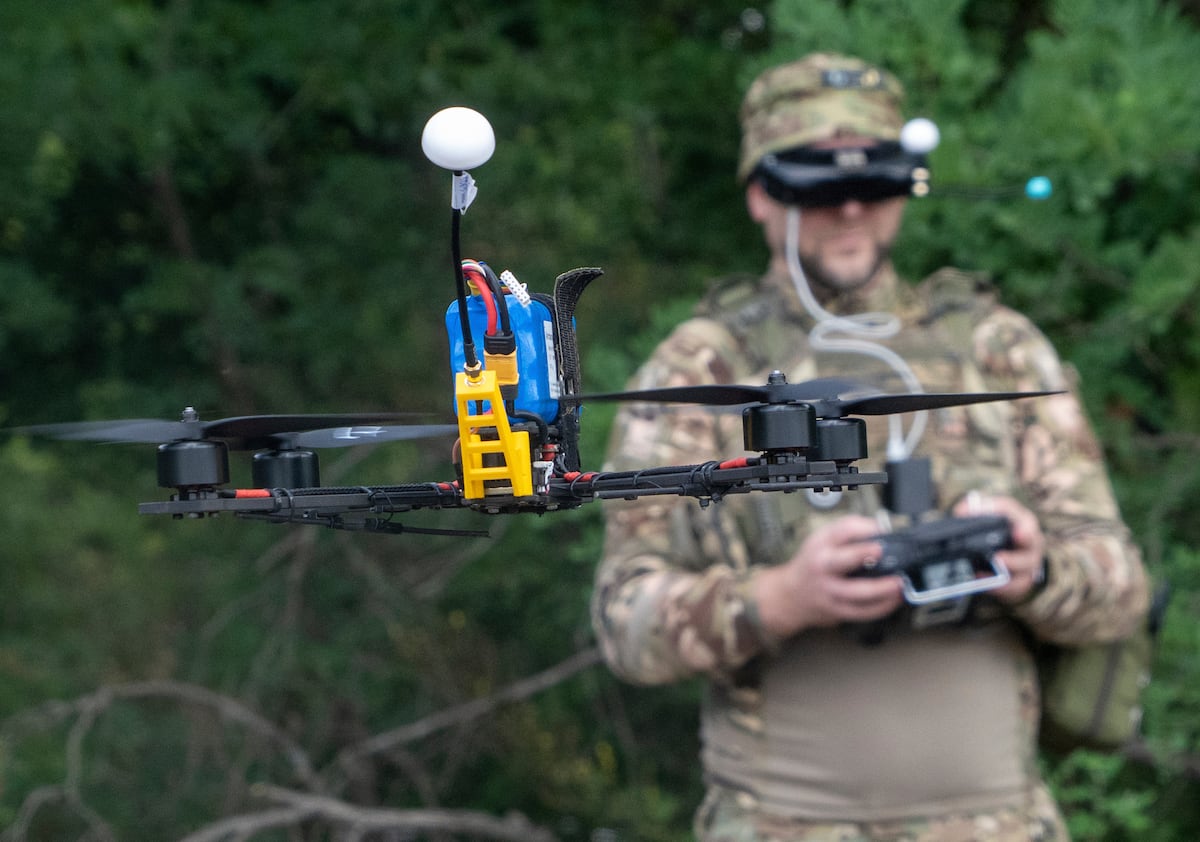
MILAN — The “Typhoon” unit is a special forces unit within Ukraine’s National Guard that focuses exclusively on unmanned systems and all aspects related to the technology. Established in 2024, it initially specialized in frontline first-person-view operations but has since expanded its capabilities to other types of unmanned aerial systems.
Its primary tasks include developing and enhancing drone capabilities in combat operations, as well as providing effective training to operators. It achieves this, in part, by integrating engineers into the team, who help to rapidly modify drones, and capable pilots who carry out complex sorties.
In a video interview with Defense News, one of its members, who goes by the callsign “Alex” for security reasons and works as an analyst providing training support to drone pilots, discussed how the unit is tackling operator shortages, adapting to intense electronic jamming and countermeasures, and the effectiveness of domestic and Western-supplied unmanned systems against Russian platforms.
Has your unit been affected by a lack of pilots or operators? How are you addressing this challenge?
I would say yes. There is a shortage of pilots, but even more so, a shortage of motivated individuals. Right now, it’s harder to train a pilot from scratch, especially if they don’t have any experience with radios, engineering or related technical fields. In general, it takes at least three months to train the pilots from scratch to the beginner level.
When we talk about pilots, it’s worth mentioning that they also need to be a bit like engineers – if we talk about FPV drones. When you are in position, you have to understand how the system works. If something goes wrong, you should be able to repair it; if the drone crashes, you need to figure out how to make it fly again. So piloting skills are important, but it’s equally important to have some engineering knowledge as well.
How to address this issue is a complex question. The first thing is quality over quantity. We do our best to train people and provide them with fresh knowledge and analysis of what’s happening on the battlefield. For example, when we talk about FPVs, we discuss what the best current setups look like and what components are needed.
Let’s say I receive new information about Russian jamming systems on the battlefield — details about the different frequencies they cover. I analyze that data, try to find the gaps, and share this with our pilots. We communicate which radio and video frequencies can still be used effectively for successful missions.
This type of information sharing is key because it improves both the quality of our pilots and the drones they operate, making us more effective. Maybe we have fewer pilots, but they’re better trained and better prepared.
For instance, in communications, a pilot might start a flight and lose control after 10 minutes. We try to understand why that happened — what caused the problem. We review the frequency data, the drone’s altitude at the time, the drone’s route, and collect this information over longer periods to identify patterns and understand the dynamics of how things are changing.
What are some of the current biggest challenges you face when it comes to electronic warfare? What works best as a jamming system?
The biggest challenge is the ability to get information about things on the battlefield today, while also being able to predict a little bit what will be going on tomorrow. Because yes, many Russian systems can now cover almost all the frequency spectrum, so we always have to be attentive to their functioning, but know these can’t work all day and night. On the battlefield, there are often shortages of power and people.
Generally, first [each side] will try to analyze who is flying the mission, and after this they will switch on the jamming systems, for instance. Here is where effectiveness comes in. Because if you are skilled enough, you can strike a target in one shot, without having them [Russian forces] have time to switch on their jamming systems. However, if you can’t reach the target in a single shot, the jamming systems will have time to switch on, and it will be quite hard to destroy it.
Some FPVs now use multiple receivers with antennas in different polarizations to overcome jamming systems. This redundancy works well because if one receiver or frequency is jammed, the drone can maintain control through the alternate receivers. For example, using two or three different receivers on separate frequencies, combined with antennas in different polarizations (linear, circular), significantly increases the chances of maintaining a stable connection even in heavy EW environments.
What are the most pressing requirements when it comes to unmanned technologies?
Many pilots and engineers use the same Chinese spare parts, especially for FPVs, and just mix how they can utilize a couple of them.
Here, again, I think quality is more important than quantity — having additional spare parts is crucial. For example, if you have different video transmitters for different frequency ranges (say 3GHz, 1.2Ghz, 6+Ghz and so on), you can change these parts as fast as possible to make you more successful.
Even if you are successful on the frontline today, the Russians will analyze the situation and may deploy jamming systems for those frequencies tomorrow, and then you lose if you don’t have spare parts for other frequencies.
The same applies to radio control: The faster you can swap components, the more successful you become. There have been many attempts to increase the localization of the production of spare parts on the Ukrainian market, which has worked to a certain extent.
What observations have you made regarding the effectiveness and performance of Western-made or Western-provided unmanned technologies?
Some of the most successful Western systems we’ve seen are in the fixed-wing reconnaissance drones category. Some of the most effective ones have included the German-made Vector drones and Polish-made FlyEye drones. What has made them successful is that they have direct feedback on the ground, ones who operate their drones. They get fast feedback from these units, are able to quickly modify the systems, and send them back. These companies are also localized in Ukraine.
Unsuccessful ones, for example, if we talk about FPVs or other smaller recon drones, in most cases, they are not the best quality when it comes to current battlefield conditions and being able to perform in the EW environment we are faced with on the frontline.
There are also information gaps between many European or U.S. manufacturers about what is going on the battlefield right now and when this information is made available or reaches them. This is also true for some Ukrainian producers that do not have direct contact with ground units.
Last year, I met with a European manufacturer of a fixed-wing strike drone, and everything looked interesting and reliable until we asked whether they had tested it in similar jamming conditions as seen on the battlefield. The producer said, “No, we haven’t even once,” — then, it’s a question of not knowing how such a system will behave on the battlefield.
Another example of a system not working very well is from the U.S. company Skydio; some of their drones have not been reliable under current jamming conditions found on the front.
These realities also apply to some Ukrainian manufacturers and domestically produced systems. During recent unmanned ground vehicle testing, several platforms encountered significant challenges under conditions designed to replicate actual battlefield scenarios.
The testing protocols were deliberately strict: vehicles had to reach firing positions and engage targets from distances between 300 and 500 meters. Crucially, the manufacturers themselves had to operate their own robots from a dugout — without direct line of sight or stable communications — relying only on the robot’s onboard camera feed and a surveillance drone overhead.
This approach was intentional, to put developers in the shoes of actual soldiers. It made the task considerably harder because the drones weren’t being piloted by experienced operators. If a UGV stopped, crossed boundary markers, or became stuck in the terrain, that run was terminated. Manufacturers were prohibited from recovering their stuck vehicles — these became additional obstacles for subsequent robots starting their runs.
Before deployment, participants could only review quadcopter flyover footage, just as they would in real combat conditions. They couldn’t walk the terrain or conduct ground reconnaissance — you can only use recon drones to understand what lies ahead, and must adapt on the spot.
This testing revealed a critical gap: many systems perform well in controlled environments where developers understand the terrain intimately, but struggle when operators must rely solely on remote sensing and make real-time decisions without ground truth. It’s a sobering reminder that battlefield effectiveness requires more than just technical specifications. It demands systems designed for operation under severe informational constraints.
Based on the targets you are intercepting or having to defend against, have you noticed any changes in the quality or components of Russian unmanned systems?
Currently, there are many cases of fixed-wing reconnaissance drones carrying FPVs and releasing them over target areas of interest. These setups can reach 30 to 50 kilometers before dropping the FPV, which has proven to be an effective tactic. In this role, the fixed-wing drone serves not just as a carrier, but also as a reconnaissance platform and [relay], providing significantly stronger connectivity to the FPV drone and helping to overcome the majority of jamming systems on the frontline.
The Russians have also been working on the quality of the fiber-optic drones they use, around the distances they can reach.
Previously, they could spread 15-20 km; now, sometimes this is 25-30km. An example of this was that they were able to strike Kramatorsk with a fiber-optic drone strike, which was one of the first times they were able to hit a major city from far behind frontlines with these platforms.
For us, the most critical part is how reliable fiber-optic drones are. On both sides, these drones have had a lot of interruptions in their signal. For now, the main change we are focused on is how to create the spool fiber for these drones that will be reliable, should we use more lubricants, or should we look at the diameter of the fiber-optic. The devil is in the details.
What are the efficiency rates of using FPV drones versus fiber-optic ones on the battlefield?
This is a complicated question: it really depends on the skills of the pilots. For example, how many spare parts do you have available to make some additional improvements to your drone? When we talk about the most successful (FPV) pilots, I would say the success rate of their missions is approximately 70% to 80% – but it really depends on how skillful the pilot is.
For mid-range skilled pilots, I would put this at a 40-50% success rate, but for new operators, it sometimes looks like a disaster, and that rate can drop to 20%.
When it comes to fiber-optic drones, it is a really different situation – I would say it’s like maybe 40-50% of success rates is the best you can achieve because a lot of additional things should be accounted for. For fiber-optic drones, you have to change your piloting approach. For these drones, success also depends on artillery intensity (which can sever the cable), weather and wind conditions, the density of friendly FPV operations that might accidentally cut the fiber-optic line, and careful route planning to avoid roads, power lines, and other obstacles that could damage the cable.
Elisabeth Gosselin-Malo was a Europe correspondent for Defense News. She covers a wide range of topics related to military procurement and international security, and specializes in reporting on the aviation sector. She is based in Milan, Italy.
米兰——“台风”部队是乌克兰国民警卫队的一支特种部队,专门负责无人系统及其相关技术。该部队成立于2024年,最初专注于前线第一视角作战,但此后已将其能力扩展到其他类型的无人机系统。
其主要任务包括开发和提升无人机在作战行动中的能力,以及为操作人员提供有效的培训。为了实现这些目标,该部门部分地将工程师纳入团队,他们负责快速改装无人机,并招募经验丰富的飞行员执行复杂的飞行任务。
在接受《防务新闻》的视频采访时,该部队的一名成员(出于安全原因,他使用代号“Alex”,担任分析师,为无人机飞行员提供培训支持)讨论了该部队如何应对操作员短缺、适应强烈的电子干扰和反制措施,以及国内和西方提供的无人系统对俄罗斯平台的有效性。
您的单位是否受到飞行员或操作员短缺的影响?您是如何应对这一挑战的?
我会说是的。飞行员短缺,但更短缺的是积极进取的飞行员。目前,从零开始培养飞行员非常困难,尤其是那些没有任何无线电、工程或相关技术领域经验的人。一般来说,从零基础到初级水平的飞行员培训至少需要三个月。
说到飞行员,值得一提的是,他们也需要具备一些工程师的素质——尤其是在FPV无人机领域。当你操控无人机时,你必须了解系统的运作原理。如果出现故障,你应该能够自行修复;如果无人机坠毁,你需要想办法让它重新飞行。因此,飞行技能固然重要,但具备一定的工程知识也同样重要。
如何解决这个问题是一个复杂的问题。首先,质量比数量更重要。我们尽最大努力培训人员,并为他们提供关于战场动态的最新知识和分析。例如,当我们讨论第一人称视角(FPV)时,我们会探讨目前最佳的配置方案以及所需的组件。
假设我收到关于战场上俄军干扰系统的新情报——包括它们覆盖的不同频率的详细信息。我分析这些数据,找出干扰盲区,并将结果分享给我们的飞行员。我们会沟通哪些无线电和视频频率仍然可以有效用于完成任务。
这种信息共享至关重要,因为它既能提高飞行员的素质,又能提升他们操作的无人机的性能,从而提高我们的效率。或许我们的飞行员数量减少了,但他们的训练水平更高,准备也更充分。
例如,在通信领域,飞行员可能起飞后10分钟就失去控制。我们会尝试了解原因——究竟是什么导致了问题。我们会审查频率数据、无人机当时的飞行高度和飞行路线,并收集更长时间的此类信息,以识别规律并了解情况变化的动态过程。
在电子战领域,您目前面临的最大挑战有哪些?哪种干扰系统效果最好?
最大的挑战在于,既要能够获取当前战场的信息,又要能够对未来的局势做出一定的预测。诚然,许多俄罗斯系统现在几乎可以覆盖所有频段,因此我们必须时刻关注它们的运行情况,但我们也必须明白,这些系统不可能全天候运转。战场上常常面临电力和人员短缺的问题。
通常情况下,双方首先会分析任务执行方是谁,之后才会启动干扰系统等。这就是效率的关键所在。因为如果技术足够娴熟,就能一击命中目标,让俄军来不及启动干扰系统。但是,如果无法一击命中目标,干扰系统就有机会启动,届时摧毁目标将变得相当困难。
为了克服干扰系统,一些FPV无人机现在使用多个接收器,并配备不同极化的天线。这种冗余设计效果显著,因为即使某个接收器或频率受到干扰,无人机也可以通过备用接收器保持控制。例如,使用两到三个不同频率的接收器,并结合不同极化方式(线极化、圆极化)的天线,可以显著提高即使在电子战环境下也能保持稳定连接的概率。
在无人技术方面,最紧迫的需求是什么?
许多飞行员和工程师都使用相同的中国产备件,特别是用于 FPV 的备件,他们只是混合使用其中的一些零件。
我再次强调,我认为质量比数量更重要——拥有充足的备用零件至关重要。例如,如果您有适用于不同频段(比如 3GHz、1.2GHz、6GHz 以上等等)的视频发射器,您可以尽快更换这些零件,从而提高工作效率。
即使你今天在前线取得了成功,俄罗斯人也会分析形势,明天就可能部署针对这些频率的干扰系统,如果你没有其他频率的备用部件,那么你就会失败。
无线电遥控领域也是如此:更换零件的速度越快,成功率就越高。人们已经多次尝试提高乌克兰市场上零部件生产的本地化程度,并在一定程度上取得了成效。
您对西方制造或提供的无人技术的有效性和性能有何观察?
我们所见过的最成功的西方系统之一属于固定翼侦察无人机领域。其中一些最有效的无人机包括德国制造的Vector无人机和波兰制造的FlyEye无人机。它们成功的关键在于能够直接获得地面操作人员的反馈。这些人员可以从无人机上快速获得反馈,从而迅速改进系统并进行反馈。这些公司在乌克兰也有分支机构。
例如,如果我们谈论 FPV 或其他小型侦察无人机,那么在大多数情况下,就当前的战场条件和我们在前线面临的电子战环境而言,它们的质量并不是最好的。
许多欧美制造商与欧洲制造商之间存在信息鸿沟,他们不了解当前战场局势,也不知道何时才能获得这些信息。一些与地面部队没有直接联系的乌克兰制造商也面临同样的问题。
去年,我与一家欧洲固定翼攻击无人机制造商会面,一切看起来都很有意思也很可靠,直到我们问到他们是否在类似战场干扰的环境下进行过测试。制造商回答说:“没有,我们一次也没有。”——这样看来,问题就变成了我们根本不知道这种系统在战场上的表现如何。
另一个系统运行不佳的例子来自美国公司 Skydio;他们的一些无人机在当前前线的干扰条件下不太可靠。
这些现实情况也适用于一些乌克兰制造商和国产系统。在最近的无人地面车辆测试中,一些平台在模拟真实战场场景的条件下遇到了重大挑战。
测试规程刻意设定得非常严格:车辆必须抵达射击位置,并在300至500米的距离上攻击目标。至关重要的是,制造商必须自行在掩体中操控机器人——没有直接的视线或稳定的通信——只能依靠机器人自带摄像头的画面和上方监视无人机的监视。
这种方法是刻意为之,旨在让开发人员设身处地地体验士兵的作战方式。由于无人机并非由经验丰富的操作员操控,这使得任务难度大大增加。如果无人地面车辆停止运行、越过边界标记或陷入地形,则该次任务即告终止。制造商被禁止回收这些陷落的车辆——它们会成为后续机器人开始任务的额外障碍。
部署前,参与者只能像在真实战斗环境中一样,观看四旋翼无人机拍摄的航拍视频。他们无法实地勘察或进行地面侦察——只能利用侦察无人机了解前方情况,并根据实际情况随机应变。
这项测试揭示了一个关键差距:许多系统在受控环境下表现良好,开发人员对地形了如指掌;但当操作人员必须完全依赖遥感数据并在缺乏实地数据的情况下做出实时决策时,系统便会举步维艰。这令人警醒地提醒我们,战场效能不仅仅取决于技术规格,它更需要能够在信息严重受限的情况下运行的系统。
根据你拦截或防御的目标,你是否注意到俄罗斯无人系统的质量或部件有任何变化?
目前,已有许多案例表明,固定翼侦察无人机可携带FPV(第一人称视角)无人机,并将其投放至目标区域。这些无人机在投放FPV无人机前可飞行30至50公里,已被证明是一种有效的战术。在此过程中,固定翼无人机不仅作为载体,还兼具侦察平台和中继功能,显著增强了FPV无人机的连接能力,并有助于突破前线的大多数干扰系统。
俄罗斯方面也一直在努力提高他们使用的光纤无人机的质量,以及它们的飞行距离。
此前,他们的打击范围可达15-20公里;现在,有时可达25-30公里。例如,他们曾利用光纤无人机袭击克拉马托尔斯克,这是他们首次能够利用这些平台从前线后方很远的地方打击一座主要城市。
对我们来说,最关键的是光纤无人机的可靠性。目前,双方的无人机信号都出现了多次中断。我们现在主要关注的改进方向是如何制造出可靠的无人机光纤卷轴,例如是否应该增加润滑剂用量,或者调整光纤的直径。细节决定成败。
在战场上使用FPV无人机与使用光纤无人机相比,效率分别是多少?
这是一个复杂的问题:这很大程度上取决于飞行员的技术水平。例如,你手头有多少备用零件可以用来对无人机进行一些额外的改进?说到最成功的(FPV)飞行员,他们的任务成功率大约在70%到80%之间——但这确实取决于飞行员的技术水平。
对于中等水平的熟练飞行员来说,成功率约为 40-50%,但对于新手来说,有时看起来像是一场灾难,成功率可能会下降到 20%。
对于光纤无人机来说,情况就大不相同了——我认为成功率大概在40%到50%之间,这已经是你能达到的最佳水平了,因为需要考虑很多其他因素。操控光纤无人机必须改变你的飞行方式。这类无人机的成功还取决于炮火强度(炮火可能会切断光缆)、天气和风况、友方FPV操作的密度(这些操作可能会意外切断光纤线路),以及精心规划的航线,以避开道路、电力线和其他可能损坏光缆的障碍物。
伊丽莎白·戈斯林-马洛曾任《防务新闻》欧洲通讯员。她的报道涵盖军事采购和国际安全等广泛领域,尤其擅长航空领域的报道。她常驻意大利米兰。