Australian navy sizes up high-risk submarine transitions under AUKUS澳大利亚海军正在评估“海鸥行动”下高风险潜艇过渡方案。
Officials have taken an “integrated approach” to orchestrating the two programs, from freshening up legacy submarines to receiving nuclear-powered boats.
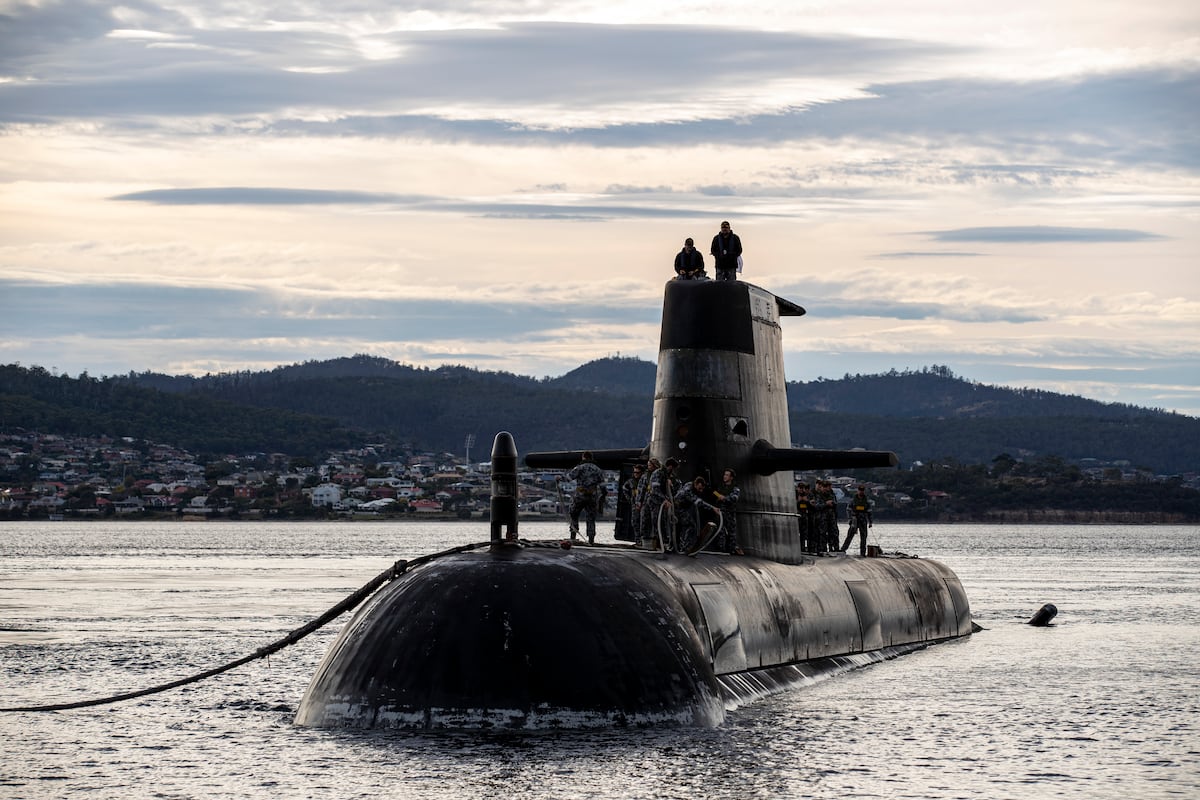
SYDNEY — Australia has its work cut out keeping aging Collins-class diesel-electric submarines in service as it transitions to nuclear-powered submarines, firstly to second-hand Virginia-class boats from the United States, and then to SSN-AUKUS submarines designed and built in conjunction with the U.K.
Asked about the risks for the Collins-class life extension and the SSN programs, Rear Adm. Stephen Hughes, head of naval capability for the Royal Australian Navy (RAN), said he holds a “half-glass-full view” about the path ahead. “There are always the naysayers, but you’ve got to remember we’re pretty focused on delivering both outcomes.”
Hughes spoke to Defense News at the Indo-Pacific 2025 naval exhibition, held in Sydney from Nov. 4-6.
“Are they high risk? Sure – schedules, demanding technologies, the workforce is demanding,” he added. “I can list all the things that could go wrong, but one thing we’re really good at in Defence, despite maybe some other commentators’ views, is we’re really good at risk management.”
Defense officials have taken an “integrated approach” to orchestrating the two programs, from legacy submarines to nuclear-powered boats, which puts the spotlight on getting the transition right, he said.
Australian industry excitement
Much attention was paid at the Indo-Pacific 2025 event here to agreements over potential involvement in the SSN-AUKUS submarine program. One announcements was about a teaming arrangement on Nov. 5 by four major primes to compete for the SSN-AUKUS combat system.
The team comprises BAE Systems, General Dynamics Mission Systems, Raytheon Australia and Thales. The quartet stated they would design a trinational command system as a “shared solution for Australia and the U.K.,” building on General Dynamics’ existing AN/BYG-1 system.
Incidentally, the AN/BYG-1 is already installed on Australia’s six Collins-class submarines.
Another announcement on Nov. 4 covered a strategic agreement paving the way for South Australian firm PMB Defence to supply nickel zinc batteries. PMB Defence is working with BAE Systems, designer of the SSN-AUKUS boat, to enable potential integration of its batteries. Contracts between the two are already valued in excess of $22 million.
Certifiable progress
With Australian companies hoping to seize a slice of the submarine pie, the Australian navy remains optimistic of the capability it will obtain.
“My view is, based on what Trump said publicly , he’s committed to the AUKUS program,” said Hughes, referring to U.S. President Donald Trump, whose government had initiated a review of the tri-national program. “We’re investing in the U.S. industry base, the U.S. is driven to ensuring we have the best capability, because it’s in their benefit to have us with a submarine that can survive in the future threat.”
HII and Babcock have joined forces to support the AUKUS submarine endeavor, creating a joint venture called H&B Defence in June 2024. To qualify Australian businesses as suppliers for the U.S. nuclear submarine enterprise, it issued an expression of interest to which 378 Australian companies responded. A handful have already been validated against HII’s standards.
Eric Chewning, HII’s executive vice president for maritime systems and corporate strategy, said the company has increased throughput at its shipyards by 15%.
“We’re continuing to hit that acceleration,” he said. “One of the important strategies we have to do that is the distributed shipbuilding model where we’re outsourcing.”
Industry experts have suggested that some bottlenecks in U.S. production could be alleviated by help from new Australian suppliers.
Meanwhile, Rolls-Royce, the only private company in the world producing nuclear reactors for submarines, is providing PWR3+ power plants for SSN-AUKUS boats.
Steve Carlier, Rolls-Royce Submarines president, told Defense News that the improved PWR3+ provides greater operational flexibility since it gives crews more options in how to use the energy, plus it brings greater safety levels.
Carlier also confirmed the SSN-AUKUS’s preliminary design review is expected to be achieved in September 2026.
Hughes confirmed the first Collins-class submarine, HMAS Farncomb, will enter a two-year life-of-type extension (LOTE) program next year. The effort is designed to stretch the life of boats by ten years, as the new SSN fleet is gradually slated to arrive.
Gordon Arthur is an Asia correspondent for Defense News. After a 20-year stint working in Hong Kong, he now resides in New Zealand. He has attended military exercises and defense exhibitions in about 20 countries around the Asia-Pacific region.
悉尼——澳大利亚在向核动力潜艇过渡的过程中,面临着艰巨的任务,即如何维持老旧的柯林斯级柴电潜艇的服役状态。澳大利亚首先将从美国购买二手的弗吉尼亚级潜艇,然后过渡到与英国联合设计建造的SSN-AUKUS核潜艇。
当被问及柯林斯级潜艇延寿和攻击型核潜艇(SSN)项目的风险时,澳大利亚皇家海军(RAN)海军能力负责人斯蒂芬·休斯少将表示,他对未来的道路持“乐观态度”。“总会有人唱反调,但你必须记住,我们非常注重实现这两个目标。”
休斯在 11 月 4 日至 6 日于悉尼举行的 2025 年印太海军展览会上接受了《防务新闻》的采访。
“它们风险高吗?当然——工期紧、技术要求高、人员配备要求也高,”他补充道。“我可以列举所有可能出错的地方,但尽管其他一些评论员可能持不同意见,我们在国防领域真正擅长的一点是风险管理。”
他说,国防部官员采取了“综合方法”来协调这两个项目,从传统潜艇到核动力潜艇,这使得重点放在正确过渡上。
澳大利亚工业界的兴奋
在印太2025活动上,各方对参与SSN-AUKUS核潜艇项目的潜在协议给予了高度关注。其中一项宣布是,11月5日,四家主要承包商达成合作协议,共同竞标SSN-AUKUS作战系统。
该团队由英国航空航天系统公司(BAE Systems)、通用动力任务系统公司(General Dynamics Mission Systems)、雷神澳大利亚公司(Raytheon Australia)和泰雷兹公司(Thales)组成。这四家公司表示,他们将基于通用动力公司现有的AN/BYG-1系统,设计一套三国联合指挥系统,作为“澳大利亚和英国的共享解决方案”。
顺便一提,AN/BYG-1 已经安装在澳大利亚的六艘柯林斯级潜艇上。
11月4日发布的另一项公告涉及一项战略协议,该协议为南澳大利亚公司PMB Defence供应镍锌电池铺平了道路。PMB Defence正与SSN-AUKUS潜艇的设计者BAE Systems合作,以实现其电池的潜在集成。双方之间的合同价值已超过2200万美元。
可认证的进展
澳大利亚企业希望在潜艇市场分一杯羹,澳大利亚海军对其将获得的能力仍然保持乐观。
“根据特朗普的公开表态,我认为他致力于‘海鸥’项目,”休斯说道,他指的是美国总统唐纳德·特朗普,其政府曾启动对这项三国合作项目的审查。“我们正在投资美国的工业基础,美国致力于确保我们拥有最强大的能力,因为拥有一艘能够应对未来威胁的潜艇符合他们的利益。”
HII和巴布科克公司已携手支持AUKUS潜艇项目,并于2024年6月成立了一家名为H&B Defence的合资企业。为了确保澳大利亚企业有资格成为美国核潜艇项目的供应商,HII发布了意向征询书,共有378家澳大利亚公司响应。其中部分公司已通过HII的资格认证。
HII 负责海事系统和企业战略的执行副总裁 Eric Chewning 表示,该公司已将其造船厂的吞吐量提高了 15%。
“我们正在继续加速发展,”他说。“我们实现这一目标的重要策略之一是采用分布式造船模式,将部分工序外包。”
业内专家认为,引入澳大利亚新供应商可以缓解美国生产中的一些瓶颈问题。
与此同时,世界上唯一一家为潜艇生产核反应堆的私营公司劳斯莱斯,正在为 SSN-AUKUS 潜艇提供 PWR3+ 动力装置。
罗尔斯·罗伊斯潜艇公司总裁史蒂夫·卡利尔告诉《防务新闻》,改进后的 PWR3+ 提供了更大的操作灵活性,因为它为船员提供了更多使用能源的选择,而且还带来了更高的安全水平。
卡利尔还确认,SSN-AUKUS 的初步设计评审预计将于 2026 年 9 月完成。
休斯证实,首艘柯林斯级潜艇“法恩科姆”号将于明年进入为期两年的延寿计划(LOTE)。该计划旨在将潜艇的使用寿命延长十年,以配合新型攻击型核潜艇(SSN)舰队的逐步交付。
戈登·阿瑟是《防务新闻》的亚洲特派记者。在香港工作20年后,他现居新西兰。他曾到访亚太地区约20个国家,参加过军事演习和防务展览。