Franco-German defense cooperation under strain as Macron, Merz meet马克龙与梅尔茨会面,法德防务合作趋于紧张
The meetings come weeks after industrial rivalries forced Paris and Berlin to scrap the landmark Future Combat Air System (FCAS) fighter jet program.
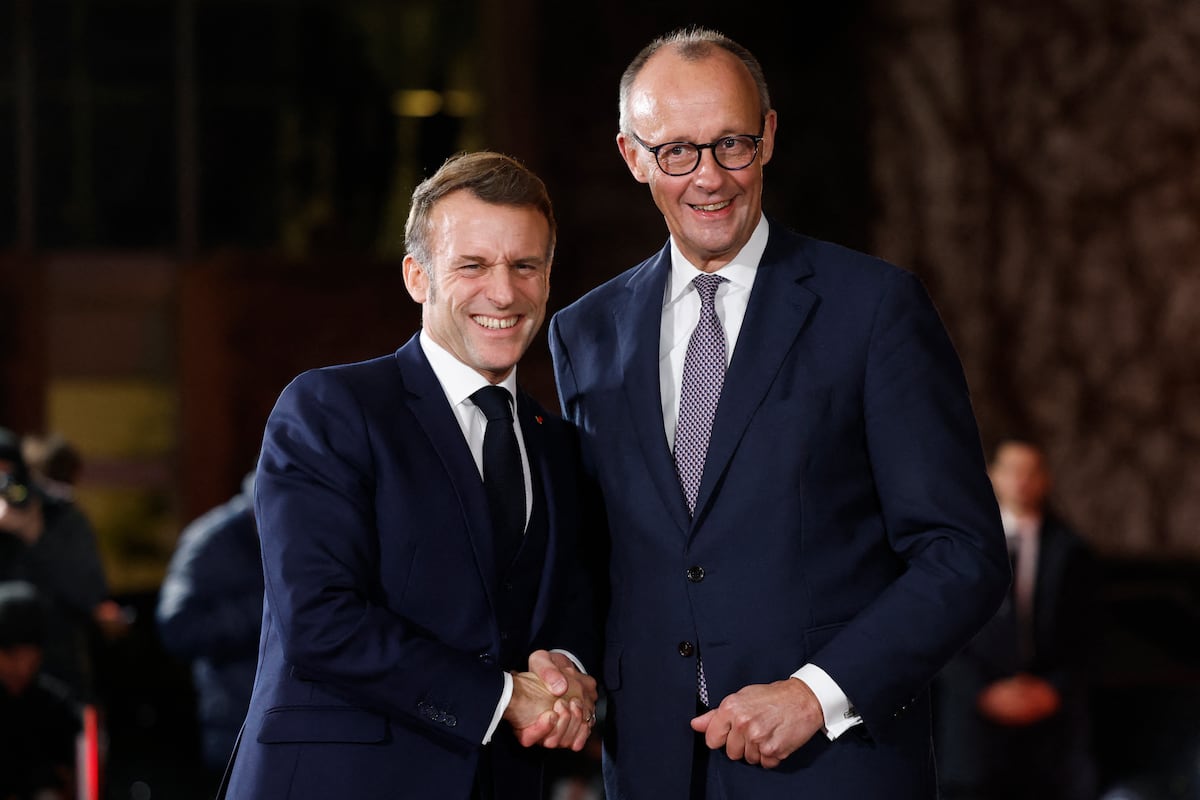
France and Germany will discuss deepening cooperation on nuclear deterrence, missile defense, long-range strike capabilities and space at a joint ministerial retreat, the Elysee said, seeking to show that the EU’s two largest defense powers can still work together despite differences over major armament programs.
The meetings come weeks after industrial rivalries forced Paris and Berlin to scrap the landmark Future Combat Air System (FCAS) fighter jet program at a time the U.S. is pressuring Europe to rearm itself.
Delays to a Franco-German next-generation tank project, setbacks to the multinational Eurodrone program meant to build a drone competitor to the U.S. Reaper and growing competition within Europe in the space sector have all underscored Europe’s challenges scaling up its defense ambitions.
Two joint declarations are expected following the Franco-German Defence and Security Council (CFADS) and a broader joint ministerial meeting near Cologne on Thursday and Friday.
A French official acknowledged that the discussions were “not a path where everything is necessarily aligned,” but said Franco-German defense industry cooperation was bigger than the failed FCAS project.
A German official said agreement was expected on how elements of the FCAS project would continue to be developed. Both countries have pledged to focus on data links between warplanes and related software known as a “combat cloud”.
The two sides will also discuss Macron’s proposal for “forward (nuclear) deterrence,” unveiled in March, under which European allies could participate in French nuclear deterrence exercises and temporarily host French nuclear assets on their territory.
Berlin now expects to agree that German troops will take part in a French nuclear exercise in the autumn, the German official said.
Underlying the Franco-German defense relationship are differences over how dependent Europe should be on U.S. weapons technology at a time the continent is questioning President Donald Trump’s reliability as a security partner.
The Elysee said the talks would also centre on conventional military capabilities, citing early warning systems, long-range strike capabilities and air and missile defense.
France has long advocated greater reliance on European technologies for missile defense.
“On ballistic missile defense, we have always argued to Germany the importance of what is sovereign,” the Elysee official said.
Space cooperation will also be on the table, another area where competition has recently complicated bilateral ties.
The Elysee said France and Germany would reaffirm support for IRIS², the European Union’s planned secure satellite communications constellation, despite Berlin simultaneously pursuing its own military satellite constellation project.
Paris sees the program as a cornerstone of Europe’s efforts to secure sovereign communications infrastructure and reduce dependence on foreign providers.
法国和德国将在联合部长级非正式会议上讨论深化在核威慑、导弹防御、远程打击能力和太空领域的合作,爱丽舍宫表示,此举旨在表明,尽管欧盟两大国防大国在主要军备计划上存在分歧,但它们仍然可以携手合作。
此次会晤是在工业竞争迫使巴黎和柏林放弃具有里程碑意义的未来作战空中系统(FCAS)战斗机计划几周后举行的,而此时美国正向欧洲施压,要求其重新武装自己。
法德合作的下一代坦克项目延期,旨在打造与美国“死神”无人机竞争的多国合作项目“欧洲无人机计划”遭遇挫折,以及欧洲航天领域日益激烈的竞争,都凸显了欧洲在扩大国防规模方面面临的挑战。
预计在周四和周五于科隆附近举行的法德防务与安全委员会(CFADS)会议和更广泛的联合部长级会议之后,将发表两份联合声明。
一位法国官员承认,这些讨论“并非在所有方面都必然一致”,但他表示,法德国防工业合作的规模远大于失败的FCAS项目。
一位德国官员表示,预计双方将就未来空中作战系统(FCAS)项目各组成部分的后续开发达成协议。两国承诺将重点发展战机与相关软件(即“作战云”)之间的数据链。
双方还将讨论马克龙在3月份提出的“前沿(核)威慑”方案,该方案允许欧洲盟友参与法国的核威慑演习,并在其领土上临时部署法国核资产。
这位德国官员表示,柏林方面现在预计将同意德国军队参加今年秋季在法国举行的核演习。
法德防务关系的根本在于,在欧洲大陆质疑唐纳德·特朗普总统作为安全伙伴的可靠性之际,双方对于欧洲应该在多大程度上依赖美国武器技术存在分歧。
爱丽舍宫表示,会谈还将重点讨论常规军事能力,包括预警系统、远程打击能力以及防空和导弹防御。
法国长期以来一直主张更多地依赖欧洲技术进行导弹防御。
“在弹道导弹防御问题上,我们一直向德国强调主权的重要性,”爱丽舍宫官员说。
太空合作也将是双方讨论的议题之一,太空领域的竞争最近也使双边关系变得复杂。
爱丽舍宫表示,尽管柏林同时也在推进自己的军事卫星星座项目,但法国和德国将重申对欧盟计划中的安全卫星通信星座 IRIS² 的支持。
巴黎方面认为,该计划是欧洲保障主权通信基础设施安全、减少对外国供应商依赖的重要举措。