Bilateral EU free trade deals can pave way for broader ASEAN-EU pact: DPM Gan甘副总理表示,欧盟双边自由贸易协定可为更广泛的东盟-欧盟协定铺平道路:甘副总理
Bilateral EU-ASEAN trade deals pave the way for a broader regional free trade agreement and enhanced digital and green economic cooperation. Read more at straitstimes.com.
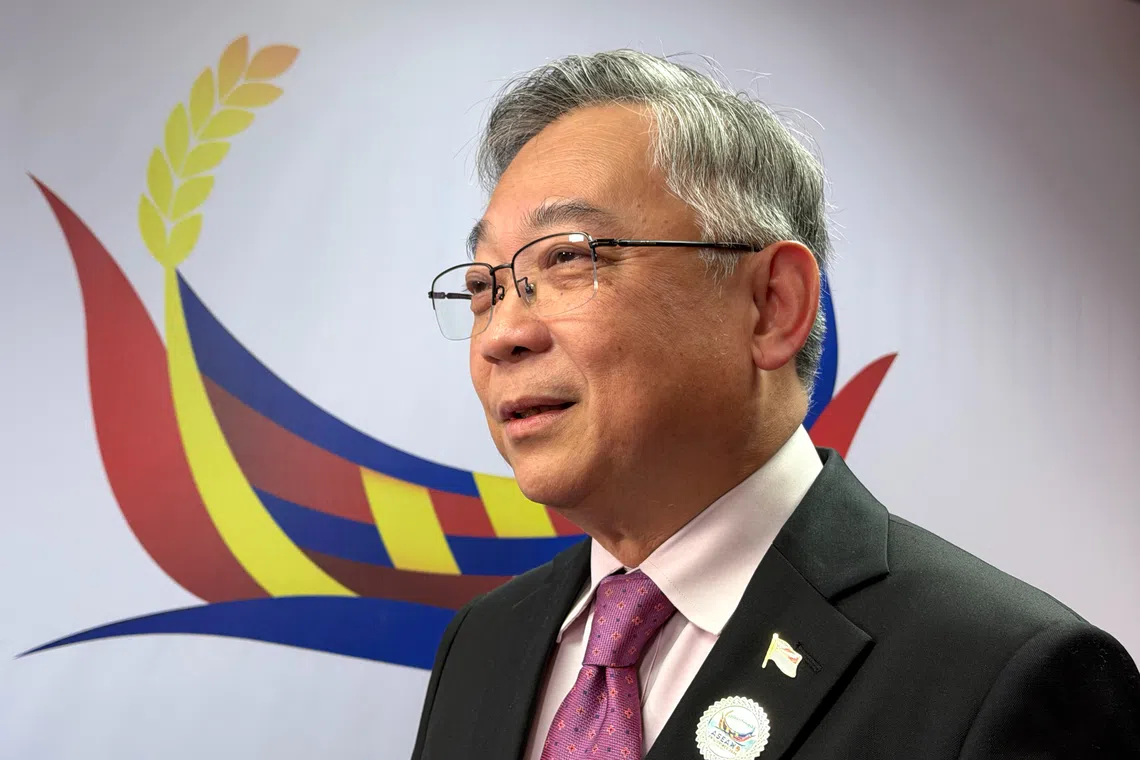
Deputy Prime Minister Gan Kim Yong’s remarks coincided with the EU and the Philippines announcing the finalisation of their own free trade deal the same day.
ST PHOTO: MARA CEPEDA
Published Sep 22, 2026, 01:00 PM
Updated Sep 22, 2026, 01:20 PM
Bilateral EU-ASEAN free trade deals help build trust and understanding, paving the way for an eventual wider ASEAN-EU free trade agreement, says Singapore Deputy PM Gan.
European businesses urge establishing a region-to-region economic framework by 2027, prioritising digital trade and investment protection agreements.
ASEAN accelerates internal trade integration with earlier ATIGA implementation and plans to adopt a flexible digital economy framework and green economy initiatives.
MANILA – Bilateral trade deals between the European Union (EU) and individual South-east Asian countries could help pave the way for an eventual ASEAN-EU free trade agreement (FTA), Singapore Deputy Prime Minister Gan Kim Yong said on Sept 22.
The remarks coincided with the EU and the Philippines announcing the finalisation of their own free trade deal the same day, adding to a growing network of bilateral pacts between the European bloc and ASEAN member-states.
“They build on each other. I think with bilateral negotiations between EU and individual countries will also set the stage for further integration at the ASEAN level,” said Gan.
Gan, who is also Singapore’s Minister for Trade and Industry, spoke to reporters on the sidelines of the ASEAN Economic Ministers’ Meeting and Related Meetings held in Manila.
The EU already has FTAs in force with Singapore and Vietnam, while a deal with Indonesia was finalised in 2025 . Negotiations with Thailand and Malaysia are also under way.
Gan said these bilateral negotiations could help individual ASEAN countries and the EU better understand each other’s needs and challenges, making it easier to eventually pursue an agreement involving the entire region.
“The FTA may be a longer-term objective, but we can take a modular approach,” he said, adding that the two sides could move step by step in areas where progress can be made more quickly.
Businesses push for ASEAN-EU framework
Echoing the ministerial push, European businesses on Sept 22 urged ASEAN and the EU to establish a region-to-region economic framework in 2027, when the two groupings mark 50 years of relations.
In a statement, the EU-ASEAN Business Council (EU-ABC) proposed a modular framework that would allow both sides to deepen economic ties gradually without waiting for every element of a comprehensive FTA to be finalised.
The council’s latest business sentiment survey found that 74 per cent of European businesses polled believe an ASEAN-wide FTA would bring greater benefits than separate bilateral agreements, while 49 per cent want negotiations for such a deal to be launched in 2027.
“Bilateral deals should not be the end point, but the foundation for a more ambitious, longer-term goal to establish a region-to-region FTA,” said EU-ABC chairman Jens Ruebbert.
The council also proposed making a region-to-region digital trade agreement the first priority, followed by an investment protection agreement and other sectoral deals.
Gan similarly pointed to the digital economy as an area where ASEAN and the EU could move more quickly.
The two sides are discussing digital trade principles, with Gan saying they hope to complete negotiations in 2027 before exploring further cooperation.
He said one possibility is to make digital payments more seamless between ASEAN and its trading partners.
Rather than maintaining multiple bilateral payment links, Gan said a multilateral system would be “much easier, more efficient”, allowing countries to connect to a wider network through a single arrangement.
Upgrading digital and goods pacts
The push for stronger external partnerships comes as ASEAN is also seeking to deepen economic integration within the region amid growing uncertainty in the global economy due to the Middle East crisis.
Gan said the economic ministers’ decision to bring forward the implementation of the ASEAN Trade in Goods Agreement (ATIGA) reflected a sense of urgency among member-states.
The upgraded pact, which aims to reduce barriers and simplify trade within ASEAN, was originally scheduled to come into force in 2027. Economic ministers are now pushing for this to happen by the end of 2026 .
“This will also signify that, despite a very challenging external environment, despite the world becoming a lot more volatile, unpredictable and beginning to be fragmented, we are able to further strengthen ASEAN’s integration,” Gan said.
He added that moving up the timeline demonstrates member states’ shared commitment to making the trade agreement benefit businesses as soon as possible, despite an increasingly unstable and fragmented global environment.
ASEAN is also preparing to implement its Digital Economy Framework Agreement (DEFA) , which is expected to be signed by the region’s leaders during the summit in November.
Gan said Singapore wants DEFA to remain a “living document” that can evolve as technology changes rapidly.
He said potential projects may include interoperable digital payments, an upgraded ASEAN Single Window to simplify trade documentation, and a centralised registration system that would allow businesses to be uniquely identified across ASEAN economies.
Gan said ASEAN is also laying the groundwork for a green economy framework, with Singapore hoping negotiations can begin in 2027 when it assumes the ASEAN chairmanship after the Philippines.
He said the framework could cover areas including renewable energy, carbon markets, and greener products and production processes.
“We hope that we can build on the achievements that the Philippines have done this year, and continue to build on the momentum,” he said.
Mara Cepeda is Philippines correspondent at The Straits Times.
Free trade agreement
副总理颜金勇发表上述讲话的同时,欧盟和菲律宾也于同一天宣布最终敲定自由贸易协定。
照片:玛拉·塞佩达
发布于2026年9月22日下午1点
更新于2026年9月22日下午1:20
新加坡副总理颜金勇表示,欧盟与东盟的双边自由贸易协定有助于建立信任和理解,为最终达成更广泛的东盟-欧盟自由贸易协定铺平道路。
欧洲企业敦促在 2027 年前建立区域间经济框架,优先考虑数字贸易和投资保护协议。
东盟加快内部贸易一体化进程,提前实施《东盟贸易一体化协定》,并计划采取灵活的数字经济框架和绿色经济举措。
马尼拉——新加坡副总理颜金勇9月22日表示,欧盟与东南亚各国之间的双边贸易协定可能有助于为最终达成东盟-欧盟自由贸易协定铺平道路。
就在同一天,欧盟和菲律宾宣布最终敲定自由贸易协定,这进一步壮大了欧洲集团与东盟成员国之间日益增长的双边协定网络。
“它们相辅相成。我认为欧盟与各个成员国之间的双边谈判也将为东盟层面的进一步一体化奠定基础,”甘说。
兼任新加坡贸易及工业部长的颜金勇在马尼拉举行的东盟经济部长会议及相关会议间隙接受了记者的采访。
欧盟已与新加坡和越南签署了自由贸易协定,与印度尼西亚的协议也于2025年最终敲定。目前,欧盟正与泰国和马来西亚进行谈判。
甘表示,这些双边谈判可以帮助东盟各国和欧盟更好地了解彼此的需求和挑战,从而更容易最终达成一项涉及整个地区的协议。
“自由贸易协定可能是一个长期目标,但我们可以采取模块化的方法,”他说道,并补充说,双方可以在进展更快的领域循序渐进地推进。
企业界推动东盟-欧盟框架
响应部长级倡议,欧洲企业于 9 月 22 日敦促东盟和欧盟在 2027 年建立区域间经济框架,届时这两个组织将迎来建交 50 周年。
欧盟-东盟商务理事会(EU-ABC)在一份声明中提出了一个模块化框架,该框架将允许双方逐步深化经济联系,而无需等待全面自由贸易协定的每个要素都最终确定。
该理事会最新的商业信心调查发现,74% 的受访欧洲企业认为,东盟范围内的自由贸易协定比单独的双边协议更有利,而 49% 的企业希望在 2027 年启动此类协议的谈判。
欧盟-ABC主席延斯·鲁伯特表示:“双边协议不应是终点,而应是建立区域间自由贸易协定这一更雄心勃勃、更长远目标的基础。”
该委员会还提议将区域间数字贸易协定作为首要任务,其次是投资保护协定和其他行业协议。
甘也同样指出,数字经济是东盟和欧盟可以加快步伐发展的一个领域。
双方正在讨论数字贸易原则,甘先生表示,他们希望在2027年完成谈判,然后再探讨进一步的合作。
他表示,一种可能性是使东盟与其贸易伙伴之间的数字支付更加便捷。
甘表示,与其维持多个双边支付渠道,不如建立多边体系,这样“更容易、更高效”,各国可以通过单一安排接入更广泛的网络。
升级数字和商品协定
在中东危机导致全球经济不确定性日益加剧之际,东盟也在寻求深化区域内的经济一体化,并大力推动加强对外伙伴关系。
甘表示,经济部长们决定提前实施东盟货物贸易协定(ATIGA),反映出成员国的紧迫感。
这项旨在减少东盟内部贸易壁垒、简化贸易的升级版协定,原定于2027年生效。目前,各国经济部长正在推动将其提前至2026年底生效。
“这也表明,尽管外部环境充满挑战,尽管世界变得更加动荡、难以预测且开始分裂,我们仍然能够进一步加强东盟一体化,”颜金勇说。
他补充说,提前达成协议表明成员国共同致力于尽快使贸易协定惠及企业,尽管全球环境日益不稳定和分裂。
东盟也正准备实施其《数字经济框架协议》(DEFA),预计该协议将在11月举行的峰会上由该地区领导人签署。
颜金勇表示,新加坡希望《国防经济政策》保持“动态文件”的状态,能够随着技术的快速发展而不断演变。
他表示,潜在的项目可能包括可互操作的数字支付、升级后的东盟单一窗口以简化贸易文件,以及一个集中式注册系统,该系统将允许企业在东盟各经济体中进行唯一识别。
甘表示,东盟也在为绿色经济框架奠定基础,新加坡希望谈判能在2027年菲律宾卸任后,新加坡接任东盟轮值主席国时开始。
他表示,该框架可以涵盖可再生能源、碳市场以及更环保的产品和生产工艺等领域。
他说:“我们希望能够巩固菲律宾今年取得的成就,并继续保持这种势头。”
玛拉·塞佩达是《海峡时报》驻菲律宾记者。
自由贸易协定