RSIS can help reduce risk of miscalculation amid geopolitical tensions: Chan Chun Sing陈振声表示,RSIS可以帮助降低地缘政治紧张局势下的误判风险。
During a lecture to mark the think tank's 30th anniversary, the defence minister also spoke about the need to "constantly reinvent ourselves" to stay relevant.
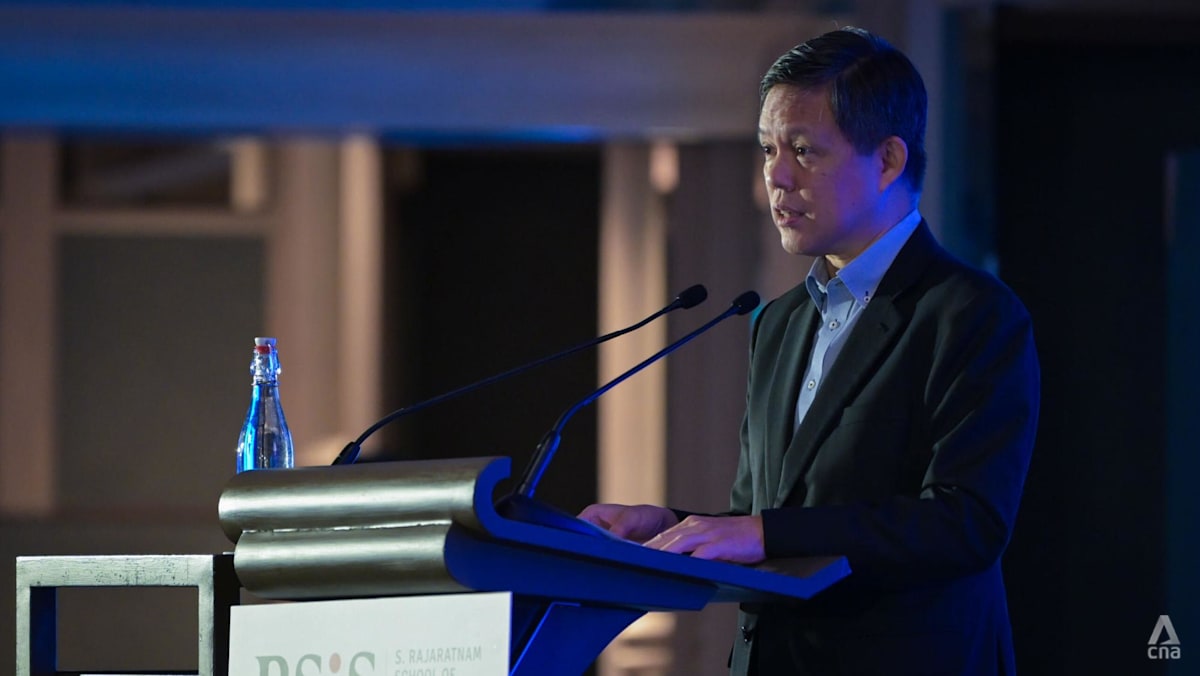
During a lecture to mark the think tank's 30th anniversary, the defence minister also spoke about the need to "constantly reinvent ourselves" to stay relevant.
Coordinating Minister for Public Services and Minister for Defence Chan Chun Sing delivering a lecture to mark the 30th anniversary of the S Rajaratnam School of International Studies (RSIS) on Sep 22, 2026. (Photo: CNA/Syamil Sapari)
This audio is generated by an AI tool.
SINGAPORE: Where technology crosses borders, think tanks like the S Rajaratnam School of International Studies (RSIS) can help develop common ground that reduces the risk of miscalculation, Defence Minister Chan Chun Sing said on Tuesday (Sep 22).
Delivering a lecture to commemorate 30 years of the Singapore-based graduate school that focuses on strategic studies and security affairs, Mr Chan said RSIS must help Singapore think through both the opportunities and the risks as a small state.
He noted how the world has changed over the past 30 years. Rivalry between the United States and China now cuts across trade, technology, supply chains and ideology, while cyberspace has "erased the protection of physical distance", he said.
"In Singapore, we can never wish away our geography, nor can we opt out of geopolitics," said Mr Chan, who is also coordinating minister for public services.
CNA Games Guess Word Crack the word, one row at a time Buzzword Create words using the given letters Mini Sudoku Tiny puzzle, mighty brain teaser Mini Crossword Small grid, big challenge Word Search Spot as many words as you can Show More Show Less "However, what we can do, and what we must do, is to understand the world more deeply than others would expect a small state to – and more importantly, to use that understanding to stay relevant, to stay connected, and to stay ahead." REINVENT TO STAY RELEVANT While RSIS is celebrating its 30th anniversary, the task is "never done" and it cannot do more of the same, said Mr Chan. "We have to constantly reinvent ourselves ahead of the times to stay relevant. We must always strive to stay one step ahead of all the changes," he said. "To interpret ongoing change must be a 101 competency for all of us that is necessary, but not sufficient." He highlighted that RSIS' mission is to help Singapore stay one step ahead, having built up deep connections and understanding of the personalities, institutions and deep forces shaping the world. It can also help to interpret and project the implications for Singapore ahead of time. "The shifts we are going through are not just structural; they are also personal. The decisions that will shape our region are being made by specific leaders with specific worldviews, specific insecurities, and specific ambitions," said the defence minister.
"However, what we can do, and what we must do, is to understand the world more deeply than others would expect a small state to – and more importantly, to use that understanding to stay relevant, to stay connected, and to stay ahead."
REINVENT TO STAY RELEVANT
While RSIS is celebrating its 30th anniversary, the task is "never done" and it cannot do more of the same, said Mr Chan.
"We have to constantly reinvent ourselves ahead of the times to stay relevant. We must always strive to stay one step ahead of all the changes," he said.
"To interpret ongoing change must be a 101 competency for all of us that is necessary, but not sufficient."
He highlighted that RSIS' mission is to help Singapore stay one step ahead, having built up deep connections and understanding of the personalities, institutions and deep forces shaping the world.
It can also help to interpret and project the implications for Singapore ahead of time.
"The shifts we are going through are not just structural; they are also personal. The decisions that will shape our region are being made by specific leaders with specific worldviews, specific insecurities, and specific ambitions," said the defence minister.
Understanding geopolitics today means understanding the Chinese conception of national rejuvenation and what that means, or how China exercises power in the region and beyond, he said.
It also means understanding the personalities, institutional pressures and domestic politics that shape American foreign and domestic policies, not just under the current administration but across different administrations, Mr Chan said.
It also means understanding what Indonesia is becoming and what that means for the Association of Southeast Asian Nations (ASEAN) and everyone else.
"The Indonesia of the 1990s is a very different Indonesia from that of the 2020s. Over the last 30 years, Indonesia has changed far more than it did in the previous 30 years, by any measure.
"Likewise, the domestic dynamics in Malaysia are also shifting fast. If we look at the last 30 years – from 1996 to 2026 – and compare that to the previous 30 years, from 1966 to 1996, you would see what I mean: the forces shaping and reshaping the societies around us and around the world have changed much more, much faster, and in far more unpredictable ways," he said.
"This is the kind of deep, granular human understanding that cannot be assembled overnight when a crisis hits. It requires persistent research, language skills, long-cultivated relationships, and genuine intellectual immersion in other societies."
In his view, RSIS must always aspire to be the institution that builds and sustains this capability for Singapore, and this will continue to be why the government will support the think tank's growth and development, said Mr Chan.
On relationships with the US and China, Singapore's ability to remain relevant to both is never guaranteed, but one that has to be earned continuously, he added.
"Singapore’s value in the room depended entirely on the quality of our understanding and the credibility of our analysis. RSIS, just as Singapore, must keep earning that credibility," he said.
"As the perspectives and needs of the US and China shift, we must constantly challenge ourselves to come up with new propositions that can continue to entrench our relevance. We cannot be the proverbial one-trick pony."
Mr Chan Chun Sing speaking during a Q&A session, moderated by Ambassador Ong Keng Yong, RSIS' executive deputy chairman RSIS, on Sep 22, 2026. (Photo: CNA/Syamil Sapari)
Beyond the two nations, Singapore must also not take its relationships with the closest neighbours, Malaysia and Indonesia, for granted, he said, adding that these were not relationships that can be managed on "autopilot".
They require the same depth of understanding of history, political culture, and the deep forces shaping their societies – from their economic structures to their demographics, to the relationships between their different states and institutions within their own polities, he said.
During a question-and-answer session, Mr Chan was asked how Singapore should decide where it can remain open to both US and China.
To this, the minister said he was "not a fan of binary thinking" and added that it was not correct to say Singapore does not choose sides.
"We always choose Singapore's side. We start everything from our national interest. It's not something profound that I say today. Every country does it. Every country does that every day. Big countries, small countries - we always have to choose our own sides, which is what is in our best interest," said Mr Chan.
Singapore has always been an open platform for collaboration due to trust, and others do not see the country as "threatening anybody", he said.
"It is whether people trust you to be an honest broker. You can do all that you want, but if you have a vested interest and (you) don't bring value to the table, then nobody is going to trust you," he said, adding this was how Singapore organised itself to project its relevance and value.
"I always say this: if you are not successful, you are not relevant, you have to choose sides. Once you choose sides, you will not be relevant as well.
"If Singapore is not a successful country, nobody will very much listen to us, and we don't have to look very far in history ... But to survive, to thrive, you must be successful, you must be trusted. You must be an open platform that seeks to integrate rather than divide."
TECHNOLOGY AND SECURITY
Technology is also redrawing the boundaries of what is possible in security and warfare, said Mr Chan.
Artificial intelligence, autonomous systems and drones are changing the way conflicts are fought and power is projected, he said.
He added that commercial technologies have given smaller states and non-state actors capabilities that once required enormous resources.
"Conflicts today do not begin only when shots are fired; they begin long before – in cyberspace, in the information environment, in the grey zones below the threshold of traditional war," Mr Chan said.
RSIS must help Singapore think through both the opportunities and the risks as a small state, looking at not just what the new technologies can do but also what they mean for how the country operates and makes decisions.
"Where technologies cross borders, RSIS can help develop the common ground and shared expectations of responsible behaviour that reduces the risk of miscalculation.
"Because in the end, this is what it is all about - sound judgement about the capabilities and intentions of others," he said.
Capabilities are easier to see and assess based on information gathered from various sources, but intentions are hard, and this is where RSIS earns its keep, he said.
Poor understanding of the other side and of oneself increases the risk of miscalculation, said Mr Chan, adding that any miscalculation in this part of the world would have "consequences that none of us want to contemplate".
Coordinating Minister for Public Services and Minister for Defence Chan Chun Sing speaking with RSIS scholars on Sep 22, 2026. (Photo: CNA/Syamil Sapari)
MIDDLE EAST CONFLICT
Mr Chan was posed questions about the ongoing Middle East conflict , including on his forecast on when the war would end.
To this, he said: "We all hope that we can all say after the Middle East conflict. But the last time we checked, for the last 2,000 years, there was no 'after the Middle East conflict'."
An important lesson for this part of the world came down to two fundamental factors: accepting each other's right to exist, and building a common future by working together, he said.
"We pray for peace in the Middle East every day, but I would say that we need very strong political leadership for these two fundamentals to happen - the right for everyone to exist, and therefore we can coexist; the aspiration that we can all have a better future … Otherwise, it's never-ending," said Mr Chan.
He was also asked what Singapore could do in the Middle East conflict.
Reiterating that Singapore will always provide a platform for people who are willing to have a dialogue and has tried behind-the-scenes to encourage parties to come together, he said Singapore "can't bring people who don't want to be together, together".
"It's very difficult to go, and rather it's impossible, to tell people to turn up and dialogue when people do not or have not crossed that fundamental hurdle to say that we want to look forward to something better together," Mr Chan said.
"If any one side does not see that as something that they are prepared to do, then it's quite impossible for Singapore or RSIS to do anything."
Get our pick of top stories and thought-provoking articles in your inbox
Stay updated with notifications for breaking news and our best stories
Join our channel for the top reads for the day on your preferred chat app
在为纪念该智库成立 30 周年而举办的讲座上,国防部长还谈到了“不断自我革新”以保持其相关性的必要性。
2026年9月22日,公共服务统筹部长兼国防部长陈振声发表演讲,庆祝拉惹勒南国际研究院(RSIS)成立30周年。(图片:CNA/Syamil Sapari)
这段音频由人工智能工具生成。
新加坡:国防部长陈振声周二(9月22日)表示,当技术跨越国界时,像拉惹勒南国际研究院(RSIS)这样的智库可以帮助建立共同基础,从而降低误判的风险。
陈先生在纪念新加坡战略研究与安全事务研究生院成立 30 周年的演讲中表示,拉曼国际研究院必须帮助新加坡作为一个小国,认真思考其面临的机遇和风险。
他指出,过去30年世界发生了巨大变化。美中之间的竞争如今已渗透到贸易、技术、供应链和意识形态等多个领域,而网络空间则“消除了物理距离的保护作用”,他说道。
“在新加坡,我们永远无法忽视我们的地理位置,也无法置身于地缘政治之外,”陈先生说道,他同时也是公共服务统筹部长。
CNA游戏 猜词游戏 逐行破解单词 流行词游戏 用给定的字母组成单词 迷你数独 小谜题,脑力挑战 迷你填字游戏 小方格,大挑战 单词搜索 尽可能多地找出单词 显示更多 显示更少 “然而,我们能做的,也是我们必须做的,是对世界有比其他人预期的更深刻的理解——更重要的是,利用这种理解来保持相关性,保持联系,并保持领先。” 重塑自我,保持相关性 陈先生表示,尽管拉脱维亚国际学院(RSIS)正在庆祝其成立30周年,但这项任务“永无止境”,它不能再墨守成规。“我们必须不断重塑自我,走在时代的前沿,才能保持相关性。我们必须始终努力领先于所有变化,”他说。“解读持续的变化必须是我们所有人的基本能力,这是必要的,但还不够。”他强调,拉贾斯坦邦国际研究院(RSIS)的使命是帮助新加坡保持领先地位,因为它与塑造世界格局的各界人士、机构和深层力量建立了深厚的联系和理解。它还能帮助新加坡提前解读和预测这些变化对新加坡的影响。国防部长表示:“我们正在经历的转变不仅是结构性的,也是个人层面的。塑造我们地区的决策是由具有特定世界观、特定不安全感和特定抱负的特定领导人做出的。”
“然而,我们能做的,也是我们必须做的,是比其他人期望一个小国更深刻地了解世界——更重要的是,利用这种理解来保持相关性、保持联系并保持领先地位。”
重塑自我,才能保持竞争力
陈先生表示,虽然拉贾斯坦邦国际研究院正在庆祝成立 30 周年,但这项工作“永无止境”,它不能再做同样的事情。
“为了保持竞争力,我们必须不断革新自己,走在时代前沿。我们必须始终努力领先一步,应对所有变化,”他说。
“解读不断变化的世界应该是我们每个人的基本能力,这是必要的,但还不够的。”
他强调,RSIS 的使命是帮助新加坡保持领先地位,因为它与塑造世界的各界人士、机构和深层力量建立了深厚的联系和理解。
它还可以帮助提前解读和预测对新加坡的影响。
国防部长表示:“我们正在经历的转变不仅是结构性的,也是个人层面的。塑造我们地区的决策是由具有特定世界观、特定不安全感和特定抱负的特定领导人做出的。”
他说,要了解当今的地缘政治,就必须了解中国的民族复兴观念及其意义,或者说,了解中国如何在地区内外行使权力。
陈先生表示,这也意味着要了解塑造美国外交和内政政策的人物、制度压力和国内政治,不仅是本届政府,而且是历届政府。
这也意味着要了解印度尼西亚正在变成什么样子,以及这对东南亚国家联盟(东盟)和其他国家意味着什么。
“上世纪90年代的印度尼西亚与2020年代的印度尼西亚截然不同。无论从哪个角度来看,过去30年里,印度尼西亚的变化都远远超过了前30年。”
“同样,马来西亚国内的动态也在快速变化。如果我们回顾过去30年——从1996年到2026年——并将其与之前的30年——从1966年到1996年——进行比较,你就会明白我的意思:塑造和重塑我们周围以及世界各地社会的各种力量变化更大、更快,而且变化的方式也更加难以预测,”他说。
“这种深刻、细致入微的人类理解,并非危机爆发后一朝一夕就能建立起来的。它需要持续不断的研究、语言技能、长期培养的关系,以及对其他社会的真正深入的了解。”
陈先生表示,他认为拉贾斯坦邦国际研究院必须始终致力于成为新加坡建设和维持这种能力的机构,而这正是政府将继续支持该智库成长和发展的原因。
他补充说,关于与美国和中国的关系,新加坡能否继续对两国保持重要性永远无法保证,而需要不断地努力去赢得这种重要性。
他说:“新加坡在会议上的价值完全取决于我们对问题的理解质量和分析的可信度。拉曼国际研究院(RSIS)和新加坡一样,必须不断赢得这种可信度。”
“随着中美两国视角和需求的变化,我们必须不断挑战自我,提出新的方案,以巩固自身的影响力。我们不能只会一招鲜。”
2026年9月22日,陈振声先生在由RSIS执行副主席王景荣大使主持的问答环节中发言。(图片:CNA/Syamil Sapari)
他还表示,除了新加坡和马来西亚之外,新加坡也不应将与最亲密的邻国马来西亚和印度尼西亚的关系视为理所当然,并补充说,这些关系不能“自动运行”。
他说,他们需要对历史、政治文化以及塑造其社会的深层力量有同样深刻的理解——从经济结构到人口结构,再到其政治体系内不同国家和机构之间的关系。
在问答环节中,有人问陈先生,新加坡应该如何决定在哪些方面可以同时对美国和中国保持开放。
对此,部长表示他“不赞成非此即彼的思维方式”,并补充说,说新加坡不选边站队是不正确的。
“我们始终选择站在新加坡一边。我们做任何事都以国家利益为出发点。我今天说的这些话并不高深。每个国家都这样做。每个国家每天都在这样做。大国也好,小国也罢——我们总是要选择自己的立场,这才是最符合我们自身利益的,”陈先生说道。
他说,由于彼此信任,新加坡一直是一个开放的合作平台,其他国家并不认为新加坡“对任何人构成威胁”。
“关键在于人们是否信任你,认为你是一个诚实的中间人。你可以做任何你想做的事,但如果你有既得利益,而且不能带来价值,那么没有人会信任你,”他说道,并补充说,新加坡就是这样组织起来,展现其重要性和价值的。
我总是说:如果你不成功,你就没有存在感,你必须选边站队。一旦你选边站队,你也就失去了存在感。
“如果新加坡不是一个成功的国家,就不会有人认真听我们说话,历史经验告诉我们这一点……但要想生存、要想繁荣,就必须成功,必须赢得信任。必须成为一个开放的平台,寻求融合而非分裂。”
技术与安全
陈先生表示,科技也在重新定义安全和战争领域的可能性边界。
他表示,人工智能、自主系统和无人机正在改变冲突的作战方式和力量的投射方式。
他还补充说,商业技术赋予了较小的国家和非国家行为体以前需要巨额资源才能获得的能力。
“如今的冲突并非始于枪声响起之时;它们早在枪声响起之前就已经开始——在网络空间、信息环境中、在传统战争门槛以下的灰色地带,”陈先生说。
RSIS必须帮助新加坡作为一个小国,认真思考机遇和风险,不仅要考虑新技术能做什么,还要考虑这些新技术对国家运作和决策的意义。
“当技术跨越国界时,RSIS 可以帮助建立共同基础和负责任行为的共同期望,从而降低误判的风险。
“因为归根结底,这就是一切的关键所在——对他人能力和意图做出正确的判断,”他说。
他说,能力更容易根据从各种来源收集的信息进行观察和评估,但意图却很难判断,而这正是 RSIS 发挥作用的地方。
陈先生表示,对对方和自身缺乏了解会增加误判的风险,他还补充说,在这个地区,任何误判都会产生“我们都不愿考虑的后果”。
2026年9月22日,公共服务统筹部长兼国防部长陈振声与拉惹勒南国际研究院(RSIS)学者交谈。(图片:CNA/Syamil Sapari)
中东冲突
陈先生被问及有关中东冲突的最新进展,包括他对战争何时结束的预测。
对此,他表示:“我们都希望中东冲突结束后,我们能够说‘中东冲突结束后’。但我们上次查阅资料发现,在过去的2000年里,根本没有‘中东冲突结束后’这样的说法。”
他说,对世界这一地区而言,一个重要的教训归根结底在于两个基本因素:接受彼此的生存权利,并通过共同努力建设共同的未来。
“我们每天都为中东和平祈祷,但我认为,要实现这两个基本目标——人人享有生存权,从而能够共存;以及我们都能拥有更美好未来的愿望——我们需要非常强有力的政治领导……否则,和平将永无止境。”陈先生说道。
他还被问及新加坡能在中东冲突中发挥什么作用。
他重申,新加坡将始终为愿意对话的人们提供平台,并一直在幕后努力鼓励各方走到一起,但他表示,新加坡“无法让不想在一起的人走到一起”。
陈先生说:“如果人们还没有跨越这个基本障碍,表示我们希望共同展望更美好的未来,那么要求人们出来对话是非常困难的,甚至是不可能的。”
“如果任何一方不认为这是他们愿意做的事情,那么新加坡或拉曼国际研究院就完全不可能采取任何行动。”
订阅我们的邮件,即可获取精选热点新闻和引人深思的文章。
订阅通知,第一时间获取突发新闻和精彩报道。
加入我们的频道,即可在您常用的聊天应用上获取当日热门文章。