The Time A F-4G Wild Weasel’s Anti-Radiation Missile Blew Apart A B-52’s Tail一架F-4G“野鼬鼠”战斗机的反辐射导弹炸毁了一架B-52轰炸机的尾翼
The freak friendly fire incident during Desert Storm that was almost fatal for a B-52 crew.
Updated Jul 3, 2020 4:25 AM EDT
In the early 1990s, one of America’s B-52Gs, serial number 58-0248, was emblazoned with nose art displaying a puzzling nickname: “In HARM’s Way.” The story of how the bomber got the moniker emanates from one of those bizarre sets of circumstances that only war seems to provide.
The incident occurred during Operation Desert Storm , on a nighttime raid deep into Iraqi territory. A brace of B-52s were interdicting into Iraqi airspace at very low-level using their nap-of-the-earth flying capabilities. The tactic was used early in the war in an attempt to avoid deadly anti-aircraft artillery and surface to air missiles—both of which Saddam Hussein’s forces have plenty of—as well as roving fighters.
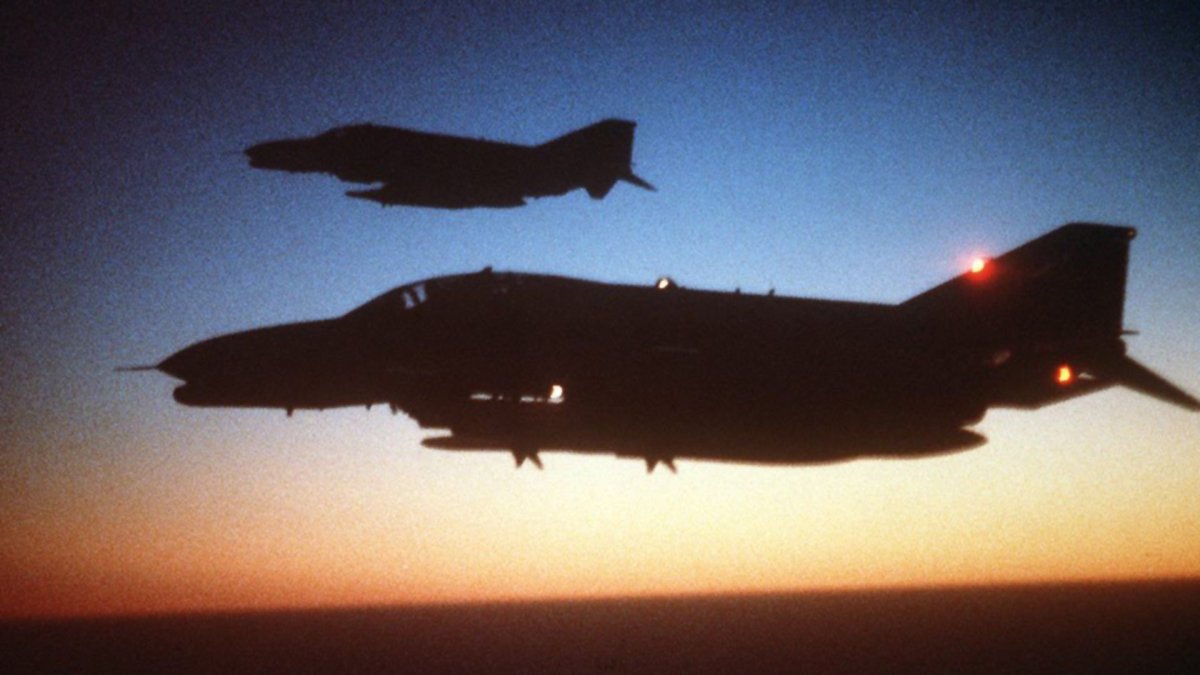
High above the B-52Gs were a flight of F-4G Wild Weasels tasked with protecting the strike package from enemy air defenses via “suppressing” any enemy emitter that popped up near their path. This is done by firing AGM-88 Hight-Speed Anti-Radiation Missiles (HARMs) at those emitters. The HARM will then home in on the unique electronic emissions characteristics of the radar targeted, and blow it to pieces.
F-4G Wild Weasel armed with a pair of AGM-88 HARMs., USAF
The specific electromagnetic “fingerprint” of different emitters, such as different types of fire control radars, are classified based on an ever evolving electronic threat library maintained by the Pentagon and America’s intelligence services. Everything from espionage to spy plane missions are used to keep this library as up to date as possible, and aircraft with radar warning receivers, and especially those tasked with attacking enemy air defenses, have their onboard threat libraries updated regularly with this information.
The B-52Gs, even with their low-altitude penetration capabilities and electronic warfare suites, were still vulnerable to multiple types of enemy attack—including by roving fighters that could fall in behind the big bombers and open up on them with cannons and short-range missiles. Just one lucky Iraqi MiG or Mirage, also flying low to counter coalition fighter and airborne early warning and control aircraft radars, that stumbled upon the bombers could be devastating.
B-52G, Rob Schleiffert/wikicommons
This was still the age when B-52s retained their tail guns , and those tail guns used radar for targeting enemy fighters at close-range. As the bombers roared across the dark desert floor, B-52 “gunners” intensely monitored their scopes for marauding enemy aircraft while electronic warfare officers watched for missile launches. At just a couple hundred feet off the ground, crews would have little time or space to react if their aircraft were pounced.
Suddenly a F-4G crew picked up the radar of an anti-aircraft artillery battery in the B-52s’ path and fired off a HARM from on high. What happened next is the most opaque part of the story, but what seems to have occurred is that the F-4G fired the missile “in the blind,” without a specific threat radar being classified before launch. Apparently this was due to the fact that multiple types of anti-aircraft artillery radars have very similar electronic signatures, so many of them were classified simply as AAA by default. Some claim the F-4G crew actually mistook the B-52’s tail gun radar or its missile warning system by accident, but it seems like a real threat did exist, with the unique geometry of the engagement being the catalyst for near disaster.
As the nearly 14 foot long, 800lb missile dove toward its target in the dark abyss below, accelerating on its way to mach two in the process, its seeker inadvertently locked onto one of the B-52’s AN/ASG-15 tail gun targeting radar system , otherwise known as the Defensive Fire Control System (DFCS). Others claim the HARM locked onto the bomber’s AN/ALQ-153 missile warning system. Like the AN/AGS-15, the AN/ALQ-153 used a radar system. But in its case that system was used to detect incoming missiles.
Apparently, this was possible because the B-52’s tail radars are similar to those used by AAA batteries, and were also classified to the default general AAA designation. As such, the missile was drawn to the B-52’s tail instead of the AAA site the Wild Weasel crew was trying to put out of commission.
The missile’s 146 pound warhead detonated just behind the big bomber, ripping off various pieces of the aircraft’s empennage, including pretty much everything behind the vertical stabilizer and blasting other surfaces, including the horizontal stabilizers, with shrapnel. The aircraft’s tail gun system and missile warning system were totally obliterated.
The badly damaged aircraft skewed about in the darkness low over the desert, the crew struggled to regain control of the stricken bomber, dropping to just feet above the ground in the process.
Amazingly they were able to limp the stricken jet back to Prince Abdullah Air Base in Jedda, Saudi Arabia, landing without a drag chute —it was streamed out the back of the B-52 as a result of the explosion, and immediately collapsed as the jet was going hundreds of knots above its maximum deployment speed.
B-52G taking off for a Desert Storm sortie. , USAF
The jet was patched together crudely and ferried thousands of miles to Andersen AFB in Guam where it would receive much more comprehensive set of fixes. Eventually it was returned to the fleet with new nose art and a new nickname: “In HARM’s Way.”
The B-52 served brilliantly in Desert Storm, secretly launching GPS-guided cruise missiles and dropping nearly one third of the tonnage of all air-to-ground weapons during the war. By 1992, all tail guns were removed from the entire B-52 fleet as part of a cost saving and tactics shifting measure, although the AN/ALQ-153 remained. Just two years later, in 1994, the B-52G fleet was retired, including 58-0248 , leaving just the B-52H to soldier on for decades to come.
Contact the author: Tyler@thedrive.com
Author’s Note: Updated B-52 gun radar designation, and added possible alternative cause being the B-52’s missile warning system.
Comments couldn’t be loaded. Please refresh the page.
更新于美国东部时间2020年7月3日凌晨4:25
上世纪90年代初,美国一架B-52G轰炸机,序列号58-0248,机头彩绘上赫然出现了一个令人费解的绰号:“身处险境”(In HARM's Way)。这架轰炸机得名的故事,源于战争中才会出现的种种离奇事件。
事件发生在“沙漠风暴”行动期间,当时美军正在对伊拉克境内进行一次夜间突袭。两架B-52轰炸机利用其超低空飞行能力,以极低的高度侵入伊拉克领空。这种战术在战争初期就被广泛使用,目的是为了躲避萨达姆·侯赛因军队拥有的大量高射炮和地对空导弹,以及敌方巡逻战斗机的攻击。
在B-52G轰炸机上空,一队F-4G“野鼬鼠”战斗机奉命保护攻击编队免受敌方防空系统的攻击,其任务是“压制”任何出现在攻击航线附近的敌方辐射源。具体做法是向这些辐射源发射AGM-88高速反辐射导弹(HARM)。HARM导弹会追踪目标雷达独特的电子辐射特征,并将其摧毁。
美国空军的F-4G“野鼬鼠”战斗机装备有两枚AGM-88“哈姆”反辐射导弹。
不同发射源(例如不同类型的火控雷达)的特定电磁“指纹”是根据五角大楼和美国情报机构维护的不断更新的电子威胁数据库进行分类的。从间谍活动到侦察机任务,所有信息都用于尽可能地更新该数据库。配备雷达告警接收器的飞机,特别是那些负责攻击敌方防空系统的飞机,其机载威胁数据库会定期更新这些信息。
即使具备低空突防能力和电子战系统,B-52G轰炸机仍然容易受到多种敌方攻击——包括游荡的战斗机尾随其后,用机炮和短程导弹对其进行猛烈攻击。哪怕只有一架运气好的伊拉克米格或幻影战斗机,同样低空飞行以对抗联军战斗机和空中预警机的雷达,一旦与轰炸机遭遇,都可能造成毁灭性打击。
B-52G,罗布·施莱弗特/wikicommons
那时B-52轰炸机还保留着尾炮,这些尾炮利用雷达近距离瞄准敌方战斗机。当轰炸机呼啸着掠过漆黑的沙漠时,B-52的“炮手”们紧盯瞄准镜,搜寻着来袭的敌机,而电子战人员则密切关注着导弹发射。由于飞机离地仅有几百英尺,一旦遭到攻击,机组人员几乎没有时间或空间做出反应。
突然,一架F-4G战斗机的机组人员探测到B-52轰炸机航线上的一个防空炮兵阵地的雷达信号,并从高空发射了一枚HARM反辐射导弹。接下来发生的事情是整个事件中最扑朔迷离的部分,但似乎F-4G是在“盲射”的情况下发射的,发射前并未对具体的威胁雷达进行分类。这显然是因为多种防空炮兵雷达的电子特征非常相似,因此很多雷达都被默认归类为AAA雷达。有人声称F-4G机组人员实际上是误判了B-52的尾炮雷达或导弹告警系统,但看起来确实存在一个真实的威胁,而这次交战的特殊地形正是导致险些酿成灾难的导火索。
这枚长约14英尺、重达800磅的导弹俯冲向下方黑暗深渊中的目标,并在加速过程中达到两马赫。然而,它的导引头却意外锁定了B-52轰炸机尾炮的AN/ASG-15瞄准雷达系统,也就是所谓的防御火控系统(DFCS)。也有人声称,HARM导弹锁定的是轰炸机的AN/ALQ-153导弹预警系统。与AN/ASG-15一样,AN/ALQ-153也使用雷达系统,但它的用途是探测来袭导弹。
显然,这之所以成为可能,是因为B-52轰炸机的尾部雷达与高射炮阵地使用的雷达类似,并且也被归类为默认的通用高射炮目标。因此,导弹被吸引到了B-52的尾部,而不是“野鼬鼠”机组试图摧毁的高射炮阵地。
导弹重达146磅的弹头在大型轰炸机后方爆炸,炸毁了飞机尾翼的多个部件,几乎炸掉了垂直尾翼后的所有部分,并将弹片炸飞到包括水平尾翼在内的其他表面。飞机的尾炮系统和导弹预警系统被彻底摧毁。
严重受损的飞机在黑暗中低空掠过沙漠,机身倾斜,机组人员努力重新控制这架受损的轰炸机,在此过程中,飞机下降到离地面仅几英尺的高度。
令人惊讶的是,他们竟然能够勉强将这架受损的喷气式飞机开回沙特阿拉伯吉达的阿卜杜拉王子空军基地,而且着陆时没有使用减速伞——由于爆炸,减速伞从 B-52 的尾部被甩了出去,并在飞机速度比最大展开速度高出数百节的情况下立即坍塌。
B-52G轰炸机起飞执行“沙漠风暴”行动任务。(美国空军)
这架喷气式飞机被粗略地拼凑起来,然后运送数千英里到达关岛的安德森空军基地,在那里接受了更全面的维修。最终,它带着新的机头彩绘和一个新的绰号“In HARM's Way”(意为“在危险中”)重新回到了机队。
B-52轰炸机在“沙漠风暴”行动中表现出色,秘密发射了GPS制导巡航导弹,并投掷了战争期间近三分之一的空对地武器。到1992年,为了节省成本和调整战术,所有B-52机队的尾炮都被拆除,但AN/ALQ-153机炮仍然保留。仅仅两年后,1994年,包括58-0248在内的B-52G机队全部退役,只剩下B-52H继续服役数十年。
联系作者:Tyler@thedrive.com
作者注:更新了 B-52 机炮雷达的型号,并补充了可能的替代原因是 B-52 的导弹预警系统。
评论加载失败,请刷新页面。