Have You Ever Seen An AV-8B Harrier Use The Meatball To Land On An Amphibious Assault Ship?你见过AV-8B“鹞”式战斗机使用“肉丸”着陆装置在两栖攻击舰上降落吗?
This awesome video shows how Marine vertical landing jets use a Fresnel Lens Optical Landing System like their supercarrier-based counterparts.
Updated Oct 7, 2021 4:21 PM EDT
When you think of carrier landings, a few essentials probably come to mind—hook, wire, and the “Meatball,” known by its full name as the Improved Fresnel Lens Optical Landing System, or IFLOS. While the Meatball is known to be a critical component for fixed-wing pilots landing on catapult and arresting gear-equipped (CATOBAR) carriers, it’s less known that America’s ‘big deck’ amphibious assault ships (LHDs and LHAs) are also equipped with the system. Thanks to one Harrier pilot that goes by the handle @overdesigned on Twitter , we get to see the system in action right from the cockpit of his AV-8B Harrier.
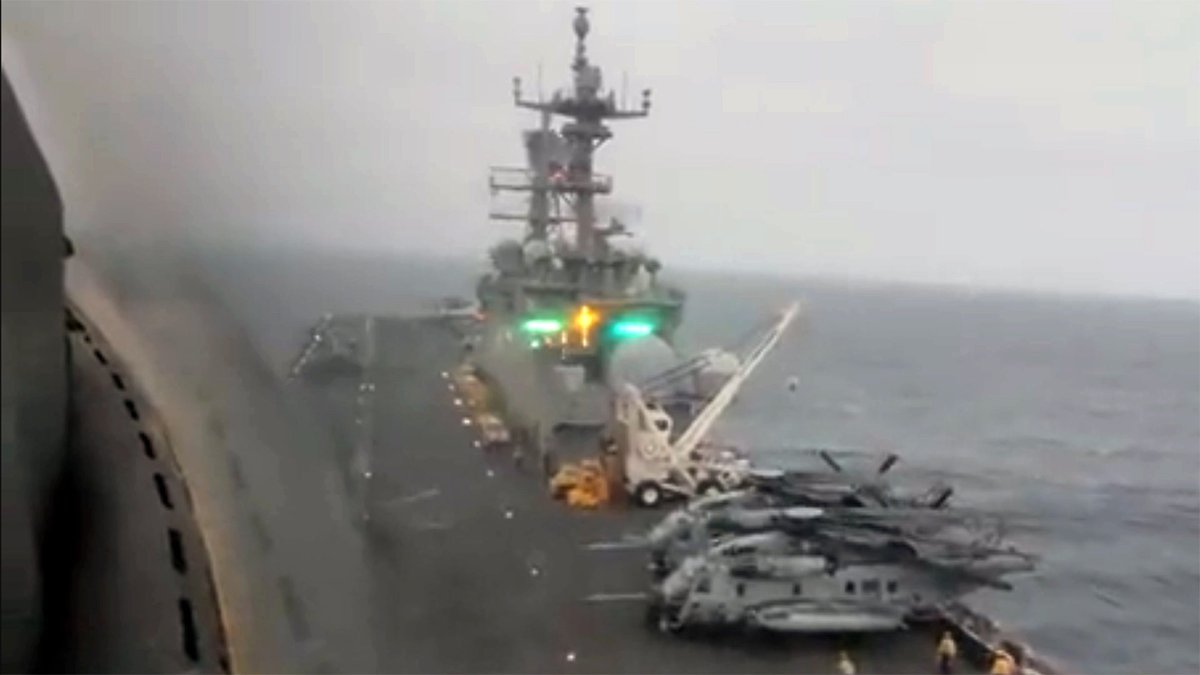
One major difference between the Meatball on America’s nuclear-powered supercarriers and those on big deck amphibious assault ships is where it is mounted. Instead of being installed on the port side amidships at deck height, it is mounted on the island superstructure, on the ship’s starboard side, high above the deck. As you can see in @overdesigned’s video below, he flies the meatball straight in, over the fantail of the ship, before entering into a solid hover and eventually touching down vertically amidships:
Left: A Harrier making an approach to an LHD in the Mediterranean with the deck lights and IFLOS illuminated. Right—The IFLOS layout. The center vertical strip provides critical glideslope positioning information. , Seaforces.org/Vladsinger via wikicommons
In addition to seeing the Meatball in action, the straight-in approach isn’t something we see much of when it comes to Harrier ops aboard amphibious assault ships. So, with all this in mind, we reached out to the guy at the controls to get more info on this approach, the Harrier’s use of the IFLOS, and more.
Here is our exchange:
Does the Harrier use the IFLOS in the same way that the CATOBAR jets do on CVNs?
Generally speaking yes, in that it gives us visual glideslope from a mile or so out in towards the ship. We transition to a different set of lights once we’re in close though, whereas CVN pilots fly the ball all the way to touchdown.
An AV-8B Harrier with Marine Attack Squadron 311, part of the Air Combat Element of the 31st Marine Expeditionary Unit, lands on the USS Essex . , USMC
When are straight-in landings used instead of the typical ones where the Harrier hovers to the left of the ship, then walks to the right over the deck in a hover before landing?
When we do night landings but aren’t on NVDs [Night Vision Devices], we fly straight up the stern. “Night” is defined as “after sunset” so sometimes you get a pretty bright night landing.
Do you “call the ball”—where the pilot acknowledges visual contact with the Meatball at 3/4 mile from the ship and their fuel state—like fixed-wing aircraft operating aboard supercarriers do? Are the radio communications similar in general?
For approaches where we use the ball, yep the ball call is the same. There are a couple of extra calls related to the vertical landing that occur after the ball call. For a normal daytime good weather recovery, we just call abeam, no ball call. And then similar to how a CVN LSO [Landing Signal Officer] provides guidance, the V/STOL [Vertical/Short Take-Off and Landing] LSO does the same, but again with some specialized terminology related to the hover and vertical landing.
Can the F-35B do the same straight-in landings?
I am sure they are technically capable, but I couldn’t tell you if it’s a thing they do or don’t do since I haven’t really talked or done anything with any F-35 guys.
An AV-8B Harrier lands on the flight deck of the amphibious assault ship USS Boxer at night., DoD
What are the most challenging things about lower visibility landings on “amphibs” with the Harrier?
Things are difficult with a rolling ship, particularly at night on NVDs, without a well-defined horizon. If you attempt to match the ship’s roll with your aircraft you start to slide laterally, so you have to watch the tramline [centerline of the takeoff and landing area] for left/right alignment while also ignoring the roll of the ship itself. Without a horizon that is challenging.
So there you have it. There are some real similarities and differences between how Harriers land on amphibs at night to how fixed-wing aircraft land on supercarriers at night—the latter of which you can read all about here. While the Meatball may still be the go-to aid in both cases, new concepts of operation and capabilities are making recovering aboard ships at night a bit easier.
Regardless, as long as humans are at the controls, the Meatball will still be there to lend its guiding light.
Contact the author: Tyler@thedrive.com
Comments couldn’t be loaded. Please refresh the page.
更新于美国东部时间2021年10月7日下午4:21
提到航母着舰,人们脑海中可能会浮现出几个关键部件——钩子、钢索,以及被称为“肉丸”(Meatball)的装置,它的全称是改进型菲涅尔透镜光学着舰系统(IFLOS)。虽然“肉丸”是固定翼飞行员在配备弹射器和阻拦装置(CATOBAR)的航母上着舰的关键部件,但鲜为人知的是,美国的大型两栖攻击舰(LHD 和 LHA)也配备了该系统。多亏了一位推特账号为 @overdesigned 的“鹞”式战斗机飞行员,我们才能从他的 AV-8B“鹞”式战斗机的座舱内亲眼目睹该系统的运作。
美国核动力超级航母上的“肉丸”遥控飞行器与大型两栖攻击舰上的“肉丸”遥控飞行器的一个主要区别在于其安装位置。前者安装在舰体左舷中部甲板高度,而后者则安装在舰体右舷的舰岛上层建筑上,位置远高于甲板。正如您在下方@overdesigned的视频中所见,他操控“肉丸”遥控飞行器径直飞入舰体,越过舰尾,然后进入稳定悬停状态,最终垂直降落在舰体中部:
左图:一架鹞式战斗机正在地中海接近一艘两栖攻击舰,甲板灯和舰载飞行观测系统(IFLOS)均已亮起。右图:舰载飞行观测系统(IFLOS)布局。中央垂直条带提供关键的下滑道定位信息。(图片来自Seaforces.org/Vladsinger via wikicommons)
除了亲眼目睹“肉丸”式战斗机的实战表现之外,这种直接突入的作战方式在鹞式战斗机于两栖攻击舰上的作战行动中并不常见。因此,考虑到这些因素,我们联系了当时的飞行员,以了解更多关于这种作战方式、鹞式战斗机对舰载机视野(IFLOS)的使用以及其他相关信息。
以下是我们的对话:
鹞式战斗机使用IFLOS的方式是否与航母上的弹射起飞/拦阻起飞(CATOBAR)战斗机相同?
一般来说,是的,它能让我们从大约一英里外就看到滑翔线,从而可以朝着舰船方向滑翔。不过,一旦接近目标,我们就会切换到另一组灯光,而CVN飞行员则会一直驾驶飞机直到着陆。
隶属于第31海军陆战队远征部队空中作战分队的第311海军陆战队攻击中队的一架AV-8B“鹞”式战斗机降落在“埃塞克斯”号两栖攻击舰上。
什么时候会采用直接着陆而不是典型的“鹞式战斗机”先悬停在舰船左侧,然后悬停着向右越过甲板着陆的着陆方式?
当我们进行夜间着陆但没有配备夜视设备时,我们会直接飞向机尾。“夜间”的定义是“日落之后”,所以有时会遇到非常明亮的夜间着陆。
你们是否像在超级航母上服役的固定翼飞机那样,“报点”(即飞行员确认与距离舰艇 3/4 英里的“肉丸”目标飞机的目视接触及其燃料状态)?无线电通信总体上是否类似?
对于使用球形标志的进近方式,是的,球形标志的呼叫方式相同。在球形标志呼叫之后,还有一些与垂直着陆相关的额外呼叫。在正常的白天良好天气条件下进行恢复飞行时,我们只需呼叫“Abeam”(水平方向),无需球形标志呼叫。然后,类似于航母着陆信号官(LSO)提供引导的方式,垂直/短距起降(V/STOL)着陆信号官也提供类似的引导,但同样会使用一些与悬停和垂直着陆相关的专业术语。
F-35B 能做到同样的直线着陆吗?
我相信他们在技术上是有能力做到的,但我无法告诉你他们是否真的这么做过,因为我没有真正和任何F-35飞行员交流或合作过。
一架AV-8B“鹞”式战斗机夜间降落在两栖攻击舰“拳师”号的飞行甲板上。(美国国防部)
在能见度较低的情况下,使用“鹞式”战斗机在水陆两用飞机上着陆最具挑战性的是什么?
在夜间使用夜视仪飞行时,由于船体摇晃,视野不清晰,操作起来会非常困难。如果试图让飞机的摇晃与船体的摇晃保持一致,飞机就会开始左右滑动,因此必须一边忽略船体自身的摇晃,一边观察起降区域的中心线(跑道线)以保持左右对齐。在没有地平线的情况下,这无疑是一项巨大的挑战。
以上就是全部内容。鹞式战斗机夜间在两栖舰艇上着陆与固定翼飞机夜间在超级航母上着陆之间存在一些真正的相似之处和不同之处——关于后者,您可以点击此处阅读全文。虽然“肉丸”(指飞机着陆装置)在两种情况下可能仍然是首选的辅助设备,但新的作战理念和能力正在使夜间舰艇上的飞机回收变得更加容易。
无论如何,只要人类掌控着权力,肉丸就会继续在那里指引方向。
联系作者:Tyler@thedrive.com
评论加载失败,请刷新页面。