Autonomous vessels, cleaner fuels, new careers: Inside Singapore’s plan to keep its edge in shipping自主船舶、更清洁的燃料、新的职业:新加坡保持航运优势的计划内幕
Discover how Singapore is transforming its maritime industry with automation, cleaner fuels and new careers to maintain its global shipping leadership. Read more at straitstimes.com.
Singapore’s success began with its strategic location. Today, automation, AI and low-carbon shipping are transforming the maritime industry and the jobs within it
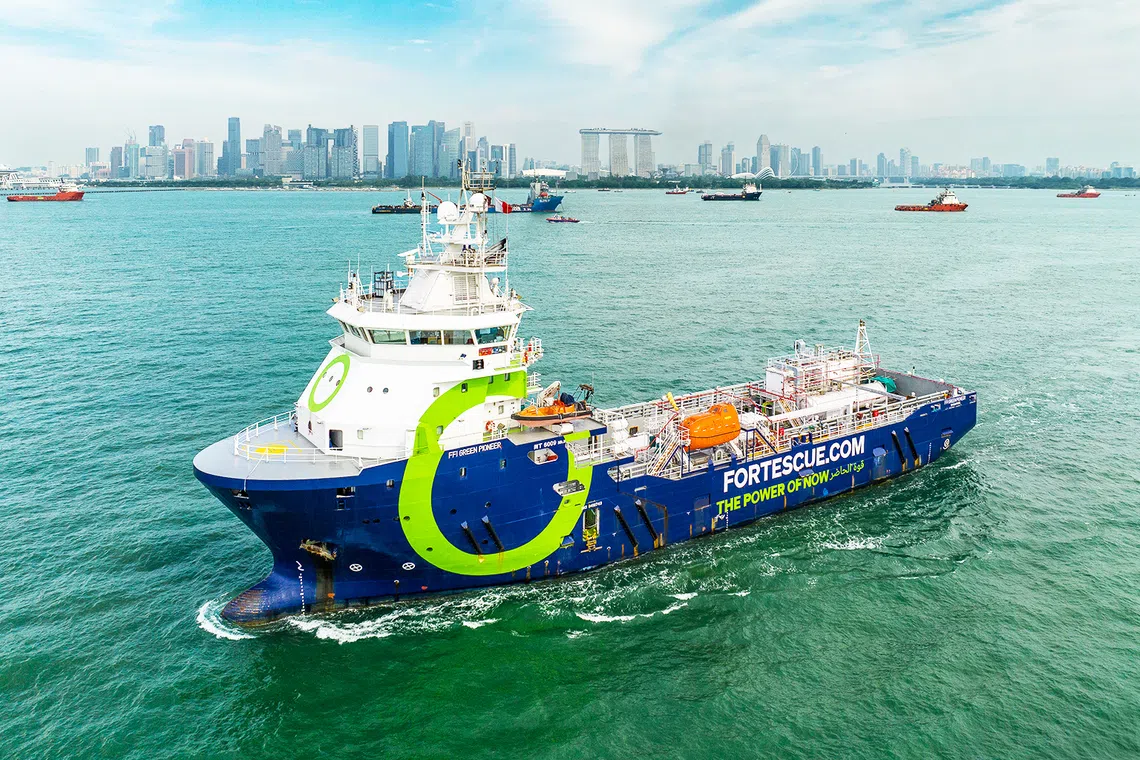
The Fortescue Green Pioneer is one of the vessels using cleaner energy to reduce emissions at sea.
PHOTO: MARITIME AND PORT AUTHORITY OF SINGAPORE
Published Sep 23, 2026, 04:00 AM
Think about the things that you use every day – your smartphone, the coffee beans that go into your morning brew, or the chair that you are sitting on. Chances are, they travelled thousands of miles by sea before reaching Singapore.
More than 80 per cent of the world’s goods are transported by sea, making the maritime industry the backbone of global trade. And Singapore sits at the heart of this ecosystem. It is the world’s leading container transshipment and bunkering – or vessel-fuelling – hub.
At any given time, about 1,000 ships are in Singapore’s waters, carrying essential goods such as food, fuel and construction materials.
Ng Yi Han, chief transformation officer and senior director for Innovation, Technology and Talent Development at the Maritime and Port Authority of Singapore (MPA), shares: “Many people may not realise this, but the maritime industry plays an outsized role, especially in Singapore, where we are a major global supply chain hub.”
Singapore’s influence extends well beyond its shores. It is home to one of the world’s busiest ports and punches above its weight in global maritime trade. Its strategic location, world-class port infrastructure, global connectivity, trusted institutions and deep ecosystem of maritime services have made it a key node of global commerce.
Keeping everyday life moving
As a member of the Council of the International Maritime Organization (IMO) – the United Nations agency responsible for regulating international shipping – Singapore actively supports the IMO in shaping global standards and policies that govern the industry.
For all its importance, the maritime sector often operates out of the public spotlight. Many see only the ships and ports, not the diverse careers behind them – from technology and sustainability to policy, logistics and global trade.
Vessel traffic officers use real-time information to keep ships moving safely through Singapore’s port waters. PHOTO: MARITIME AND PORT AUTHORITY OF SINGAPORE
Vessel traffic officers use real-time information to keep ships moving safely through Singapore’s port waters.
“People usually don’t see the maritime industry working quietly behind the scenes 24/7,” says Ng. “The average Singaporean doesn’t realise that when they do their groceries at the supermarket, these goods are actually brought to Singapore by ships from all over the world.”
When these supply chains are disrupted, the effects can be felt across the economy through shortages, delays and rising costs.
Ng experienced this first-hand. When the Covid-19 pandemic struck, he watched as port congestion and crew shortages cascaded into global supply chain disruptions. This led to emptied supermarket shelves and drove up prices worldwide.
“When the maritime industry is under stress, the ripple effects spread far beyond the ports, and everyone feels it,” he recalls.
Despite the industry’s significance, maritime may not always be top of mind for fresh graduates or professionals considering a career switch.
Careers in maritime go beyond working at sea. ZAG International senior chartering manager Vale Tan, for example, monitors market trends, vessel availability and freight rates to help move cargo efficiently around the world. PHOTO: SPH MEDIA
Careers in maritime go beyond working at sea. ZAG International senior chartering manager Vale Tan, for example, monitors market trends, vessel availability and freight rates to help move cargo efficiently around the world.
“Many people think that the maritime industry is all about the vessels and operating the vessels as a seafarer, but it goes beyond that,” says Ng.
While seafarers remain a vital part of the workforce, today’s maritime industry offers opportunities across commercial, engineering and technology functions. Roles in the industry range from monitoring global trade flows and developing cleaner fuels, to applying digital tools and artificial intelligence to optimise maritime operations.
“In order for the maritime industry to work well and efficiently, we do need a diverse workforce,” says Ng.
“A workforce not just in technical roles such as seafaring and operational roles, but also in commercial and technology-related roles as well.”
When ports become innovation hubs
Another common misconception is that maritime is a traditional industry with little room for innovation. In reality, technologies are rapidly reshaping ports, ships and global supply chains.
“The industry is moving towards using technology, AI and automation to drive progress. These tools are going to play an important role in not just shipping itself but also in the global supply chain. And what this means is that ports are also going to be increasingly automated,” says Ng.
Tuas Port began operations in September 2022 and will continue to grow in phases towards its completion in the 2040s. PHOTO: PSA
Tuas Port began operations in September 2022 and will continue to grow in phases towards its completion in the 2040s.
At PSA, port operations are coordinated from shore-based operation centres, where equipment can be monitored and even operated remotely with a high degree of efficiency.
At Seatrium, their Yard Of The Future initiative uses digital twins of its global shipyards , allowing engineers to detect anomalies on digital dashboards before they become real-world problems.
The future could see even larger changes. MPA and PSA are inviting proposals to develop and test autonomous inter-gateway container feeder vessel operations within Singapore’s port.
These innovations create new career opportunities in areas such as remote vessel monitoring and operations, autonomous systems engineering, maritime data analytics and specialised technical maintenance.
MPA works with partners such as the Technology Centre for Offshore and Marine, Singapore (TCOMS) at the National University of Singapore to develop and test new maritime technologies. PHOTO: SPH MEDIA
MPA works with partners such as the Technology Centre for Offshore and Marine, Singapore (TCOMS) at the National University of Singapore to develop and test new maritime technologies.
Alongside digitalisation and automation, sustainability has become a major priority for the maritime sector. International shipping accounts for around 3 per cent of global carbon emissions.
To reduce their environmental footprint, international shipping is exploring cleaner energy sources such as biofuels, methanol and ammonia, while Singapore is also working towards electrifying local harbour crafts.
To support the transition, a $100m Maritime Singapore Green Initiative (MSGI) was launched in 2011 to promote clean and green shipping in Singapore, and by 2030, all new harbour craft in Singapore’s waters must operate on low-carbon energy solutions .
Singapore is also accelerating efforts on the use of biofuels and establishing methanol and ammonia bunkering at scale, which will reduce the carbon footprint of ships.
New pathways into maritime careers
As maritime evolves, so too must its workforce. MPA is working closely with educational institutions to build a strong talent pipeline.
“We work with the universities, the polytechnics, as well as ITE on the various maritime careers,” says Ng. “We support them in reviewing some of their maritime-related curriculum.”
New programmes are also being introduced to broaden the pathways into the sector. These include an Industry Graduate Diploma in Maritime at Singapore Management University and a master’s-level vessel management programme at the Singapore Institute of Technology.
They add to existing maritime programmes, including master’s-level courses in Maritime Studies at Nanyang Technological University (NTU) and Maritime Technology Management at the National University of Singapore, as well as undergraduate and polytechnic programmes at NTU and the Singapore Maritime Academy at Singapore Polytechnic.
But a maritime qualification is not the only way into the industry. Ng himself came from a computer engineering background and started out as a research and development executive. Drawn to maritime by the opportunities to apply technology and innovation, he has since risen through the ranks over more than 20 years and now helps shape how the industry evolves.
Ng Yi Han joined maritime with a computer engineering background and has spent more than 20 years helping the industry evolve. PHOTO: SPH MEDIA
Ng Yi Han joined maritime with a computer engineering background and has spent more than 20 years helping the industry evolve.
“What is most important is really to have the passion to gain more exposure to the industry,” he says. “We welcome students from non-maritime disciplines because a lot of the technologies and solutions come from other domains and disciplines.”
The industry also welcomes mid-career professionals from adjacent sectors such as logistics, commodities and trading. Career conversion programmes can help these professionals acquire the skills needed to transition into maritime roles.
“It will be very useful if the person is a problem solver, and is able to work with uncertainties or challenges,” Ng says. “Maritime is also a very international industry, so the ability to engage different cultures and understand different perspectives is important.”
Find out more about the career opportunities in the maritime industry.
Maritime and shipping
Maritime and Port Authority of Singapore
Ministry of Transport
新加坡的成功始于其战略位置。如今,自动化、人工智能和低碳航运正在改变海事行业及其相关就业。
“福特斯克绿色先锋号”是使用更清洁能源以减少海上排放的船舶之一。
图片来源:新加坡海事及港务管理局
发布于 2026 年 9 月 23 日 上午 4:00
想想你每天使用的东西——你的智能手机、你早上冲泡咖啡用的咖啡豆,或者你现在坐的椅子。它们很可能在抵达新加坡之前,已经经历了数千英里的海上航行。
全球超过80%的货物通过海运运输,使海运业成为全球贸易的支柱。而新加坡则位于这一生态系统的核心。它是世界领先的集装箱转运和船舶加油枢纽。
任何时候,新加坡水域内大约有 1000 艘船只,运载着食品、燃料和建筑材料等必需品。
新加坡海事及港务管理局 (MPA) 首席转型官兼创新、技术和人才发展高级总监吴义涵表示:“很多人可能没有意识到这一点,但海事行业发挥着举足轻重的作用,尤其是在新加坡,我们是全球重要的供应链枢纽。”
新加坡的影响力远超其国界。它拥有世界上最繁忙的港口之一,在全球海运贸易中扮演着举足轻重的角色。其优越的地理位置、世界一流的港口基础设施、全球互联互通、值得信赖的机构以及完善的海运服务体系,使其成为全球商业的关键节点。
保持日常生活的节奏
作为负责监管国际航运的联合国机构——国际海事组织(IMO)理事会的成员,新加坡积极支持国际海事组织制定管理该行业的全球标准和政策。
尽管海事行业至关重要,但它往往不在公众的关注范围内。许多人看到的只是船舶和港口,却忽略了其背后丰富多彩的职业——从技术和可持续发展到政策、物流和全球贸易。
船舶交通管制员利用实时信息,确保船舶安全通过新加坡港口水域。图片:新加坡海事及港务管理局
船舶交通管制员利用实时信息,确保船舶安全通过新加坡港口水域。
“人们通常看不到海运业在幕后24小时不间断地默默运转,”吴先生说。“普通新加坡人没有意识到,他们在超市购买的食品杂货实际上是由来自世界各地的船只运送到新加坡的。”
当这些供应链中断时,短缺、延误和成本上升等影响会波及整个经济。
吴先生对此深有体会。新冠疫情爆发后,他亲眼目睹了港口拥堵和船员短缺如何引发全球供应链中断,导致超市货架空空如也,全球物价飞涨。
他回忆说:“当海运业面临压力时,其连锁反应会远远超出港口范围,每个人都会感受到。”
尽管海事行业非常重要,但对于应届毕业生或考虑转行的专业人士来说,海事行业可能并非他们的首选。
海事行业的职业发展远不止于海上工作。例如,ZAG International 的高级租船经理 Vale Tan 会密切关注市场趋势、船舶可用性和运费,以帮助货物高效地在全球范围内运输。图片:SPH MEDIA
海事行业的职业发展不仅限于海上工作。例如,ZAG International 的高级租船经理 Vale Tan 会密切关注市场趋势、船舶可用性和运费,以帮助在全球范围内高效运输货物。
“很多人认为海事行业就是船舶以及海员操作船舶,但它远不止于此,”吴说。
尽管海员仍然是劳动力的重要组成部分,但如今的海事行业在商业、工程和技术等各个领域都提供了就业机会。该行业的职位涵盖范围广泛,从监测全球贸易流和开发更清洁的燃料,到应用数字工具和人工智能来优化海事运营,不一而足。
“为了使海事行业良好高效地运作,我们需要一支多元化的员工队伍,”吴先生说。
“我们的劳动力不仅包括航海和运营等技术岗位,还包括商业和技术相关岗位。”
当港口成为创新中心
另一个常见的误解是,海运业是一个传统行业,创新空间有限。但实际上,科技正在迅速重塑港口、船舶和全球供应链。
“航运业正朝着利用技术、人工智能和自动化来推动发展的方向迈进。这些工具不仅在航运业本身,而且在全球供应链中都将发挥重要作用。这意味着港口也将日益自动化,”吴先生说道。
大士港于2022年9月开始运营,并将分阶段持续扩建,预计于2040年代全面竣工。图片:菲律宾统计局
大士港于 2022 年 9 月开始运营,并将分阶段继续发展,直至 2040 年代完工。
在PSA,港口运营由岸基运营中心协调,在那里可以监控设备,甚至可以远程高效地操作设备。
Seatrium 的“未来船厂”计划利用其全球船厂的数字孪生体,使工程师能够在数字仪表盘上检测到异常情况,然后再将其变成现实世界的问题。
未来可能会出现更大的变化。新加坡海事及港务管理局 (MPA) 和新加坡港务集团 (PSA) 正在邀请各方提交方案,以开发和测试新加坡港口内自主运营的跨港区集装箱支线船舶运营模式。
这些创新为远程船舶监控和操作、自主系统工程、海事数据分析和专业技术维护等领域创造了新的职业机会。
新加坡海事及港务管理局(MPA)与新加坡国立大学新加坡近海及海洋技术中心(TCOMS)等合作伙伴携手,共同研发和测试新型海事技术。图片:新加坡报业控股(SPH MEDIA)
新加坡海事及港务管理局 (MPA) 与新加坡国立大学的新加坡近海及海洋技术中心 (TCOMS) 等合作伙伴携手,共同开发和测试新的海事技术。
随着数字化和自动化的发展,可持续发展已成为海运业的一项重要优先事项。国际航运约占全球碳排放量的3%。
为了减少对环境的影响,国际航运正在探索更清洁的能源,例如生物燃料、甲醇和氨,而新加坡也在努力实现当地港口船舶的电气化。
为了支持转型,新加坡于 2011 年启动了一项 1 亿美元的“新加坡海事绿色倡议”(MSGI),旨在促进新加坡的清洁绿色航运。到 2030 年,新加坡水域的所有新港口船舶都必须使用低碳能源解决方案。
新加坡也在加快生物燃料的使用,并大规模建立甲醇和氨燃料供应,这将减少船舶的碳足迹。
进入海事行业的新途径
随着海事行业的不断发展,其从业人员也必须随之变革。MPA正与教育机构紧密合作,构建强大的人才储备体系。
“我们与各大学、理工学院以及工艺教育学院(ITE)合作,共同发展各种海事职业,”吴先生说。“我们支持他们审查一些与海事相关的课程。”
为了拓宽进入该行业的途径,新加坡还推出了新的课程。其中包括新加坡管理大学的海事行业研究生文凭课程和新加坡理工大学的船舶管理硕士课程。
这些课程是对现有海事课程的补充,包括南洋理工大学 (NTU) 的海事研究硕士课程、新加坡国立大学的海事技术管理硕士课程,以及南洋理工大学和新加坡理工学院新加坡海事学院的本科和理工课程。
但获得海事资格并非进入该行业的唯一途径。吴先生本人拥有计算机工程背景,最初担任研发主管。海事行业蕴藏着应用技术和创新的机会,这深深吸引了他。在过去的20多年里,他一步步晋升,如今已成为行业发展的重要推动力量。
吴怡涵拥有计算机工程背景,投身海事行业,二十多年来一直致力于推动该行业的发展。图片:新加坡报业控股媒体
吴义汉拥有计算机工程背景,投身海事行业,20多年来一直致力于帮助该行业发展。
“最重要的是要有热情,渴望更多地了解这个行业,”他说。“我们欢迎非海事专业的学生,因为很多技术和解决方案都来自其他领域和学科。”
该行业也欢迎来自物流、商品和贸易等相关行业的中年专业人士。职业转型计划可以帮助这些专业人士获得过渡到海事岗位所需的技能。
“如果应聘者善于解决问题,并且能够应对不确定性或挑战,那就非常有用,”吴先生说。“海事行业也是一个高度国际化的行业,因此,能够与不同文化背景的人交流并理解不同的观点至关重要。”
了解更多海事行业的职业机会。
海事和航运
新加坡海事及港务管理局
交通部