This Workhorse Huey Rescue Helicopter Flew President Reagan As Marine One In Its Previous Life这架“主力”休伊救援直升机在之前的服役生涯中曾作为“海军陆战队一号”搭载里根总统飞行。
The many lives of aircraft are fascinating to ponder, but one well-worn Huey that's the last of its kind in USMC service has a uniquely colorful past.
Updated Feb 22, 2020 10:39 PM EST
For as long as I’ve been taking photos of aircraft , I’ve never really been a serial number tracking guy. Sure, after photographing aircraft from the same squadrons repeatedly over a number of years, you recognize things like a new pilot’s name painted on the canopy rail or bomb-shaped mission marks stenciled on the nose after an aircraft returns from a deployment, but I’ve never kept logs of the aircraft I’ve photographed or documented these changes. That’s just never been my thing.
Last week, while searching for images of HMX-1’s fleet of ‘White Top’ Presidential transport helicopters for a book I’m writing about Marine Corps aviation in the 21st Century (due out through Harpia Publishing in late 2020 ), I came across a series of images depicting the squadron’s Bell VH-1Ns supporting President Ronald Reagan’s trip to Venice, Italy for the 1987 G8 Summit. Though HMX-1 retired the VH-1Ns in the early 1990s – putting them outside the period I am covering in my book – I’ve long been a fan of the ‘November’ model Hueys. Yes, they are ancient and underpowered, but to me, they are the best-looking UH-1 variant out there. Everything just looks ‘right.’
As I was browsing through the images, something familiar caught my eye: ‘158554’
Back in June 2018, I visited MCAS Yuma on assignment for Air Forces Monthly magazine, as I had been assigned to write an article about Yuma’s Search and Rescue (SAR) detachment. At the time, Yuma SAR was – and remains – the last remaining operator of the ‘November’ model Hueys in the US Marine Corps, with four HH-1Ns providing search and rescue services across a 100-mile radius from Yuma. This area covers most of the Barry M. Goldwater and Chocolate Mountain bombing ranges used by military aircraft from all across the United States, as well as by allies like the UK, the Netherlands, Singapore, and others. Additionally, the Marines and sailors (all of Yuma SAR’s Search and Rescue Medical Technicians, or SMTs, are Navy Corpsmen) of Yuma SAR provide civilian search and rescue support for local, county, state, and federal law enforcement throughout that 100-mile radius from home plate.
After a morning spent interviewing pilots, crew chiefs, and SMTs about Yuma SAR and its mission, I accompanied two crew chiefs into the rugged foothills north of Yuma, going as far as we could in a four-wheel-drive pickup truck before dismounting and – in the words of one of the crew chiefs – ‘Chevrolegging’ another half mile to a rocky canyon with a vertical face about five or six stories tall.
Over the next hour, I shot hundreds of images of the Huey crew ‘rescuing’ two dummies known as ‘Rescue Randys,’ one dangling from the cliff being retrieved via a ‘short-haul’ hoist out of the canyon, and the other hoisted out of a shallow ravine and aboard the Huey after the SMT evaluated the dummy’s simulated injuries and rigging it for hoisting.
In the days that followed, I transcribed over two hours of interviews and started going through the images from that day, trying to pick out the dozen or so I would be submitting to my editor at AFM to accompany my article.
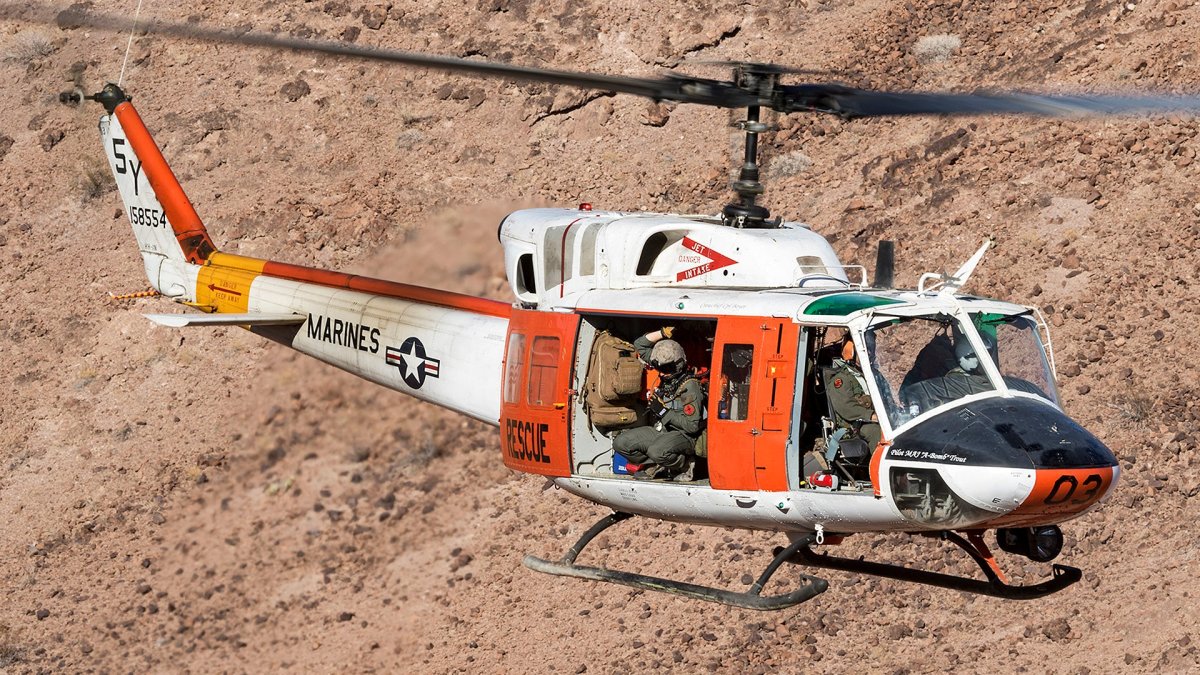
The crew of 158554 approaches for landing in the rough mountain terrain outside of Yuma, Arizona., Photo by Joe Copalman
SAR MedTech HM3 Drinnonstands on the skids, preparing for a short hoist down to the ground to provide simulated treatment to an ‘injured’ Randy., Photo by Joe Copalman
158554 flying over some rough terrain., Photo by Joe Copalman
Sgt Cardinale, an HH-1N crew chief, assists SAR Med Tech HM3 Drinnon just prior to rappelling from former HMX-1 VH-1N 158554 as Major ‘Meatball’ Stramaglia uses fixed ground references to hold a steady hover. With no automated flight control system for things like hover holds, the HH-1N is completely hands-on from takeoff to touchdown. , Photo by Joe Copalman
This side-on study shows off the November’s sleek lines., Photo by Joe Copalman
Pilot and crew chief survey a landing zone in the rough mountains north of Yuma., Photo by Joe Copalman
Sgt Cardinale, an HH-1N crew chief with Yuma SAR, passing directly overhead. The bottom of the aircraft reads “ABANDON CHUTE,” as the downwash from the Huey’s main rotor can cause a pilot’s parachute to drag him or her, possibly causing further injury. , Photo by Joe Copalman
SAR crew chief Sgt Cardinale helps bring SAR Med Tech HM3 Drinnon back aboard with ‘Lt Dan,’ a dummy Yuma SAR has used for so long that its legs have fallen off., Photo by Joe Copalman
158554 returning to Yuma. The black ‘bag’ toward the rear of the cargo compartment is an auxiliary fuel tank, allowing the HH-1N to fly farther from home plate and remain engaged in searches or rescue missions for longer periods of time., Photo by Joe Copalman
The cockpit of the HH-1N offers little in the way of modern, digital avionics or displays. The hoist, stowed internally, can be seen at the right., Photo by Joe Copalman
The HH-1N I shot that day was bureau number 158554. I stared at that number for hours, through image after image, sorting the ‘yups’ from the ‘nopes’ from the ‘maybes’ for publishing. As I said, I’m not a serial number guy, but when I came across that image of an HMX-1 VH-1N landing on a grass field in Italy back in 1987, I immediately knew which aircraft that was.
Marine Experimental Helicopter Squadron One (HMX-1) operated six VH-1Ns throughout the 1980s, both on the ‘green side’ doing test and evaluation work and on the ‘white side,’ complementing the squadron’s fleet of ‘white top’ VH-3D Presidential transport helicopters.
Built by Bell specifically as VIP-configured VH-1Ns, HMX-1’s Hueys featured the aerodynamic ‘shell’ from the upper fuselage of Bell’s 214ST just forward of the rotor shroud to cover and air conditioning unit and a satellite communications antenna. Passengers accessed the cabin through a four-door configuration unique to the VH-1N in place of the large, rearward-sliding door on standard UH-1s.
Seating received a massive upgrade as well, with the Huey’s bench-style seating being replaced by plush bucket seats. The cabin was completed covered in carpet, both for comfort and a degree of sound dampening from the whine of the twin Pratt & Whitney T400-CP-400 engines and the unmistakable “WHUMP-WHUMP” of the Huey’s two-bladed main rotor. A state-of-the-art for the time Sperry autopilot system rounded out the modifications that made these particular Hueys VH-1Ns.
VH-1N 158557 landing in Venice with President Reagan aboard., National Archives
158557 and another unidentified VH-1N on the ground at Marco Polo Airport in Venice during President Reagan’s 1987 visit. , USMC Photo by GySgt Hernandez
This shot of a Presidential aide boarding 158554 shows the upper fuselage ‘shell’ adapted from the Bell 214ST. The shell-covered an air conditioning unit and a satellite communications antenna. Also shown to good effect is the four-door modification unique to the VH-1N. USMC , Photo by GySgt Hernandez
Members of an Italian honor guard prepare to welcome President Reagan aboard 158557 on the tarmac at Marco Polo Airport in Venice at the conclusion of the 1987 Venice Summit. The President departed Venice for Rome. , USMC Photo by GySgt Hernandez
158556 and 158552 on the ground at Marco Polo Airport in Venice. 556 went to NAS Fallon as a SAR HH-1N, but was written off in September 2001 after being damaged in a hard landing a few months prior. , USMC Photo by GySgt Hernandez
Two HMX-1 pilots standing in front of President Reagan’s VH-1N with several US Air Force personnel during the Venice Summit. , USMC Photo by GySgt Hernandez
Vice President Bush en route to the Peace in the Pacific celebration, commemorating the 40th anniversary of the end of the war with Japan. The celebration was held aboard the nuclear-powered aircraft carrier USS ENTERPRISE (CVN 65) in 1985. , National Archives
Just as the Presidential VC-25As operate under the callsign ‘Air Force One’ while transporting the President, individual ‘white top’ US Marine Corps helicopters are known as ‘Marine One’ whenever POTUS is aboard. The Hueys typically operated as Marine One aircraft either on short-notice trips inside the continental United States, for example, if the President needed to tour an area ravaged by a tornado or other natural disaster, or during overseas trips, as the Hueys were much easier to move via cargo aircraft like the Lockheed C-5 Galaxy without having to deeply reconfigure the aircraft for transport.
The Marine Corps’ acquisition of the vastly more capable Sikorsky VH-60N ‘White Hawk’ in 1988 signaled the end of the VH-1N’s service as a Presidential transport. The final overseas mission for the Presidential Hueys occurred in July 1989, when President George H.W. Bush visited the Netherlands, relying on VH-1N 158554 for local transport.
Following the end of the Hueys’ VIP mission, Bell Helicopter modified all six aircraft to HH-1N standard, stripping them of all the bells and whistles, restoring the bench seating and rearward-sliding cabin doors, and adding a rescue winch for hoist work. All six aircraft were subsequently assigned to bases on the west coast, providing SAR coverage for aircraft flying out of Naval Air Warfare Center China Lake, Naval Air Stations Fallon and Lemoore, and Marine Corps Air Station Yuma.
Of the six, two were written off in crashes. Another was damaged in a hard landing but appears to have returned to flight to finish its career with HMLAT-303 ‘Atlas,’ a training squadron, at MCAS Camp Pendleton. Another retired from rescue duties with NAS Fallon’s ‘Longhorn’ SAR unit before being acquired by the Battleship Memorial Park museum in Mobile, Alabama, faithfully restored as a VH-1N in HMX-1 markings. The last two former VH-1Ns – 158554 and 158557 – remain on the active roster, assigned to Headquarters & Headquarters Squadron MCAS Yuma’s SAR unit.
The missions the Marines and sailors of Yuma SAR perform range from responding to military aircraft mishaps and special operations free-fall parachute injuries, to finding lost hikers in the ‘dual-use’ areas of the ranges surrounding Yuma, to providing first aid to law enforcement officers and federal agents along the US-Mexico border, to rescuing injured boaters along the Colorado River, to providing air support for Yuma’s Military Working Dog training program. Some of the more bizarre call-outs include serving as an aerial ‘pathfinder’ for Boy Scouts lost in the maze-like marshes along the Colorado River, leading them back to the river itself. Another involved searching for two men who called authorities saying they were kidnapped and driven out to the middle of the desert, only to find them completely blitzed out of their minds on drugs in the middle of the desert not far from the car they had wrecked, miles from anything remotely resembling a road.
The juxtaposition of all these missions with the Presidential pedigree of two of Yuma SAR’s four HH-1Ns intrigues and amuses me. Did President Reagan ever board one of his VH-1Ns thinking “Someday a drunk boater with a broken leg or a pair of drugged-out jacknobs are going to be taken to the hospital in this thing?”
Of course he didn’t.
Conversely, did any of the wounded or lost people rescued by Yuma SAR’s corpsmen ever know the flight that saved their lives was aboard one of President Reagan’s former helicopters? Probably not. But I love thinking about the storied lives of these aircraft and how, despite never seeing combat, they have a hell of a lot of interesting stories to tell.
Yuma SAR and their HH-1Ns have officially been ordered to shut-down next month. The Yuma Airshow will be their final flight with the HH-1N.
Joe Copalman lives in Mesa, Arizona with his wife, daughter, and son. A lifelong aviation enthusiast, he has been writing about military aviation since 2013 for publications including Air Forces Monthly and Combat Aircraft Journal. He is currently writing his first book detailing modern Marine Corps airpower. Joe is also the co-founder of Arizona Aviation Photographers and a Photography Instructor with 3G Aviation Media and Photography Workshops.
Contact the editor: Tyler@thedrive.com
Comments couldn’t be loaded. Please refresh the page.
更新于美国东部时间2020年2月22日晚上10:39。
这么多年来,我一直没怎么关注过飞机的序列号。当然,如果连续几年反复拍摄同一中队的飞机,你肯定会认出一些细节,比如新飞行员的名字被涂在座舱盖导轨上,或者飞机执行任务归来后机头上喷涂的炸弹形状的任务标记。但我从来没有记录过我拍摄过的飞机,也没有记录过这些变化。这从来就不是我的风格。
上周,我在为一本关于21世纪美国海军陆战队航空兵的书(预计2020年底由Harpia出版社出版)寻找HMX-1中队“白顶”总统运输直升机机队的图片时,偶然发现了一组照片,照片中该中队的贝尔VH-1N直升机正在为罗纳德·里根总统1987年赴意大利威尼斯参加八国集团峰会提供后勤保障。虽然HMX-1中队在20世纪90年代初就退役了VH-1N——这超出了我书中涵盖的时期——但我一直以来都很喜欢“十一月”型的休伊直升机。没错,它们老旧且动力不足,但在我看来,它们是UH-1系列中最漂亮的机型。一切都显得那么完美。
浏览图片时,一个熟悉的字眼吸引了我的目光:“158554”
2018年6月,我受《空军月刊》委派,前往尤马海军陆战队航空站(MCAS Yuma)采访,撰写一篇关于尤马搜救分队的文章。当时,尤马搜救队是美国海军陆战队中唯一仍在使用“十一月”型休伊直升机的单位,至今仍是如此。该分队拥有四架HH-1N直升机,在尤马方圆100英里范围内提供搜救服务。这一区域涵盖了巴里·戈德华特靶场和巧克力山靶场的大部分区域,这些靶场供美国各地以及英国、荷兰、新加坡等盟国的军用飞机使用。此外,尤马搜救队的陆战队员和水兵(尤马搜救队的所有搜救医疗技术员,即SMT,均为海军医务兵)还为尤马方圆100英里范围内的当地、县、州和联邦执法部门提供民用搜救支持。
在花了一上午时间采访飞行员、机组长和搜救队队员,了解尤马搜救队及其任务之后,我陪同两名机组长进入尤马北部崎岖的山麓,乘坐四驱皮卡车尽可能地行驶,然后下车,用其中一名机组长的话说,又“像雪佛兰一样”行驶了半英里,到达一个岩石峡谷,峡谷的垂直峭壁大约有五六层楼高。
在接下来的一个小时里,我拍摄了数百张休伊直升机机组人员“营救”两个被称为“救援兰迪”的假人的照片,其中一个假人悬挂在悬崖上,通过“短途”吊索从峡谷中被吊起,另一个假人则从一个浅沟中被吊起,并被抬上休伊直升机。此前,SMT(安全医疗队)评估了假人的模拟伤情,并为其安装了吊装装置。
接下来的几天里,我整理了两个多小时的采访内容,并开始翻阅当天拍摄的照片,试图从中挑选出十几张照片提交给 AFM 的编辑,作为我文章的补充。
158554号航班的机组人员正在亚利桑那州尤马郊外崎岖的山区地形上准备降落。(乔·科帕尔曼摄)
SAR MedTech HM3 Drinnon 站在滑橇上,准备短距离吊运至地面,为“受伤”的 Randy 提供模拟治疗。(照片由 Joe Copalman 拍摄)
158554 号飞机飞越崎岖地形。照片由乔·科帕尔曼拍摄
卡迪纳尔中士(一名HH-1N机组长)在从原HMX-1中队的VH-1N 158554号直升机上绳降前,协助搜救医疗技术员德里农(HM3)进行操作。与此同时,“肉丸”斯特拉马利亚少校正利用固定的地面参照物保持直升机的稳定悬停。由于HH-1N没有用于悬停等操作的自动飞行控制系统,因此从起飞到降落,飞行员必须全程手动操控。(照片由乔·科帕尔曼拍摄)
这张侧面照片展现了十一月系列的流畅线条。(摄影:乔·科帕尔曼)
飞行员和机组长正在勘察尤马北部崎岖山区的一处着陆区。(乔·科帕尔曼摄)
尤马搜救队的HH-1N直升机机组长卡迪纳尔中士正从飞机上方飞过。飞机底部写着“弃伞”,因为休伊直升机主旋翼产生的下洗气流可能会导致飞行员的降落伞被拖拽,从而造成进一步的伤害。照片由乔·科帕尔曼拍摄
搜救队队长卡迪纳尔中士协助搜救队医务兵德里农返回船上,他身边放着“丹中尉”——一个尤马搜救队使用时间过长、双腿都脱落的假人。(照片由乔·科帕尔曼拍摄)
158554号飞机返回尤马。货舱后部的黑色“袋子”是辅助油箱,使HH-1N能够飞得更远,并在搜救任务中持续飞行更长时间。(照片由乔·科帕尔曼拍摄)
HH-1N的驾驶舱几乎没有配备任何现代化的数字航空电子设备或显示器。照片右侧可以看到内部收纳的绞车。(乔·科帕尔曼摄)
那天我拍摄的那架HH-1N的序列号是158554。我盯着这个数字看了好几个小时,一张接一张地翻看照片,筛选出哪些照片可以发表,哪些不能发表,哪些可能发表。正如我所说,我不是个序列号爱好者,但当我看到那张1987年HMX-1中队VH-1N降落在意大利草地上的照片时,我立刻就知道那是哪架飞机了。
20 世纪 80 年代,海军陆战队实验直升机中队一 (HMX-1) 运营了 6 架 VH-1N,既有“绿色”的,用于测试和评估工作,也有“白色”的,作为中队“白色”VH-3D 总统运输直升机机队的补充。
这些由贝尔公司专门为贵宾打造的VH-1N型休伊直升机,其机身上采用了贝尔214ST型直升机的空气动力学“外壳”,该外壳从旋翼罩前方延伸至机身上部,覆盖了空调装置和卫星通信天线。乘客通过VH-1N特有的四扇门进入机舱,而非标准UH-1直升机上的大型后滑门。
座椅也进行了大幅升级,休伊直升机的长条形座椅被豪华的桶形座椅取代。整个机舱都铺上了地毯,既是为了提升舒适度,也是为了降低两台普惠T400-CP-400发动机的啸叫声以及休伊双叶主旋翼特有的“轰隆隆”声。当时最先进的斯佩里自动驾驶系统也为这些休伊直升机的VH-1N型改装画上了圆满的句号。
VH-1N 158557 号飞机载着里根总统降落在威尼斯。(美国国家档案馆)
1987年里根总统访问威尼斯期间,一架编号为158557的VH-1N和另一架身份不明的VH-1N停在威尼斯马可波罗机场地面上。(美国海军陆战队,由海军陆战队中士埃尔南德斯拍摄)
这张总统助理登上158554号飞机的照片展示了其上部机身“外壳”,该外壳由贝尔214ST直升机改装而来。外壳内装有空调装置和卫星通信天线。照片中还清晰地展示了VH-1N特有的四门改装。美国海军陆战队,摄影:海军陆战队中士埃尔南德斯
1987年威尼斯峰会结束后,意大利仪仗队成员在威尼斯马可波罗机场停机坪上准备迎接里根总统登上158557号飞机。总统随后离开威尼斯前往罗马。(美国海军陆战队中士埃尔南德斯摄)
158556 和 158552 号飞机停在威尼斯马可波罗机场地面上。556 号飞机作为搜救型 HH-1N 直升机交付给法伦海军航空站,但在几个月前的一次硬着陆中受损,于 2001 年 9 月报废。(美国海军陆战队照片,由海军陆战队中士埃尔南德斯拍摄)
在威尼斯峰会期间,两名HMX-1飞行员与几名美国空军人员站在里根总统的VH-1N直升机前。(美国海军陆战队,由海军陆战队中士埃尔南德斯拍摄)
1985年,副总统布什前往参加太平洋和平纪念活动,纪念美日战争结束40周年。该纪念活动在核动力航空母舰“企业”号(CVN 65)上举行。(美国国家档案馆)
就像总统专机VC-25A在运送总统时使用“空军一号”的呼号一样,美国海军陆战队的“白顶”直升机在总统乘坐时也被称为“海军陆战队一号”。休伊直升机通常作为“海军陆战队一号”的专机,用于美国本土的紧急出行,例如总统需要视察遭受龙卷风或其他自然灾害的地区时;或者用于海外访问,因为休伊直升机更容易通过洛克希德C-5“银河”运输机等货机运输,而无需对飞机进行大幅改装。
1988年,海军陆战队采购了性能远胜于VH-1N的西科斯基VH-60N“白鹰”直升机,这标志着VH-1N作为总统专机的服役生涯正式结束。总统专机的最后一次海外任务发生在1989年7月,当时老布什总统访问荷兰,当地交通主要依靠VH-1N 158554号直升机。
在休伊直升机完成VIP任务后,贝尔直升机公司将全部六架飞机改装为HH-1N标准,拆除了所有花哨的设备,恢复了长条座椅和后滑式舱门,并加装了用于吊装作业的救援绞车。随后,这六架飞机被分配到西海岸的各个基地,为从中国湖海军航空作战中心、法伦海军航空站、勒莫尔海军航空站和尤马海军陆战队航空站起飞的飞机提供搜救服务。
六架飞机中,两架因坠毁而报废。另一架在一次硬着陆中受损,但似乎已恢复飞行,并在彭德尔顿海军陆战队航空站的HMLAT-303“阿特拉斯”训练中队完成了其服役生涯。还有一架从法伦海军航空站的“长角牛”搜救队退役,之后被阿拉巴马州莫比尔的战列舰纪念公园博物馆收藏,并被忠实地修复为涂装HMX-1中队的VH-1N型。最后两架原VH-1N型飞机——158554和158557——仍在现役,隶属于尤马海军陆战队航空站总部及总部中队的搜救部队。
尤马搜救队的海军陆战队员和水兵执行的任务范围很广,包括应对军用飞机事故和特种作战人员自由落体跳伞受伤事件,在尤马周边靶场的“双用途”区域搜寻迷路的徒步旅行者,为美墨边境的执法人员和联邦特工提供急救,在科罗拉多河上营救受伤的划船者,以及为尤马的军犬训练项目提供空中支援。一些比较奇特的出动任务包括:为在科罗拉多河迷宫般的沼泽地中迷路的童子军提供空中“探路”,引导他们回到河边;还有一次,他们搜寻两名男子,这两名男子报警称自己被绑架并带到沙漠中央,结果搜救人员在沙漠中央发现了他们,他们神志不清,显然是吸毒过量,而他们撞毁的汽车距离沙漠中心不远,距离任何类似道路的地方都有数英里之遥。
尤马搜救队四架HH-1N直升机中,有两架是总统级的,而所有这些任务与这两架直升机的总统级背景并置在一起,这让我既好奇又觉得好笑。里根总统是否曾经登上过他的VH-1N直升机,心里想着“总有一天,会有人因为喝醉酒摔断了腿,或者两个吸毒过量的混蛋会被这架直升机送往医院”呢?
他当然没有。
反过来想,那些被尤马搜救队医护人员救起的伤员或失踪者,是否知道救了他们的那架直升机曾是里根总统的座驾?恐怕没有。但我很喜欢思考这些飞机的传奇故事,尽管它们从未经历过战斗,却有着许多精彩纷呈的经历。
尤马搜救队及其HH-1N直升机已被正式勒令于下月关闭。尤马航展将是他们驾驶HH-1N的最后一次飞行。
乔·科帕尔曼与妻子、女儿和儿子居住在亚利桑那州梅萨市。他毕生热爱航空,自2013年起便开始为《空军月刊》和《战斗机杂志》等刊物撰写有关军事航空的文章。目前,他正在撰写他的第一本书,详细介绍现代海军陆战队的空中力量。乔还是亚利桑那航空摄影师协会的联合创始人,并在3G航空媒体与摄影工作室担任摄影讲师。
联系编辑:Tyler@thedrive.com
评论加载失败,请刷新页面。