Did NASA’s Administrator Just Tease An SR-71 Blackbird Follow-On X-Plane?美国宇航局局长是不是暗示了SR-71“黑鸟”的后续X型飞机?
NASA’s Isaacman has shown a silhouette that evokes the famed SR-71 Blackbird as his agency pushes to get "back in the business of flying high and fast again."
新闻视频
By Thomas Newdick , Tyler Rogoway
Published Sep 23, 2026 11:33 AM EDT
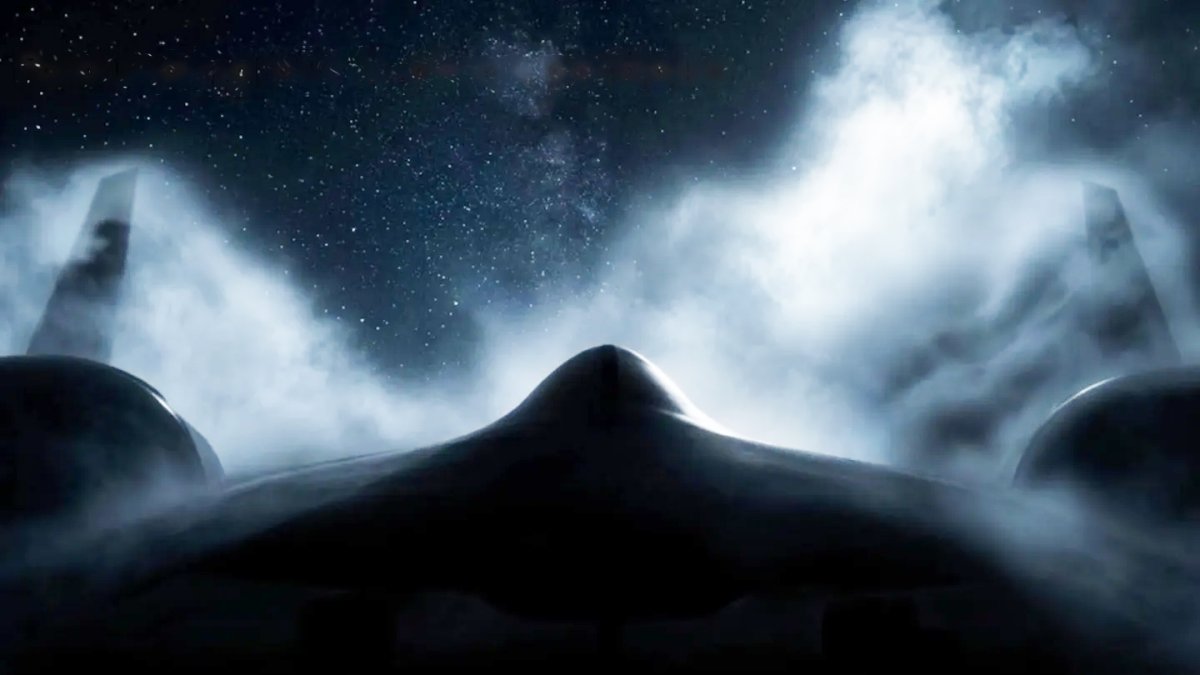
NASA Administrator Jared Isaacman has left something of a mystery hanging in the air after showing the silhouette of an aircraft that immediately drew comparisons to the famed SR-71 Blackbird during a recent speech. Isaacman pushed back on a direct link to the SR-71, but said his agency is working hard to get “back in the business of flying high and fast again.”
The silhouette, accompanied by the tagline “Rebuilding our X-plane portfolio,” was among the backdrops for Isaacman’s remarks at the annual All-In Summit in Los Angeles, California, last week.
The SR-71’s iconic shape is defined by its long, sword-like profile, pronounced chines, and deeply swept wings, and huge spiked engine nacelles with canted fins on top. Its distinctive geometry is reflected in the silhouette, which shows a broad, highly blended aircraft from an unusual head-on angle.
NASA Administrator Jared Isaacman talks at the All-In Summit about new high- and fast-flying X-planes with the eye-catching aircraft silhouette in the background. All-In Summit/YouTube screencap
“In the service of the first A [aeronautics] in NASA, we are rebuilding our X-plane fleet. The X-59 is researching quiet supersonic flight, but it’s just the beginning,” the head of NASA told attendees. “As NASA recommits to flight test and works alongside industry to push the boundaries of airframe and propulsion design, it will not be long before NASA once again is flying as high and as fast as we had in decades past, and then even more.”
Isaacman’s full speech at the All-In Summit, as well as his remarks during a live interview that followed immediately afterward, are contained in the video below. The high-speed aircraft silhouette is first seen at around the 12:40-mark in the runtime, and is then further discussed at around the 28:39-mark.
Chamath Palihapitiya, co-host of the All-In Podcast and one of the hosts of the summit, asked Isaacman directly about the silhouette during the fireside chat after his speech.
“You showed a picture of the [SR-71] Blackbird up there,” Palihapitiya said at one point, before Isaacman interjected.
“You sure that’s a Blackbird?” Isaacman said.
“Well, ok. What was that picture you showed up there?” Palihapitiya asked.
“Like I said, NASA is getting back in the business of flying high and fast again,” Isaacman said in response, and declined to further elaborate.
Whether or not the silhouette reflects a real design that is in development now is unclear. TWZ has reached out to NASA for more information.
Though the Mach-3+-capable SR-71 is primarily remembered as a Cold War-era intelligence-gathering aircraft, NASA operated several Blackbirds in support of aeronautical research efforts for years. The agency was actually the last operator of the type, flying SR-71s until 1999.
Lockheed Martin openly pitched a successor to the SR-71, dubbed the SR-72, in the late 2010s . There was even talk of building a flying fighter jet-sized demonstrator to prove out key technologies.
A rendering of a notional SR-72. Lockheed Martin An artist’s conception of the proposed SR-72. Lockheed Martin
Discussion about the SR-72, or a further evolution of that concept , resurfaced in the early 2020s after Lockheed Martin helped craft a fictional hypersonic aircraft called Darkstar for the blockbuster movie Top Gun: Maverick .
Exactly where Lockheed’s SR-72 ambitions sit today is unclear. After talking constantly about the potential program for a number of years, it went silent , which could indicate the program had moved forward deep in classification.
NASA has worked with other supersonic and hypersonic X-planes in the past, as well. This includes reusable space planes, as well as aircraft designed to fly within the Earth’s atmosphere.
“I mean, that doesn’t seem like a space vehicle. It seems like an Earth-air vehicle,” All-In’s Palihapitiya noted during his chat with Isaacman about the silhouette he showed.
“Yeah. The first ‘A’ in NASA is our aeronautics portfolio,” Isaacman said in response, before highlighting a host of contributions his agency has made to advanced military and commercial developments over the years. “You know what I want to do? I want to get back to the radical airframe and engine designs like we were always supposed to do.”
As mentioned, Isaacman also highlighted the X-59 Quiet Supersonic Technology experimental test aircraft, or QueSST, at the summit, but made clear the goal is to go well beyond that design. The QueSST jet is the centerpiece of a program now to investigate technologies that could eventually enable commercial supersonic flight over land with a substantially reduced sonic boom.
The X-59 conducted its first supersonic test flight , reaching Mach 1.1, in June. NASA’s test program aims to eventually push the aircraft up to a speed of Mach 1.4. This is significantly below the record-breaking mark of approximately Mach 3.3 that the SR-71 clocked back in the mid-1970s , but it was never designed for extreme speed as testing its sonic signature was its primary goal.
NASA’s X-59 flies above the Mojave Desert in California on August 18, 2026. NASA/Jim Ross
As for bringing a Blackbird back into operation for high-speed testing, which is now at the forefront of military aeronautics ( and civilian to a lesser degree ) after decades of being sidelined, that would be a very challenging operation. The SR-71s are long retired and have been placed in museums and other display areas. While the Pentagon could technically claw some of them back from their ‘on loan’ status, reconstituting even one of them would be a major undertaking as the entire support ecosystem that once sustained them has been gone for decades. Still, having a Mach 3+ capable jet for testing would be a highly relevant tool in a new age of high-speed flight exploration.
On the other hand, building a new test aircraft that aims higher and faster than the SR-71, but may be based on its ‘DNA,’ is certainly possible. Such an aircraft could leverage material science, avionics, flight controls, and engines that are seven decades more modern than its progenitor. Technology demonstrators in this class could also already exist in the classified domain. NASA could possibly assume ownership of one after the Pentagon declassifies it, as well.
Regardless of how such an exotic aircraft is obtained, one of the biggest differentiating factors could be that a NASA aircraft is piloted by a human onboard, instead of it being a drone, but an uncrewed aircraft is possible too.
A NASA SR-71 taxis at Dryden Flight Research Center during its late operational phase. NASA
Isaacman has been very open about its interest in and support for new X-plane developments . On only his second day on the job, in December of last year, he called for revamping the agency’s aeronautics program and stated that “I’d love to see an expanded X-plane portfolio” during a town hall with NASA staff.
“If NASA has a healthy X-plane portfolio, we should be flying experimental aircraft so routinely that the second flight of a single X-plane is not newsworthy,” he wrote in a post on X in March of this year. “For example, the two NASA X-29 aircraft flew 422 flights between 1984 and 1991. That period also overlapped with the development of two X-31 aircraft , which together flew about 580 times.”
One of the X-29 X-planes, at left, and the X-31, at right. NASA/DARPA
NASA’s proposed FY2027 budget also spelled out rapid, cost-effective flight experimentation as an explicit priority . Budget documents specifically highlight work toward new advances in supersonic and hypersonic flight technologies “that will revolutionize air transportation, strengthen national security capabilities, and position America to lead the future of high-speed flight,” as well.
Furthremore, in April, NASA outlined a new Aeronautics Flight Accelerator (AFA) initiative . At that time the agency put out a call for “input on technologies, concepts, and flight test campaigns suitable for cost shared maturation leading to flight within the next three years.” Stated areas of interest included “subsonic (including vertical lift), supersonic, and hypersonic flight technologies.”
It is important to reiterate that we still do not know whether the silhouette Isaacman showed at the All-In Summit represents an active development effort and, if so, how mature it might be. Government agencies and contractors routinely use concept art to illustrate an area of research or communicate a future vision. Such artwork does not necessarily correspond to a funded aircraft, an active prototype, or even a specific configuration.
At the same time, under Isaacman, NASA is clearly pushing toward new X-planes. NASA’s X-plane programs have historically served as a way to investigate technologies that conventional aircraft programs were not prepared to risk. The resulting aircraft have explored everything from supersonic and hypersonic flight to unconventional configurations and new propulsion concepts.
At the very least, evoking the visual legacy of the SR-71 Blackbird, coupled with Isaacman’s comments, provides a clear indication that NASA is interested in returning to the high-speed flight regime as part of its future plans.
Contact the author: thomas@thewarzone.com
Comments couldn’t be loaded. Please refresh the page.
作者:托马斯·纽迪克、泰勒·罗戈威
发布于美国东部时间2026年9月23日上午11:33
美国国家航空航天局(NASA)局长贾里德·艾萨克曼在最近的一次演讲中展示了一架飞机的轮廓,这架飞机立刻让人联想到著名的SR-71“黑鸟”侦察机,留下了一个谜团。艾萨克曼否认了这架飞机与SR-71的直接联系,但他表示,NASA正在努力“重返高空高速飞行”。
上周,在加利福尼亚州洛杉矶举行的年度 All-In 峰会上,艾萨克曼发表讲话时,背景中就出现了这幅剪影,并配有“重建我们的 X 型飞机产品组合”的标语。
SR-71标志性的外形特征在于其修长的剑形轮廓、突出的机腰、深后掠翼以及顶部带有倾斜尾翼的巨大尖刺状发动机舱。其独特的几何形状体现在其轮廓上,从一个不寻常的正面角度看,它展现出一架宽阔且高度融合的飞机。
美国国家航空航天局(NASA)局长贾里德·艾萨克曼在“全民参与峰会”(All-In Summit)上谈论新型高空高速X系列飞机,背景中引人注目的飞机轮廓清晰可见。(All-In Summit/YouTube截图)
“为了服务于NASA的首要任务——航空,我们正在重建X系列飞机机队。X-59正在研究静音超音速飞行,但这仅仅是个开始,”NASA负责人告诉与会者。“随着NASA重新致力于飞行测试,并与业界携手突破机身和推进系统设计的极限,NASA很快就能再次像几十年前那样,甚至超越以往的高度和速度。”
艾萨克曼在“全民峰会”上的完整演讲,以及随后立即进行的现场采访内容,都包含在以下视频中。高速飞行器的轮廓最早出现在视频约12分40秒处,并在约28分39秒处进行了进一步讨论。
《All-In Podcast》的联合主持人兼峰会主持人之一的查马斯·帕里哈皮蒂亚在艾萨克曼演讲后的炉边谈话中直接询问了他关于剪影的问题。
“你刚才展示了一张 [SR-71] 黑鸟的照片,”帕利哈皮蒂亚说道,这时艾萨克曼插话道。
“你确定那是只黑鸟吗?”艾萨克曼问道。
“好吧。你刚才展示的那张照片是什么?”帕利哈皮蒂亚问道。
“正如我所说,NASA 又要开始高速飞行了,”艾萨克曼回应道,并拒绝进一步详细说明。
目前尚不清楚该轮廓是否反映了正在开发中的真实设计。TWZ已联系NASA以获取更多信息。
尽管SR-71“黑鸟”侦察机凭借其3马赫以上的飞行能力,主要被人们铭记为冷战时期的情报搜集飞机,但美国国家航空航天局(NASA)也曾运营多架“黑鸟”侦察机,用于支持航空研究工作多年。事实上,NASA是该机型的最后一个运营商,一直运营SR-71直到1999年。
洛克希德·马丁公司在2010年代后期公开推介了SR-71的后继机型SR-72。甚至有传言说要建造一架战斗机大小的飞行验证机来验证关键技术。
SR-72概念图。洛克希德·马丁公司。艺术家对SR-72概念设计的构想图。洛克希德·马丁公司
2020 年代初,洛克希德·马丁公司帮助打造了一部名为“暗星”的虚构高超音速飞机,用于热门电影《壮志凌云:独行侠》,之后,关于 SR-72 或其进一步发展形式的讨论再次浮出水面。
洛克希德公司SR-72项目的现状目前尚不明朗。该公司曾多次谈及该项目,但之后却突然偃旗息鼓,这可能意味着该项目已进入高度机密状态。
美国宇航局过去也曾与其他超音速和高超音速X系列飞机合作过。这其中包括可重复使用的航天飞机,以及设计用于在地球大气层内飞行的飞机。
“我的意思是,那看起来不像是太空飞行器。它看起来像是地空飞行器,”All-In 公司的 Palihapitiya 在与 Isaacman 讨论他展示的轮廓时指出。
“没错。NASA 的第一个‘A’代表的是我们的航空业务,”艾萨克曼回应道,随后他重点介绍了NASA多年来在先进军事和商业发展方面做出的诸多贡献。“你知道我想做什么吗?我想回归到我们一直以来应该做的那种激进的机身和发动机设计。”
正如前文所述,艾萨克曼在峰会上重点介绍了X-59静音超音速技术实验测试飞机(QueSST),但他明确表示,目标远不止于此。QueSST喷气式飞机是目前一项旨在研究相关技术的核心项目,这些技术最终有望实现陆地商业超音速飞行,并大幅降低音爆。
X-59于6月进行了首次超音速试飞,速度达到1.1马赫。NASA的测试计划旨在最终将该飞机的速度提升至1.4马赫。这远低于SR-71在20世纪70年代中期创下的约3.3马赫的纪录,但SR-71的设计初衷并非追求极致速度,其主要目标是测试其音速特征。
2026年8月18日,NASA的X-59飞行器飞越加利福尼亚州莫哈韦沙漠上空。NASA/吉姆·罗斯
至于让黑鸟侦察机重新投入高速飞行测试,这项如今已成为军事航空(以及在较小程度上,民用航空)前沿领域的一项艰巨任务,此前它已被搁置数十年。SR-71侦察机早已退役,并被安置在博物馆和其他展览场所。虽然五角大楼理论上可以从“借用”状态中收回部分飞机,但即便重建其中一架也是一项浩大的工程,因为曾经支撑它们的整个支持体系早已不复存在数十年。然而,拥有一架能够以3马赫以上速度飞行的喷气式飞机进行测试,在高速飞行探索的新时代将是一项极其重要的工具。
另一方面,建造一架目标更高、速度更快的新型测试飞机,其设计可能基于SR-71的“基因”,这当然是可能的。这样的飞机可以利用比其前身先进七十年的材料科学、航空电子设备、飞行控制系统和发动机。此类技术验证机可能已经存在于机密领域。五角大楼解密后,NASA或许也会拥有一架。
无论这种奇特的飞机是如何获得的,最大的区别因素之一可能是,NASA 的飞机是由机上人员驾驶的,而不是无人机,但无人驾驶飞机也是有可能的。
一架NASA SR-71侦察机在德莱顿飞行研究中心滑行,此时正处于其运行后期阶段。
艾萨克曼一直公开表示对新型X飞机研发项目的兴趣和支持。去年12月,他上任仅第二天,就在与NASA员工举行的一次市政厅会议上呼吁改革该机构的航空项目,并表示“我非常希望看到X飞机项目组合的扩大”。
“如果NASA拥有健康的X系列飞机项目组合,那么我们应该能够非常频繁地进行实验性飞机的飞行,以至于单架X系列飞机的第二次飞行都不算新闻,”他在今年3月发表于X杂志的一篇文章中写道。“例如,NASA的两架X-29飞机在1984年至1991年间共飞行了422次。这一时期也恰逢两架X-31飞机的研发,这两架飞机总共飞行了约580次。”
左图为X-29 X系列飞机,右图为X-31。图片来源:NASA/DARPA
美国国家航空航天局(NASA)提出的2027财年预算也明确将快速、经济高效的飞行试验列为优先事项。预算文件特别强调了在超音速和高超音速飞行技术方面取得新进展的工作,“这将彻底改变航空运输,增强国家安全能力,并使美国在未来高速飞行领域占据领先地位”。
此外,今年4月,NASA概述了一项新的航空飞行加速器(AFA)计划。当时,该机构发出征集意见,希望“就适合成本分摊的成熟技术、概念和飞行测试方案征求意见,以便在未来三年内实现飞行”。其感兴趣的领域包括“亚音速(包括垂直升力)、超音速和高超音速飞行技术”。
需要重申的是,我们目前仍不清楚艾萨克曼在“全员参与峰会”上展示的轮廓图是否代表着一项正在积极研发的项目,如果是,其成熟度如何。政府机构和承包商经常使用概念图来展示研究领域或传达未来愿景。此类概念图并不一定对应于已获资助的飞机、正在研发的原型机,甚至不一定对应于具体的配置。
与此同时,在艾萨克曼的领导下,NASA 显然正在大力推进新型 X 型飞机项目。NASA 的 X 型飞机项目历来都是为了探索传统飞机项目不愿冒险尝试的技术。这些飞机探索了从超音速和高超音速飞行到非常规构型和新型推进概念等方方面面。
至少,唤起 SR-71 黑鸟的视觉遗产,再加上艾萨克曼的评论,清楚地表明 NASA 有兴趣将高速飞行纳入其未来的计划。
联系作者:thomas@thewarzone.com
评论加载失败,请刷新页面。