Where Are The Aircraft Carriers?: September 23, 2026航空母舰在哪里?:2026年9月23日
USS Abraham Lincoln spent its first day on American soil after 307 days into a marathon deployment, approaching the record set by USS Gerald R. Ford.
新闻视频
Published Sep 23, 2026 3:14 PM EDT
The crew of the USS Abraham Lincoln touched American soil for the first time in nine months, when the strike group pulled into Apra Harbor, Guam, for a brief logistics stop and on-base liberty. The supercarrier, alongside guided-missile destroyer USS Frank E. Petersen Jr. , arrived on September 19 and left the next day. Lincoln is 307 days into her deployment, 19 short of the record set earlier this year by the USS Gerald R. Ford , and is now just weeks away from San Diego. Meanwhile, two flattops are on station in the Middle East supporting blockade operations, and the USS Ronald Reagan has rejoined the fleet after an extended maintenance availability.
Here’s TWZ’s weekly carrier tracker monitoring America’s flattop fleet, including deployed Carrier Strike Groups (CSG) and Amphibious Ready Groups (ARG), using publicly available open-source information. Check out our last report here .
Abraham Lincoln Departs Guam, Continuing Her Journey Home
The USS Abraham Lincoln is currently conducting routine operations at an undisclosed location in the U.S. 7th Fleet area of responsibility (AOR), presumably steaming east en route to her homeport at Naval Air Station North Island in San Diego. After leaving Thailand on September 6 following a five-day liberty port call , Lincoln topped off the Petersen Jr. in the Gulf of Thailand and linked up with two Royal Australian Navy frigates for joint training in the South China Sea. Publicly available flight tracking data shows the carrier transited the Balabac Strait eastbound around September 13, and the Surigao Strait northbound two days later to enter the Philippine Sea. After going dark for a few days, she resurfaced in Guam and moored at Kilo Wharf over the weekend.
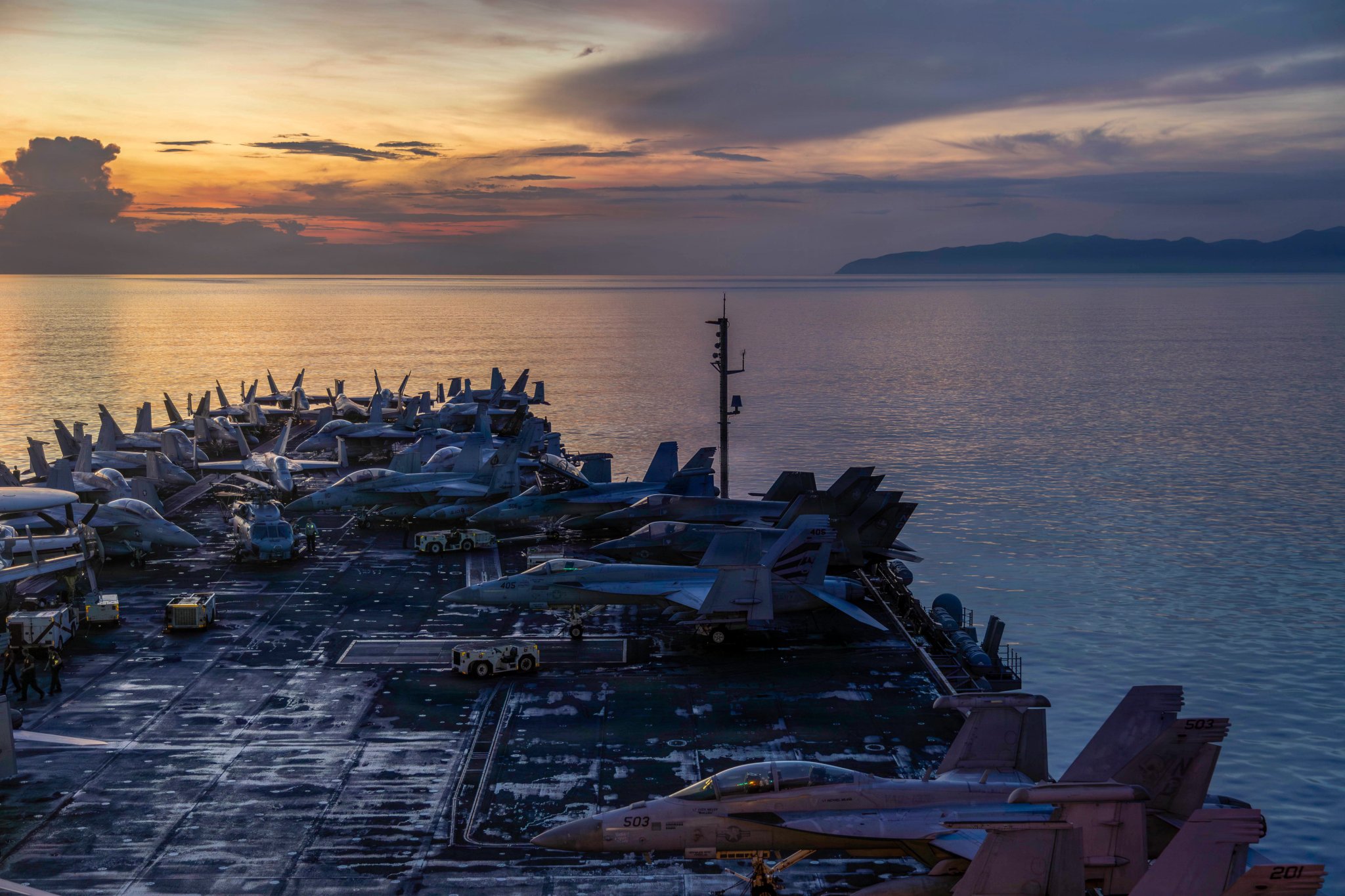
Lincoln transits the Philippine Sea. U.S. Navy photo
“Due to the brief nature of the logistics stop, the crew were afforded on-base liberty to access base services and attend a Navy Entertainment-sponsored concert,” CSG-3 spokesman Lt. Cmdr. Tyler Barker wrote in an email to Stars and Stripes . The carrier took on stores, mail, and equipment, according to Barker, and 13 Fleet and Family counselors are now aboard to run return-and-reunion classes but “the crew and ship remain focused and ready.”
USS Abraham Lincoln (CVN 72) arrives in Guam on Sept. 19, 2026. U.S. Navy photo
A homecoming date has not been announced publicly. Unless Lincoln makes another stop (in Hawaii, for example) or conducts additional training on the way, she should arrive in early October just shy of Ford’s record. The Chief of Naval Operations, Adm. Daryl Caudle, said in June that Lincoln would likely shift her homeport to Naval Base Kitsap-Bremerton in Washington state, which aligns with TWZ’s reporting that she is expected to begin a Drydocking Planned Incremental Availability (DPIA) after returning stateside. The timeline for the DPIA is unclear.
George Washington and George H.W. Bush Project Power In The Middle East
The American public got a rare look at ongoing combat operations aboard the USS George Washington when two reporters embarked earlier this month. Fox News’ Trey Yingst and CBS News’ Tom Hanson reported live from the flight deck, as F-35C Lightning IIs and F/A-18E/F Super Hornets launched behind them, in hits that aired September 11 to 14. The only other publicized media embark since the war began on February 28 went to CNN’s Pamela Brown, who reported on the conditions aboard the USS Abraham Lincoln while the flattop was still in theater.
An F-35C launches from Washington. U.S. Navy photo
A pair of Super Hornets on Washington. U.S. Navy photo
“Last weekend, the aircraft carrier came under Iranian missile attack; the first of three attacks on US warships in the last week alone,” Yingst said , indicating it was the USS George Washington , and not the USS George H.W. Bush , that was targeted by the Islamic Revolutionary Guard Corps (IRGC) in early September. The Navy declined to comment when TWZ asked which carrier was targeted after Iranian state media claimed the strike had been successful. “We’re pretty much employing all our capabilities right now,” Washington’s commanding officer (CO), Capt. Nicholas DeLeo, told Yingst.
Night flight ops aboard USS George Washington. U.S. Navy photos
“The GW is surrounded by four to five guided-missile destroyers at any moment,” Yingst also reported . He flew out to USS Shoup , positioned off the starboard side at the time, to make the point and speak with the warship’s CO. Shoup is the only destroyer officially confirmed to be part of CSG-5. “My ship is in charge of coordinating defense amongst the various other units, allocating defensive assets to it, be it potentially a missile to shoot something down or just aircraft to go identify and monitor the picture,” Capt. William Buford said. Based on that description, Shoup’s CO appears to be coordinating Integrated Air and Missile Defense (IAMD) for the strike group, a question we’ve been asking the Navy to confirm . TWZ understands additional destroyers operating in the U.S. Central Command (CENTCOM) AOR are also escorting Washington , but a U.S. official declined to say which ones.
Hanson asked DeLeo about the recent IRGC ballistic missile threat targeting Navy ships in the region. “We have a variety of ways to protect, both offensively and defensively, a Navy ship, and we employ all these methods,” he told the network. “It’s something that we train to.” Hanson also pressed the commander of CSG-5, Rear Adm. Jeff Heames, on whether he was concerned about the munitions stockpile, a dynamic TWZ detailed in a special feature yesterday. “Of course we’re concerned about the expenditure to some degree, but I have no concerns locally at my level here,” Heames replied.
Gun shoot aboard USS George Washington (CVN 73), Sept. 15, 2026. U.S. Navy video
In addition to Washington , Bush is still working the blockade from the Arabian Sea, nearly six months into her deployment. As of CENTCOM’s latest social media update on September 21, U.S. forces in the region had redirected 110 commercial vessels to ensure “total compliance” with the blockade. More than 50 ships “supporting humanitarian efforts” have been allowed through, according to the command. CENTCOM recently stopped publishing the number of ships boarded, seized, or disabled kinetically.
An MH-60S Sea Hawk lifts cargo from the flight deck of USS George H.W. Bush, Sept. 18, 2026. U.S. Navy photo
Ronald Reagan Rejoins the Fleet
The USS Ronald Reagan is officially back. The Navy, in a recent statement , confirmed the flattop “returned to the fleet capable and mission-ready.” The carrier had been out of action since March 2025 for a DPIA at Puget Sound Naval Shipyard in Washington state and completed four days of sea trials in early September. While the Navy does not comment on upcoming deployments due to operational security, current speculation points to a spring 2027 deployment, but that is not confirmed.
Counter measure wash down on USS Ronald Reagan in the Pacific Ocean on Sept. 6, 2026. U.S. Navy photo
Reagan is the only carrier currently homeported at Naval Base Kitsap-Bremerton in Washington. Previously, she was America’s only forward-deployed carrier based in Yokosuka, Japan, until swapping hulls with the USS George Washington in 2024. USS Nimitz was stationed at Naval Base Kitsap-Bremerton before circumnavigating South America to Naval Station Norfolk this summer, where she is being used primarily for training before deactivation in 2027. The yet-to-be-commissioned PCU John F. Kennedy , the second and newest Ford class supercarrier, is slated to homeport in Washington state no earlier than 2029 .
U.S. Navy Big Deck Fleet At A Glance
Overall, three U.S. carriers are deployed (with one heading home), one is preparing to deploy in the near term, three are working up in various states of readiness, three are in current or upcoming maintenance, and one is being used primarily for training before deactivation next year. One amphibious ready group is deployed, one is forward-stationed and in port, four are working up or in port, and three are in maintenance.
Note: Positions are general approximations. Non-deployed LHA/LHD amphibious warships are not shown.
Contact the author: ian.ellis-jones@recurrent.io or @ianellisjones
Comments couldn’t be loaded. Please refresh the page.
发布于美国东部时间2026年9月23日下午3:14
“亚伯拉罕·林肯”号航空母舰的官兵们九个月来首次踏上美国本土。该航母打击群停靠关岛阿普拉港,进行短暂的后勤补给和基地内休假。这艘超级航母与导弹驱逐舰“弗兰克·E·彼得森”号于9月19日抵达,次日离开。“林肯”号已部署307天,比今年早些时候“杰拉尔德·R·福特”号创下的纪录少了19天,距离圣地亚哥仅几周之遥。与此同时,两艘航母在中东执行封锁任务,“罗纳德·里根”号航空母舰在完成长期维护后已重新加入舰队。
以下是TWZ每周发布的航母追踪报告,监测美国航母舰队,包括已部署的航母打击群(CSG)和两栖戒备群(ARG),数据来源于公开的开源信息。点击此处查看我们上一份报告。
亚伯拉罕·林肯号离开关岛,继续返乡之旅
“亚伯拉罕·林肯”号航空母舰目前正在美国第七舰队责任区内一处未公开地点进行例行作业,据推测正向东航行,返回位于圣地亚哥北岛海军航空站的母港。9月6日,“林肯”号结束了为期五天的泰国港访问后离开泰国,随后在泰国湾为“彼得森二世”号补给站加满油,并与两艘澳大利亚皇家海军护卫舰在南海进行联合训练。公开的飞行跟踪数据显示,该航母于9月13日左右向东穿越巴拉巴克海峡,两天后向北穿越苏里高海峡进入菲律宾海。在与外界失去联系数日后,该舰于周末在关岛重新出现,并停泊在基洛码头。
林肯号穿越菲律宾海。美国海军照片
“由于此次后勤补给停留时间短暂,舰员们获准在基地内自由活动,可以使用基地服务并参加由海军娱乐部门赞助的音乐会,”第三航母战斗群发言人泰勒·巴克中校在给《星条旗报》的电子邮件中写道。巴克表示,航母补充了物资、邮件和设备,目前有13名舰队和家庭辅导员登舰,为返乡和团聚人员开设课程,但“舰员和舰艇仍然保持专注,随时准备就绪”。
2026年9月19日,美国海军“亚伯拉罕·林肯”号航空母舰(CVN 72)抵达关岛。(美国海军照片)
林肯号航母的返航日期尚未公开。除非途中经停其他地点(例如夏威夷)或进行额外训练,否则她将于10月初抵达,略晚于福特号航母的航程纪录。海军作战部长达里尔·考德尔海军上将在6月份表示,林肯号航母的母港可能会转移到华盛顿州的基萨普-布雷默顿海军基地,这与TWZ的报道相符,即林肯号返回美国本土后预计将开始干船坞计划增量可用性(DPIA)维护。DPIA的具体时间表尚不明确。
乔治·华盛顿和乔治·H·W·布什在中东建立权力体系
本月初,两名记者登上“乔治·华盛顿”号航空母舰,让美国公众得以罕见地一窥舰上正在进行的作战行动。福克斯新闻的特雷·英斯特和哥伦比亚广播公司新闻的汤姆·汉森在飞行甲板上进行了现场报道,F-35C“闪电II”战斗机和F/A-18E/F“超级大黄蜂”战斗机在他们身后起飞,相关报道于9月11日至14日播出。自2月28日战争爆发以来,唯一一次媒体公开登舰报道是CNN记者帕梅拉·布朗,她当时报道了仍在战区的“亚伯拉罕·林肯”号航空母舰上的情况。
一架F-35C战斗机从华盛顿起飞。(美国海军照片)
两架超级大黄蜂战斗机停在华盛顿街上。美国海军照片
“上周末,这艘航空母舰遭到伊朗导弹袭击;仅上周,美国军舰就遭到三次袭击,”英斯特说道,他指出,9月初被伊朗伊斯兰革命卫队(IRGC)袭击的并非“乔治·H·W·布什”号航母,而是“乔治·华盛顿”号。在伊朗国家媒体宣称袭击成功后,当TWZ询问究竟是哪艘航母遭到袭击时,海军拒绝置评。“我们现在几乎动用了所有能力,” “华盛顿”号舰长尼古拉斯·德莱奥上校告诉英斯特。
美国海军“乔治·华盛顿”号航空母舰上的夜间飞行作业。美国海军照片
“华盛顿号航母随时都有四到五艘导弹驱逐舰包围着它,”英斯特还报道说。他飞往当时位于航母右舷的“舒普”号驱逐舰,向舰长说明了情况并与其进行了交谈。“舒普”号是目前唯一被官方确认隶属于第五航母打击群(CSG-5)的驱逐舰。“我的舰艇负责协调各舰艇之间的防御,并为其分配防御资源,无论是用于击落目标的导弹,还是用于识别和监视目标的飞机,”威廉·布福德上校说道。根据这一描述,“舒普”号的舰长似乎正在协调该打击群的综合防空反导(IAMD)任务,我们一直在向海军询问此事,希望得到证实。据TWZ了解,还有其他在美国中央司令部责任区(CENTCOM AOR)内执行任务的驱逐舰也在为“华盛顿”号护航,但一位美国官员拒绝透露具体是哪些驱逐舰。
汉森就伊朗伊斯兰革命卫队近期针对该地区海军舰艇的弹道导弹威胁询问了德利奥。“我们有多种方式保护海军舰艇,包括进攻和防御,而且我们都会运用这些方法,”他告诉记者,“这是我们训练的内容。”汉森还追问了第五航母战斗群(CSG-5)指挥官杰夫·希姆斯少将,他是否担心弹药储备,昨天的一篇专题报道详细介绍了动态的战术武器区(TWZ)。“当然,我们在一定程度上会关注军费开支,但就我目前的级别而言,我并不担心,”希姆斯回答说。
2026年9月15日,乔治·华盛顿号航空母舰(CVN 73)进行实弹射击。美国海军视频
除了华盛顿之外,布什号航母在阿拉伯海的封锁行动仍在进行,该航母已部署近六个月。根据中央司令部9月21日发布的最新社交媒体消息,该地区的美国部队已调转110艘商船的航向,以确保“完全遵守”封锁。据司令部称,已有50多艘“支持人道主义行动”的船只获准通行。中央司令部最近停止公布被登船、扣押或以武力瘫痪的船只数量。
2026年9月18日,一架MH-60S“海鹰”直升机从“乔治·H·W·布什”号航空母舰的飞行甲板上吊运货物。(美国海军照片)
罗纳德·里根重返舰队
“罗纳德·里根”号航空母舰正式回归。美国海军近日发表声明,确认这艘航母“已恢复作战能力并做好任务准备”。该航母自2025年3月起在华盛顿州普吉特海湾海军造船厂进行防务维护检修(DPIA),并于9月初完成了为期四天的海上试航。虽然出于作战安全考虑,海军不对即将到来的部署发表评论,但目前有猜测认为该航母将于2027年春季部署,但尚未得到证实。
2026年9月6日,太平洋上的“罗纳德·里根”号航空母舰正在进行反制措施清洗。美国海军照片
“里根”号是目前唯一以华盛顿州基萨普-布雷默顿海军基地为母港的航母。此前,她是美国唯一一艘前沿部署的航母,驻扎在日本横须贺,直到2024年与“乔治·华盛顿”号交换了船体。“尼米兹”号航母此前驻扎在基萨普-布雷默顿海军基地,今年夏天环绕南美洲航行至诺福克海军基地,在那里主要用于训练,预计将于2027年退役。尚未服役的“约翰·F·肯尼迪”号(PCU)是第二艘也是最新的福特级超级航母,预计最早也要到2029年才会以华盛顿州为母港。
美国海军大型甲板舰队概览
总体而言,美国目前部署了三艘航母(其中一艘正在返航),一艘正在准备近期部署,三艘正在进行不同程度的战备训练,三艘正在进行或即将进行维护,还有一艘主要用于训练,将于明年退役。此外,美国还部署了一个两栖戒备群,一个两栖戒备群前沿部署在港口,四个两栖戒备群正在进行战备训练或在港口,三个两栖戒备群正在进行维护。
注:位置均为大致估计。未部署的LHA/LHD两栖攻击舰未显示。
联系作者:ian.ellis-jones@recurrent.io 或 @ianellisjones
评论加载失败,请刷新页面。