EXCLUSIVE: SpaceX given unique access to classified DoD space tracking data, sources say独家消息:消息人士称,SpaceX获得了获取美国国防部机密太空跟踪数据的独特权限
Commercial space monitoring firms are concerned SpaceX's ability to use the best DoD data could threaten the market, sources tell Breaking Defense.
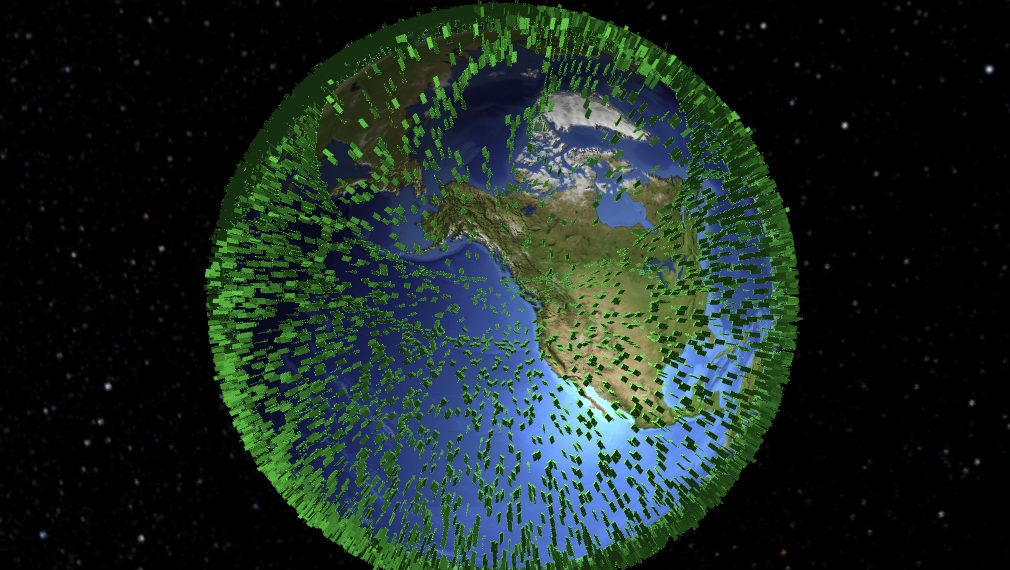
Snapshot of the some 11,000 Starlink satellites on orbit as of Sept. 21, 2026 using LeoLab's free online tool for visualizing objects in low Earth orbit. (Screenshot from LeoLab's visualization tool)
WASHINGTON — In an unprecedented move, the Defense Department has agreed to give SpaceX exclusive access to the government’s most classified space tracking data, according to a dozen government and industry sources.
One of the sources, a Space Force official, told Breaking Defense a “contractual agreement” has been signed between SpaceX and the Space Force’s Joint Commercial Operations Cell (JCO) , trading company access to US Space Command’s (SPACECOM) most detailed version of its High Accuracy Catalog (HAC) of on-orbit objects in exchange for SpaceX giving the JCO data from its Stargaze star-tracking cameras.
It’s unclear when the arrangement began, but in recent days it has sparked concern in the US space tracking industry, sources said. Even though the Space Force official said the high-fidelity information has been provided to SpaceX only for “internal use”, industry and government sources told Breaking Defense it is not clear whether that data is permitted to play a background role in honing the accuracy of products and analysis SpaceX provides to non-military space operators — potentially undercutting the market.
Barbara Golf, head of JCO, referred a question from Breaking Defense to Space Force Space Systems Command, which oversees JCO acquisition. Neither the Space Force nor SpaceX responded to multiple inquiries about the deal.
Jon Herman, SpaceX senior director for Starlink constellation engineering, was asked directly about the purported deal, the data’s value to the company, and its terms of use during a panel at the Advanced Maui Optical and Space Surveillance Technologies (AMOS) Conference in Hawaii last week. In response, he did not address the deal specifically, but explained why the data is helpful.
SpaceX’s Starlink satellites, he said, are “bad at seeing the small stuff,” and therefore “radar data is an extremely valuable tool to supplement Stargaze.”
The Purpose Of Stargazing
A new era of uncrewed airpower: GA-ASI’s lineup for high-tech warfare
GA-ASI is serious about retaining its position as the leading provider of UAS to the United States and its allies.
Star trackers like those used by Stargaze can provide valuable capabilities as they are used to determine a spacecraft’s orientation in three-dimensional space (known as attitude), and are especially important for precisely aiming on-board cameras and intersatellite laser links.
But they also can be used to detect and characterize satellites and space debris, meaning Stargaze, even if its free tracking service is based only on the observations of its own cameras, is at a minimum a market perturbator.
Stargaze currently uses about 30,000 star-tracking cameras mounted on Starlink satellites — SpaceX’s broadband communications network — to keep tabs on the heavens in low Earth orbit (LEO), according to Herman.
“We detect objects that are down to about a meter/half a meter in size, which means that we can see more than 80 percent of the Space Force catalog that is below 600 kilometers (about 373 miles),” he told the AMOS conference on Sept. 17.
Most current military and commercial radar and telescopes based on the ground, meanwhile, can see and routinely track objects down to about 10 centimeters in LEO. But while Stargaze’s resolution is not as good for small things as that offered by other providers of LEO space tracking information, Herman said the advantage is in the fact that the cameras can take “tens to hundreds” of pictures of an object in a given period of time — which allows better tracking over time of an object’s orbital path.
The star-tracker observations are entered into a database that catalogs objects seen, and then processed to create a picture of what is in space where and when. For SpaceX, this allows it to keep its roughly 11,000 Starlink and Starshield satellites safe from collisions.
That Stargaze catalog of space objects itself is not shared publicly, or with other operators who agree to share the whereabouts of their own satellites in exchange for services, Herman said. Rather, he said, those participating operators will receive products and services, such as information about potential collisions — known in space industry parlance as conjunctions — derived from it.
“The way this works is you send us your [emphemeris], and then we screen you against every Starlink trajectory as well as the entire Stargate catalog,” he said. “You’ll see all these scary things that we see in Stargaze.”
There are about 100 operators currently “onboarded” with Stargaze, Herman added.
For JCO, access to the Stargaze tracking data could improve the fidelity of fused commercial space surveillance data available via the Unified Data Library .
SPACECOM specialists are responsible for monitoring the heavens, with particular eye toward adversary satellites. They also are responsible at the moment for providing warnings of close approaches and possible collisions to all satellite operators.
They do this by generating three types of space object database reports, each with a varying level of accuracy, for plotting the trajectories of on-orbit objects, according to public information and industry sources . The catalogs use observational data about satellites and space debris gleaned by the Space Surveillance Network (SSN) of radars and telescopes around the world, but are created using different methodologies.
The public version, contained on the Space-Track.org website with explanatory information accessible to anyone, includes what are known as two-line elements (TLEs) showing a snapshot of a space object’s position and velocity at a certain time. How often those snapshots are provided various from object to object, and this is the least precise of the three report types.
A second version is called the Special Perturbations-High Accuracy Catalog (SP-HAC), which uses a higher fidelity mathematical model to predict a space object’s trajectory. It is not public, but industry officials explained that access is provided to those companies and foreign governments that sign a sharing agreement with SPACECOM. SPACECOM also bases the Conjunction Data Messages it provides for free to US and foreign satellite operators warning them of potential close approaches to other space objects on the SP-HAC, according to explanatory information on the Space-Track.org website.
The third and most precise version of the HAC is embodied in what are called Vector Covariance Messages (VCMs), industry sources said, which in addition to being based on SP-HAC’s high-fidelity mathematical model also include volumetric margin of error bubbles, called covariances, that allow more precise plotting of potential collisions. In the past, those error bubbles have been classified and largely kept for internal military use, in order to ensure against reverse engineering of the SSN sensors’ capabilities.
According to the industry sources, while some commercial entities have been given limited access to VCM data in the past, no other firm besides SpaceX has been given routine access to VCM and the error bubbles for non-government uses. (After a long negotiation , the Pentagon also shares the covariances with the Commerce Department for its troubled Traffic Coordination System for Space program.)
The JCO-SpaceX agreement, the Space Force official said, does contain certain restrictions on use of the data.
“We do have stipulations on it that they’re not allowed to use that for any sort of commercial gain or benefit. It’s only for their internal use,” the official said on the condition of anonymity.
This implies that SpaceX is permitted to integrate the VCM-type tracking and covariance data into its Stargaze catalog to plot safe maneuvers for its own satellites.
Herman said the Starlink satellites perform “20,000 maneuvers every single day.” He added that 1,000 of those daily maneuvers are to avoid collisions, “so the majority is either station keeping or orbit transfer.” The “collision avoidance burns are overwhelmingly for non-Starlink objects,” he added.
Several industry analysts said that if SpaceX is using the covariance data only for ensuring the safety of Starlink/Starshield satellites, that is to be welcomed for space safety reasons since the SpaceX satellites make up more than half of the traffic in LEO.
However, industry sources said, since SpaceX provides Stargaze services to others for free, there’s lingering concern over what restrictions based on terms like “commercial benefit” might mean practically and whether the “internal use”-only data could influence the Stargaze services. In other words, industry officials said they are worried that if Stargaze is using an integrated catalog, SpaceX may well siphon off customers from other space tracking providers who cannot provide the same level of accuracy about LEO space traffic even for a price.
Since the terms of the agreement with the JCO have so far been kept secret, there is widespread worst-case speculation.
And of course, the more satellite operators provide their data to Stargaze, the more accurate its tracking capabilities become — further undermining for-profit providers.
No sources were able to point to evidence the deal has influenced Stargaze products, but industry reps fret that if it did, it could lead to a feedback loop: Stargaze, a free service owned by the world’s richest man and armed with the covariance data, becomes the killer app for LEO tracking that everyone signs up to, driving competitors out of business while continuously improving its own data set. And, in a doomsday scenario envisioned by several sources, once the competitors are out of business, Stargaze could in theory then turn around and start charging once it is a monopoly.
“It’s very very hard to compete with free when you have costs,” Audrey Schaffer, senior vice president for global policy and government strategy at Slingshot Aerospace, told the AMOS conference on Sept. 17. This applies, she said, whether it’s data provided by government agencies or by free private services like Stargaze.
Some industry and government sources also fretted that Starga ze ― despite its current shortcomings — could become viewed as a private substitute for TraCSS, which would wipe out another potential source of revenue for current space tracking firms. (However, Stargaze currently only looks at LEO, while TraCCS covers other orbits as well.)
“It absolutely is gives SpaceX an unfair market advantage,” one industry analyst alleged.
Perhaps adding fuel to industry concerns is an in-depth analysis by Quilty Space published Aug. 28 that shows that the Pentagon’s Defense Advanced Research Project Agency (DARPA) provided $107.7 million in contracts to SpaceX for work leading to Stargaze under a program called Space-WATCH.
DARPA launched Space-WATCH, for Space-domain Wide Area Tracking and Characterization, in 2023, and Quilty said that as of now, “SpaceX is the only known supplier.”
这是截至2026年9月21日,约11000颗星链卫星在轨运行的快照,该快照使用了LeoLab的免费在线工具来可视化近地轨道物体。(截图来自LeoLab的可视化工具)
华盛顿——据十几位政府和行业消息人士透露,美国国防部采取了一项史无前例的举措,同意给予 SpaceX 公司独家访问政府最高机密太空跟踪数据的权限。
其中一位消息人士,一位太空军官员告诉《防务新闻》,SpaceX 与太空军联合商业运营中心 (JCO) 签署了一项“合同协议”,SpaceX 将获得美国太空司令部 (SPACECOM) 最详细的在轨物体高精度目录 (HAC) 的访问权限,以换取 SpaceX 向 JCO 提供其 Stargaze 星空追踪相机的数据。
消息人士称,目前尚不清楚这项安排何时开始,但近几日已引发美国太空追踪行业的担忧。尽管美国太空军官员表示,提供给SpaceX的高精度信息仅供“内部使用”,但业内人士和政府消息人士告诉《防务新闻》,目前尚不清楚这些数据是否被允许在SpaceX向非军事航天运营商提供的产品和分析的准确性提升过程中发挥辅助作用——这可能会损害市场竞争。
JCO负责人芭芭拉·戈尔夫将《防务新闻》的提问转给了负责JCO采购的太空军太空系统司令部。太空军和SpaceX均未回应关于这笔交易的多次问询。
上周在夏威夷举行的先进毛伊岛光学和空间监视技术(AMOS)会议上,SpaceX星链星座工程高级总监乔恩·赫尔曼在一次小组讨论中被直接问及所谓的交易、数据对公司的价值以及使用条款。对此,他并未具体回应交易本身,而是解释了这些数据为何有用。
他说,SpaceX 的星链卫星“不擅长观测小物体”,因此“雷达数据是补充 Stargaze 的极其宝贵的工具”。
观星的目的
无人空中力量的新时代:通用航空系统公司(GA-ASI)的高科技战争产品阵容
通用航空系统公司 (GA-ASI) 非常重视保持其作为美国及其盟国领先的无人机系统供应商的地位。
像 Stargaze 使用的那种星跟踪器可以提供宝贵的功能,因为它们用于确定航天器在三维空间中的方向(称为姿态),对于精确瞄准机载相机和星间激光链路尤其重要。
但它们也可以用来探测和识别卫星和太空碎片,这意味着 Stargaze 即使其免费跟踪服务仅基于其自身相机的观测结果,至少也是一个市场扰乱者。
据赫尔曼称,Stargaze 目前使用安装在 Starlink 卫星(SpaceX 的宽带通信网络)上的约 30,000 台星空跟踪相机,以监视近地轨道 (LEO) 上的天体。
“我们探测到的物体尺寸小至大约一米/半米,这意味着我们可以看到太空部队目录中 80% 以上的低于 600 公里(约 373 英里)的目标,”他在 9 月 17 日的 AMOS 会议上说道。
目前大多数地面军用和商用雷达及望远镜都能观测并追踪近地轨道上小至约10厘米的物体。但赫尔曼表示,虽然Stargaze的分辨率在观测小型目标方面不如其他近地轨道空间跟踪信息提供商,但其优势在于,其相机可以在给定时间内拍摄“数十到数百张”物体照片——这使得对物体轨道路径的长期跟踪更加精准。
星敏感器观测数据会被输入到一个数据库中,该数据库会对观测到的天体进行编目,然后进行处理,从而生成一幅太空天体分布图,展现其在特定时间和位置上的运行情况。对于SpaceX公司而言,这使得它能够保护其大约11000颗星链和星盾卫星免受碰撞。
赫尔曼表示,Stargaze的太空物体目录本身并不公开,也不会与其他运营商共享,即使他们同意共享各自卫星的位置信息以换取服务。相反,他说,参与的运营商将获得基于该目录的产品和服务,例如有关潜在碰撞(在航天领域被称为“交会”)的信息。
他说:“具体操作方法是,你把你的星历表发给我们,然后我们根据所有星链轨道以及整个星门目录对你的星历表进行比对。你会看到我们在星空观测中看到的那些可怕的东西。”
赫尔曼补充说,目前大约有 100 家运营商“加入”了 Stargaze 平台。
对于 JCO 而言,获取 Stargaze 跟踪数据可以提高通过统一数据库提供的融合商业空间监视数据的保真度。
太空司令部专家负责监测太空,尤其关注敌方卫星。目前,他们还负责向所有卫星运营商发出近距离接近和可能发生碰撞的预警。
根据公开信息和行业资料,他们通过生成三种不同精度的空间物体数据库报告来绘制在轨物体的轨迹。这些目录利用了由全球雷达和望远镜组成的空间监视网络(SSN)收集的卫星和空间碎片观测数据,但创建方法各不相同。
公开版本发布在Space-Track.org网站上,任何人都可以访问其中的解释性信息。该版本包含所谓的双线元素(TLE),用于显示太空物体在特定时刻的位置和速度快照。不同物体的快照提供频率各不相同,而且这是三种报告类型中精度最低的一种。
第二个版本称为“特殊扰动-高精度星表”(SP-HAC),它使用更高保真度的数学模型来预测空间物体的轨迹。该星表尚未公开,但业内人士解释说,与美国太空司令部(SPACECOM)签署共享协议的公司和外国政府可以获得访问权限。根据Space-Track.org网站上的说明信息,SPACECOM还基于SP-HAC,免费向美国和外国卫星运营商提供“交会数据消息”(Conjunction Data Messages),以警告他们可能与其他空间物体近距离接触。
据业内人士透露,第三版也是最精确的HAC版本体现在所谓的矢量协方差消息(VCM)中。VCM不仅基于SP-HAC的高保真数学模型,还包含称为协方差的体积误差范围,从而能够更精确地绘制潜在碰撞区域。过去,这些误差范围一直被列为机密,主要用于军方内部,以防止对SSN传感器的性能进行逆向工程。
据业内人士透露,虽然过去一些商业实体曾被有限地获取过VCM数据,但除SpaceX之外,没有其他公司被允许出于非政府用途常规获取VCM及其误差气泡数据。(经过漫长的谈判,五角大楼也与商务部共享协方差数据,用于其问题重重的太空交通协调系统项目。)
这位太空军官员表示,JCO-SpaceX协议确实对数据的使用包含某些限制。
“我们确实有相关规定,他们不得将这些信息用于任何商业获利或利益。这仅供他们内部使用,”这位不愿透露姓名的官员说道。
这意味着 SpaceX 可以把 VCM 类型的跟踪和协方差数据整合到其 Stargaze 目录中,以便为其自己的卫星绘制安全机动路线。
赫尔曼表示,星链卫星每天要进行“2万次机动”。他补充说,其中1000次机动是为了避免碰撞,“因此大部分机动都是维持轨道位置或进行轨道转移”。他还补充道,“这些避碰机动绝大多数是针对非星链目标进行的。”
一些行业分析师表示,如果 SpaceX 仅将协方差数据用于确保 Starlink/Starshield 卫星的安全,那么出于太空安全考虑,这是值得欢迎的,因为 SpaceX 的卫星占近地轨道交通量的一半以上。
然而,业内人士表示,由于SpaceX免费向其他公司提供Stargaze服务,人们仍然担心基于“商业利益”等条款的限制在实际操作中意味着什么,以及“仅限内部使用”的数据是否会影响Stargaze服务。换句话说,业内人士担心,如果Stargaze使用集成目录,SpaceX很可能会从其他太空跟踪服务提供商那里抢走客户,因为即使收费,这些服务提供商也无法提供同等精度的近地轨道(LEO)太空交通信息。
由于与联合军官团的协议条款至今仍未公开,因此外界普遍猜测会出现最糟糕的情况。
当然,卫星运营商向 Stargaze 提供的数据越多,其跟踪能力就越准确——这进一步削弱了营利性供应商的实力。
目前尚无任何消息来源能够提供证据表明该交易对Stargaze的产品产生了影响,但业内人士担忧,如果确实如此,可能会形成恶性循环:Stargaze作为一项由世界首富拥有的免费服务,凭借其协方差数据,成为人人争相注册的低地球轨道(LEO)追踪杀手级应用,在不断完善自身数据集的同时,将竞争对手挤出市场。此外,在一些消息来源设想的末日情景中,一旦竞争对手倒闭,Stargaze理论上可以反其道而行之,在形成垄断后开始收费。
“当你有成本的时候,与免费服务竞争是非常非常困难的,”Slingshot Aerospace 全球政策和政府战略高级副总裁奥黛丽·沙弗 (Audrey Schaffer) 在 9 月 17 日的 AMOS 会议上表示。她说,无论是政府机构提供的数据,还是像 Stargaze 这样的免费私人服务提供的数据,都适用这一原则。
一些业内人士和政府官员也担心,尽管 Stargaze 目前存在不足,但它可能会被视为 TraCSS 的私人替代品,这将使现有太空跟踪公司失去另一个潜在的收入来源。(然而,Stargaze 目前只观测近地轨道,而 TraCSS 还覆盖其他轨道。)
一位行业分析师声称:“这无疑给了SpaceX不公平的市场优势。”
或许加剧业界担忧的是,Quilty Space 于 8 月 28 日发布的一篇深度分析文章显示,五角大楼的国防高级研究计划局 (DARPA) 向 SpaceX 提供了价值 1.077 亿美元的合同,用于在名为 Space-WATCH 的计划下开展 Stargaze 项目。
DARPA 于 2023 年启动了 Space-WATCH(太空域广域跟踪和表征)项目,Quilty 表示,截至目前,“SpaceX 是唯一已知的供应商”。