French Navy dials up stress level in crew drills after Red Sea experience经历红海海战后,法国海军提高了船员演习的压力水平。
The idea is to make people "feel like their final hour has come," said the officer in charge of training naval surface personnel.
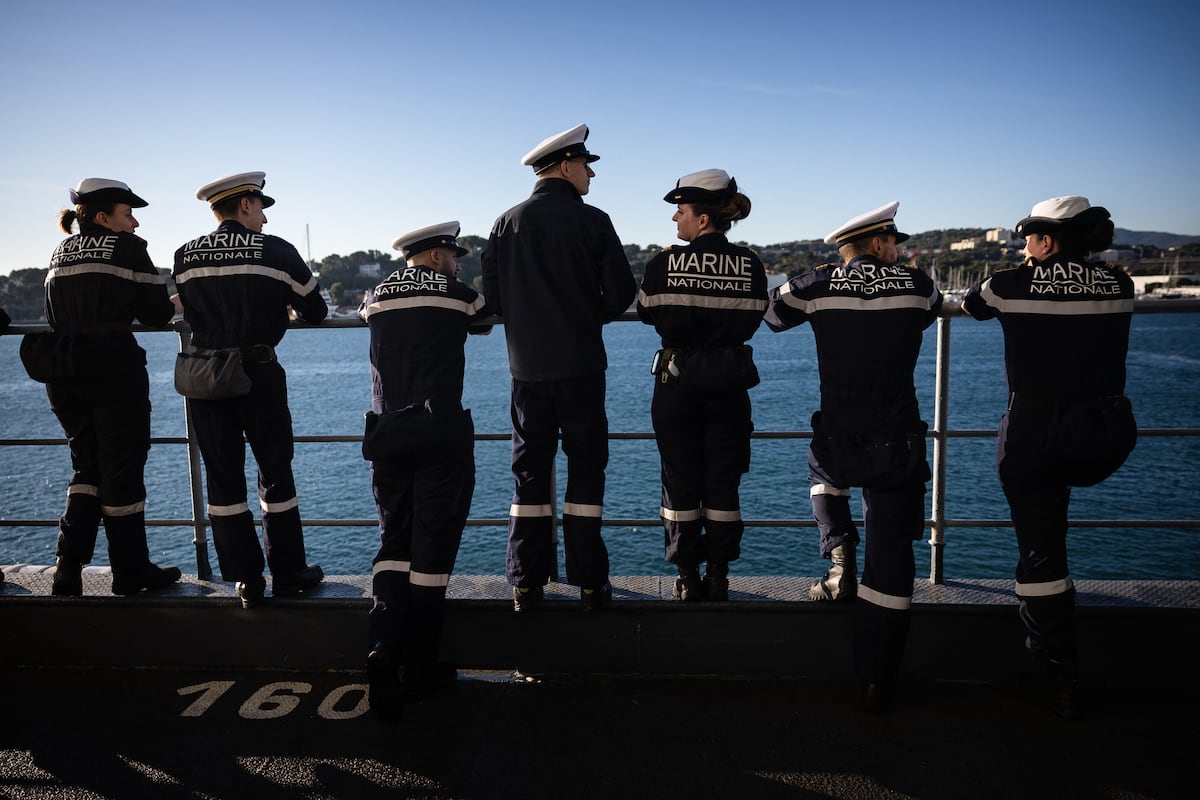
PARIS — The French Navy is toughening crew drills to better prepare sailors for the stress of coming under fire, following deployments to the Red Sea where Houthi rebels targeted Western warships and commercial traffic with drones and ballistic missiles.
The navy is experimenting with its simulator drills to put crews in “increasingly stressful situations,” said Capt. Jérôme Henry, the head of training for the navy’s surface personnel, at the Paris Naval Conference this week. Henry said he’s drawing on past experience as commander of the frigate Alsace, which came under attack multiple times in the Red Sea, to “toughen up our crews.”
“What I saw in the Red Sea is that when you’re under intense stress, people react more or less well but in any case, you lose some of your composure, you get what’s called tunnel vision,” Henry told Defense News on the sidelines of the conference. “If we’re going to be in high-intensity combat , our crews need to be ready for that stress, and the question is, how are we going to prepare them?”
Training tweaks include crews going for a run or doing push-ups right before stepping into weapon simulators to get heart rates up, creating sensory overload by adding noise, smoke and drone swarms to simulations, and adding weapon malfunctions in drills, said Henry, who took on his current role last year.
Henry says he adopted the idea of stress drills from the French Navy’s special forces, the Commandos Marine, and is seeking to find out how American and Israeli forces include stress in their training.
The goal for now is to dial up stress levels “as high as possible” to ensure that reflex actions are always the right ones, the training chief said. Henry said the challenge is the difficulty of putting people under such stress “that they feel like their final hour has come.”
The training division is trying to create the most disruptive environment possible in its simulators, so that personnel including gunners and missile operators “can mechanize their actions” to ensure they’ll be able to perform in combat whatever the situation, according to Henry.
“I know what it feels like to take a missile on the nose at four times the speed of sound,” Henry said. “So we know where we start to get stressed, we know we have to prepare for that.”
The most important lesson learned from the Red Sea is the need to be ready at all times, Adm. Harold Liebregs, commander of the Royal Netherlands Navy, told Defense News.
“The time when we could leave port, then build up and then see what mission we were going to do, that has changed,” Liebregs said. “It’s about training, but also about buildup. It’s about everything becoming more and more realistic, and it starts with having your war plans ready.”
Liebregs said the officer who commanded the support ship Karel Doorman during its deployment in the Red Sea, Paul Bijleveld, is now the navy’s commander for Sea Training, “so all the lessons we learned there, he’ll take onboard. Perhaps that is no coincidence.”
Western navies lack combat experiences in terms of high-intensity naval war, said Capt. Bryan McCavour, deputy assistant chief of staff for information warfare at the United Kingdom’s Royal Navy, who spoke on a panel with Henry. With fewer and fewer platforms in national fleets, ongoing problems with ship maintenance and availability, training is consistently getting compressed, he said.
“If we’re going to engender that war-fighting spirit and maintain it, and have that culture as a decisive factor in battle, we need to invest more time in high-end war-fighting training than I think we currently do,” McCavour said.
McCavour said it’s been longer since the Falklands War than between that conflict and World War II, and “combat-ready naval forces in that sense maybe don’t exist today in the way we think, because it’s been a very long time since we had a high-end conflict.”
He said Russia was reminded of that lesson with the sinking of the cruiser Moskva in the Black Sea, and Western forces need to take that into account when they look at responding in the South China Sea or the High North around the Kola Peninsula.
The Red Sea was also “a little bit the rediscovery” of low-end threats, with renewed focus on small-caliber weapons and cannons, and a pipeline of defensive layers including jamming, light missiles and laser-guided rockets, according to Henry, who directed the navy’s annual Wildfire drone exercise to focus on saturation as well as the risk of friendly fire in a busy environment.
“When you have a lot of things flying around you, and you open fire with other friendly units, we saw in the Red Sea that mistakes can be made,” Henry said. “So we’re working on that.”
The French Navy is furthermore training for combat while minimizing radio emissions, relying on adversary emissions to build situational awareness, according to Henry. The force is working to cut reliance on satellite positioning, helped by improved inertial-navigation systems as well as astral sights using the stars for positioning.
Henry mentioned the ‘Back to the ‘80s’ exercises by the French carrier strike group, which entails forgoing satellite communications and instead using HF and UHF radio for comms, “and above all, to be more frugal in our exchanges.”
Cyber warfare is the prime example of a threat likely to deprive naval forces of capabilities “at the worst possible moment,” according to Capt. Florian El-Ahdab, commanding officer of the French frigate Languedoc. He said preparing for eventualities such as loss of connectivity requires ‘Back to 80s’ type exercises and placing forces in situations of “great discomfort.”
“Today’s sailors reflect today’s society, so if I took your smartphone away today and told you to go somewhere, I’m not sure you’d feel very comfortable,” said El-Ahdab. He said “it’s the same thing” for the navy.
“If you take away all the tools available to the commander today, and all the amazing tools that are currently being developed, if I suddenly tell you that all of that is no longer available for one reason or another, how would you respond?” El-Ahdab asked. “That seems like a very, very good challenge to explore.”
Rudy Ruitenberg is a Europe correspondent for Defense News. He started his career at Bloomberg News and has experience reporting on technology, commodity markets and politics.
巴黎——在部署到红海后,法国海军正在加强船员训练,以更好地让水兵们做好应对炮火压力的准备。在红海,胡塞武装分子使用无人机和弹道导弹袭击了西方军舰和商船。
海军水面舰艇人员训练负责人杰罗姆·亨利上校本周在巴黎海军会议上表示,海军正在试验模拟演练,以使船员应对“日益紧张的局面”。亨利说,他正借鉴自己担任“阿尔萨斯”号护卫舰舰长时的经验——该舰曾在红海多次遭到袭击——来“增强船员的韧性”。
亨利在会议间隙接受《防务新闻》采访时表示:“我在红海看到的是,当人们承受巨大压力时,他们的反应或多或少都会好转,但无论如何,都会失去一些镇定,出现所谓的‘隧道视野’。如果我们要进行高强度战斗,我们的队员就必须做好应对这种压力的准备,问题是,我们该如何让他们做好准备?”
亨利说,训练调整包括让队员在进入武器模拟器之前先跑步或做俯卧撑以提高心率,通过在模拟中加入噪音、烟雾和无人机群来制造感官超载,以及在演习中加入武器故障。亨利去年开始担任目前的职务。
亨利表示,他从法国海军特种部队“海军突击队”那里借鉴了压力训练的想法,并正在研究美国和以色列军队是如何将压力训练纳入其训练中的。
训练主管表示,目前的目标是尽可能提高压力水平,以确保受试者的反射性反应始终正确。亨利说,挑战在于如何让人们承受如此巨大的压力,“让他们感觉自己已命悬一线”。
据亨利称,训练部门正努力在其模拟器中创造最具破坏性的环境,以便包括炮手和导弹操作员在内的人员“能够机械化他们的行动”,从而确保他们无论在何种情况下都能在战斗中发挥作用。
“我知道被一枚速度达到音速四倍的导弹击中头部是什么感觉,”亨利说。“所以我们知道什么时候会感到压力,也知道我们必须为此做好准备。”
荷兰皇家海军司令哈罗德·利布雷格斯海军上将告诉《防务新闻》,从红海事件中吸取的最重要教训是,必须时刻做好准备。
“过去那种先出港集结,然后再决定执行什么任务的时代已经改变了,”利布雷格斯说。“现在不仅要进行训练,还要做好集结准备。一切都变得越来越贴近实战,而这一切都始于制定完善的作战计划。”
利布雷格斯说,在“卡雷尔·多尔曼”号支援舰部署到红海期间指挥该舰的军官保罗·比耶勒费尔德,现在是海军海上训练司令,“所以我们在那里学到的所有经验教训,他都会带到舰上去。也许这并非巧合。”
英国皇家海军信息战副助理参谋长布莱恩·麦卡沃上校在与亨利共同出席的小组讨论会上表示,西方海军缺乏高强度海战的实战经验。他指出,由于各国舰队的舰艇数量日益减少,舰艇维护和可用性问题持续存在,训练时间不断压缩。
麦卡沃说:“如果我们想要培养并保持这种战争精神,并将这种文化作为战斗中的决定性因素,我们就需要投入比目前更多的时间进行高端战争训练。”
麦卡沃表示,福克兰群岛战争结束至今的时间比那场冲突到第二次世界大战结束的时间还要长,“从某种意义上说,如今可能已经不存在我们想象中的那种随时可以作战的海军力量了,因为我们已经很久没有经历过一场高强度的冲突了。”
他说,俄罗斯从“莫斯科”号巡洋舰在黑海的沉没事件中吸取了教训,西方军队在考虑如何应对南海或科拉半岛附近高北地区的局势时,需要考虑到这一点。
据亨利称,红海也“在某种程度上重新发现了”低端威胁,重新关注小口径武器和火炮,以及包括干扰、轻型导弹和激光制导火箭在内的多层防御体系。亨利曾指导海军一年一度的“野火”无人机演习,重点关注饱和攻击以及在繁忙环境中误伤友军的风险。
亨利说:“当周围有很多东西乱飞,而且你还和其他友军部队交火时,我们在红海战役中就看到了,很容易犯错。所以我们正在努力改进这一点。”
据亨利称,法国海军正在加强作战训练,同时尽可能减少无线电辐射,并依靠敌方辐射来获取态势感知。该部队正努力减少对卫星定位的依赖,这得益于改进的惯性导航系统以及利用星体进行定位的天文观测系统。
亨利提到了法国航母打击群的“回到 80 年代”演习,该演习要求放弃卫星通信,转而使用高频和超高频无线电进行通信,“最重要的是,在交流中更加节约。”
法国“朗格多克”号护卫舰舰长弗洛里安·埃尔-阿赫达布上校表示,网络战是可能在“最糟糕的时刻”剥夺海军作战能力的典型威胁。他指出,为应对诸如网络连接中断等突发情况,需要开展类似“回到80年代”的演习,并将部队置于“极其不利”的环境中。
“今天的水兵反映了当今社会,所以如果我今天没收你的智能手机,让你去某个地方,我不确定你会感到很自在,”埃尔-阿赫达布说。他表示,海军的情况也“一样”。
“如果我突然告诉你,由于某种原因,指挥官现在可以使用的所有工具,以及所有正在开发的先进工具都无法使用了,你会作何反应?”埃尔-阿赫达布问道。“这似乎是一个非常值得探讨的挑战。”
鲁迪·鲁伊滕贝格是《防务新闻》的欧洲记者。他的职业生涯始于彭博新闻社,拥有报道科技、大宗商品市场和政治方面的经验。