Shield AI, ST Engineering join forces on fine-tuning drone swarmsShield AI与ST Engineering联手优化无人机集群
The companies will use artificial intelligence to optimize the interactions of drones with drones, and drones with humans.
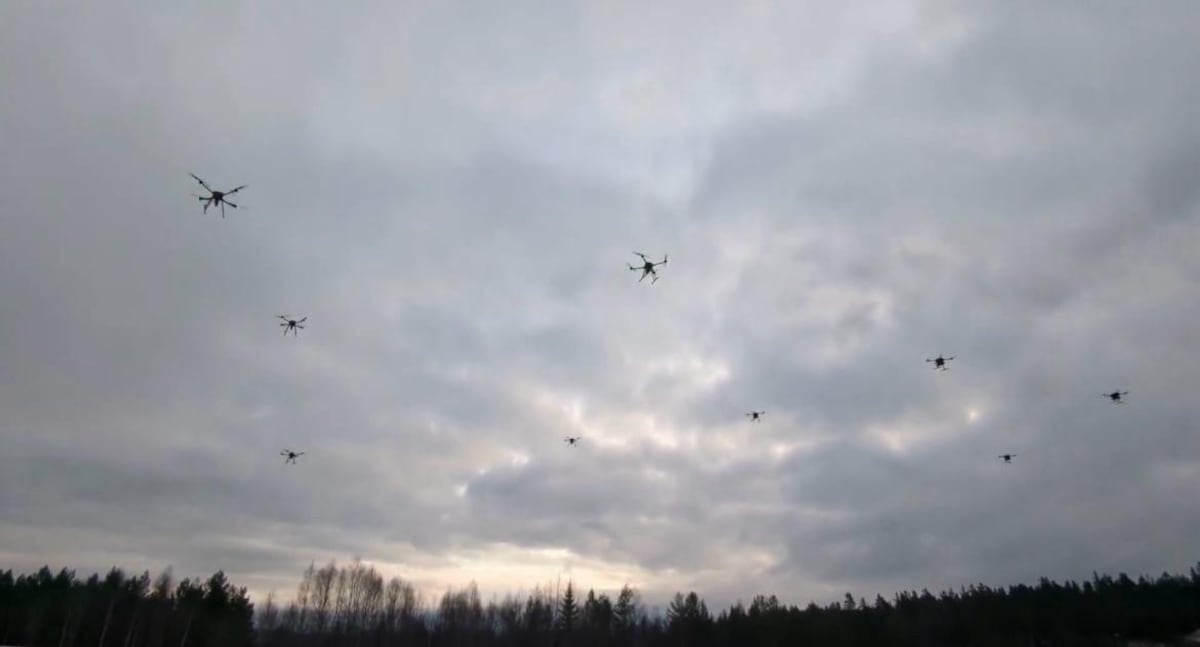
SINGAPORE — American drone company Shield AI plans to integrate its AI-enabled software into Singaporean manned-unmanned-teaming applications, enabling the coordination of drone swarms.
Local firm ST Engineering and Shield AI signed a memorandum of understanding at the Singapore Airshow here on Feb. 5 to combine the Hivemind autonomy software on different platforms manufactured by the national defense-tech champion.
An ST Engineering spokesperson told Defense News the company sees possibilities for integrating Hivemind into its manned-unmanned teaming operating system, or MUMTOS, marketed on the firm’s website as a tool for balancing “human judgment and machine precision.”
The open-architecture system is designed to connect a wide range of unmanned platforms, such as micro-drones, unmanned surface vessels, and robotic ground vehicles.
The Singaporean Armed Forces have been experimenting with collective drone operations. During its largest overseas exercise in Australia recently, the military deployed the largest number of drones in its history, according to the Singapore-based news network CNA. Over 100 drones logged 560 flight hours during Exercise Wallaby.
Hivemind allows unmanned systems to sense and adapt while executing missions by generating new navigation alternatives based on targets and environmental conditions. According to Shield AI, it is designed to continue operating in a GPS- or communications-degraded environment without constant remote control.
The company’s V-BAT drone equipped with Hivemind has been deployed in Ukraine. The AI-intelligence software provides the platform with a global navigation satellite, or GNSS-denied state estimator, that merges sensor data to continue navigation in jammed areas.
“To date, V-BAT has completed about 200 flights in Ukraine [including operational and training missions] – in 2025 alone, it identified more than 200 Russian targets, and we are working with Ukrainian company Iron Belly to integrate Hivemind onto more autonomous strike platforms,” a Shield AI representative said.
Elisabeth Gosselin-Malo was a Europe correspondent for Defense News. She covers a wide range of topics related to military procurement and international security, and specializes in reporting on the aviation sector. She is based in Milan, Italy.
新加坡——美国无人机公司 Shield AI 计划将其人工智能软件集成到新加坡有人-无人协同作战应用中,从而实现无人机群的协调。
2月5日,新加坡本土企业ST Engineering和Shield AI在新加坡航展上签署了一份谅解备忘录,旨在将Hivemind自主软件整合到这家国防科技领军企业生产的不同平台上。
ST Engineering 的一位发言人告诉《防务新闻》,该公司看到了将 Hivemind 集成到其有人-无人协同操作系统(MUMTOS)中的可能性,MUMTOS 在该公司的网站上被宣传为一种平衡“人类判断和机器精确度”的工具。
该开放式架构系统旨在连接各种无人平台,例如微型无人机、无人水面舰艇和机器人地面车辆。
新加坡武装部队一直在试验无人机协同作战。据新加坡新闻通讯社CNA报道,在近期于澳大利亚举行的规模最大的海外演习中,新加坡军方部署了史上数量最多的无人机。在“袋鼠行动”(Exercise Wallaby)期间,超过100架无人机累计飞行了560小时。
群体智能技术使无人系统能够在执行任务时感知并适应环境,根据目标和环境条件生成新的导航方案。据Shield AI公司称,该技术旨在无需持续远程控制,即可在GPS或通信信号减弱的环境中继续运行。
该公司搭载Hivemind人工智能系统的V-BAT无人机已在乌克兰部署。该人工智能软件为无人机平台提供全球导航卫星系统(GNSS)干扰下的状态估计功能,通过融合传感器数据,使其能够在受干扰区域继续导航。
“迄今为止,V-BAT 已在乌克兰完成了约 200 次飞行(包括作战和训练任务)——仅在 2025 年,它就识别出了 200 多个俄罗斯目标,我们正在与乌克兰公司 Iron Belly 合作,将 Hivemind 集成到更多自主打击平台上,”Shield AI 的一位代表表示。
伊丽莎白·戈斯林-马洛曾任《防务新闻》欧洲通讯员。她的报道涵盖军事采购和国际安全等广泛领域,尤其擅长航空领域的报道。她常驻意大利米兰。