Singapore aims to help WHO get new vaccines approved during global crises: Ong Ye Kung王乙康:新加坡致力于在全球危机期间帮助世卫组织批准新疫苗
Singapore offers global emergency vaccine regulation and pandemic preparedness, enhancing rapid approval, surveillance, and manufacturing to address future outbreaks. Read more at straitstimes.com.
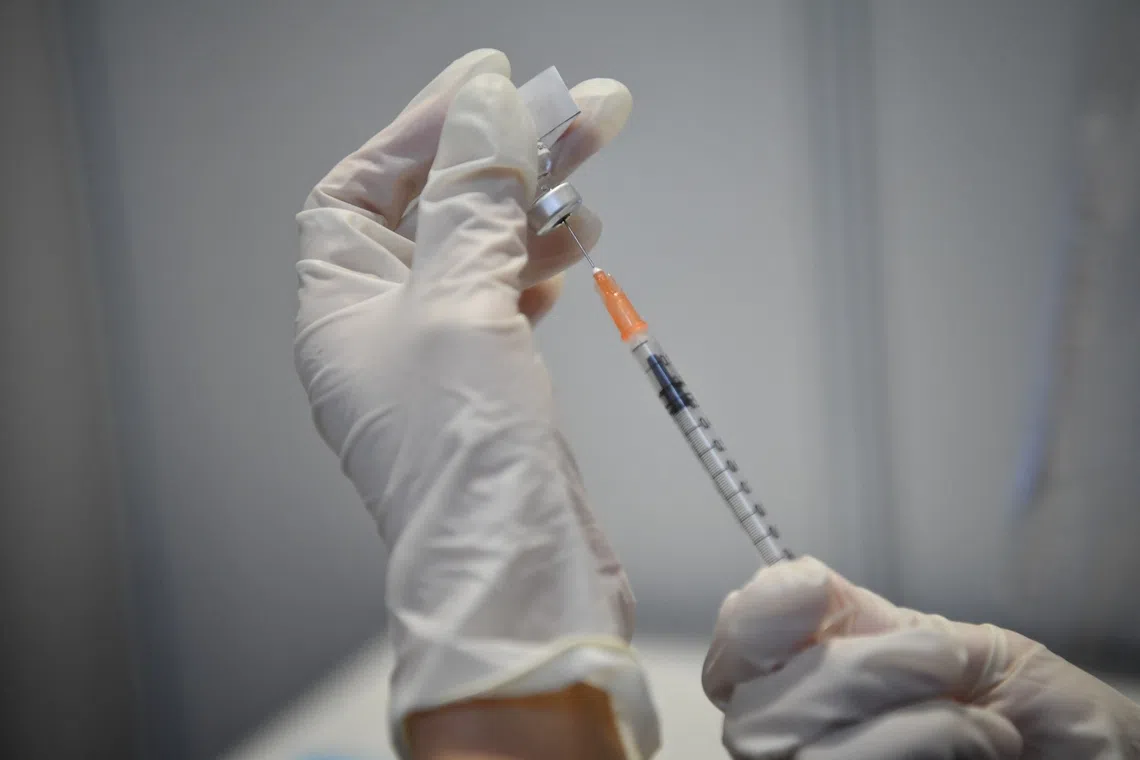
Pointing to Covid-19, Health Minister Ong Ye Kung said that the approval process for new vaccines could become a bottleneck as they all had to be certified by WHO.
Published Sep 24, 2026, 12:01 PM
Updated Sep 24, 2026, 12:01 PM
Singapore offers to be a global emergency safeguard for pandemic preparedness by speeding vaccine approvals through its Health Sciences Authority and joining a global regulatory network.
Singapore supports early pathogen detection via genomic surveillance with GISAID and builds local vaccine manufacturing to enhance global response and equity.
Experts stress continuous vigilance, combating misinformation, and maintaining trust through community-government-media partnerships as key to effective pandemic preparedness.
SINGAPORE – Singapore is looking to shoulder some of the World Health Organization’s (WHO) work when Disease X - the next deadly pandemic - strikes, by joining the ranks of countries that can help speed up the vaccine approval process, said Health Minister Ong Ye Kung.
This would involve the Health Sciences Authority (HSA) stepping up as a regulator to approve new vaccines during outbreaks.
Pointing to Covid-19, Ong said that the approval process for new vaccines could become a bottleneck as they all had to be certified by WHO .
“So our proposal to WHO is that we don’t need WHO to do all the work itself,” Ong said.
Instead, he suggested, it could rely on the network of the most reputable regulatory authorities around the world, from the US Centers for Disease Control and Prevention to the European Union’s European Medicines Agency, among others. This is a network which Singapore would like to be part of as well.
He was speaking to The Straits Times and Lianhe Zaobao ahead of a United Nations General Assembly (UNGA) high-level meeting on pandemic prevention, preparedness and response in New York on Sept 25.
The minister also spoke at an event in New York organised by the Ministry of Health and Hilleman Laboratories, a Singapore-based vaccine research and development organisation.
“Singapore (would) like to be part of it. We are certified at the highest maturity level for medical devices and drugs, not yet for vaccines,” Ong added.
HSA is the first national authority assessed by WHO at maturity Level 4 for medical device regulation , and it is a WHO-listed authority for medicines.
Maturity Level 4 is the highest classification given by WHO to a country’s national regulatory system, and establishes it as a global reference agency which other regulators can rely on.
“I think we want to get maturity level four for vaccines as well, then we can be part of this network to have swift regulatory approval for use during an emergency”, he said.
As Singapore expands vaccine manufacturing, HSA will hence work towards the corresponding WHO benchmarking and listing for vaccines.
“Vaccines must be evaluated, approved and deployed quickly without compromising safety and quality. During a crisis, we are in a fog of war, and regulators operate with urgency and incomplete information. Trust built in peacetime allows authorities to rely on one another’s assessments, share workloads and reduce duplication, while each jurisdiction retains responsibility for its own decisions”, he added.
Singapore also needs to support the surveillance and detection of dangerous pathogens early, alongside vaccine regulation, building vaccine-manufacturing capabilities in Singapore, and supporting the Coalition for Epidemic Preparedness Innovations’ mission to develop safe, effective and accessible vaccines for initial authorisation and manufacturing.
On surveillance, Singapore works closely with and actively contributes to GISAID, a non-profit organisation which runs a platform for scientists and governments to share genomic data of pathogens.
GISAID is the largest international source of genomic data for influenza, Covid-19 and mpox, and it is expanding to i nclude other pathogens of importance, including Ebola.
Much of that data is processed here by A*STAR (the Agency for Science, Technology and Research) , and GISAID has said genetic sequences will be accessible to the public immediately.
Data sharing allows for early detection of dangerous pathogens around the world that have been picked up by surveillance systems.
Ong, who is also Coordinating Minister for Social Policies, said the value of this approach was recently showcased when Singapore detected a novel SARS-CoV-2 recombinant in July through its routine genomic surveillance.
A patient who had mild illness was found to be infected with this recombinant. The patient has since recovered and no further local cases were detected.
At the time of assessment, it was the only such sequence detected locally, with no closely matching sequence identified in GISAID, which means no other very similar cases had been detected globally.
Ong said that he was informed about this only days later, after the scientific process was under way – and that this should be the case, given “public health surveillance must be professional, timely and transparent”.
He noted that when a country reports an unusual pathogen, it may worry about reputational or economic consequences. But it is important to not delay reporting.
Instead, it is to build international norms that recognise transparency as responsible conduct, which could well be the way that a new disease will be discovered.
Ong said Singapore’s current capabilities are part of the new plan to have the Republic - a small and globally connected country, contribute to the world’s pandemic preparedness, so as to address uneven access to vaccines.
He called the plan “a backstop that leverages global networks and co-operation, should regional efforts stall during an emergency ”. It works hand-in-hand with two existing global plans.
The first is the unifying global framework for preparedness and equitable access t o vaccines through the WHO’s pandemic fund, as laid out in WHO’s pandemic agreement. Though was adopted in May 2025 , details on pathogen access and benefits-sharing are still being sorted out .
The second is to build sustainable regional vaccine-manufacturing resilience , a highly complex task.
On this front, Singapore has attracted and anchored several flexible production facilities which can produce mRNA vaccines here, with the help of the Economic Development Board.
More equitable vaccine access and continuously maintaining trust, even outside periods of crisis, were among key findings relevant to Singapore, according to a report released on Sept 21 at a UNGA side event.
The report was put together by the Pandemic Readiness through Institutions, Mobilising Communities and Equity (PRIME) Commission, established by the National University of Singapore (NUS) and leading academic journal The Lancet .
“Singapore is already engaging in many of the key activities necessary for the next outbreak... the most important immediate next step is to ensure that Singapore does not relax its focus on pandemic preparedness, that the key policy and public health leaders remain vigilant and prepared for the next outbreak”, said co-author of the report Teo Yik Ying, NUS’ vice-president for global health.
Teo also urged Singapore to continuously monitor whether fake news and irresponsible statements about vaccines are gaining traction in the community, and to proactively address dangerous misinformation, despite the nation having a considerably smaller challenge with vaccine hesitancy.
He noted that the report highlighted that the very best policy intentions are sometimes ineffective due to a lack of trust, poor communications and inadequate coordination in the community.
To tackle misinformation and maintain trust calls for close partnership between community leaders, journalists and media outlets, and government policy makers, said Teo, who is also the dean of the NUS’ Saw Swee Hock School of Public Health.
卫生部长王乙康指出,新冠疫情可能导致新疫苗审批流程出现瓶颈,因为所有疫苗都必须得到世界卫生组织的认证。
发布于 2026 年 9 月 24 日下午 12:01
更新于2026年9月24日下午12:01
新加坡表示愿意通过其卫生科学局加快疫苗审批速度并加入全球监管网络,成为全球应对疫情的紧急保障力量。
新加坡通过与GISAID合作进行基因组监测,支持病原体的早期检测,并建立本地疫苗生产,以增强全球应对能力和公平性。
专家强调,持续保持警惕、打击虚假信息以及通过社区-政府-媒体伙伴关系维护信任,是有效应对疫情的关键。
新加坡——卫生部长王乙康表示,新加坡希望在下一次致命的大流行病——“X疾病”来袭时,承担世界卫生组织(世卫组织)的部分工作,加入能够帮助加快疫苗审批进程的国家行列。
这意味着卫生科学局(HSA)将作为监管机构,在疫情爆发期间批准新的疫苗。
Ong指出,以新冠肺炎为例,新疫苗的审批过程可能会成为瓶颈,因为它们都必须得到世卫组织的认证。
“所以我们向世卫组织提出的建议是,我们不需要世卫组织自己完成所有工作,”翁说。
他建议,新加坡可以依靠全球最权威的监管机构网络,例如美国疾病控制与预防中心和欧盟欧洲药品管理局等。新加坡也希望加入这个网络。
在9月25日于纽约举行的联合国大会(联大)大流行病预防、准备和应对高级别会议之前,他接受了《海峡时报》和《联合早报》的采访。
这位部长还在纽约出席了由卫生部和总部位于新加坡的疫苗研发机构 Hilleman Laboratories 联合举办的活动并发表了讲话。
“新加坡(希望)参与其中。我们在医疗器械和药品方面已获得最高成熟度认证,但在疫苗方面尚未获得认证,”翁补充道。
新加坡卫生科学局 (HSA) 是世界卫生组织 (WHO) 评估中第一个达到医疗器械监管成熟度 4 级的国家主管机构,也是世界卫生组织认可的药品主管机构。
世界卫生组织将一个国家的监管体系评为成熟度 4 级,这是该组织给予该国监管体系的最高级别,并将其确立为其他监管机构可以信赖的全球参考机构。
他说:“我认为我们也希望疫苗达到第四级成熟度,这样我们就可以加入这个网络,以便在紧急情况下迅速获得监管批准使用。”
随着新加坡扩大疫苗生产,新加坡卫生科学局将努力达到世界卫生组织相应的疫苗基准和清单要求。
“疫苗必须在不影响安全性和质量的前提下,迅速进行评估、审批和部署。危机时期,我们如同身处战争迷雾之中,监管机构在信息不全的情况下仓促行事。和平时期建立的信任能够让各部门相互依赖评估结果,分担工作量,减少重复劳动,同时每个管辖区也对其自身决策负责。”他补充道。
新加坡还需要支持对危险病原体的早期监测和检测,同时加强疫苗监管,在新加坡建立疫苗生产能力,并支持流行病防范创新联盟的使命,即开发安全、有效且易于获得的疫苗,以供初步授权和生产。
在监测方面,新加坡与GISAID密切合作并积极为其做出贡献。GISAID是一个非营利组织,运营着一个供科学家和政府共享病原体基因组数据的平台。
GISAID 是流感、新冠肺炎和痘病毒基因组数据的最大国际来源,并且正在扩展以纳入其他重要病原体,包括埃博拉病毒。
这些数据大多由新加坡科技研究局 (A*STAR) 处理,GISAID 表示,基因序列将立即向公众开放。
数据共享有助于及早发现世界各地通过监测系统发现的危险病原体。
兼任社会政策统筹部长的王乙康表示,这种方法的价值最近得到了体现:新加坡在7月份通过例行基因组监测发现了一种新型SARS-CoV-2重组病毒。
一名症状较轻的患者被发现感染了这种重组病毒。该患者目前已康复,当地未发现其他病例。
评估时,这是本地检测到的唯一此类序列,GISAID 中没有发现密切匹配的序列,这意味着在全球范围内没有检测到其他非常相似的病例。
Ong表示,他是在科学调查进行几天后才得知此事的——他认为这是理所应当的,因为“公共卫生监测必须专业、及时和透明”。
他指出,当一个国家报告一种不寻常的病原体时,可能会担心声誉或经济后果。但重要的是不要拖延报告。
相反,其目的是建立国际规范,将透明度视为负责任的行为,这很可能是发现一种新疾病的方式。
王乙康表示,新加坡目前的能力是新计划的一部分,该计划旨在让新加坡这个面积小但与全球联系紧密的国家为世界应对疫情做好准备,从而解决疫苗获取不均的问题。
他称该计划为“一项后备方案,旨在利用全球网络与合作,以防区域努力在紧急情况下停滞不前”。它与两项现有的全球计划相辅相成。
第一个是世卫组织通过其大流行基金建立的全球统一框架,旨在确保疫苗的准备和公平获取,该框架已在世卫组织的《大流行协议》中阐述。尽管该协议于2025年5月通过,但关于病原体获取和惠益分享的细节仍在商讨中。
第二项任务是建立可持续的区域疫苗生产韧性,这是一项高度复杂的任务。
在这方面,在新加坡经济发展局的帮助下,新加坡已经吸引并落户了多家能够在这里生产mRNA疫苗的灵活生产设施。
根据9月21日在联合国大会边会上发布的一份报告,更公平地获取疫苗以及持续保持信任(即使在危机时期之外)是与新加坡相关的关键发现之一。
该报告由新加坡国立大学 (NUS) 和领先的学术期刊《柳叶刀》共同成立的“通过机构、动员社区和公平来应对疫情”委员会 (PRIME) 编写。
“新加坡已经在开展应对下一次疫情爆发所需的许多关键活动……目前最重要的下一步是确保新加坡不放松对疫情防范的重视,确保关键的政策和公共卫生领导人保持警惕,为下一次疫情爆发做好准备”,该报告的合著者、新加坡国立大学全球健康副校长张奕颖表示。
张志贤还敦促新加坡持续关注有关疫苗的虚假新闻和不负责任的言论是否在社会上传播,并积极应对危险的错误信息,尽管新加坡面临的疫苗犹豫挑战要小得多。
他指出,该报告强调,即使是最好的政策意图,有时也会因为社区缺乏信任、沟通不畅和协调不足而失效。
新加坡国立大学苏瑞福公共卫生学院院长张先生表示,要应对虚假信息并维护信任,需要社区领袖、记者和媒体机构以及政府决策者之间密切合作。