Watch These Old World War II Bombers Launch Target Drones观看这些二战时期的老式轰炸机发射靶机
Early on in the Cold War, the Royal Canadian Air Force modified two iconic Lancasters to carry the early unmanned aircraft.
新闻视频
By Joseph Trevithick
Updated Jul 3, 2020 4:13 AM EDT
While unmanned aircraft have become synonymous with America’s way of war since 9/11, they’ve actually been an important feature of military aviation for the better part of a century. In the early years of the Cold War, the Royal Canadian Air Force (RCAF) turned two of Avro Lancasters in unique training aircraft, able launch and control jet-powered target drones rather than bombs.
In March 2017, the San Diego Air and Space Museum posted a series of videos online showing these specialized Lancaster B Mk 10DCs in action. The museum’s archive had digitized the footage from a collection of films the Ryan Aeronautical Company donated in the 1990s.
In 1951, American plane-maker Ryan began building the portly Firebee unmanned aircraft for the U.S. Air Force, Navy and Army. Canada was among the first foreign customers.
The pilotless planes were ideal training tools. With a top speed of over 500 miles per hour and a wing span of just 11 feet, the drones were more agile and challenging for pilots and gunners than many towed targets, which were limited by the characteristics of the tug aircraft.
Since they weren’t physically attached to the controlling aircraft, the Firebees made things safer for everyone involved, too. Trainees could shoot live rounds at the drones without worrying about accidentally shooting down another plane.
Crews could recover the unmanned aircraft even if they suffered significant damage. The flying targets had a two-stage parachute system that would deploy if the engine failed or the radio signal with the control station cut out. The individual controlling the Firebee could also trigger this sequence manually.
The Firebee wasn’t without its own faults. The aircraft could only stay aloft for around 50 minutes at a time. In addition, the range of the radio link was limited, meaning the drones had to stay relatively close to the control station.
The U.S. Army launched its versions from the ground using an expendable rocket booster. This worked fine for low-altitude training exercises for anti-aircraft crews.
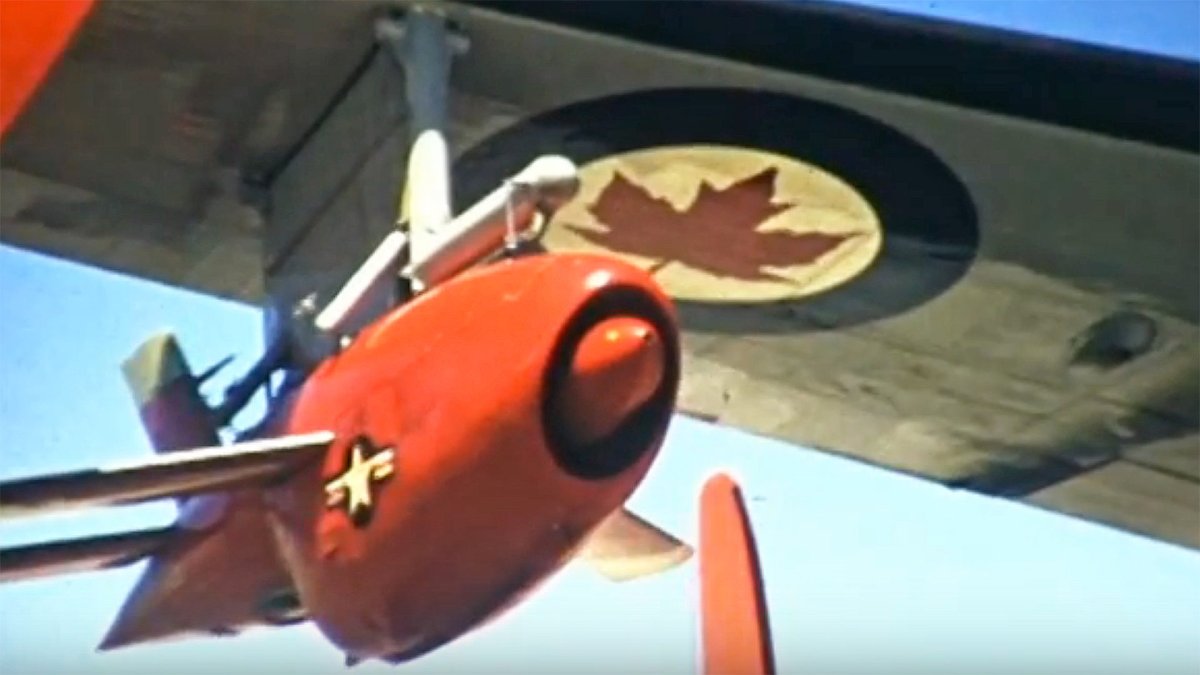
For training higher-flying fighter pilots, the U.S. Air Force and U.S. Navy launched their variants in mid-air from modified twin-engine Douglas B-26 Invader attack planes and Lockheed P2V Neptune patrol aircraft. The RCAF took a similar approach with the modified Lancasters. The four-engine planes were each capable of carrying two drones, one under each wing.
An early Firebee drone with a colorful paintjob., Ryan Aeronautical via the San Diego Air and Space Museum
The iconic World War II bomber would have made sense since it both had the payload to carry the Firebees and was readily available. During World War II , Canadian company Victory Aircraft Limited produced 430 B Mk 10s for service with RCAF units under the Royal Air Force’s Bomber Command.
Able to carry 14,000 pounds of bombs, the Lancaster series was a key component of the RAF’s bombing campaign in Europe. Special versions could carry the 22,000 pound Grand Slam bomb , which were supposed to break through reinforced structures like submarine pens, and unique “bouncing bombs” as part of a daring, top secret plan to attack dams in Germany and cause catastrophic flooding.
An RCAF B Mk 10MR maritime patrol aircraft at Naval Air Station Jacksonville in Florida in 1953., USN
After the war ended, many of these planes made their way back home and ended up in new roles, like as drone motherships. With bright orange noses, wing tips, and tails over a natural metal finish, the B Mk 10DCs soldiered on well into the 1950s.
Fighter pilots in Canadair Sabre , Avro Canada CF-100 Canuck , and McDonnell CF-101 Voodoo jet fighters could have squared off against the Firebees. Canadian forces might have also tested early surface-to-air missiles against the drones.
In the early 1960s, the RCAF retired the last of its Lancasters, still in service as maritime patrol planes and search and rescue aircraft, with its own fleet of Neptunes. Ryan continued to upgrade the Firebee family , building improved targets, unmanned spies, and experimental pilotless attackers, primarily for the U.S. military.
Contact the author: joe@thedrive.com
Comments couldn’t be loaded. Please refresh the page.
作者:约瑟夫·特雷维西克
更新于美国东部时间2020年7月3日凌晨4:13
虽然自9·11事件以来,无人机已成为美国战争方式的代名词,但实际上,它们在近一个世纪的时间里一直是军事航空的重要组成部分。在冷战初期,加拿大皇家空军(RCAF)将两架阿弗罗·兰开斯特轰炸机改装成独特的教练机,使其能够发射和控制喷气式靶机,而不是炸弹。
2017年3月,圣地亚哥航空航天博物馆在网上发布了一系列视频,展示了这些特制的兰开斯特B Mk 10DC轰炸机的飞行英姿。这些视频素材来自博物馆的档案馆,由瑞安航空公司在20世纪90年代捐赠的一批胶片数字化而成。
1951年,美国飞机制造商瑞安公司开始为美国空军、海军和陆军生产笨重的“火蜂”无人机。加拿大是最早的外国客户之一。
这些无人驾驶飞机是理想的训练工具。无人机的最高时速超过500英里,翼展仅为11英尺,比许多受牵引飞机性能限制的拖曳目标更灵活,对飞行员和炮手来说也更具挑战性。
由于它们与控制飞机没有物理连接,火蜂无人机也提高了所有参与人员的安全。受训人员可以向无人机发射实弹,而不用担心误击其他飞机。
即使无人机遭受严重损坏,机组人员也能将其回收。这些飞行目标配备了两级降落伞系统,一旦发动机失效或与控制站的无线电信号中断,该系统就会自动展开。操控“火蜂”无人机的人员也可以手动触发这一程序。
“火蜂”无人机也并非完美无缺。它每次只能在空中停留大约50分钟。此外,无线电链路的有效范围有限,这意味着无人机必须与控制站保持相对较近的距离。
美国陆军使用一次性火箭助推器从地面发射其研制的导弹。这种方法对于防空部队的低空训练演习效果很好。
为了训练高空战斗机飞行员,美国空军和海军使用改装后的双引擎道格拉斯B-26“入侵者”攻击机和洛克希德P2V“海王星”巡逻机,在空中投放其改进型无人机。加拿大皇家空军也采用了类似的方法,使用改装后的兰开斯特轰炸机。这些四引擎飞机每架都能携带两架无人机,每侧机翼下各一架。
一架早期的火蜂无人机,涂装色彩鲜艳。图片来自瑞安航空,经由圣地亚哥航空航天博物馆提供。
这款二战时期标志性的轰炸机是理想之选,因为它既有足够的有效载荷搭载“火蜂”无人机,又易于获取。二战期间,加拿大胜利飞机有限公司(Victory Aircraft Limited)生产了430架B Mk 10型轰炸机,供隶属于英国皇家空军轰炸机司令部的加拿大皇家空军部队使用。
兰开斯特系列轰炸机能够携带14000磅炸弹,是英国皇家空军在欧洲轰炸行动中的关键组成部分。特殊型号可以携带22000磅重的“大满贯”炸弹,这种炸弹旨在突破潜艇基地等加固结构;此外,它还能携带独特的“跳弹”,作为一项大胆的绝密计划的一部分,该计划旨在袭击德国的水坝,造成灾难性的洪水。
1953年,一架加拿大皇家空军B Mk 10MR海上巡逻机停放在佛罗里达州杰克逊维尔海军航空站。(美国海军)
战争结束后,许多这样的飞机返回家乡,并被用于新的用途,例如作为无人机母舰。B Mk 10DC 型飞机机头、翼尖和尾翼涂成亮橙色,机身则保持金属原色,一直服役到 20 世纪 50 年代。
驾驶加拿大佩刀式战斗机、加拿大阿弗罗CF-100“卡纳克”战斗机和麦克唐纳CF-101“巫毒”战斗机的飞行员可能与“火蜂”无人机交锋过。加拿大军队也可能曾用早期地对空导弹测试过这些无人机。
20世纪60年代初,加拿大皇家空军退役了最后一批兰开斯特轰炸机,这些飞机仍作为海上巡逻机和搜救机服役,同时加拿大皇家空军也拥有了自己的海王星轰炸机机队。瑞安公司继续改进火蜂系列轰炸机,制造出改进型靶机、无人侦察机和实验型无人攻击机,主要服务于美国军方。
联系作者:joe@thedrive.com
评论加载失败,请刷新页面。