Fortune Coconut Whan Neng still makes freshly pressed coconut milk, uses TikTok to market businessFortune Coconut Whan Neng 仍然坚持生产鲜榨椰奶,并利用 TikTok 进行市场推广。
The third-generation successor, a basketball coach, plans to take over the stall from his dad, who starts work at 4.30am daily, pressing 300 coconuts for their sweet, preservative-free milk.
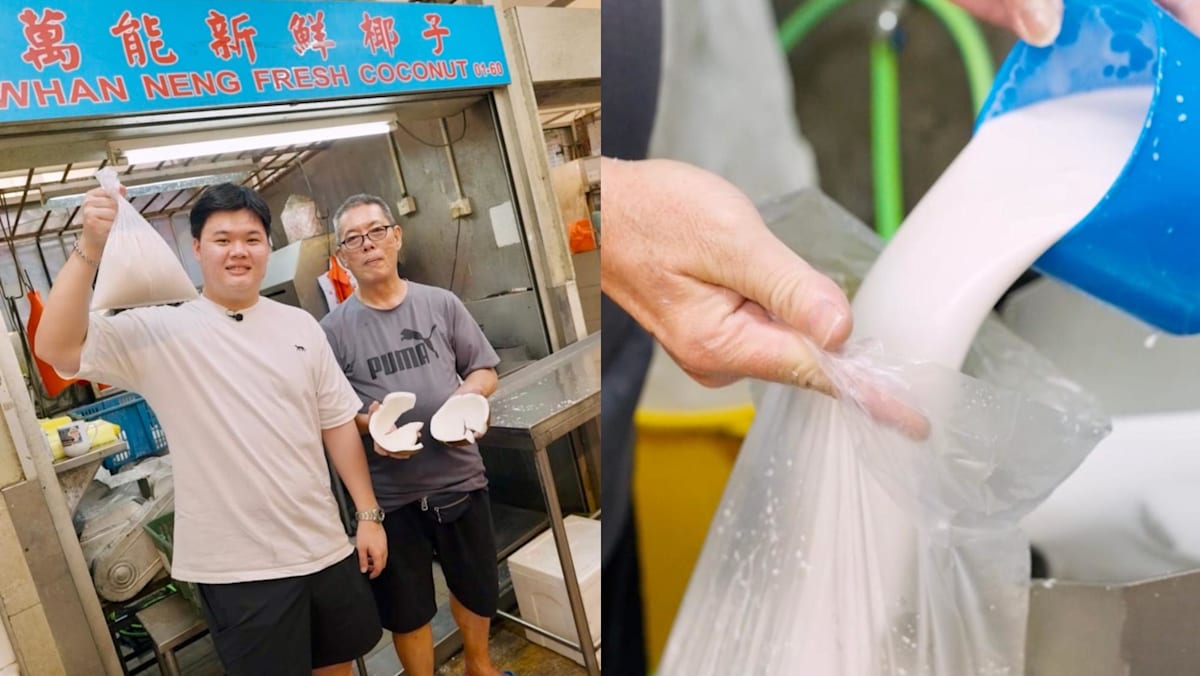
The third-generation successor, a basketball coach, plans to take over the stall from his dad, who starts work at 4.30am daily, pressing 300 coconuts for their sweet, preservative-free milk.
The owners of Fortune Coconut Whan Neng. The stall still makes freshly pressed coconut milk. (Photos: 8Days)
This audio is generated by an AI tool.
Before shelf-stable packets of coconut milk dominated supermarkets, home cooks often made their santan the painstaking way: buying freshly grated coconut from wet markets and wringing it through a muslin cloth to extract the creamy liquid.
Today, freshly squeezed coconut milk has become increasingly rare in Singapore due to the labour needed and its perishable nature. Fortune Coconut Whan Neng at MacPherson Market & Food Centre does all the hard work for you, making it worth a trip to get some of its super-fresh stuff for your homemade curry or chendol.
Located in the wet market section, the stall has two old-school electric coconut graters rattling away as they reduce the chunky coconut slices to tiny flecks. At the back, a large hydraulic press takes up much of the cramped space, extracting every drop from the grated coconut.
According to third-generation successor Lee Zhao Yuan, 27, coconut milk was largely squeezed by hand in the old days, as hydraulic presses were uncommon back then.
Third-gen hawker Lee Zhao Yuan (left) with his father, second-gen owner Lee Siew Hiang. (Photo: 8Days)
The family-run business processes around 300 coconuts to yield up to 100 litres of coconut milk a day. Lee now hopes to keep the old-school trade alive by introducing it to a younger audience through social media.
“I decided to continue my family business because I understand how rare this trade is, and freshly squeezed coconut milk is extremely hard to find now in Singapore,” Lee tells 8days.sg. “Seeing my ageing parents working is also one of the reasons [I want to help out].”
Creamy coconut milk gushes out as the hydraulic press crushes grated flesh. (Photo: 8Days)
Fortune Coconut was founded by Lee Zhao Yuan’s late grandfather, Lee Hong Tang, in the 1970s. His father, Lee Siew Hiang, 63, took over in the early ’90s and moved the business to its current stall at MacPherson Market & Food Centre in the early 2000s.
According to the younger Lee, packaged ultra-high temperature (UHT) coconut milk was not widely available in the early noughties, and freshly pressed coconut milk was in high demand. “My dad saw that and started pressing fresh coconut milk daily for the MacPherson community,” says Lee.
But these days, most folks just reach for the pasteurised stuff at supermarkets. “Sometimes, people choose convenience,” he reasons.
“There’s a very big difference between using commercially packaged coconut milk and fresh coconut milk,” he says. “When using fresh coconut milk, the fragrance is stronger.”
Pouring freshly pressed coconut milk. (Photo: 8Days)
Even before Lee Zhao Yuan began marketing the family’s stall on social media, the business remained sustainable through its base of regular customers, whose combined orders can reach 30kg to 40kg a day.
However, his marketing efforts have since attracted new customers.
Every morning, mature Malayan Tall coconuts from Malaysia (with a brown husk and thicker flesh vs young green nuts with translucent meat) are washed and split in half. Their flesh is then ground and placed inside a coarse woven bag.
The bag goes into a S$15,000 (US$11,800) custom-made hydraulic press, where a circular plate pushes down the grated coconut to extract its rich milk. Each press yields 4 litres.
The stall sells two types of grated coconut flesh: white (S$7/kg) and brown (S$6.50/kg). White grated coconut has the brown skin removed from its flesh and is mainly used as a topping for desserts such as ondeh-ondeh.
For brown grated coconut, the outer layer is retained, which Lee says produces more fragrant milk. It’s mainly used to extract coconut milk for both savoury dishes such as laksa and sweet ones like bubur cha cha.
The stall’s coconut milk costs S$7.50 per litre, with smaller quantities available at S$1.50 for 200ml and S$3.75 for 500ml.
Brown grated coconut. (Photo: 8Days)
The freshly pressed milk does not contain preservatives and is best consumed on the day of purchase or by the following day. Once the milk is used in a cooked item, Lee recommends refrigerating the dish and consuming it within two to three days.
The grated coconut is similarly perishable – he recommends using it by the following day or freezing it for up to a week.
How does he enjoy his family’s coconut milk? Well, the Gen Z way – he loves adding it to his overnight oats in place of regular milk for a richer kick. He also adds it to beverages such as tea.
Most of Fortune Coconut’s customers are middle-aged and elderly home cooks living around MacPherson, though it also supplies the milk to hawker stalls, bakeries and restaurants, mainly in eastern Singapore.
Its customers include heritage brand Kim Choo Kueh Chang, which uses coconut milk for some of its rice dumplings, and Yhingthai Palace Restaurant, which adds it to its Thai curries. Slow Bakes bakery also uses Fortune Coconut’s milk to make kaya.
“We might not be the only stall in Singapore producing fresh coconut milk (there’s another one in Fengshan Market & Food Centre), but I might be the only third-generation [successor] producing content about it,” he says. “I hope to bring back nostalgic memories for older folks while introducing this fresh product to younger generations.”
Lee Zhao Yuan currently handles sales and marketing for Fortune Coconut but has not officially taken over its daily operations. He works mostly from home, coordinating online orders and managing the brand’s social media accounts. He visits the stall thrice a week to help out. He expects to take over the business within the next five years, when his father retires.
A typical workday for Lee’s father begins at 4.30am. He first washes and prepares the coconuts before fulfilling orders from regulars. From around 9am, he turns his attention to walk-in customers and finishes work at noon.
According to Lee, hauling heavy coconuts and preparing them for grating are the most physically demanding aspects of the job. The hydraulic press is automated, compressing the grated coconut at the push of a button.
For now, Lee’s main source of income is from his job at Scholar Basketball Academy, where he coaches children. He plans to switch to part-time coaching to focus more on the family business.
The 1.78m-tall former competitive player competed at the Under-18 level for a Bukit Merah-based club and attended national team trials but was not selected. After a knee injury, he decided not to pursue competitive basketball further.
Any regrets? “I guess a part of me is sad. Basketball was a way for me to escape [my problems as a teen],” he shares.
He adds: “I never thought I would join the family business. [Back then], I wanted to do my own thing,” he says. “But I’m definitely happy to be part of it now.”
Lee Zhao Yuan (far right), aged 17, during his competitive basketball days. (Photo: Lee Zhao Yuan)
Lee Zhao Yuan holds a Higher Nitec in Chemical Technology from ITE College East. Interestingly, before becoming a basketball coach, Lee worked in operations and marketing at an ad agency – experience he now uses to promote the family business online.
He has a 32-year-old sister who works in tech sales and isn’t involved in the business. However, she appeared in the social media video he produced for Fortune Coconut.
So far, he has filmed and produced only one TikTok video for Fortune Coconut, alongside managing its other social media posts. The clip highlights the increasing rarity of freshly pressed coconut milk in an age of packaged versions, showing how the family’s coconut products are made. Its nostalgic angle helped the video gain traction online.
“My family recognised that I had the potential to market the business to a wider audience,” he says, referring to the video. “From there, I did not look back.”
Lee hopes to eventually move coconut milk production into a central kitchen, though he does not have a concrete timeline or production target yet. He says the business must first build a sufficiently large and consistent customer base to justify the move.
Rather than extending the milk’s shelf life with preservatives, he hopes to supply more F&B clients and eventually develop other products incorporating fresh coconut milk.
“With digital marketing and new ways to reach people today, I want to see how far I can take this traditional family trade,” he says.
Recently engaged, Lee hopes his future children will one day take over the family business, though he’ll leave the decision up to them. “Ultimately, each person must have a certain level of understanding and commitment if they wish to step into this trade,” he muses.
Fortune Coconut Whan Neng is located at #01-60, MacPherson Market & Food Centre, 89 Circuit Road, Singapore 370089. Open daily 6am–11.40am.
This story was originally published in 8Days.
For more 8Days stories, visit https://www.8days.sg/ .
A single handpicked story that we think you shouldn't miss. Just one a day.
第三代继承人是一位篮球教练,他计划从父亲手中接管摊位。他的父亲每天早上 4 点 30 分开始工作,榨取 300 个椰子,制成香甜的、不含防腐剂的椰奶。
财富椰子店的老板万能。这家店至今仍坚持鲜榨椰奶。(图片来源:8Days)
这段音频由人工智能工具生成。
在超市里到处都是保质期长的椰奶包装之前,家庭厨师们常常费力地制作椰奶:从菜市场购买新鲜的椰丝,然后用棉布挤压,提取出浓稠的椰汁。
如今,由于人工成本高昂且椰奶易腐,新加坡鲜榨椰奶已变得越来越难得。位于麦波申巴刹与熟食中心的Fortune Coconut Whan Neng为您省去了所有繁琐的步骤,因此非常值得您专程前往,购买一些超级新鲜的椰奶,用于自制咖喱或珍多冰。
这家摊位位于菜市场区,两台老式电动椰子刨丝器嘎吱作响地运转着,将厚厚的椰子片刨成细小的椰丝。摊位后方,一台大型液压机占据了狭小的空间,将椰丝中的汁液全部榨出。
据第三代继承人、27岁的李兆元介绍,过去椰奶大多是手工榨取的,因为当时液压机并不普及。
第三代小贩李兆元(左)与其父、第二代店主李秀香合影。(图片来源:8Days)
这家家族企业每天加工约300个椰子,可产出多达100升椰奶。李先生现在希望通过社交媒体将这项传统技艺介绍给年轻一代,从而使之传承下去。
李告诉8days.sg:“我决定继承家业,因为我知道这门手艺有多么稀缺,现在在新加坡很难找到鲜榨椰奶。看到年迈的父母还在工作,这也是我想帮忙的原因之一。”
随着液压机碾碎椰肉,浓郁的椰奶喷涌而出。(图片来源:8Days)
Fortune Coconut 由李兆元的已故祖父李鸿堂于 20 世纪 70 年代创立。他的父亲李秀贤(63 岁)在 20 世纪 90 年代初接手,并在 21 世纪初将生意搬到了麦波申巴刹与熟食中心的现址。
据小李先生回忆,2000年代初期,包装好的超高温灭菌(UHT)椰奶并不普及,鲜榨椰奶的需求量很大。“我父亲看到了这一点,就开始每天为麦弗逊社区鲜榨椰奶。”李先生说道。
但如今,大多数人都会直接在超市购买巴氏杀菌产品。“有时候,人们会选择方便,”他解释道。
他说:“市售包装椰奶和新鲜椰奶之间有很大的区别。新鲜椰奶的香味更浓郁。”
倒入新鲜压榨的椰奶。(图片来源:8Days)
甚至在李兆元开始在社交媒体上宣传自家摊位之前,该生意就依靠其稳定的老客户群维持运营,这些老客户的订单加起来每天可达 30 公斤至 40 公斤。
然而,他的营销努力此后确实吸引了一些新客户。
每天早晨,来自马来西亚的成熟马来高椰子(外壳呈棕色,果肉较厚,与果肉半透明的嫩椰子不同)会被清洗干净并剖开。然后,果肉会被磨碎,装入一个粗编织袋中。
椰丝被放入一台价值15000新加坡元(约合11800美元)的定制液压机中,机内一个圆形压板向下压榨椰丝,提取出浓郁的椰奶。每次压榨可产出4升椰奶。
这家摊位出售两种椰丝:白椰丝(7新元/公斤)和棕椰丝(6.50新元/公斤)。白椰丝去除了椰肉的棕色外皮,主要用于制作甜点,例如椰丝球(ondeh-ondeh)。
李先生说,棕色椰丝保留了外层椰肉,这样榨出的椰奶更香。它主要用于榨取椰奶,既可用于叻沙等咸味菜肴,也可用于摩摩喳喳等甜味甜点。
该摊位的椰奶售价为每升 7.50 新元,小包装售价为 200 毫升 1.50 新元,500 毫升 3.75 新元。
棕色椰蓉。(图片来源:8Days)
鲜榨牛奶不含防腐剂,最好在购买当天或第二天饮用。如果牛奶用于烹饪,李建议将菜肴冷藏并在两到三天内食用。
椰蓉同样容易变质——他建议第二天用完,或者冷冻保存一周。
他喜欢怎么享用家里的椰奶呢?嗯,他用的是Z世代的方式——用椰奶代替牛奶加到隔夜燕麦里,让燕麦粥更香浓。他还会把椰奶加到茶之类的饮料里。
Fortune Coconut 的大部分客户是居住在麦波申附近的中老年家庭厨师,不过该公司也向小贩摊位、面包店和餐馆供应椰奶,主要分布在新加坡东部。
其客户包括使用椰奶制作部分粽子的历史悠久的品牌金珠粽(Kim Choo Kueh Chang),以及在其泰式咖喱中添加椰奶的英泰宫餐厅(Yhingthai Palace Restaurant)。慢烤面包店(Slow Bakes)也使用福运椰奶制作咖椰酱(kaya)。
“我们可能不是新加坡唯一一家生产新鲜椰奶的摊位(凤山巴刹与熟食中心还有一家),但我可能是唯一一位制作相关内容的第三代传人,”他说。“我希望在向年轻一代介绍这种新鲜产品的同时,也能唤起老一辈人的怀旧记忆。”
李兆元目前负责Fortune Coconut的销售和市场营销,但尚未正式接管日常运营。他主要在家办公,负责协调线上订单和管理品牌的社交媒体账号。他每周会去摊位三次帮忙。他希望在未来五年内,等他父亲退休后,能够接管这家公司。
李的父亲通常早上4点半开始工作。他先清洗和处理椰子,然后开始为老顾客服务。大约9点以后,他开始接待散客,中午结束一天的工作。
李说,搬运沉重的椰子和准备椰丝是这项工作中最耗费体力的环节。液压机是自动化的,只需按一下按钮即可压缩椰丝。
目前,李的主要收入来源是他在Scholar篮球学院担任教练的工作,他在那里指导孩子们打球。他计划转为兼职教练,以便有更多时间专注于家族生意。
这位身高1.78米的前职业篮球运动员曾代表武吉美拉的一家俱乐部参加18岁以下级别的比赛,并参加过国家队选拔赛,但最终落选。膝伤之后,他决定不再继续从事职业篮球运动。
后悔吗?“我想我内心深处有点难过。篮球是我逃避(青少年时期)问题的一种方式,”他说道。
他补充道:“我从没想过会加入家族企业。(那时候),我只想做自己的事业,”他说。“但现在能成为其中的一份子,我当然非常高兴。”
李兆远(最右),17岁时参加篮球比赛时的照片。(照片:李兆远)
李兆元持有ITE东区学院化学技术高级证书。有趣的是,在成为篮球教练之前,李曾在一家广告公司从事运营和市场营销工作——他现在利用这段经验在网上推广家族企业。
他有个32岁的妹妹,从事科技销售工作,并不参与家族生意。不过,她出现在他为Fortune Coconut制作的社交媒体视频中。
到目前为止,他只为 Fortune Coconut 拍摄制作了一条 TikTok 视频,同时还负责管理其其他社交媒体账号。这段视频突出了在包装椰奶盛行的时代,鲜榨椰奶日益稀缺的现状,并展示了这家椰子产品的制作过程。视频中流露出的怀旧情怀帮助其在网络上迅速走红。
“我的家人意识到我有潜力将这项业务推广到更广泛的受众,”他指着视频说道。“从那时起,我就义无反顾地向前迈进。”
李先生希望最终能将椰奶生产集中到一个中央厨房,但他目前还没有具体的时间表或产量目标。他表示,公司必须首先建立起足够庞大且稳定的客户群,才能证明这一举措的合理性。
他希望通过添加防腐剂来延长椰奶的保质期,从而为更多餐饮客户提供产品,并最终开发出其他含有新鲜椰奶的产品。
“借助数字营销和如今接触人们的新方式,我想看看我能把这项传统的家族生意发展到什么程度,”他说。
最近订婚的李先生希望他未来的孩子有朝一日能够接管家族企业,但他会把决定权留给他们。“归根结底,每个人如果想涉足这个行业,都必须具备一定的理解力和责任心,”他沉思道。
Fortune Coconut Whan Neng 位于新加坡环路 89 号麦波申市场与熟食中心 #01-60,邮编 370089。每日营业时间为早上 6 点至上午 11 点 40 分。
本文最初发表于《8Days》杂志。
更多8Days的故事,请访问https://www.8days.sg/。
每天一篇,我们精心挑选一篇您不容错过的精彩故事。