Commentary: Could P1 registration changes be bolder? Focus first on public mandate of primary schools评论:小学一年级注册改革能否更大胆一些?首先关注小学教育的公共授权
Before considering bolder changes, we need to decide how to balance individual competitiveness and our collective values, say SMU’s Jacqueline Ho, NIE’s Jason Tan and NUS’ Vincent Chua.
新闻视频
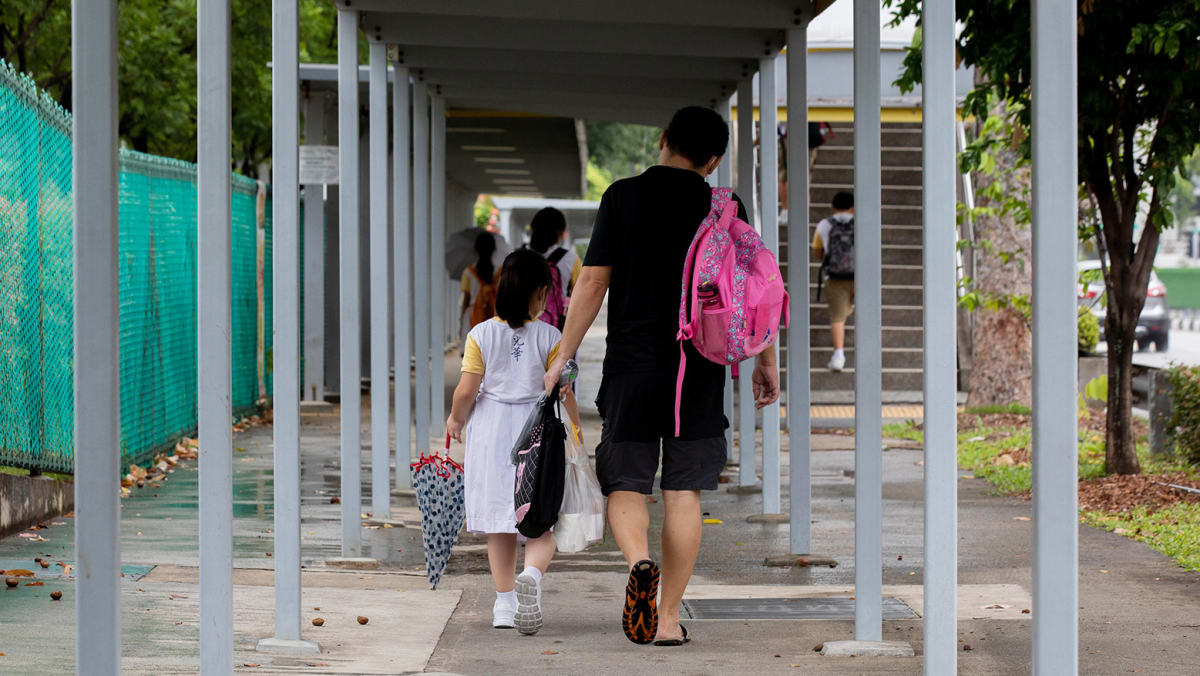
Before considering bolder changes, we need to decide how to balance individual competitiveness and our collective values, say SMU’s Jacqueline Ho, NIE’s Jason Tan and NUS’ Vincent Chua.
There are at least nine ways – including by joining the alumni association or the school management committee, becoming a community leader or a parent volunteer, among others – by which parents can seek priority entry to a school if their child doesn’t already have siblings who are schooling there or had studied there.
This audio is generated by an AI tool.
SINGAPORE: In a high-stakes, credential-conscious environment, parents understandably want to deploy every available resource to secure their child’s educational future .
Recognising these pressures, the Ministry of Education recently announced adjustments to the Primary 1 registration framework . There will be more reserved places in Phase 2C for children with no prior connection to the school, up from 40 to 60 spots. Additionally, twelve schools in neighbourhoods with more private housing will offer a two-track Phase 2C to include those living beyond the usual 2km radius.
These changes send an important signal about MOE’s commitment to broadening access to schools. Yet in practice, they can feel incremental.
In schools with larger cohorts of 300 students or more, many of them popular schools, 60 spots translate to at most 20 per cent of yearly enrolment. The 20-seat increase may end up making little practical difference at many oversubscribed schools to “improve access and support inclusivity”.
CNA Games Guess Word Crack the word, one row at a time Buzzword Create words using the given letters Mini Sudoku Tiny puzzle, mighty brain teaser Mini Crossword Small grid, big challenge Word Search Spot as many words as you can Show More Show Less
"PARENTOCRACY" IN ACTION
Understanding how much further reform can go requires us to examine the underlying policy goals of the P1 registration framework.
The stated goals of Phase 2A and Phase 2B are to preserve school culture through alumni, clan and church connections, and recognise volunteer or grassroots contributions. For decades, these priorities have defined the boundaries of what Singaporeans imagine the P1 registration framework can and should accomplish.
Yet while these policy objectives sound reasonable in theory, the registration rules meant to achieve them have become gameable levers of advantage in practice.
Alumni priority, once a celebration of institutional heritage, is now frequently used as an “insurance policy” against the unpredictable Phase 2C ballot. Justified by the language of “school culture”, it converts public educational opportunities into inheritable private assets, allowing top schools to remain self-reproducing enclaves.
Likewise, parent volunteer schemes are less about active community service, and more about the possible reward of securing a spot. This in effect turns time into access—favouring those who have flexible working hours, are stay-home parents or can afford domestic help.
Even proximity rules, which are wholly defensible from a convenience and child well-being standpoint, mean that access to public education in some neighbourhoods comes via the luxury real estate market.
Left unexamined, this natural parental instinct to give their children the best can encourage the formation of “ self-perpetuating closed circles ”—something that former Prime Minister Lee Hsien Loong warned against.
THE BALANCE IS SHIFTING
The P1 registration system directly ties educational access to the advantages that parents bring to the table, to a much greater degree than in other admission exercises. However, the revised rules chip away at these mechanisms, building on the direction of previous reforms.
Reserving 20 additional spots in Phase 2C makes it less guaranteed that alumni and volunteers will secure a spot. This expands on the last change in the 2022 registration exercise, which doubled the number of reserved places in Phase 2C to 40, in addition to removing the advantage that alumni association members had over regular alumni.
At schools surrounded primarily by low-density private housing, the two-track scheme achieves a better balance between ensuring convenience for families and keeping access open to families that cannot afford to live in these prime areas.
This drift towards more inclusivity is increasingly acknowledged on the ground. A growing number of primary schools have reportedly scrapped the parent volunteer scheme.
These are vital first steps, and we support efforts to encourage the success of the policy change, including parent education and transportation arrangements.
A DEBATE ABOUT FUNDAMENTAL VALUES
But tweaking the rules within existing parameters cannot substitute for a more fundamental cultural debate.
Some have asked: Why not think bolder? For instance, some have proposed eliminating rules that grant priority access to school alumni and parent volunteers. Anecdotally, others have suggested removing the golden pipelines linking affiliated primary schools with affiliated secondary schools that super-charge competition into the former.
Before we can consider these, we must first confront a fundamental question about the balance to strike between a “me-first” competitive impulse and a “we-first” collective ideal.
Within the P1 registration framework, the two are at odds in a very literal way: Priority rules that grant certain families a leg up necessarily reduce the odds for other parents without connections and capital, thereby carving up school-based social networks along lines of wealth and privilege.
If we agree that our schools serve a larger collective purpose than our individual need to get ahead, they ought to be places where children can interact with others from backgrounds different than their own.
Early cross-class friendships turn unfamiliar others into familiar peers, building the cognitive flexibility, empathy, and social trust that are essential for long-term social cohesion and national resilience.
There is much at stake. In the end, a society of growing social distance between groups is a deeply fragile one.
Do not misunderstand. Pointing out the existence of privilege and “parentocracy” is not about moralising against individual parents, who act out of natural care for their children within the rules they are given.
It is about exercising the intellectual courage to inspect and rewrite those structural rules. If bringing together children from different backgrounds to share a common experience is part of the public mandate of primary schools, then that should carry greater weight in deciding how those rules are written.
If Singapore is to flourish, our primary school gates must no longer be guarded by the private advantages of parents, but opened wide as the common starting point of every Singaporean child.
Jacqueline Ho is assistant professor of sociology at the Singapore Management University.
Jason Tan is associate professor of policy, curriculum and leadership at the National Institute of Education.
Vincent Chua is associate professor of sociology at the National University of Singapore.
Get our pick of top stories and thought-provoking articles in your inbox
Stay updated with notifications for breaking news and our best stories
Join our channel for the top reads for the day on your preferred chat app
新加坡管理大学的何嘉琳、国立教育学院的陈俊杰和新加坡国立大学的蔡文森表示,在考虑更大胆的变革之前,我们需要决定如何平衡个人竞争力和我们的集体价值观。
至少有九种方法——包括加入校友会或学校管理委员会、成为社区领袖或家长志愿者等等——可以让家长为孩子争取优先入学资格,前提是他们的孩子还没有兄弟姐妹在该校就读或曾经在该校学习。
这段音频由人工智能工具生成。
新加坡:在一个竞争激烈、注重学历的环境中,家长们自然希望动用一切可用资源来保障孩子的教育未来。
鉴于这些压力,教育部近期宣布调整小学一年级入学登记制度。第二阶段C类入学名额将增加,从40个增加到60个,专门面向与学校没有直接联系的儿童。此外,12所位于私人住宅较多社区的学校将实行第二阶段C类入学双轨制,以惠及居住在通常2公里半径以外的儿童。
这些变化传递出教育部致力于扩大入学机会的重要信号。然而,在实践中,这些变化可能感觉只是渐进式的。
在学生人数超过300人的大型学校(其中许多是热门学校)中,增加的60个名额最多只占年度入学人数的20%。这20个新增名额最终可能对许多招生名额已满的学校来说,并不能真正“改善入学机会,促进包容性”。
CNA游戏 猜词游戏 逐行破解单词 流行词游戏 用给定的字母组成单词 迷你数独 小小谜题,挑战你的大脑 迷你填字游戏 小方格,大挑战 单词搜索 尽可能多地找出单词 显示更多 显示更少
“家长专制”的实践
要了解改革还能走多远,我们需要审视P1注册框架的根本政策目标。
第二阶段A和B的既定目标是通过校友、宗亲和教会的联系来传承学校文化,并表彰志愿者和基层人士的贡献。几十年来,这些优先事项界定了新加坡人对小学一年级注册框架能够且应该实现的目标的设想范围。
然而,尽管这些政策目标在理论上听起来合理,但旨在实现这些目标的登记规则在实践中却变成了可以利用的优势手段。
校友优先权曾经是对学校传统的颂扬,如今却常常被用作应对难以预测的第二阶段C投票结果的“保险措施”。它以“学校文化”为幌子,将公共教育机会转化为可继承的私人资产,使顶尖学校得以继续保持其自我复制的封闭状态。
同样,家长志愿者计划与其说是积极的社区服务,不如说是争取名额的潜在回报。这实际上将时间转化为机会——更有利于那些工作时间灵活、全职在家带孩子或能负担得起家政服务的人。
即使是出于便利和儿童福祉考虑而完全合理的邻近性规定,也意味着在某些社区获得公共教育的机会需要通过豪华房地产市场来实现。
如果不加以审视,这种父母想要给孩子最好的自然本能可能会助长“自我延续的封闭圈子”的形成——这是前总理李显龙曾警告过的情况。
平衡正在发生变化
小学一年级(P1)的注册制度将教育机会与家长带来的资源直接挂钩,其程度远高于其他入学方式。然而,修订后的规则在延续先前改革方向的基础上,逐步削弱了这些机制。
在第二阶段C期额外预留20个名额,降低了校友和志愿者获得名额的保障。这比2022年注册流程中的上次调整更为严格,上次调整将第二阶段C期的预留名额增加了一倍,达到40个,同时取消了校友会成员相对于普通校友的优势。
在主要被低密度私人住宅环绕的学校,双轨制方案在确保家庭便利和保持那些无力负担在这些黄金地段居住的家庭的入学机会之间取得了更好的平衡。
这种包容性增强的趋势正日益得到实际认可。据报道,越来越多的小学已经取消了家长志愿者计划。
这些都是至关重要的第一步,我们支持为促进政策变革成功所做的努力,包括家长教育和交通安排。
关于基本价值观的辩论
但是,在现有框架内调整规则并不能取代更根本的文化辩论。
有人问道:为什么不考虑得更大胆一些呢?例如,有人提议取消那些给予学校校友和家长志愿者优先权的规定。另一些人则建议取消那些连接附属小学和附属中学的“黄金通道”,因为这些通道会加剧小学之间的竞争。
在考虑这些问题之前,我们必须首先面对一个根本问题,即如何在“以自我为先”的竞争冲动和“以我们为先”的集体理想之间取得平衡。
在小学一年级注册框架内,这两者之间存在着非常明显的矛盾:给予某些家庭优势的优先规则必然会降低其他没有关系和资金的家长的机会,从而沿着财富和特权的界限分割学校的社交网络。
如果我们认同学校服务于比个人出人头地更大的集体目标,那么学校就应该是孩子们可以与来自不同背景的人互动交流的地方。
早期的跨阶级友谊将陌生人变成熟悉的同伴,培养认知灵活性、同理心和社会信任,这对于长期的社会凝聚力和国家韧性至关重要。
事关重大。归根结底,一个群体间社会距离日益扩大的社会是极其脆弱的。
请不要误解。指出特权和“父母专制”的存在,并不是要对个别父母进行道德评判,他们只是在既定规则范围内出于对子女的自然关爱而行事。
这关乎运用理性勇气去审视并重塑这些结构性规则。如果让来自不同背景的孩子们共同经历一段时光是小学的公共使命之一,那么在决定如何制定这些规则时,就应该赋予这一使命更大的权重。
如果新加坡想要繁荣发展,我们的小学大门就不应该再被家长的私人利益把守,而应该向所有人敞开,成为每个新加坡孩子共同的起点。
何嘉琳是新加坡管理大学社会学助理教授。
Jason Tan 是国立教育学院政策、课程和领导力专业的副教授。
Vincent Chua是新加坡国立大学社会学副教授。
订阅我们的邮件,即可获取精选热点新闻和引人深思的文章。
订阅通知,第一时间获取突发新闻和精彩报道。
加入我们的频道,即可在您常用的聊天应用上获取当日热门文章。