Leonardo banks on space, cybersecurity, AI for double-digit growth莱昂纳多公司寄希望于太空、网络安全和人工智能实现两位数增长。
Italy's state-controlled defense giant predicted that by 2028 its annual order tally will rise to $24.7 billion.
ROME — Italy’s Leonardo has promised double-digit order and revenue growth by 2028 with a new five-year plan emphasizing investments in space, cybersecurity and artificial intelligence, as well as corporate streamlining.
The state-controlled defense giant predicted that by 2028 its new annual order tally will rise by 16.5% to €22.6 billion ($24.7 billion) from this year’s expected €19.4 billion, while revenue will soar 27% to reach €21.3 billion.
In a presentation to analysts and reporters in Rome, the firm predicted its defense-related cybersecurity work would rise fourfold in the period, while its space revenue would increase from €800 million last year to €1.4 billion by 2028.
CEO Roberto Cingolani said a new space division was being set up and due diligence was being carried out for a dozen potential small acquisitions in the space, cyber and unmanned fields.
“The world geopolitical scenario calls for a new global security paradigm, where we aim to play a proactive role in the evolution of the European defense sector,” Cingolani said in a statement.
The CEO promised a greater use of AI, high-powered computing and digitalization across the firm’s divisions, sparking communication between managers “that have never talked to each other.”
Meanwhile, the firm will make €1.8 billion in savings over the five-year period by tightening up on supplier payments, slimming down its corporate HQ and reducing the 100-120 million euro annual travel budget of staff.
A review of Leonardo’s electronics products to identify non-performing items could lead to the scrapping of 20% of them, Cingolani said.
The CEO said the firm was ending its five-year involvement in Skydweller, a U.S.-Spanish program to develop a the world’s first fully solar powered unmanned aircraft.
“It’s a €25 million program that can be easily replaced by a €100,000 aerostat balloon,” he said.
Shares in Leonardo rose on March 12 after the plan was announced, continuing an upward trend reflecting the boom in defense stocks following Russia’s invasion of Ukraine.
“There are still margins for growth, the company’s market capitalization is still low,” Cingolani said.
He restressed his belief that Leonardo must play a role in the greater integration of Europe’s defense industry through alliances and joint ventures to promote the launch of fewer new products – saving funds and avoiding overlaps.
The perennial drive to create better cross-border tie-ups in Europe has taken on new urgency as the bloc faces a growing threat from Russia.
“The good thing is people are ready to talk about it, although due to fear,” Cingolani said.
“I don’t know if this will be enough for Europeans to understand that at least in defense they need to get together. The point is that every country in Europe has its own aircraft, its own tank, its own torpedo, and when you want to achieve a joint European defense you have to give up something,” he said.
Cingolani warned that the EU’s anti-trust rules risked hindering mergers that would beef up Europe’s defense capability.
“There are areas where rules for the free market apply in peacetime but in a war economy, free market and anti-trust rules can be an obstacle to global security,” he said.
“Companies can be proactive and we have a model that works well in Europe - MBDA - a triple joint venture. Maybe we should consider triple joint ventures,” he added, referring to the missile company’s distributed ownership across Airbus, BAE Systems and Leonardo, with subsidiaries in France, Italy, Germany, Spain and the U.K.
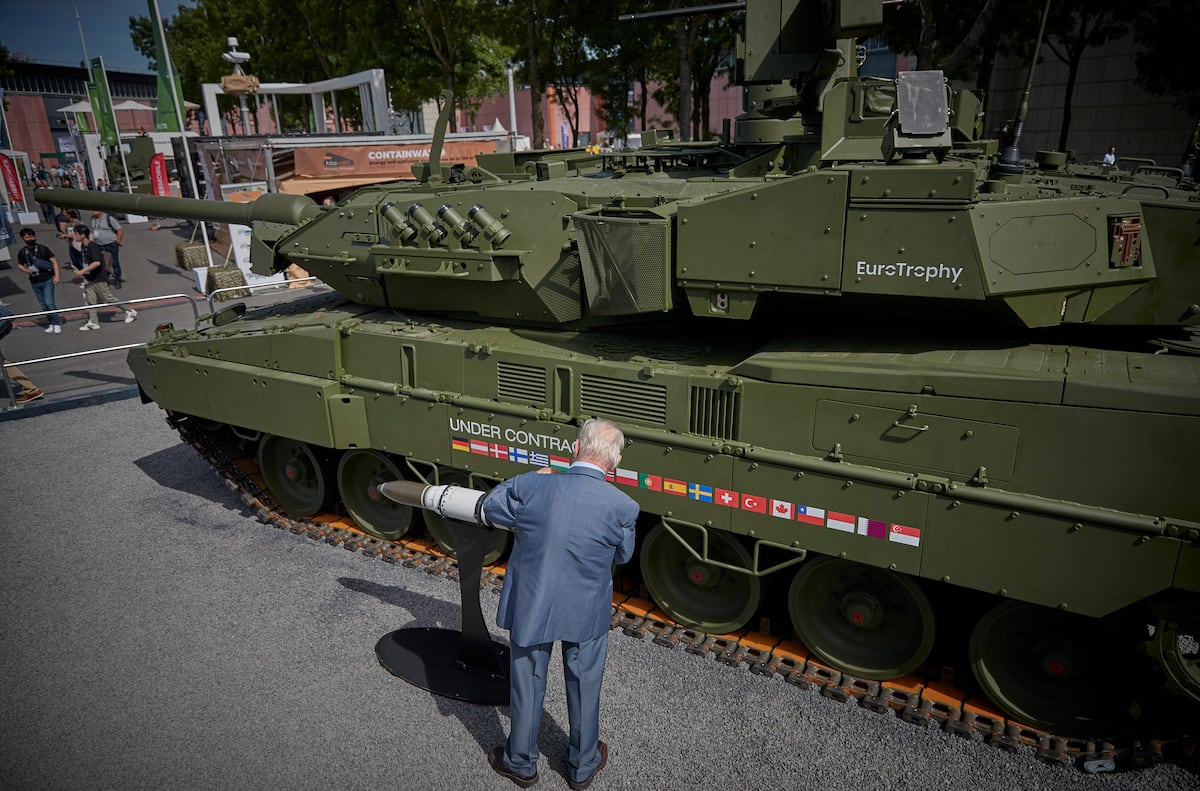
In December, Leonardo signed to create a “strategic alliance” with KNDS - the consortium of Germany’s Krauss-Maffei Wegmann and France’s Nexter - to work on the European MGCS next-generation tank program, as well on the Leopard tanks Italy is purchasing.
When asked if Leonardo would take a stake in KNDS, Cingolani said, “In nature and life nothing is impossible,” but he cautioned that the matter was “very complex,” adding: “Let’s see the technology first, then let’s see if there are synergies and compatibilities in the market, if it’s convenient and cost effective, and then see if there is an agreement.”
He added, “There are technical discussions,” but said no talks had taken place at the governmental level.
Tom Kington is the Italy correspondent for Defense News.
罗马——意大利莱昂纳多公司承诺,到 2028 年,其订单和收入将实现两位数增长。该公司制定了一项新的五年计划,重点投资于太空、网络安全和人工智能领域,并进行公司精简。
这家国有控股的国防巨头预测,到 2028 年,其年度新订单总额将从今年预计的 194 亿欧元增长 16.5%,达到 226 亿欧元(247 亿美元),而收入将飙升 27%,达到 213 亿欧元。
该公司在罗马向分析师和记者发表讲话时预测,其国防相关网络安全工作量将在此期间增长四倍,而其太空收入将从去年的 8 亿欧元增长到 2028 年的 14 亿欧元。
首席执行官罗伯托·辛戈拉尼表示,公司正在组建一个新的太空部门,并对太空、网络和无人领域十几个潜在的小型收购项目进行尽职调查。
“世界地缘政治形势需要一种新的全球安全范式,我们的目标是在欧洲国防领域的演变中发挥积极作用,”辛戈拉尼在一份声明中表示。
首席执行官承诺将在公司各部门更广泛地使用人工智能、高性能计算和数字化技术,从而促进“从未交谈过”的经理之间的沟通。
与此同时,该公司将在五年内通过收紧供应商付款、精简公司总部以及削减员工每年 1 亿至 1.2 亿欧元的差旅预算来节省 18 亿欧元。
Cingolani表示,对Leonardo的电子产品进行审查,找出不合格的产品,可能会导致其中20%的产品被报废。
首席执行官表示,该公司将结束其参与 Skydweller 项目五年的历程。Skydweller 是一个美西合作项目,旨在开发世界上第一架完全太阳能驱动的无人机。
他说:“这是一个耗资 2500 万欧元的项目,完全可以用一个价值 10 万欧元的系留气球来替代。”
3月12日,该计划公布后,莱昂纳多公司的股价上涨,延续了此前因俄罗斯入侵乌克兰而引发的国防股繁荣的上升趋势。
“公司仍有增长空间,市值仍然很低,”辛戈拉尼说。
他重申,他认为莱昂纳多必须通过联盟和合资企业,在欧洲国防工业的更大一体化进程中发挥作用,以促进推出更少的新产品——从而节省资金并避免重叠。
随着欧盟面临来自俄罗斯日益增长的威胁,欧洲长期以来致力于建立更好的跨境联系的努力变得更加紧迫。
“好消息是,尽管出于恐惧,人们还是愿意谈论这件事,”辛戈拉尼说。
“我不知道这是否足以让欧洲人明白,至少在国防方面,他们需要团结起来。关键在于,欧洲每个国家都有自己的飞机、坦克和鱼雷,而当你想要实现欧洲联合防御时,就必须做出一些让步,”他说。
辛戈拉尼警告说,欧盟的反垄断规则可能会阻碍那些能够增强欧洲国防能力的合并。
他说:“有些领域在和平时期适用自由市场规则,但在战时经济中,自由市场和反垄断规则可能会成为全球安全的障碍。”
“企业可以采取积极主动的策略,我们在欧洲有一个行之有效的模式——MBDA,一家三方合资企业。或许我们也应该考虑成立三方合资企业,”他补充道,这里指的是这家导弹公司由空客、BAE系统公司和莱昂纳多三家公司共同拥有,并在法国、意大利、德国、西班牙和英国设有子公司。
去年 12 月,莱昂纳多公司与德国克劳斯-玛菲·韦格曼公司和法国奈克斯特公司组成的财团 KNDS 签署协议,建立“战略联盟”,共同参与欧洲 MGCS 下一代坦克项目以及意大利正在采购的豹式坦克项目。
当被问及莱昂纳多是否会入股KNDS时,辛戈拉尼表示:“在自然界和生活中,没有什么是不可能的。”但他同时谨慎地指出,此事“非常复杂”,并补充道:“我们先来看看技术,然后看看市场上是否存在协同效应和兼容性,是否方便且具有成本效益,然后再看看能否达成协议。”
他补充说:“存在一些技术性讨论”,但表示尚未进行政府层面的会谈。
汤姆·金顿是《防务新闻》驻意大利记者。