Singapore parents increasingly value holistic development, but academic concerns persist: IPS study新加坡家长越来越重视子女的全面发展,但对学业的担忧依然存在:IPS研究
The study by the Institute of Policy Studies looked at how parental mindsets towards education have changed over the last 10 years.
The study by the Institute of Policy Studies looked at how parental mindsets towards education have changed over the last 10 years.
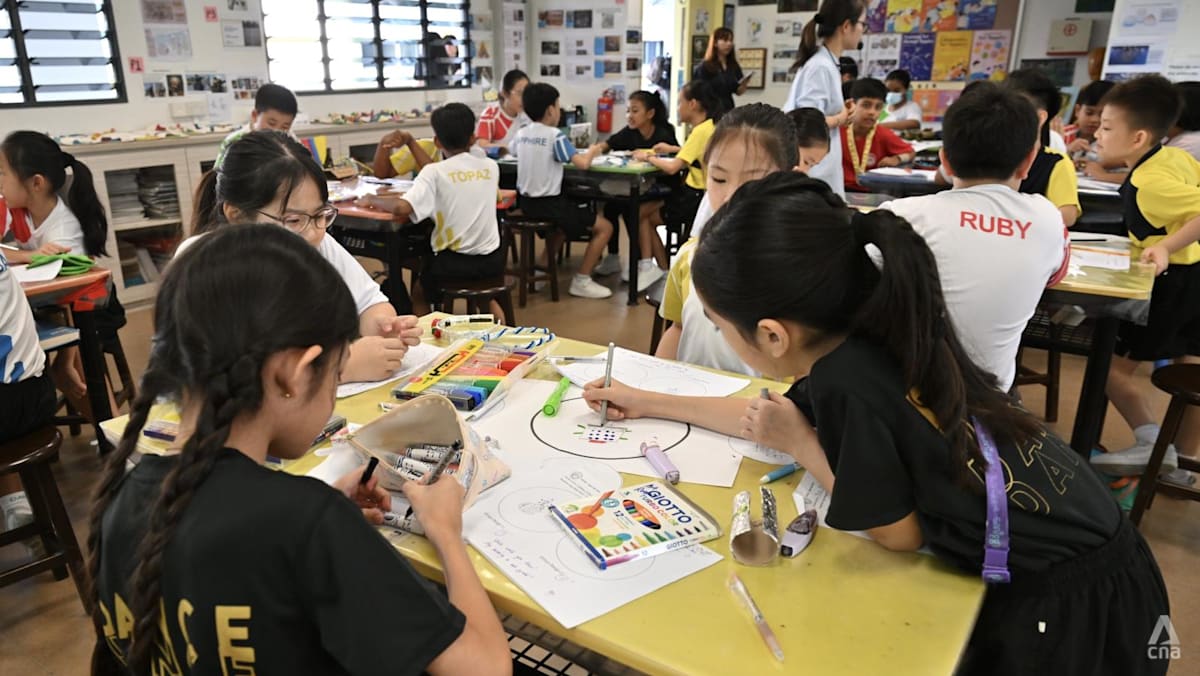
A classroom at Oasis Primary School on Jul 8, 2025. (File photo: CNA/Jeremy Long)
This audio is generated by an AI tool.
SINGAPORE: More parents in Singapore are embracing a holistic approach to their children's education, but academic signals remain important, with families spending more on tuition, a new study by the Institute of Policy Studies (IPS) has found.
Besides valuing happy learning environments and social-emotional development in schools, they also rely on markers of academic school standing, such as cut-off points and branding.
Published on Friday (Sep 25), the study examined parents' attitudes towards their children's education across four broad areas: the education system, schooling choices, educational stress and tuition or enrichment, as well as education policies.
Conducted by IPS Social Lab researchers Dr Mathew Mathews, Dr Melvin Tay and Dr Teo Kay Key, the study surveyed a nationally representative sample of 1,500 Singaporean and permanent resident parents with children attending local primary schools.
CNA Games Guess Word Crack the word, one row at a time Buzzword Create words using the given letters Mini Sudoku Tiny puzzle, mighty brain teaser Mini Crossword Small grid, big challenge Word Search Spot as many words as you can Show More Show Less Fieldwork was done from May to August 2026. The survey, which took about 30 minutes to complete in a single sitting, was done either online or in person with a surveyor during a household visit. The report compared selected findings with an IPS survey conducted in 2016. The two surveys are independent cross-sectional surveys of parents, rather than following the same parents over time. The latest survey found that parents' broad confidence in Singapore’s education system has remained high, and views of the system as highly competitive have remained broadly stable. At the same time, 68.7 per cent of parents in 2026 agreed that the education system caused unnecessary stress to children, down from 76.3 per cent in 2016.
Fieldwork was done from May to August 2026. The survey, which took about 30 minutes to complete in a single sitting, was done either online or in person with a surveyor during a household visit.
The report compared selected findings with an IPS survey conducted in 2016. The two surveys are independent cross-sectional surveys of parents, rather than following the same parents over time.
The latest survey found that parents' broad confidence in Singapore’s education system has remained high, and views of the system as highly competitive have remained broadly stable.
At the same time, 68.7 per cent of parents in 2026 agreed that the education system caused unnecessary stress to children, down from 76.3 per cent in 2016.
Speaking to reporters on Friday, Dr Mathews said parents reported less stress and anxiety over their child’s homework or being there for exam preparation, but greater concern about whether their child was reaching his or her full potential.
He added that parents’ behaviour is often driven by concerns about their child’s future and there is a perception that missing out on the “right” school or programme could put their child at a disadvantage.
“I think we do need to help parents better understand the many options and pathways that exist in Singapore,” Dr Mathews said. “One step into a particular school does not mean an end of their future.”
HOLISTIC DEVELOPMENT
According to the study, 90.2 per cent of parents continue to rate Singapore’s education system highly in 2026, similar to 90.3 per cent in 2016.
Fewer parents believed the system caused unnecessary stress to children, with the proportion falling to 68.7 per cent from 76.3 per cent in the same period.
More parents also believed children should be allowed to fail and learn from their mistakes, rising to 79 per cent from 62.2 per cent.
When choosing schools, parents’ growing emphasis on holistic development was also reflected in the factors they considered important.
For primary schools, teachers who care for students’ social-emotional development remained the highest-rated factor.
Competitive environments and alumni networks fell in importance by 19.9 and 14.2 percentage points, respectively.
For secondary schools, parents most prioritised the holistic fit of the school for their child, with character and values (95 per cent), discipline (91 per cent) and their child’s own preference (88.8 per cent) rated highly.
When comparing with the 2016 data, IPS researchers noted that the holistic features of a good primary school remain highly valued, while the importance of several traditional achievement-oriented markers has declined.
“Parents also continue to emphasise character, self-discipline and other developmental outcomes as important goals of primary education,” the researchers said.
ACADEMIC SIGNALS IMPORTANT
Despite this shift towards holistic development, academic signals are still viewed as important.
Among conventional academic or results-oriented factors, a record of good PSLE scores and a history of students enrolling in reputable secondary schools remained the most important.
However, the proportion of parents who viewed these factors as important dropped by around seven to 10 percentage points.
Parents still perceived the PSLE as a useful indicator, but desired lower-stakes assessments and broader recognition of strengths. They also remain attached to familiar markers of merit and certainty.
About 85.9 per cent of respondents indicated that the PSLE is still an important checkpoint that helps children set goals and prepare for secondary school.
Parents also felt that a national standardised exam like the PSLE was still necessary to assess students fairly.
However, most of them preferred some change to the current PSLE arrangement, with 73.7 per cent indicating so.
There was stronger support for reducing its high-stakes nature (45.6 per cent), with fewer supporting other options, such as postponing it to a later stage (12.4 per cent), removing it (10.3 per cent), or making it optional (5.4 per cent).
The remaining 19.4 per cent preferred retaining the PSLE in its current form, while 6.9 per cent did not have a view or preference.
Since the previous survey in 2016, the Ministry of Education (MOE) has introduced numerous policy changes across the primary and secondary education system.
For instance, the numerical PSLE T-score was replaced by the achievement level scoring system in 2021, mid-year examinations were progressively removed across all primary and secondary levels by 2023, and the Express, Normal (Academic) and Normal (Technical) course structure was replaced by full subject-based banding.
Around two-thirds of parents said the PSLE achievement level scoring system makes it harder for their children to get into their school of choice, and 85.6 per cent felt the system still causes significant stress.
The Direct School Admission (DSA) scheme was valued as a complement to PSLE, but most parents still preferred PSLE-based posting.
The DSA provides a pathway for students to gain admission to secondary schools based on their interests, aptitude and potential, beyond their performance at the PSLE.
The scheme was viewed positively by over four in 10 parents. Nearly six in 10 were considering DSA as a possible option for their child, while the same proportion felt that DSA better recognised their child’s strengths than PSLE.
About 78.2 per cent also saw it as a useful hedge against underperforming in PSLE.
However, 75.8 per cent indicated they would prefer their child to enter secondary school based on PSLE results rather than through DSA.
For secondary schools, markers of academic school standing remained important, including cut-off points (75.8 per cent), O- or N-Level scores (66.5 per cent), school branding (52.5 per cent) and competitive environment (50.6 per cent).
SPENDING MORE ON TUITION
Parents surveyed remained critical of excessive tuition and enrichment, but were investing more in both, the study found.
About 74.9 per cent of parents believed that parents needed to heavily invest in quality tuition to succeed in Singapore’s education system, down slightly from 78.9 per cent in 2016.
At the same time, nearly nine in 10 parents agreed that children in the country spend too much time on tuition and enrichment.
Despite this, 70.2 per cent of parents said they would spend more on tuition and enrichment if they had the resources to do so.
Tuition is viewed primarily as a means to give children an advantage in the PSLE and help them reach their potential, while enrichment is more commonly associated with developing skills outside the classroom.
Expenditure on both tuition and enrichment classes has also risen since 2016.
The mean monthly tuition expenditure rose to S$677 in 2026 from S$318 in 2016. When adjusted for inflation, this represents a rise from approximately S$386 to S$677.
Mean monthly enrichment expenditure rose to S$355 in 2026 from S$125 in 2016. When adjusted for inflation, this represents a rise from about S$152 to S$355.
Although parents placed greater value on holistic development, this has not translated into less parental stress, the IPS study found.
The proportion of parents who reported arguing with their spouse over their children's education - ranging from at least once in the past year or up to once a week or more - increased to 59.7 per cent in 2026 from 42.8 per cent a decade ago.
Those who reported feeling stressed - ranging from at least once in the past year or up to once a week or more - rose to 87.9 per cent from 73.1 per cent in the same period.
Fewer parents supported disciplining children for poor exam results, down to 50 per cent in 2026 from 66.7 per cent in 2016. The factors contributing to this stress have also shifted over time, the study found.
“While concerns relating directly to examinations and schoolwork have become less prominent, parents are now more likely to worry that their children are not obtaining the grades they are capable of, may lose out in the education system in the longer run, or are not keeping up with what is taught in school.”
Parents were less likely to agree that the system causes children undue stress, but reported more frequent stress-related behaviours themselves.
“One possible explanation is that parental stress has shifted from immediate examination pressure to broader uncertainty about children’s longer-term educational prospects, especially in the ever-increasing global competition for jobs,” the researchers said.
The study further explained that while assessment reforms may have reduced the salience of specific tests, they may also have left parents managing a wider set of concerns, including whether their children are keeping up, developing holistically, building relevant skills and remaining competitive for future pathways.
“In this sense, educational competition may have diversified rather than disappeared, moving into tuition, enrichment, school choice and alternative admissions routes.”
SHIFT IN PARENTAL ATTITUDES
While the study showed that parental attitudes towards education in Singapore have moved in the past decade from academic competition towards holistic development, the study found that this shift is not necessarily linear, with a large portion of parents increasingly holding both orientations at once.
“Parents continue to value what a school’s education can provide to their child in terms of character, self-discipline, social-emotional development, and a happy learning environment, and place less importance than parents did in 2016 on several conventional markers of a ‘good’ primary school, including competitive environments, alumni networks and records of academic achievement,” said the researchers.
The study showed that parents were more willing to say children should be allowed to fail and learn, and less willing to endorse disciplining children for poor examination performance.
“Yet these attitudinal changes coexist with continued concern about academic positioning, greater use of tuition and enrichment, and rising expenditure on both.
“Educational ambition is not necessarily declining, though it is being expressed through a broader combination of academic, developmental and well-being goals,” said the researchers.
The study also suggested that the central challenge for Singapore’s education system is no longer simply to persuade parents of the value of holistic development, since parents already placed considerable value on character, social-emotional development, and child-school fit.
The harder task is to make it easier for parents to act on their holistic aspirations while managing continuing concerns about their children’s academic progress and future opportunities.
“If holistic development is to become more than an aspiration layered onto continuing competition, reforms will need to reduce the positional stakes attached to school placement, make information and support more accessible, and ensure that meaningful academic and developmental opportunities do not depend disproportionately on family resources,” said the researchers.
They added that the key question for the next phase of education reform is how to reduce the tension between the holistic development parents say they value and the strategies many continue to pursue to safeguard their children’s academic progress and future opportunities.
“Achieving that alignment would allow educational ambition to remain strong while being expressed in ways that are healthier, fairer and more consistent with Singapore’s commitment to mobility and opportunity,” they said.
Get our pick of top stories and thought-provoking articles in your inbox
Stay updated with notifications for breaking news and our best stories
Join our channel for the top reads for the day on your preferred chat app
政策研究所的这项研究调查了过去 10 年来家长对教育的看法发生了怎样的变化。
2025年7月8日,绿洲小学的一间教室。(资料照片:CNA/Jeremy Long)
这段音频是由人工智能工具生成的。
新加坡:政策研究所 (IPS) 的一项新研究发现,新加坡越来越多的家长开始采用全面教育的方式对待孩子的教育,但学业成绩仍然很重要,家庭在补习上的花费也越来越多。
除了重视学校中快乐的学习环境和社交情感发展之外,他们还依赖于学校学术地位的标志,例如录取分数线和品牌。
该研究于周五(9 月 25 日)发表,从四个方面调查了父母对子女教育的态度:教育体系、学校选择、教育压力和学费或课外辅导,以及教育政策。
该研究由 IPS 社会实验室的研究人员 Mathew Mathews 博士、Melvin Tay 博士和 Teo Kay Key 博士进行,调查了 1500 名新加坡公民和永久居民父母的全国代表性样本,这些父母的孩子都在当地小学就读。
CNA游戏猜词游戏:逐行破解单词;流行词游戏:用给定的字母组成单词;迷你数独:小巧的谜题,强大的脑力挑战;迷你填字游戏:小方格,大挑战;单词搜索:尽可能多地找到单词。显示更多 显示更少 实地调查于2026年5月至8月进行。该调查大约需要30分钟即可完成,可通过在线方式或入户调查员上门完成。报告将部分调查结果与2016年IPS进行的一项调查进行了比较。这两项调查均为独立的横断面调查,调查对象均为家长,而非对同一批家长进行长期跟踪。最新调查发现,家长对新加坡教育体系的总体信心依然很高,对教育体系竞争激烈的看法也基本保持稳定。与此同时,2026年有68.7%的家长认为教育体系给孩子带来了不必要的压力,低于2016年的76.3%。
实地调查于 2026 年 5 月至 8 月进行。该调查大约需要 30 分钟即可一次性完成,可通过在线方式或由调查员上门进行面对面调查的方式完成。
该报告将部分调查结果与 2016 年进行的 IPS 调查进行了比较。这两项调查都是对父母进行的独立横断面调查,而不是对同一批父母进行长期跟踪调查。
最新调查发现,家长对新加坡教育体系的总体信心依然很高,认为该体系竞争激烈的观点也基本保持稳定。
与此同时,2026 年有 68.7% 的家长认为教育系统给孩子造成了不必要的压力,低于 2016 年的 76.3%。
马修斯博士周五在接受记者采访时表示,家长们反映,他们对孩子的家庭作业或考试准备方面的压力和焦虑有所减少,但更关心孩子是否充分发挥了自己的潜力。
他还补充说,父母的行为往往是出于对孩子未来的担忧,他们认为错过“合适的”学校或课程可能会让孩子处于不利地位。
“我认为我们确实需要帮助家长更好地了解新加坡现有的各种选择和途径,”马修斯博士说。“进入某所学校并不意味着他们未来的终点。”
全面发展
根据这项研究,90.2% 的家长在 2026 年仍然对新加坡的教育体系给予高度评价,与 2016 年的 90.3% 相似。
认为该制度会给孩子造成不必要的压力的家长比例有所下降,从同期的 76.3% 降至 68.7%。
越来越多的家长认为应该允许孩子失败并从错误中吸取教训,这一比例从 62.2% 上升到 79%。
在选择学校时,家长们越来越重视孩子的全面发展,这一点也体现在他们认为重要的因素上。
对于小学而言,关心学生社交情感发展的教师仍然是评价最高的因素。
竞争环境和校友网络的重要性分别下降了 19.9 和 14.2 个百分点。
对于中学,家长最看重的是学校是否与孩子全面契合,其中品格和价值观(95%)、纪律(91%)以及孩子自身的喜好(88.8%)都获得了很高的评价。
与 2016 年的数据相比,IPS 研究人员指出,一所优秀小学的整体特征仍然备受重视,而一些传统的以成绩为导向的指标的重要性有所下降。
研究人员表示:“家长们也继续强调品格、自律和其他发展成果是小学教育的重要目标。”
学术信号很重要
尽管这种趋势转向了全面发展,但学业成绩仍然被认为很重要。
在传统的学术或结果导向因素中,小学离校考试(PSLE)的良好成绩记录和学生进入知名中学就读的历史仍然是最重要的。
然而,认为这些因素重要的家长比例下降了约 7 到 10 个百分点。
家长们仍然认为小学离校考试(PSLE)是一个有用的指标,但他们希望评估结果的风险更低,并且能够更全面地认可孩子的优势。他们也仍然执着于那些熟悉的衡量优秀和确定性的标准。
约 85.9% 的受访者表示,小学离校考试 (PSLE) 仍然是一个重要的检查点,可以帮助孩子们设定目标并为中学做好准备。
家长们也认为,像小学离校考试(PSLE)这样的全国性标准化考试仍然是公平评估学生的必要手段。
然而,73.7% 的人表示他们更倾向于对目前的小学离校考试安排进行一些改变。
45.6% 的人更支持降低其高风险性,而支持其他选项的人较少,例如将其推迟到后期阶段(12.4%)、取消它(10.3%)或使其成为可选的(5.4%)。
其余 19.4% 的人倾向于保留小学离校考试 (PSLE) 的现有形式,而 6.9% 的人没有意见或偏好。
自 2016 年上次调查以来,教育部在中小学教育体系中推行了多项政策改革。
例如,2021 年,PSLE 的数值 T 分数被成绩等级评分系统取代;到 2023 年,小学和中学各阶段的年中考试逐步取消;快捷班、普通(学术)班和普通(技术)班的课程结构被完全基于科目的分级制度取代。
约三分之二的家长表示,小学离校考试(PSLE)的成绩等级评分制度使他们的孩子更难进入理想的学校,85.6% 的家长认为该制度仍然会造成很大的压力。
直接入学计划(DSA)被视为小学离校考试(PSLE)的补充,但大多数家长仍然更喜欢以小学离校考试(PSLE)为基础的入学方式。
DSA 为学生提供了一条途径,让他们能够根据自己的兴趣、能力和潜力,而不是仅仅依靠在小学离校考试 (PSLE) 中的表现,进入中学就读。
超过四成的家长对该计划持积极态度。近六成家长正在考虑将DSA作为孩子可能的入学选择,同时,也有相同比例的家长认为DSA比PSLE更能体现孩子的优势。
约 78.2% 的人也认为这是对冲小学离校考试 (PSLE) 成绩不佳的有效手段。
然而,75.8% 的受访者表示,他们更希望孩子根据小学离校考试 (PSLE) 成绩进入中学,而不是通过直接入学计划 (DSA)。
对于中学而言,衡量学校学术地位的指标仍然很重要,包括录取分数线(75.8%)、O水准或N水准成绩(66.5%)、学校品牌(52.5%)和竞争环境(50.6%)。
在学费上花费更多
研究发现,受访家长仍然对过高的学费和课外活动持批评态度,但他们在这两方面的投入却越来越多。
约 74.9% 的家长认为,家长需要投入大量资金进行高质量的补习才能在新加坡的教育体系中取得成功,这一比例略低于 2016 年的 78.9%。
与此同时,近九成家长认为,该国的孩子在补习和课外活动上花费了太多时间。
尽管如此,70.2% 的家长表示,如果他们有经济能力,他们会在补习和课外活动上投入更多资金。
补习主要被视为让孩子在小学离校考试 (PSLE) 中获得优势并帮助他们发挥潜力的手段,而课外活动则更常与培养课堂外的技能联系在一起。
自 2016 年以来,学费和课外辅导班的支出也有所增加。
2026 年,平均每月学费支出从 2016 年的 318 新元增至 677 新元。经通货膨胀调整后,相当于从约 386 新元增至 677 新元。
2026 年,每月平均课外活动支出从 2016 年的 125 新元增至 355 新元。经通货膨胀调整后,相当于从约 152 新元增至 355 新元。
IPS 研究发现,尽管父母更加重视全面发展,但这并没有减轻父母的压力。
报告称,过去一年中至少与配偶就子女教育问题发生过一次争吵,甚至每周一次或以上的父母比例,从十年前的 42.8% 增加到 2026 年的 59.7%。
在过去一年中至少感到压力一次,或每周一次或更多次的人表示感到压力,这一比例从同期的 73.1% 上升至 87.9%。
研究发现,支持因孩子考试成绩差而对其进行管教的家长比例从 2016 年的 66.7% 下降到 2026 年的 50%。导致这种压力的因素也随着时间推移而发生了变化。
“虽然与考试和学业直接相关的担忧有所减少,但家长们现在更可能担心他们的孩子没有取得他们应有的成绩,从长远来看可能会在教育体系中处于劣势,或者跟不上学校的教学进度。”
家长们不太认同该制度会给孩子带来不必要的压力,但他们自己却报告说,与压力相关的行为更加频繁。
研究人员表示:“一种可能的解释是,父母的压力已经从眼前的考试压力转移到对孩子长期教育前景的更广泛的不确定性,尤其是在日益激烈的全球就业竞争中。”
该研究进一步解释说,虽然评估改革可能降低了特定考试的重要性,但也可能让家长们面临更广泛的担忧,包括他们的孩子是否跟上进度、全面发展、培养相关技能以及在未来的道路上保持竞争力。
“从这个意义上讲,教育竞争可能已经多元化而非消失,转向了学费竞争、课外活动竞争、择校竞争和替代入学途径。”
父母态度的转变
虽然研究表明,过去十年新加坡家长对教育的态度已经从学术竞争转向全面发展,但研究发现,这种转变并不一定是线性的,越来越多的家长同时持有这两种观点。
研究人员表示:“家长们仍然重视学校教育能够为孩子提供的品格、自律、社交情感发展和快乐的学习环境,与 2016 年的家长相比,他们对一些传统的‘好’小学指标的重视程度有所降低,这些指标包括竞争环境、校友网络和学业成就记录。”
研究表明,家长们更倾向于认为应该允许孩子经历失败并从中学习,而不太赞成因为孩子考试成绩不好而惩罚他们。
“然而,这些态度上的变化与人们对学术地位的持续关注、对学费和课外活动的更多投入以及在这两方面的支出不断增加并存。
研究人员表示:“教育抱负未必在下降,尽管它正通过更广泛的学术、发展和福祉目标组合来表达。”
该研究还表明,新加坡教育体系面临的核心挑战不再仅仅是说服家长全面发展的价值,因为家长们已经非常重视品格、社交情感发展以及儿童与学校的匹配度。
更难的是,如何让家长更容易地实现他们的全面发展愿望,同时又能应对他们对孩子学业进步和未来机会的持续担忧。
研究人员表示:“如果全面发展要成为不仅仅是持续竞争之外的一个愿望,改革就需要减少与入学名额挂钩的地位风险,使信息和支持更容易获得,并确保有意义的学术和发展机会不会过度依赖于家庭资源。”
他们补充说,下一阶段教育改革的关键问题是如何减少家长们所重视的全面发展与许多家长为了保障子女的学业进步和未来机会而继续采取的策略之间的矛盾。
他们表示:“实现这种协调一致,既能让教育抱负保持强劲势头,又能以更健康、更公平、更符合新加坡对流动性和机会的承诺的方式表达出来。”
订阅我们的邮件,即可获取精选热点新闻和引人深思的文章。
订阅通知,第一时间获取突发新闻和精彩报道。
加入我们的频道,即可在您常用的聊天应用上获取当日热门文章。