Family business fights rising costs to keep nasi lemak at S$2, even with rent of S$10,000即使租金高达1万新元,家族企业仍努力将椰浆饭的价格维持在2新元。
His parents see their stall’s best-known dish as a way of giving back, leaving second-generation owner Adam Danish to make the numbers work. CNA’s Money Mind finds out what the family must do.
新闻视频
His parents see their stall’s best-known dish as a way of giving back, leaving second-generation owner Adam Danish to make the numbers work. CNA’s Money Mind finds out what the family must do.
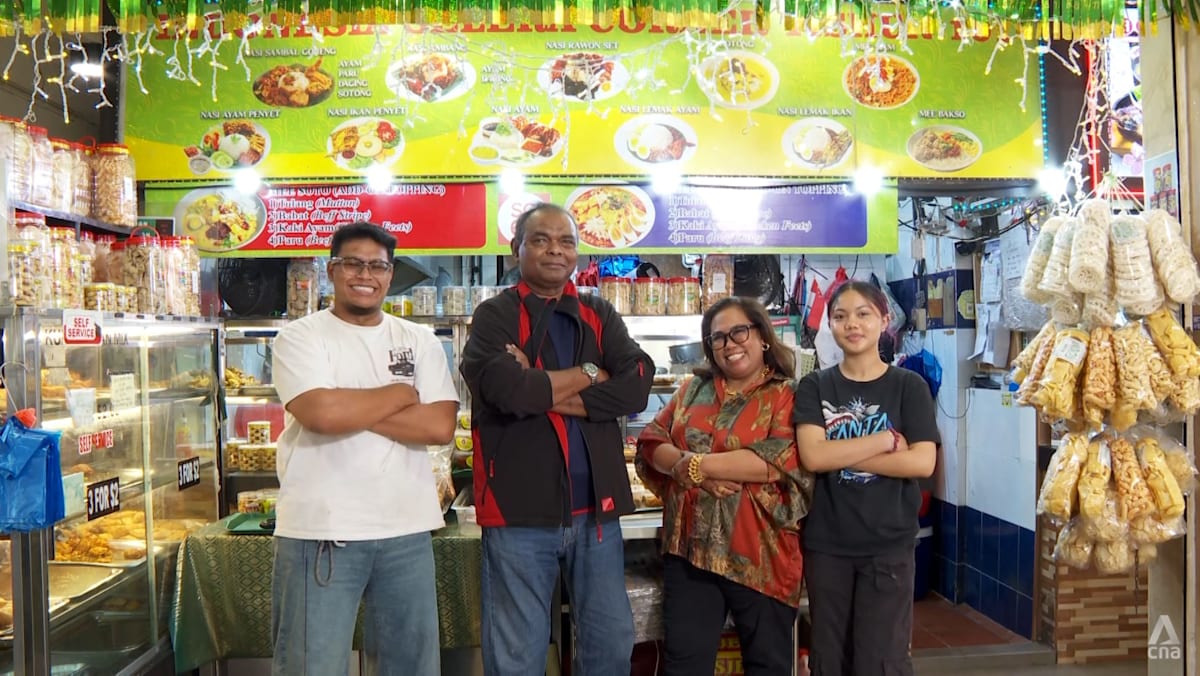
(From left): Adam Danish, Reban Kasran, Sakdiah Abdul Latiff and Nurangellina Hassan run Indonesian Selera Corner in Block 101, Yishun Avenue 5.
This audio is generated by an AI tool.
SINGAPORE: For a food stall whose rent is nearly S$10,000 (US$7,820) a month, but still sells nasi lemak at S$2, one might think its owners did calculate the cost of selling at that price.
Certainly, that was what Adam Danish thought until he joined the family business this year. “It was messy, because there weren’t any numbers being recorded,” said the 25-year-old second-generation owner of Indonesian Selera Corner in Yishun.
Without crunching the numbers properly, it was hard to tell if sales were covering costs — and if the family can keep the dish to S$2, a price they have maintained for more than a decade.
They run their stall in a privately owned coffee shop, where rents are commercially based and can be considerably higher than at government-run hawker centres. With utilities, the family pays S$13,000 a month, before manpower and ingredient costs.
CNA Games Guess Word Crack the word, one row at a time Buzzword Create words using the given letters Mini Sudoku Tiny puzzle, mighty brain teaser Mini Crossword Small grid, big challenge Word Search Spot as many words as you can Show More Show Less
A packet of the stall’s S$2 nasi lemak.
Those cost pressures are climbing too. Adam said supplies and utilities were among the stall’s biggest cost increases over the past year, and the family has already had to raise the prices of many other dishes by 50 cents.
But not the S$2 nasi lemak, which his parents began selling after an elderly customer said she wanted something smaller than their standard S$5.50 portion.
They later found the smaller serving also suited other customers, such as workers caught up in the morning rush who need to grab a quick bite to eat.
The stall now sells about 200 packets a day. For Adam’s parents, this was never meant to be a big money-maker, but rather a little something for customers including large families, low-income households and the elderly.
The couple have been operating Indonesian Selera Corner for more than 20 years.
“I believe what we get we have to return to the public,” said his mother, Sakdiah Abdul Latiff, 53.
But can Adam and his sister, Nurangellina Hassan, 18, who goes by Angel, keep the stall going without raising the price of a dish their parents want to keep affordable?
They must get the business’ finances in order, rein in costs and find new revenue sources, Money Mind finds out.
GETTING A GRIP ON FINANCES
When Adam joined the business, its accounts were not detailed enough to show how much each dish was making.
His parents had been looking at “top line numbers” instead of the bottom line, he said, referring to the amount they received from sales. This did not give them a clear view of their profit margins.
So, he began breaking down the costs. A S$2 packet of nasi lemak with rice (30 cents), fish (40 cents), egg (10 cents), sambal (20 cents) and other sides (30 cents), such as cucumber and peanuts, is worth S$1.30 in ingredients — before the other operational costs are added.
But nasi lemak is only part of a wider menu that includes epok epok (fried pastries) and nasi padang (Indonesian-style rice meal). And the latter is the stall’s main revenue earner: On average, customers spend about S$7 per order.
Adam worked out the break-even point for the stall as a whole: It needs to sell 159 plates of food every day, at S$7.40 each. This is before the family draw their salaries.
Adam not only does the sums, but also works behind the counter.
Getting the accounts in order also gave him a clear idea of what the business could pay him, which, for the first four months, was nothing.
His first pay cheque, in June, was S$1,500. And his target is a salary of S$4,000 a month, which he has yet to reach.
The family has also been looking more closely at costs — without lowering the quality of its food.
That requires “extra homework”, said Reban. For example, the family now buys fish at Jurong Fishery Port to “get the best price”, rather than from a fishmonger at the market.
Adam is looking at other operating expenses too. They spend about S$600 to S$700 a week on cooking gas and plan on switching to electric cookers, which he estimates would cut that cost by about half.
Sakdiah scooping food into a box for a customer.
They have reduced petrol costs by, for example, making fewer trips to Jurong Fishery Port and filling up at a cheaper petrol station, paying S$190 for a full tank instead of S$220 to S$230 at the station near the stall.
But there is a limit to how much the family can save. “We can’t always look at reducing costs because things aren’t going to get cheaper,” said Adam.
“I’LL TAKE EVERY WIN”
There is room to bring in more revenue, however. Over the years, the family expanded the menu to include dishes such as nasi ambeng and nasi jenganan — both are Javanese-style rice sets — and introduced mini buffets.
More recently, Adam and Angel have taken the business online via TikTok Live, using different bundle deals and promotions to draw customers. She handles the morning livestreams, and he takes over from her in the afternoon.
Angel selling online through TikTok Live.
Some of the dishes with promotional deals.
With customers placing their orders via WhatsApp for pickup or delivery, the stall can reach people beyond Yishun. After about two months, said Adam, the gross revenue from the livestreams was as much as S$12,000.
Still, sales are not guaranteed. There are livestreams where they receive no orders. “It’s a new stream of revenue, so I’ll take every win,” he said. “But I believe we can do much better in the future.”
Taking orders online created a manpower challenge, however. Adam found it difficult to host a livestream while simultaneously responding to WhatsApp enquiries.
So he began using an artificial intelligence chatbot to process kitchen orders. It costs him S$50 a month, compared with the estimated S$900 it would cost to hire someone specifically for the role.
Previously, he could spend an hour and a half sorting out orders before packing them, he recalled. With the chatbot, they can be done at the same time, freeing him up to upsell to livestream viewers.
For all these changes made to the family business, its S$2 nasi lemak remains untouched. “That’s the only thing that we can (give) back to the public,” Reban said. “That’s why I say (to) my wife, we stay with it.”
Watch this Money Mind segment here . The programme airs every Wednesday at 9pm.
CNA's best current affairs documentaries with a deeper look at issues affecting Asia, sent to your inbox weekly.
Get our pick of top stories and thought-provoking articles in your inbox
Stay updated with notifications for breaking news and our best stories
Join our channel for the top reads for the day on your preferred chat app
他的父母将摊位上最出名的菜肴视为回馈社会的一种方式,而让第二代经营者亚当·丹尼什来维持收支平衡则成了当务之急。CNA的《理财之道》栏目将带您了解这家人必须如何应对。
(左起):Adam Dutch、Reban Kasran、Sakdiah Abdul Latiff 和 Nurangellina Hassan 在义顺 5 大道 101 街区经营印尼 Selera 角。
这段音频由人工智能工具生成。
新加坡:一个食品摊位的月租金接近 10,000 新元(7,820 美元),但椰浆饭却只卖 2 新元,人们可能会认为摊主已经计算过以这个价格出售的成本。
当然,亚当·丹尼什在今年加入家族企业之前也是这么想的。“当时很混乱,因为没有任何数据记录,”这位25岁的第二代店主说道,他是义顺印尼风味餐厅Selera Corner的老板。
如果没有仔细核算,很难判断销售额是否足以支付成本,以及这家餐厅能否将这道菜的价格维持在 2 新元,而这个价格他们已经维持了十多年。
他们在一家私人咖啡店里摆摊,租金按商业标准收取,比政府经营的小贩中心要高得多。加上水电费,这家人每月要支付13000新元,这还不包括人工和食材成本。
CNA游戏 猜词游戏 逐行破解单词 流行词游戏 用给定的字母组成单词 迷你数独 小小谜题,挑战你的大脑 迷你填字游戏 小方格,大挑战 单词搜索 尽可能多地找出单词 显示更多 显示更少
一包摊位售价 2 新元的椰浆饭。
这些成本压力也在不断增加。亚当说,过去一年里,摊位上最大的成本增长点是物料和水电费,他们一家已经不得不将许多其他菜品的价格提高了50美分。
但不是售价 2 新元的椰浆饭,这是他的父母在一位老年顾客表示她想要比他们标准的 5.50 新元一份更小的份量后开始出售的。
他们后来发现,小份量的食物也适合其他顾客,例如早高峰期间需要快速吃点东西的上班族。
现在这个摊位每天大约能卖出200包。对亚当的父母来说,这从来就不是为了赚大钱,而是为了给包括大家庭、低收入家庭和老年人在内的顾客提供一些小东西。
这对夫妇经营印尼美食角已有20多年了。
“我认为我们得到的一切都应该回馈给公众,”他的母亲,53岁的萨克迪亚·阿卜杜勒·拉蒂夫说道。
但是,亚当和他的妹妹,18岁的努兰杰利娜·哈桑(昵称安琪儿),能否在不提高父母希望保持价格亲民的菜肴价格的情况下,继续经营这个摊位呢?
《理财之道》发现,他们必须理顺公司的财务状况,控制成本,并寻找新的收入来源。
掌控财务状况
亚当加入公司时,公司的账目不够详细,无法显示每道菜的利润。
他说,他的父母一直只关注“营业额”,而不是“利润”,也就是他们从销售额中获得的收入。这让他们无法清楚地了解利润率。
于是,他开始计算成本。一份售价2新元的椰浆饭,包含米饭(30分)、鱼(40分)、鸡蛋(10分)、叁巴酱(20分)以及其他配菜(30分),例如黄瓜和花生,食材价值仅为1.30新元——这还不包括其他运营成本。
但椰浆饭只是这家店众多菜品中的一部分,菜单上还包括炸点心(epok epok)和印尼式米饭(nasi padang)。而印尼式米饭才是这家摊位的主要收入来源:顾客平均每份消费约7新元。
亚当计算出了摊位的整体盈亏平衡点:每天需要卖出159份食物,每份7.40新元。这还不包括家人的工资。
亚当不仅负责计算,还在柜台后面工作。
整理好账目后,他也清楚地了解了公司能付给他多少钱,而头四个月,他一分钱也没拿到。
他六月份拿到的第一份工资是1500新元。他的目标是每月工资4000新元,但他尚未达到这个目标。
这家人也一直在更加仔细地控制成本——同时又不降低食品质量。
雷班说,这需要“额外的准备工作”。例如,他们一家现在会去裕廊渔港买鱼,以便“买到最优惠的价格”,而不是从市场上的鱼贩那里买。
亚当还在考虑其他运营开支。他们每周大约花费600到700新元用于烹饪燃气,计划改用电磁炉,他估计这样可以节省大约一半的费用。
萨克迪亚正在把食物舀进盒子里,准备交给顾客。
例如,他们减少了去裕廊渔港的次数,并在更便宜的加油站加油,从而降低了汽油成本。在摊位附近的加油站加满一箱油只需 190 新元,而加满一箱油则需要 220 至 230 新元。
但这个家庭的储蓄能力是有限的。“我们不能总是想着如何节省开支,因为物价不会一直下降,”亚当说。
“我接受每一场胜利”
不过,餐厅还有增加收入的空间。多年来,这家餐厅不断扩充菜单,增加了诸如nasi ambeng和nasi jenganan(均为爪哇风味米饭套餐)等菜品,并推出了迷你自助餐。
最近,亚当和安吉尔将业务拓展到线上,通过TikTok直播,利用各种套餐和促销活动吸引顾客。安吉尔负责上午的直播,亚当则在下午接替她的工作。
Angel通过TikTok直播进行线上销售。
部分菜品有促销优惠。
顾客可以通过WhatsApp下单自取或送货,这使得这家摊位的服务范围扩展到了义顺以外的地区。亚当表示,大约两个月后,直播带来的总收入高达12000新元。
不过,销售额并不能保证。有些直播甚至没有订单。“这是一条新的收入来源,所以我很珍惜每一次成功,”他说。“但我相信我们未来可以做得更好。”
然而,在线接单带来了人力方面的挑战。亚当发现,一边进行直播一边回复WhatsApp上的咨询非常困难。
于是他开始使用人工智能聊天机器人来处理厨房订单。每月花费50新元,而专门雇佣一个人来做这件事,估计要花费900新元。
他回忆说,以前他得花一个半小时整理订单才能打包。有了聊天机器人,这两项工作可以同时完成,让他有更多时间向直播观众推销其他商品。
尽管家族企业进行了诸多变革,但售价2新元的椰浆饭却始终未变。“这是我们唯一能回馈给公众的东西,”雷班说道,“所以我跟妻子说,我们要坚持下去。”
点击此处观看本期《理财之道》节目片段。该节目每周三晚9点播出。
每周将 CNA 精选的、深入探讨影响亚洲问题的时事纪录片发送到您的邮箱。
订阅我们的邮件,即可获取精选热点新闻和引人深思的文章。
订阅通知,第一时间获取突发新闻和精彩报道。
加入我们的频道,即可在您常用的聊天应用上获取当日热门文章。