'Feels more of a hotel, less like a home': Why residents at this Hillview condo are unhappy with co-living setups“感觉更像酒店,不像家”:为什么希尔维尤这栋公寓的居民对合租模式不满意
As co-living takes root in more condominiums, some residents in at least one condo are up in arms. Their complaints include having to jostle for facilities, strangers entering the compound and increased wear-and-tear in common areas.
新闻视频
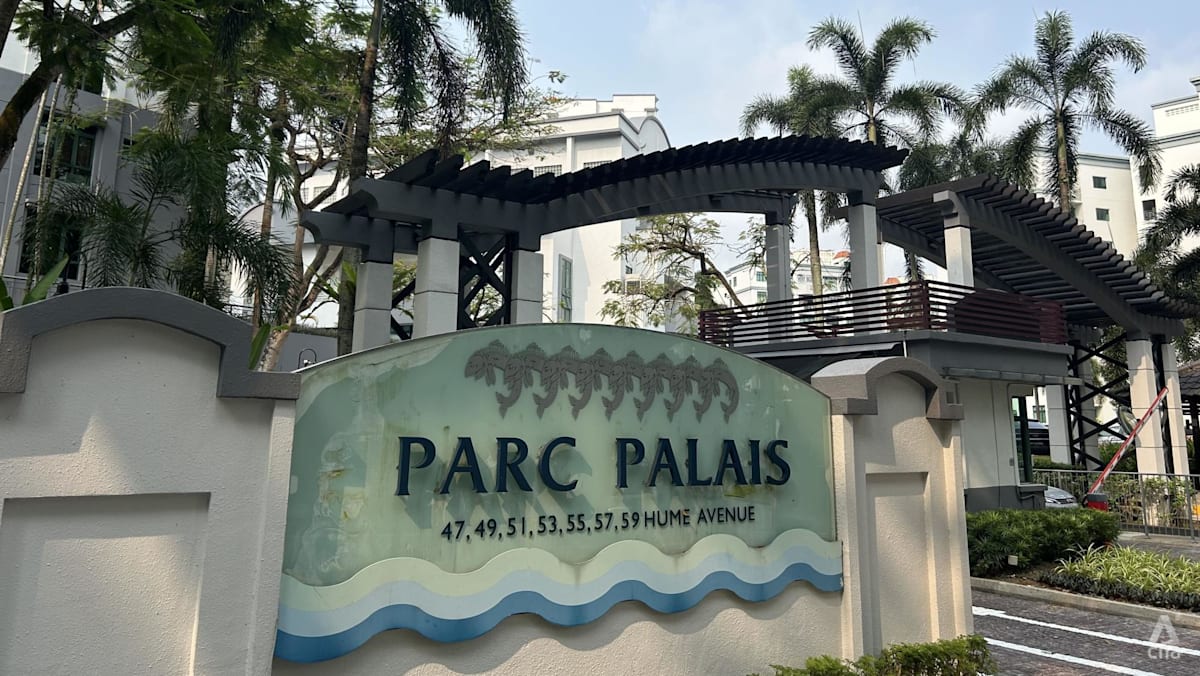
As co-living takes root in more condominiums, some residents in at least one condo are up in arms. Their complaints include having to jostle for facilities, strangers entering the compound and increased wear-and-tear in common areas.
Owners at Parc Palais in Hillview attended a meeting in July to discuss co-living and how the condominium could address their concerns. (Photo: CNA)
This audio is generated by an AI tool.
After living at her Hillview condominium for 15 years, Madam P Lina is familiar with most of the residents at the 517-unit estate.
"If you stay here for a long time, you will know everyone you meet," she told CNA TODAY.
But in the last two years, the 62-year-old has sometimes found it hard to put a name to a face.
Groups of unfamiliar faces started appearing at Parc Palais condominium, with many using the facilities like the gym, swimming pool and the poolside showers.
The retiree, who swims two to three times a week, said that it's now not unusual to see groups of 10 to 15 people taking a dip in the pool, which used to be relatively quiet.
She has also noticed more people using the common bathrooms by the pool, which she said were barely used in the past as residents preferred to head home to shower.
Mdm Lina attributes these changes to the emergence of co-living units in her estate, with at least five such units there now.
Co-living generally refers to accommodation arrangements where tenants have their own private living spaces and share communal facilities such as kitchens and lounges.
Up to six unrelated people can generally live in a private residential property, with each occupant required to stay for at least three consecutive months.
CNA Games Guess Word Crack the word, one row at a time Buzzword Create words using the given letters Mini Sudoku Tiny puzzle, mighty brain teaser Mini Crossword Small grid, big challenge Word Search Spot as many words as you can Show More Show Less For larger homes of at least 90 sqm, however, owners are required to register with the Urban Redevelopment Authority (URA) if they wish to house up to eight unrelated people under a temporary relaxation of the occupancy cap that has been extended until the end of 2028. Co-living is not new to Singapore, but the model has gained traction in recent years with private homeowners drawn to it as a way to increase rental income.
For larger homes of at least 90 sqm, however, owners are required to register with the Urban Redevelopment Authority (URA) if they wish to house up to eight unrelated people under a temporary relaxation of the occupancy cap that has been extended until the end of 2028.
Co-living is not new to Singapore, but the model has gained traction in recent years with private homeowners drawn to it as a way to increase rental income.
CONCERNS ABOUT SECURITY, CROWDING, WEAR AND TEAR
Mdm Lina and other Parc Palais residents' concerns about co-living arrangements at their estate prompted the condominium's Management Corporation Strata Title (MCST) to hold a meeting with property owners on July 31.
CNA TODAY understands that about 30 owners attended the meeting.
Residents, who spoke to CNA TODAY on the condition of anonymity, said questions raised at the meeting included:
How the management would keep track of this pool of transient occupants
How facilities would be managed given they were getting more crowded
What measures would be put in place if the number of co-living units increased.
Fire safety was also raised given how co-living units are sometimes partitioned to create additional bedrooms to house more tenants.
The discussion also included concerns about the increased use of shared amenities such as the pool, lifts, and other communal facilities, leading to greater wear and tear and potentially higher maintenance costs.
The swimming pool at Parc Palais, one of the common facilities shared by owners and tenants of the condominium. (Photo: CNA)
The residents noted that co-living units increase the number of people in the estate than would otherwise have been the case if the units had been rented out to families or couples.
Speaking to CNA TODAY after the meeting, Mdm Lina questioned whether it was fair for units with substantially fewer occupants to make the same maintenance contributions.
She said that units with more occupants could place greater demands on common facilities and result in higher maintenance costs.
Another resident, who has lived at the condominium for three years, said her main concern is the frequent turnover of tenants, which makes the estate feel "more of a hotel and less like a home".
"I have seen pictures shared by neighbours showing large groups of people walking in with their suitcases, guided by someone who looks like a property agent," she said.
"With tenants who rent for at least a year, they make the effort to get to know their neighbours and be a part of our community. But with people staying short-term, there are fewer reasons to care."
DOES CO-LIVING HAVE TO BE A PROBLEM?
CNA TODAY's checks with residents, management council members and property managers at 10 other condominiums with co-living units, however, suggest that the level of tension seen at Parc Palais is not widespread, at least for now.
Mr Dennis Tan, president of the MCST Association of Singapore, said that the association has observed a gradual increase in co-living-related issues cropping up at condominiums since early 2025.
He said that while the numbers have not been significant, the cases reaching the association may understate the extent of the issue, as MCSTs generally try to resolve problems themselves before seeking outside help.
At Rajah Tower in Balestier, for instance, management council chairman Kenny Lim said co-living units have existed for several years, but residents appear largely accustomed to them and complaints are limited to issues such as clutter outside units.
At The Bayshore in Bedok, management council chairman Chetan Khosla said the management has not received any complaints about co-living so far, although he has spotted online listings that appear to offer such arrangements in the development.
"We have to monitor. Once we see that dynamics of the estate are changing ... then we might have to make some guidelines," he said.
Real estate consultancy Knight Frank Singapore, which manages more than 55,000 units across 160 strata-titled developments, said complaints relating to co-living have so far remained "manageable".
Ms Eleana Teo, its senior managing director of strata management, estimated that co-living arrangements were present in about 10 to 15 per cent of the residential developments under the firm's management.
Another property firm, Ocean IFM, which manages about 170 strata developments, similarly said co-living-related complaints were not widespread across its portfolio, arising only occasionally at some developments.
Where complaints do arise, however, both firms said they tend to involve concerns similar to those raised at Parc Palais, including security and access control, unfamiliar or changing occupants, noise and the use of common facilities.
But Ocean IFM managing director Andy Lim said that such issues were not necessarily unique to co-living and could similarly arise from conventional tenancies.
"A properly managed co-living arrangement with occupants staying for the required minimum period may create little or no greater impact than a conventional tenancy," Mr Lim said.
Mr Ernee Ong, chief executive of co-living operator Bespoke Habitat, agreed with Mr Lim.
Mr Ong said that before operating in a new condominium development, his team checks its by-laws and requirements.
They also provide tenant details to the MCST for registration and verification and require tenants to comply with the condominium's access and security procedures.
"If concerns do come up, our approach is to speak with the relevant parties, understand the concern and work towards an amicable resolution," said Mr Ong, adding that his firm had managed a Parc Palais unit for about three years until earlier this year.
CNA TODAY reached out to other co-living companies operating in Parc Palais, as well as real estate agents marketing co-living units there. They either declined to comment or did not respond.
USE OF BY-LAWS REMAINS LIMITED
Parc Palais' meeting on co-living ended after two hours with no clear conclusion, though residents were told they could submit their suggestions to the management office.
Various options were discussed, including improving access control by upgrading the security management system and ways to better keep track of occupants, but it remained unclear what powers the MCST had in regulating lawful co-living arrangements.
A spokesperson for the MCST's management council of Parc Palais declined to comment when CNA TODAY asked how it planned to manage residents' concerns on co-living arrangements.
What was clear, though, from residents CNA TODAY spoke to was that there is no straightforward way for the MCST to prevent owners from renting out their units for co-living, as long as they comply with URA regulations.
An MCST comprises all unit owners in a strata development, while its management council is an elected group of owners that oversees day-to-day matters.
A recent dispute at another condominium highlighted the limits of what MCSTs can achieve through by-laws. In June, the Building and Construction Authority (BCA) clarified that condominium by-laws cannot restrict an owner's right to lease his or her property.
The clarification followed reports about Casa Aerata, a 78-unit condominium in Geylang, where its management council had passed by-laws restricting certain groups of foreign workers from living in the development.
One by-law passed in March 2025 prohibited unit owners from housing work permit holders, while another passed in January this year stipulated which groups of foreign employees were eligible to rent units there.
BCA subsequently said that while MCSTs can make by-laws regulating the management and use of common property, these cannot restrict an owner's right to transfer, lease, mortgage or otherwise deal with his or her property.
For condominiums grappling with co-living, the focus is therefore largely on managing its impact on the wider estate rather than trying to prevent owners from renting out their units.
Ms Winnie Wong, senior managing director of property management at Savills Singapore, which manages Parc Palais, declined to comment on the situation at the condominium specifically.
Speaking about co-living more generally, Ms Wong said these arrangements could create additional management challenges, including the heavier use of facilities, wear and tear, security and overcrowding.
Ms Wong said some condominiums have introduced facial-recognition systems, partly because conventional access cards can easily be passed from one occupant to another when tenants change.
"We cannot stop co-living. We can only manage the situation," she said.
Two lawyers told CNA TODAY that MCSTs can use by-laws to regulate matters such as common property, security, noise, nuisance and facility use, but by-laws that single out co-living arrangements or seek to restrict an otherwise lawful residential use may be open to challenge.
"The focus therefore has to be on regulating conduct and the use of common property rather than restricting ownership rights," said Mr Ivan Tay, director at Robertson Chambers LLC.
Ms Elaine Low, director at Peter Low Chambers LLC, similarly said that where co-living arrangements are lawful, MCSTs should not try to "eliminate or economically penalise the model".
When it comes to crowded facilities, Mr Tay said a theoretical by-law allowing only two occupants from a co-living unit to use the pool or gym at once, while allowing larger groups from other households to do so, could be criticised as discriminatory.
A more defensible approach, he said, would be to impose capacity limits that apply equally to all residents.
For facilities that require reservations, such as tennis courts or function rooms, Mr Tay said MCSTs could also allocate bookings on a per-unit basis, giving every unit the same number of slots regardless of how many people live there.
He said this would be easier to justify because it treats all units equally and manages competition for limited facilities without distinguishing between family households, tenants or co-living occupants.
"However, the specific by-law should still be carefully drafted to ensure it is reasonable and proportionate," he said, adding that it should also prevent residents from abusing the booking system to deprive others of access to the facilities.
Ms Low added that rules do not necessarily have to apply identically to every unit, but any differential treatment should be "objectively connected to the operational impact" rather than simply targeting a unit because it is labelled as co-living.
There is, however, less flexibility when it comes to maintenance contributions.
Both lawyers said these are generally determined according to a unit's share value rather than the number of people living there. Ms Low said maintenance- and sinking-fund contributions "must be levied in proportion to each lot's share value", with narrow exceptions unlikely to apply in this situation.
Even if residents flag suspected overcrowding or unauthorised internal partitions to the management council, the MCST has "no general statutory power" to enter a private unit to investigate, Ms Low said.
Suspected occupancy breaches are principally a planning-enforcement matter for URA, she added. BCA may also be relevant where partitions constitute unauthorised building works or affect structural or building-control requirements, while the Singapore Civil Defence Force may be involved where the configuration creates fire-safety risks.
For property managers, however, clearer rules could help as co-living becomes more common.
Knight Frank's Ms Teo said it would help if the authorities introduced standard co-living guidelines and model by-laws that set out more clearly the responsibilities of owners, operators and MCSTs.
A private condo is not the right place to have co-living units. We are not ready.
In response to CNA TODAY's queries, URA said that existing rental rules seek to balance homeowners' flexibility to rent out their properties with the need to "safeguard the residential character and amenity of neighbourhoods" and maintain a conducive living environment.
The agency said it investigates suspected breaches of occupancy caps and minimum-stay requirements in private residential properties. In 2025, it investigated 544 cases involving suspected occupancy-cap breaches, up from 534 in 2024.
Cases involving suspected breaches of the minimum three-month stay requirement rose from 200 in 2024 to 219 in 2025.
URA said it does not track how many such cases involved properties marketed as co-living spaces, nor does it maintain separate statistics on co-living-related feedback.
Asked whether additional guidelines were needed for co-living arrangements within private condominiums, URA noted that co-living is not a formal planning or regulatory term and that prevailing rental rules apply regardless of whether a private residential property is marketed as co-living.
For concerned residents like Mdm Lina, knowing that co-living units in her condominium are not breaking any laws provides little solace.
Even when such arrangements comply with occupancy and minimum-stay requirements, Mdm Lina remains unconvinced that conventional condominiums are equipped to accommodate the model.
"A private condo is not the right place to have co-living units. We are not ready."
Get our pick of top stories and thought-provoking articles in your inbox
Stay updated with notifications for breaking news and our best stories
Join our channel for the top reads for the day on your preferred chat app
随着合租模式在越来越多的公寓楼中兴起,至少有一栋公寓楼的部分住户对此感到不满。他们的抱怨包括:使用公共设施时需要争抢、陌生人随意出入小区以及公共区域的损耗加剧。
位于希尔维尤的帕克帕莱斯公寓的业主们于7月举行了一次会议,讨论合租公寓的运营模式以及公寓如何解决他们的顾虑。(图片:CNA)
这段音频由人工智能工具生成。
在希尔维尤公寓住了 15 年之后,P Lina 女士对这座拥有 517 个单元的住宅区的大多数居民都很熟悉。
“如果你在这里待的时间长了,你就会认识你遇到的每一个人,”她告诉 CNA TODAY。
但在过去两年里,这位 62 岁的老人有时发现很难将名字与面孔对应起来。
一群群陌生的面孔开始出现在 Parc Palais 公寓,许多人都在使用健身房、游泳池和池畔淋浴等设施。
这位每周游泳两到三次的退休人士表示,现在经常可以看到 10 到 15 人一组在游泳池里游泳,而以前这个游泳池相对比较安静。
她还注意到,使用游泳池旁公共浴室的人越来越多,她说,过去这些浴室几乎没人使用,因为居民们更喜欢回家洗澡。
莉娜女士将这些变化归因于她所在社区合租公寓的出现,目前那里至少有五套这样的公寓。
合租通常是指租户拥有自己的私人生活空间,并共享厨房和休息室等公共设施的住宿安排。
通常情况下,最多可以有六名互不相干的人居住在私人住宅中,每位居住者必须连续居住至少三个月。
CNA游戏猜词游戏:逐行破解单词;流行词游戏:用给定的字母组成单词;迷你数独:小巧的谜题,强大的脑力挑战;迷你填字游戏:小方格,大挑战;单词搜索:尽可能多地找出单词。显示更多 显示更少 然而,对于面积至少为90平方米的大户型住宅,业主如果希望根据一项临时放宽的居住人数上限政策(该政策已延长至2028年底),容纳最多八位非亲属关系的人士,则必须向市区重建局(URA)登记。合租在新加坡并不新鲜,但近年来,这种模式越来越受欢迎,私人房主将其视为增加租金收入的一种方式。
对于面积至少为 90 平方米的较大房屋,业主如果希望根据一项暂时放宽的居住人数上限规定(该规定已延长至 2028 年底),安置最多八名非亲属关系的人员,则必须向市区重建局 (URA) 登记。
合租生活对新加坡来说并不新鲜,但近年来,这种模式越来越受欢迎,私人房主们纷纷效仿,将其作为增加租金收入的一种方式。
对安全、拥挤、磨损的担忧
Lina 女士和其他 Parc Palais 居民对他们所在社区的合住安排表示担忧,促使该公寓的管理公司分契式产权 (MCST) 于 7 月 31 日与业主举行了一次会议。
据 CNA TODAY 了解,约有 30 位业主参加了此次会议。
一些不愿透露姓名的居民告诉 CNA TODAY,会议上提出的问题包括:
管理层将如何跟踪这些临时住户?
随着设施日益拥挤,应该如何管理?
如果合租单元数量增加,将会采取哪些措施?
鉴于合租单元有时会被隔断以创建额外的卧室来容纳更多租户,消防安全问题也得到了重视。
讨论中还包括对游泳池、电梯和其他公共设施等共享设施使用量增加的担忧,这会导致更大的磨损和潜在的更高维护成本。
帕莱斯公园的游泳池是该公寓业主和租户共用的公共设施之一。(图片:CNA)
居民们指出,合租单元增加了小区内的人口数量,而如果这些单元是出租给家庭或情侣的话,就不会出现这种情况。
会后,莉娜女士在接受 CNA TODAY 采访时质疑,对于居住人数少得多的单位来说,缴纳同样的维护费是否公平。
她表示,居住人数较多的单元会对公共设施提出更高的要求,从而导致更高的维护成本。
另一位在该公寓住了三年的居民表示,她最担心的是租户频繁更迭,这让这处房产感觉“更像一家酒店,而不是一个家”。
她说:“我看到邻居们分享的照片显示,一大群人拖着行李箱走进来,领头的是一个看起来像房产经纪人的人。”
“租期至少一年的租户会努力了解邻居,融入社区。但对于短期居住者来说,他们就没那么多理由在意了。”
合租生活就一定是问题吗?
然而,CNA TODAY 对其他 10 个设有合租单元的公寓的居民、管理委员会成员和物业经理的调查显示,Parc Palais 所出现的紧张局势并不普遍,至少目前如此。
新加坡公寓业主协会主席陈丹尼斯先生表示,该协会注意到,自 2025 年初以来,公寓中与合住生活相关的问题逐渐增多。
他表示,虽然数量并不多,但提交给协会的案例可能低估了问题的严重程度,因为MCST通常会在寻求外部帮助之前尝试自行解决问题。
例如,巴莱斯蒂尔的拉惹大厦管理委员会主席林建明表示,共享居住单元已经存在好几年了,但居民们似乎已经基本习惯了,抱怨仅限于单元外杂乱等问题。
勿洛海滨公寓管理委员会主席切坦·科斯拉表示,尽管他已在网上看到一些房源似乎在该楼盘中提供合租安排,但管理委员会至今尚未收到任何关于合租的投诉。
“我们必须密切关注。一旦我们发现庄园的动态发生变化……那么我们可能就需要制定一些指导方针,”他说。
房地产咨询公司 Knight Frank Singapore 管理着 160 个分层地契开发项目中的 55,000 多个单元,该公司表示,与合租生活相关的投诉到目前为止仍然“可控”。
该公司物业管理高级董事总经理 Eleana Teo 女士估计,该公司管理的住宅开发项目中,约有 10% 至 15% 存在合住安排。
另一家房地产公司 Ocean IFM 管理着大约 170 个分契式产权开发项目,该公司也表示,与合租生活相关的投诉在其投资组合中并不普遍,只是偶尔在某些开发项目中出现。
然而,两家公司都表示,如果出现投诉,这些投诉往往与 Parc Palais 提出的问题类似,包括安全和门禁控制、不熟悉或不断变化的住户、噪音和公共设施的使用。
但 Ocean IFM 的董事总经理 Andy Lim 表示,这类问题并非合租公寓独有,传统租赁也可能出现类似问题。
林先生表示:“管理得当的合租安排,只要居住者达到规定的最短期限,可能对居住环境的影响与传统租赁相比微乎其微,甚至没有影响。”
共享居住空间运营商 Bespoke Habitat 的首席执行官 Ernee Ong 先生同意 Lim 先生的观点。
Ong先生表示,在新公寓开发项目开展业务之前,他的团队会检查该项目的章程和要求。
他们还会向 MCST 提供租户详细信息以进行登记和核实,并要求租户遵守公寓的出入和安全程序。
“如果出现问题,我们的做法是与相关各方沟通,了解问题所在,并努力寻求友好解决,”翁先生说。他还补充道,他的公司曾管理 Parc Palais 的一个单元约三年,直到今年年初。
CNA TODAY联系了在Parc Palais运营的其他共享公寓公司以及在那里销售共享公寓的房地产经纪人。他们要么拒绝置评,要么没有回复。
章程的使用仍然受到限制
Parc Palais关于合住的会议持续了两个小时,但没有得出明确的结论,不过居民们被告知他们可以将自己的建议提交给管理办公室。
讨论了各种方案,包括通过升级安全管理系统来改进访问控制,以及更好地跟踪住户的方法,但MCST在监管合法合住安排方面拥有哪些权力仍然不清楚。
当 CNA TODAY 询问 MCST 管理委员会发言人如何应对居民对合住安排的担忧时,该发言人拒绝置评。
不过,从 CNA TODAY 采访的居民来看,很明显,只要业主遵守市区重建局的规定,市政委员会就没有直接的方法阻止业主将他们的单元出租给合租人。
MCST 由分契式物业开发项目中的所有单元业主组成,而其管理委员会是由业主选举产生的团体,负责监督日常事务。
最近另一处公寓发生的纠纷凸显了业主委员会通过章程所能达到的局限性。今年6月,建设局(BCA)澄清,公寓章程不得限制业主出租其房产的权利。
此前有报道称,位于芽笼的 Casa Aerata 是一栋拥有 78 个单元的公寓,其管理委员会通过了细则,限制某些外籍劳工群体居住在该公寓内。随后,相关部门对此作出了澄清。
2025 年 3 月通过的一项地方法规禁止业主为工作许可证持有者提供住房,而今年 1 月通过的另一项地方法规则规定了哪些外国雇员群体有资格在那里租房。
建设局随后表示,虽然市政委员会可以制定规章来规范公共财产的管理和使用,但这些规章不能限制业主转让、出租、抵押或以其他方式处置其财产的权利。
因此,对于面临合租问题的公寓而言,重点主要在于管理其对整个社区的影响,而不是试图阻止业主出租他们的单元。
负责管理 Parc Palais 的 Savills Singapore 物业管理高级董事总经理 Winnie Wong 女士拒绝就该公寓的具体情况发表评论。
黄女士在谈到合住生活时表示,这些安排可能会带来额外的管理挑战,包括设施使用频率增加、损耗、安全和过度拥挤等问题。
黄女士表示,一些公寓引入了人脸识别系统,部分原因是传统的门禁卡在租户变更时很容易从一位住户转移到另一位住户。
“我们不能停止合住,我们只能想办法应对这种情况。”她说。
两名律师告诉 CNA TODAY,MCST 可以使用章程来规范公共财产、安全、噪音、滋扰和设施使用等事项,但专门针对合住安排或试图限制其他合法居住用途的章程可能会受到挑战。
Robertson Chambers LLC 的董事 Ivan Tay 先生表示:“因此,重点必须放在规范行为和公共财产的使用上,而不是限制所有权。”
Peter Low Chambers LLC 的董事 Elaine Low 女士也表示,在合住安排合法的情况下,MCST 不应该试图“消除或经济惩罚这种模式”。
泰先生表示,就拥挤的公共设施而言,如果一项理论上的附例只允许合租单元中的两名住户同时使用游泳池或健身房,而允许其他家庭的更多人同时使用,则可能会被批评为歧视。
他表示,更站得住脚的做法是对所有居民实行同等的容量限制。
Tay先生表示,对于网球场或多功能厅等需要预约的设施,市政委员会也可以按单元分配预约名额,无论该单元居住多少人,每个单元都能获得相同数量的名额。
他表示,这样做更容易证明其合理性,因为它平等对待所有单元,并且在管理有限设施的竞争时,不会区分家庭住户、租户或合租住户。
“然而,具体细则仍需仔细起草,以确保其合理性和适度性,”他说道,并补充说,该细则还应防止居民滥用预订系统,剥夺他人使用设施的权利。
Low女士补充说,规则不一定必须完全适用于每个单元,但任何差别对待都应该“与运营影响客观相关”,而不是仅仅因为某个单元被贴上“合租”的标签就对其进行针对。
然而,在维护费用方面则缺乏灵活性。
两位律师均表示,这些费用通常是根据单位的份额价值而非居住人数来确定的。罗女士指出,维护费和维修基金“必须按每个单位的份额价值比例收取”,极少数例外情况不太可能适用于这种情况。
Low女士表示,即使居民向管理委员会举报疑似过度拥挤或未经授权的内部隔断,MCST也没有“一般法定权力”进入私人单位进行调查。
她补充说,涉嫌违反入住规定主要属于市区重建局(URA)的规划执法范畴。如果隔断构成未经授权的建筑工程或影响结构或建筑控制要求,建筑控制局(BCA)也可能介入;而如果隔断布局造成消防安全隐患,新加坡民防部队则可能介入。
然而,随着合租生活变得越来越普遍,对于物业管理者来说,更清晰的规则可能会有所帮助。
莱坊的张女士表示,如果当局出台标准的合租生活指导方针和示范章程,更清楚地规定业主、经营者和MCST的责任,将会有所帮助。
私人公寓并不适合合租。我们还没做好准备。
针对 CNA TODAY 的询问,市区重建局表示,现行的租赁规则旨在平衡业主出租房产的灵活性与“维护社区的居住特色和便利设施”以及维持良好的居住环境的需要。
该机构表示,其负责调查私人住宅物业中涉嫌违反入住人数上限和最短入住期限规定的行为。2025年,该机构调查了544起涉嫌违反入住人数上限规定的案件,高于2024年的534起。
涉嫌违反至少三个月停留期限的案件数量从 2024 年的 200 起增加到 2025 年的 219 起。
市区重建局表示,他们没有追踪有多少此类案件涉及以合租空间名义销售的房产,也没有单独统计与合租相关的反馈意见。
当被问及私人公寓内的合住安排是否需要额外的指导方针时,市区重建局指出,合住并不是一个正式的规划或监管术语,无论私人住宅物业是否以合住的形式进行营销,现行的租赁规则都适用。
对于像莉娜女士这样忧心忡忡的居民来说,知道她所在公寓的合租单元没有违反任何法律并不能带来多少安慰。
即使这样的安排符合入住率和最短入住期限的要求,莉娜女士仍然不相信传统的公寓能够容纳这种模式。
“私人公寓并不适合合租。我们还没做好准备。”
订阅我们的邮件,即可获取精选热点新闻和引人深思的文章。
订阅通知,第一时间获取突发新闻和精彩报道。
加入我们的频道,即可在您常用的聊天应用上获取当日热门文章。