More growth but fewer workers needed? Countries grapple with the risk of 'jobless growth' amid AI boom经济增长更快,但所需劳动力更少?人工智能蓬勃发展,各国都在努力应对“无就业增长”的风险。
What happens when an economy keeps getting richer, but no longer needs as many new workers to grow? As AI reshapes how companies operate and where economic value is created, Singapore may need to rethink the relationship between growth, jobs and prosperity, experts say.
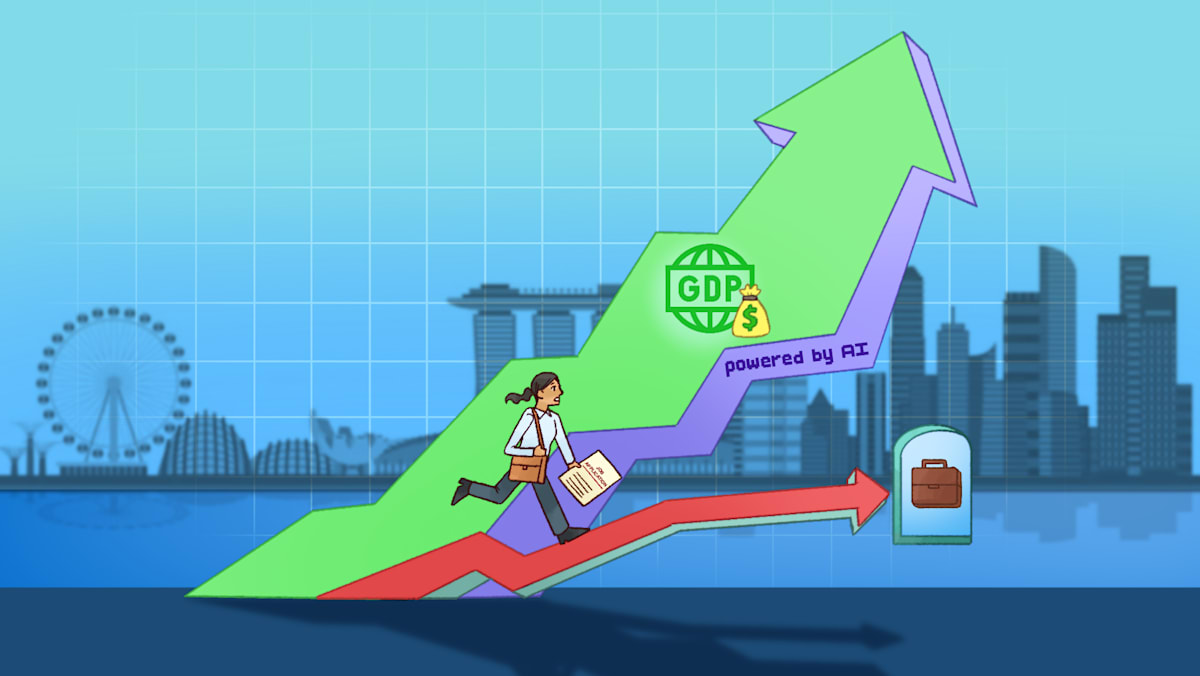
What happens when an economy keeps getting richer, but no longer needs as many new workers to grow? As AI reshapes how companies operate and where economic value is created, Singapore may need to rethink the relationship between growth, jobs and prosperity, experts say.
While a broad-based labour market slump is not happening now, jobless growth, along with its repercussions, remains a risk to keep firmly on everyone’s radar, experts said. (Illustration: CNA/Clara Ho)
This audio is generated by an AI tool.
Against a backdrop of global geopolitical tensions and economic headwinds, Singapore's optimistic gross domestic product (GDP) growth outlook stands as a bright spot.
And yet that positive outlook has also been accompanied by concerns about "jobless growth" – a paradoxical combination of a strengthening economy with a stagnant job market.
At the heart of the paradox lies artificial intelligence (AI), which has been driving economic growth through corporate investments, without the need for additional manpower.
The data tells the story: Following a “ better-than-expected performance ” in the first six months of 2026, the Ministry of Trade and Industry (MTI) in August upgraded its economic growth forecast for Singapore this year to 4.5 per cent to 5.5 per cent, up from its earlier forecast of 2 per cent to 4 per cent.
CNA Games Guess Word Crack the word, one row at a time Buzzword Create words using the given letters Mini Sudoku Tiny puzzle, mighty brain teaser Mini Crossword Small grid, big challenge Word Search Spot as many words as you can Show More Show Less The improved outlook for the rest of the year is expected to be supported by an acceleration in global AI-related capital expenditure, MTI said. And yet, retrenchments in the second quarter of the year, driven by business reorganisation and restructuring in some sectors, rose to 4,620, their highest level since the fourth quarter of 2020 . While overall employment did grow, resident employment growth slowed to 2,200 from 5,400 in the previous quarter. To be sure, this spectre of jobless growth is not confined to Singapore and warnings have come from authorities around the world. The Bank of England in July noted how the adoption of AI has led to firms "often slowing hiring or leaving vacancies unfilled to increase output without a proportional rise in headcount". International Monetary Fund (IMF) chief Kristalina Georgieva said in April that "the jobs that are routinely starter jobs for young people, this middle is shrinking fast" amid AI disruption. In Singapore, Prime Minister Lawrence Wong acknowledged the concerns over jobless growth in his round-up speech after the Budget 2026 debate in February. Mr Wong, who is also Finance Minister, said that " we will not have jobless growt h in Singapore", adding that the government will ensure that growth translates into good jobs and better wages. In May, parliament also unanimously backed a motion affirming that Singapore must not have jobless growth amid AI transition . All this is happening as leading AI companies and some world leaders are calling for a slowdown of AI development amid mounting worries over the risks of "superintelligent" computer systems .
The improved outlook for the rest of the year is expected to be supported by an acceleration in global AI-related capital expenditure, MTI said.
And yet, retrenchments in the second quarter of the year, driven by business reorganisation and restructuring in some sectors, rose to 4,620, their highest level since the fourth quarter of 2020 . While overall employment did grow, resident employment growth slowed to 2,200 from 5,400 in the previous quarter.
To be sure, this spectre of jobless growth is not confined to Singapore and warnings have come from authorities around the world.
The Bank of England in July noted how the adoption of AI has led to firms "often slowing hiring or leaving vacancies unfilled to increase output without a proportional rise in headcount".
International Monetary Fund (IMF) chief Kristalina Georgieva said in April that "the jobs that are routinely starter jobs for young people, this middle is shrinking fast" amid AI disruption.
In Singapore, Prime Minister Lawrence Wong acknowledged the concerns over jobless growth in his round-up speech after the Budget 2026 debate in February. Mr Wong, who is also Finance Minister, said that " we will not have jobless growt h in Singapore", adding that the government will ensure that growth translates into good jobs and better wages.
In May, parliament also unanimously backed a motion affirming that Singapore must not have jobless growth amid AI transition .
All this is happening as leading AI companies and some world leaders are calling for a slowdown of AI development amid mounting worries over the risks of "superintelligent" computer systems .
Singapore's improved GDP growth outlook for the rest 2026 is expected to be supported by an acceleration in global AI-related capital expenditure, MTI said. (File photo: REUTERS/Edgar Su)
While the long shadow of jobless growth looms, economists and business experts who spoke to CNA TODAY generally agreed that a broad-based labour market slump isn’t happening locally or globally – for now.
The experts noted how a report by the Ministry of Manpower (MOM) in April found that among companies here that have adopted AI, only 6.2 per cent reported reduced headcount, while another 8.5 per cent reported lower hiring activity.
The vast majority of the other companies reported that they had redesigned jobs, created new AI-related jobs or redeployed workers to new roles, among other moves.
That said, jobless growth, along with its repercussions, remains a risk to keep firmly on everyone’s radar, experts said.
Labour economist Walter Theseira, from the Singapore University of Social Sciences (SUSS), said: "Given the direction of technological developments, and given what basically the economics tells us could happen if this continues, I think it would be irresponsible not to plan for it."
MORE THAN JUST PRODUCTIVITY GAINS
Singapore has long pushed hard on productivity to prevent its small labour pool from hamstringing economic growth – an urgency that has only intensified amid an ageing population and falling fertility rate.
Given this long struggle with a tight labour market, why the anxiety over “jobless growth” or its milder variant, “job-light growth”?
The extent to which economic growth outpaces job creation, and whether those gains trickle down to regular workers, makes all the difference, said experts.
Mr Seng Bingxun, partner at global consulting firm EY-Parthenon, said: "Healthy productivity growth raises the value created by workers broadly, supporting better wages and continued demand for labour.
"Jobless growth occurs when GDP rises but the gains are concentrated in a small number of highly productive firms, industries or workers."
Agreeing, Dr Eugene Or, a lecturer in applied economics at SUSS, said that economic growth at a faster speed than employment in itself is "not automatically undesirable" if it reflects strong productivity growth in a tight labour market.
"It becomes more concerning when workers who want jobs increasingly cannot find them, or when labour incomes fail to share in the gains from growth," he said.
A distinguishing feature of AI is that, unlike the technological advances that came before, it goes beyond simply reducing workload or automating.
Earlier forms of general-purpose technology grew the economy by making workers more productive and then inventing new tasks for them to do – in a process called reinstatement effect, noted Professor Will Cong, associate dean of Nanyang Business School (NBS), Nanyang Technological University (NTU).
That reinstatement effect is why employment kept rising through previous technological leaps, such as computing, he added.
However, AI agents are themselves capital-manufactured labour that can take on the new tasks as readily as the old ones, he said.
"Firms can now expand productive capacity by training and deploying more agents rather than hiring more people," said Prof Cong. In the national accounts, this will show up as growth through software and compute investment, not wages.
AI is fuelling the rise of capital-intensive companies and sectors that inherently generate high economic value with comparatively fewer – and arguably more niche – employment opportunities. (File photo: REUTERS/Dado Ruvic/Illustration)
In the bigger scheme of things, AI is fuelling the rise of capital-intensive companies and sectors that inherently generate high economic value with comparatively fewer – and arguably more niche – employment opportunities.
"AI can expand high-value, capital-intensive activities such as software, advanced manufacturing, semiconductor production and data centres. These can generate considerable value-added with relatively few direct operating jobs," said Dr Or of SUSS.
He added, however, that such activities could still create indirect employment through construction, maintenance, professional services and supply chains.
UNEVEN GROWTH, UNEVEN BENEFITS
Associate Professor Theseira of SUSS argued that the underlying concern is not jobless growth per se but "desirable job-less growth" – or economic growth that still sees jobs being created, but much less growth among job types deemed desirable by the society.
A problem may arise, he said, when there's a bifurcation of job growth: where AI expands a certain set of very elite jobs but at the same time reduces middle-level jobs, leaving behind what is deemed by some as lower-skilled or manual jobs that are harder to replace by AI.
"People might say: 'Oh, I thought my kid should be a computer engineer or AI programmer or something. I don't really think it would be a success if my kid became a dog walker'."
Experts also noted that not all industries or companies can equally benefit from AI, thus giving rise to concerns over uneven growth.
"For companies, gains land first with MNCs (multi-national corporations) and large firms that can build and govern (AI) agents; SMEs, which employ the majority of the workforce (in Singapore), risk falling further behind," said Prof Cong of NTU.
"Firm-level productivity dispersion is the number to watch."
When it comes to job displacement, entry-level roles are widely acknowledged to be more at risk of being supplanted by AI. But such work, while relatively lower in economic value, makes for an important training ground for juniors to cut their teeth and hone their skills before climbing the ladder.
"Automate the junior work and in 20 years there are no seniors able to verify what the machines produce, and verification is precisely the human skill that AI makes most valuable," said Prof Cong.
"Machine-learning researchers call it ‘model collapse’ when a model trains on its own output. A society that stops training its people faces the human version. I cannot underscore enough the importance of human experts who can verify and govern machines and machine outputs."
These risks have revived an age-old debate dating to the industrial revolution: who benefits the most from this form of growth, the capital owner or the labour?
Dr Or from SUSS noted that AI is likely to increase returns to capital and workers whose skills are highly complementary to AI.
"IMF research suggests that AI could increase wealth inequality through higher returns to capital, while its effect on wage inequality depends partly on which workers AI complements and which workers it substitutes for."
Assoc Prof Theseira of SUSS added that during the time of the industrial revolution, capital owners may have owned the factories, but they needed workers to run them.
"In that sense, part of the returns to capital actually got shared with labour because without the labour you couldn't do anything."
Newer concerns in this AI age are that capital investment can be self-sustaining "in terms of no longer needing complementary labour", he noted.
IMF research suggests that AI could increase wealth inequality through higher returns to capital, noted one economic expert. (File Photo: REUTERS/Benoit Tessier)
GENERATING GROWTH THE RIGHT WAY
Indeed, globally it is easy to find examples of staunch advocates promoting AI as a way to generate growth without labour, and cases of companies which have successfully done just that, hence stoking concerns over jobless growth.
For example, e-commerce platform Shopify CEO Tobi Lutke, in an internal memo to his managers in April 2025, said: “Before asking for more headcount and resources, teams must demonstrate why they cannot get what they want done using AI.”
The following month, JPMorgan Chase shared with investors that the business had grown by more than 25 per cent in the preceding five years, while headcount grew only 13 per cent over the same period. The bank attributed this to automation, organisational efficiency tune-ups and AI.
“We expect headcount will trend down by about 10 per cent over the next five years or so, even as the business grows by another more than 25 per cent," said its then - CEO of consumer and community banking Marianne Lake.
Yet, experts said that a stagnating or shrinking headcount amid AI-driven business growth is not necessarily a given.
Experts like Associate Professor Trevor Yu from NBS acknowledged that companies should not be expected to maximise headcount for its own sake, as it is unlikely to be a commercially sustainable move.
"But commercial incentives and employment creation are not necessarily in conflict. The key question is what companies do with productivity gains," said Assoc Prof Yu.
The fundamental difference lies in whether a company uses such technology simply for efficiency to do the same thing with fewer resources, or for innovation to do things that were previously difficult, expensive or impossible.
"If technology lowers costs, improves quality, enables new products and services or allows a Singapore company to enter new markets, commercial success can itself generate new demand for human talent," said Assoc Prof Yu.
Mr Marcus Lam, executive chairman and CEO of PwC Singapore, noted how the company's 2026 Job Barometer report found AI-related job postings in Singapore had risen from around 54,000 in 2024 to about 84,000 in 2025, thereby "signalling a labour market in transition".
"Additionally, our global analysis also found that the most AI-exposed companies recorded stronger headcount growth than the least AI-exposed companies, at 52 per cent versus 36 per cent," he said.
AI-exposed companies refer to companies which operate in industries or sectors where a significant share of work tasks is susceptible to change brought about by AI.
"These findings suggest that greater AI exposure can coincide with workforce growth."
New job opportunities can still be created, depending on what companies do with the AI-driven productivity gains, say experts. (File photo: CNA/Mak Jia Kee)
Experts pointed out that there are top AI companies whose business models are capital-intensive, generating high value but requiring low labour. Think of the big AI players, such as OpenAI and Anthropic .
Such companies may "hold all the cards" and it would be more challenging for a country to negotiate terms with them, such as hiring a certain number of local workers when setting up shop, because these companies are in high demand and could easily relocate to another country.
"But one reason why you need to have (such top companies) here is that when they're here, they'll actually incentivise a lot of the other companies to come, which you have more negotiating power with (in terms of creating employment opportunities)," said Assoc Prof Theseira.
The government’s constant clarion call for workers facing disruption has always been to upskill, which experts said is important but, on its own, insufficient.
"You can train someone very well for a particular occupation, but if firms collectively require fewer workers in that occupation, training alone cannot create the vacancy," said Dr Or of SUSS.
"Training therefore works best when it is closely connected to employers, expanding sectors, actual vacancies, job redesign, work attachments and placement outcomes."
This is where the government plays an important role, to ensure that affected workers pick up skills that are relevant and that they transition to growth areas in the economy, said the experts.
Assoc Prof Theseira said the roll-out of autonomous vehicles (AVs) can "serve as a test" in how to handle broader AI-related jobs displacement and transition.
The case of AVs shows how the correct policy solution would not be to protect the drivers' jobs, given how this would be less competitive in terms of cost and safety, but to help the workers.
"It's about how do you find ways to warn the affected workers ahead of time, encourage those who can to leave the industry preemptively, and then also to prepare transition plans for the rest."
The government also needs to play a part in encouraging the use of AI in ways that drive innovation and expansion, not only in productivity.
For its part, the government has given assurances that it would encourage the adoption of AI in a manner that will benefit Singaporeans.
Acting Minister for Manpower Jasmin Lau earlier this month acknowledged "some groundswell" of anti-AI sentiment among workers and younger students who, among other things, fear how the technology will be taking away many of their jobs and aspirations.
Ms Lau, who is also Senior Minister of State for Digital Development and Information, said that Singapore is “ not blind in our pursuit for AI ” and that the technology will be used "for good".
“We will do so if it means giving our workers better jobs, and we will do so if it means providing better services for our people.”
You can train someone very well for a particular occupation, but if firms collectively require fewer workers in that occupation, training alone cannot create the vacancy.
In a joint response to CNA TODAY's queries, MOM and MTI acknowledged Singaporeans' anxiety about job prospects even as both retrenchments and resident unemployment remain low as hiring sentiments have strengthened.
"In our latest survey, hiring sentiments have improved – in July, 48.7 per cent of businesses indicated they intended to hire in the next three months, compared to 43.9 per cent in June," said the ministries. "However, we observe that job searches have taken longer, and job openings have dipped. We understand the concerns of our workers."
MOM and MTI said that creating good jobs for Singaporeans "remains the central objective" of the nation's growth strategy.
"In line with the Economic Strategy Review , we are shaping growth towards activities that generate sustainable employment opportunities," said the ministries.
"We will also deepen partnerships between multinational corporations (MNCs) and local SMEs through schemes such as the Partnerships for Capability Transformation, so that the MNCs’ investments translate into wider employment and progression opportunities for Singaporeans."
The ministries will also support firms in transforming their workforce, help fresh graduates find jobs and those already in the workforce transit to new careers by working together with tripartite partners, while at the same time providing support for workers who lost their jobs.
Beyond encouraging the use of AI that still generates employment, and preemptively nudging workers to new areas of growth where their old roles are affected, the government will also have to consider the wider societal impact that possible jobless growth may bring, experts told CNA TODAY.
"If there's a more society-wide impact, in other words, of general shifting towards perhaps less desirable jobs and so on, that's when I think you have to look more carefully at it. Do we need to actually take some of the excess returns from capital in the very high-skilled workers and see what we can do with them on a society-wide basis?" asked Assoc Prof Theseira.
"For example, uplift wages, provide more income support and things like that."
Offering some sparks of optimism amid this uncertain outlook, some companies in Singapore report that they are harnessing AI to pursue growth without eliminating jobs – and in some instances creating more employment.
Local technology startup SimpleAI, which develops AI agents for clients to automate processes like accounting and bookkeeping, has itself deployed AI internally since 2025, including in product development.
Their team of five engineers used to ship 40 releases a month, including features, updates and fixes.
"Most of an engineer's time went into writing code line by line, testing it and fixing issues after release. Every new feature or customer request competed for the same limited engineering hours, so we had to be very selective about what we built," said co-founder and chief technology officer Shim Young Jun.
Now with AI producing the first draft, the engineers only need to review the output and validate that it works correctly. The same team now ships about 200 releases per month.
CEO Bryan Ng added that in that period, the company had only three new hires bringing in new specialisations, such as knowledge in a new geographical market that SimpleAI is entering.
Other companies here, like Singapore-based financial technology company Aspire, go a step further by expanding both the company and headcount.
CEO and co-founder Andrea Baronchelli shared how AI has been used since the start of the year to reduce engineers' coding work by about 60 per cent, and help their analysts identify, in a matter of minutes, patterns across thousands of transactions that they are monitoring.
Key to all these is how the firm invests in their employees.
"One thing we’ve been doing consistently is investing a lot of time in enabling employees to use AI. We run weekly internal workshops led by our own teams, rather than external vendors," said Mr Baronchelli.
He said that the company of about 500 employees now is expanding headcount by 10 per cent by the end of the year, with more hires planned next year.
"(With AI), we can build more products, enter new markets and pursue opportunities that previously would have been beyond our capacity," said Mr Baronchelli.
"And that creates a strong business case for hiring. We still need people who understand our customers, exercise judgment, make decisions and take responsibility for outcomes."
Like Aspire, Singapore-headquartered cybersecurity solutions and hardware manufacturing company Flexxon, too, has been hiring even as AI helped the company grow.
Flexxon CEO Camellia Chan said the company began deploying AI at the end of 2024 in its daily operations, covering "every function" in the company including sales, marketing and logistics.
Over the same period, headcount grew by about 30 per cent to about 100 employees globally.
"The shape of our workforce changed. The growth went into product development, field engineering and new market coverage, and almost none of it into administrative roles, because the (AI) agents absorb that work. No role at Flexxon has been cut because of an agent," said Ms Chan.
"On the commercial side, business activities like sales and inbound inquiries have grown around five times over this period."
Asked why the company chooses to add headcount when AI has clearly lightened its staff workload and allowed the same number of workers to do more, Ms Chan said that AI does not replace high-value human work.
"What they do is clear the ground for it. Every hour an (AI) agent takes off a product manager’s inbox or a salesperson’s data entry is an hour that goes back into development, innovation and expansion."
At the end of the day, Mr Lam of PwC Singapore said everyone has a part to play in ensuring AI-led economic growth remains inclusive for all.
Companies need to create opportunities in redesigned jobs; employees need to retrain to benefit from said new jobs; and the government needs to provide transition support, accessible retraining and incentivise enterprise transformation in the right direction, he said.
"Ultimately, the test of a successful AI transition is not whether every existing job remains unchanged, but whether Singapore can create new sources of growth while enabling workers to remain relevant, productive and able to share in the gains," said Mr Lam.
Get our pick of top stories and thought-provoking articles in your inbox
Stay updated with notifications for breaking news and our best stories
Join our channel for the top reads for the day on your preferred chat app
当一个经济体不断增长,但不再需要那么多新员工来维持增长时,会发生什么?专家表示,随着人工智能重塑企业的运营方式和经济价值的创造方式,新加坡或许需要重新思考增长、就业和繁荣之间的关系。
专家表示,虽然目前尚未出现大范围的劳动力市场低迷,但失业率上升及其后果仍然是所有人需要密切关注的风险。(插图:CNA/Clara Ho)
这段音频由人工智能工具生成。
在全球地缘政治紧张局势和经济逆风的背景下,新加坡乐观的国内生产总值(GDP)增长前景成为一大亮点。
然而,这种乐观前景也伴随着对“无就业增长”的担忧——经济走强与就业市场停滞不前,形成了一种自相矛盾的局面。
这一悖论的核心在于人工智能(AI),它通过企业投资推动经济增长,而无需额外的人力。
数据说明了一切:在 2026 年上半年表现“好于预期”之后,新加坡贸易和工业部 (MTI) 在 8 月份将新加坡今年的经济增长预测从之前的 2% 至 4% 上调至 4.5% 至 5.5%。
CNA游戏猜词游戏:逐行破解单词;流行词游戏:用给定的字母组成单词;迷你数独:小巧的谜题,强大的脑力挑战;迷你填字游戏:小网格,大挑战;单词搜索:尽可能多地找出单词。显示更多 显示更少 贸工部表示,预计今年剩余时间的前景改善将得益于全球人工智能相关资本支出的加速增长。然而,受部分行业业务重组和结构调整的影响,今年第二季度的裁员人数上升至4620人,为2020年第四季度以来的最高水平。虽然整体就业人数有所增长,但居民就业增长放缓,从上一季度的5400人降至2200人。可以肯定的是,这种“无就业增长”的阴影并非新加坡独有,世界各地的监管机构都发出了警告。英国央行在7月份指出,人工智能的采用导致企业“经常放缓招聘或不填补空缺职位,以提高产量,而员工人数却没有相应增加”。国际货币基金组织(IMF)总裁克里斯塔利娜·格奥尔基耶娃在4月份表示,在人工智能颠覆性变革的背景下,“年轻人通常的入门级工作岗位,也就是中产阶级的工作岗位,正在迅速萎缩”。在新加坡,总理黄循财在2月份2026年财政预算案辩论后的总结讲话中,也承认了人们对“无就业增长”的担忧。黄循财同时也是新加坡的财政部长,他表示“新加坡不会出现无就业增长”,并补充说,政府将确保经济增长转化为优质就业岗位和更高的工资。5月份,国会也一致通过了一项动议,重申新加坡在人工智能转型过程中绝不能出现无就业增长。与此同时,领先的人工智能公司和一些世界领导人呼吁放缓人工智能的发展速度,因为他们越来越担心“超级智能”计算机系统带来的风险。
贸工部表示,预计今年剩余时间的良好前景将得益于全球人工智能相关资本支出的加速增长。
然而,受部分行业企业重组和结构调整的影响,今年第二季度裁员人数上升至4620人,为2020年第四季度以来的最高水平。虽然整体就业人数有所增长,但居民就业人数的增长速度从上一季度的5400人放缓至2200人。
可以肯定的是,这种无就业增长的幽灵并非新加坡独有,世界各地的当局都发出了警告。
英国央行在 7 月份指出,人工智能的采用导致企业“经常放慢招聘速度或让职位空缺无人填补,以在不相应增加员工人数的情况下提高产量”。
国际货币基金组织(IMF)总裁克里斯塔利娜·格奥尔基耶娃在4月份表示,在人工智能颠覆性的冲击下,“年轻人通常的入门级工作,也就是中产阶级的工作岗位,正在迅速萎缩”。
新加坡总理黄循财在2月份2026年财政预算案辩论后的总结讲话中,承认了人们对“无就业增长”的担忧。黄循财同时也是财政部长,他表示“新加坡不会出现无就业增长”,并补充说,政府将确保经济增长转化为优质就业岗位和更高工资。
5 月,国会也一致通过了一项动议,重申新加坡在人工智能转型期间绝不能出现无就业增长。
与此同时,领先的人工智能公司和一些世界领导人呼吁放缓人工智能的发展,因为他们越来越担心“超级智能”计算机系统的风险。
新加坡贸工部表示,全球人工智能相关资本支出加速增长预计将支撑新加坡2026年剩余时间的GDP增长前景。(资料图片:路透社/Edgar Su)
尽管无就业增长的阴影挥之不去,但接受 CNA TODAY 采访的经济学家和商业专家普遍认为,目前本地或全球范围内尚未出现大范围的劳动力市场低迷。
专家指出,人力部 (MOM) 在 4 月份发布的一份报告显示,在本地采用人工智能的公司中,只有 6.2% 的公司报告减少了员工人数,另有 8.5% 的公司报告减少了招聘活动。
绝大多数其他公司表示,他们采取了包括重新设计工作岗位、创造新的人工智能相关工作岗位或将员工重新部署到新岗位等措施。
专家表示,即便如此,无就业增长及其后果仍然是每个人都应该密切关注的风险。
新加坡社会科学大学 (SUSS) 的劳动经济学家沃尔特·特塞拉 (Walter Theseira) 表示:“鉴于技术发展的方向,以及经济学告诉我们如果这种情况继续下去将会发生什么,我认为不为此做好规划是不负责任的。”
不仅仅是生产力提升
新加坡长期以来一直大力提高生产力,以防止劳动力短缺阻碍经济增长——随着人口老龄化和生育率下降,这种紧迫性只会更加凸显。
鉴于长期以来劳动力市场紧张的局面,为什么还要对“无就业增长”或其较温和的变体“就业不足的增长”感到焦虑呢?
专家表示,经济增长速度超过就业增长速度的程度,以及这些增长能否惠及普通劳动者,才是决定性因素。
全球咨询公司安永-帕特侬的合伙人曾炳勋表示:“健康的生产力增长提高了劳动者创造的价值,从而支持了更高的工资和对劳动力的持续需求。”
“当GDP增长,但收益集中在少数高生产力企业、行业或工人手中时,就会出现无就业增长。”
新加坡社会科学大学应用经济学讲师尤金·奥尔博士对此表示赞同,他指出,如果经济增长速度快于就业增长速度,并且这反映了劳动力市场紧张的情况下生产率的强劲增长,那么这种增长速度“并非必然是坏事”。
他说:“当想找工作的劳动者越来越找不到工作,或者劳动收入未能分享经济增长带来的收益时,情况就变得更加令人担忧了。”
人工智能的一个显著特点是,与之前的技术进步不同,它不仅仅是减少工作量或实现自动化。
南洋理工大学南洋商学院副院长威尔·康教授指出,早期的通用技术通过提高工人的生产力来促进经济增长,然后又为他们发明新的任务——这一过程被称为恢复效应。
他补充说,正是这种恢复效应使得就业率在以往的技术飞跃(例如计算机技术)中持续增长。
他说,然而,人工智能代理本身就是资本制造的劳动力,可以像承担旧任务一样轻松地承担新任务。
丛教授表示:“企业现在可以通过培训和部署更多代理人来扩大生产能力,而不是雇用更多员工。”在国民经济核算中,这将体现为软件和计算投资的增长,而不是工资的增长。
人工智能正在推动资本密集型企业和行业的崛起,这些企业和行业本身就能创造高经济价值,但就业机会相对较少,而且可以说更加小众。(图片:路透社/Dado Ruvic/插图)
从更宏观的角度来看,人工智能正在推动资本密集型公司和行业的崛起,这些公司和行业本身就能创造很高的经济价值,但就业机会相对较少,而且可以说更加小众。
“人工智能可以拓展高价值、资本密集型活动,例如软件、先进制造、半导体生产和数据中心。这些活动可以创造相当大的附加值,而直接运营岗位相对较少,”新加坡新跃社科大学的奥尔博士说。
但他补充说,此类活动仍然可以通过建筑、维护、专业服务和供应链创造间接就业机会。
增长不均衡,收益不均衡
新加坡社会科学大学副教授蒂塞拉认为,根本问题不在于无就业增长本身,而在于“理想的无就业增长”——即经济增长仍然创造了就业机会,但社会认为理想的就业类型增长却少得多。
他表示,当就业增长出现分化时,可能会出现问题:人工智能扩大了某些非常精英的职位,但同时也减少了中等水平的职位,留下了一些被一些人认为是低技能或体力劳动的工作,这些工作更难被人工智能取代。
“人们可能会说:‘哦,我原以为我的孩子应该成为计算机工程师或人工智能程序员之类的。如果我的孩子去当遛狗员,我觉得那不算成功。’”
专家还指出,并非所有行业或公司都能平等地从人工智能中受益,因此引发了人们对增长不平衡的担忧。
“对于企业而言,能够构建和管理(人工智能)代理的跨国公司和大公司会率先获得市场份额;而(新加坡)雇佣了大部分劳动力的中小企业则有可能进一步落后,”南洋理工大学丛教授表示。
“企业层面的生产率差异是值得关注的指标。”
谈到工作岗位流失,人们普遍认为入门级岗位更容易被人工智能取代。但这类工作虽然经济价值相对较低,却是初级员工积累经验、磨练技能、为职业晋升奠定基础的重要平台。
丛教授说:“如果让初级工作自动化,20 年后就不会有高级人员能够验证机器生产出的产品,而验证恰恰是人工智能最有价值的人类技能。”
“机器学习研究人员将模型基于自身输出进行训练的现象称为‘模型崩溃’。一个停止训练民众的社会将面临人类版的崩溃。我必须强调,人类专家对于验证和管理机器及其输出至关重要。”
这些风险重新引发了一场可以追溯到工业革命的古老争论:在这种增长形式中,谁获益最多,是资本所有者还是劳动者?
来自新加坡新跃社科大学的奥尔博士指出,人工智能可能会提高资本回报率,并提高技能与人工智能高度互补的劳动者的回报率。
“国际货币基金组织的研究表明,人工智能可能会通过提高资本回报率来加剧财富不平等,而其对工资不平等的影响部分取决于人工智能与哪些工人互补,又替代了哪些工人。”
新跃社科大学副教授蒂塞拉补充说,在工业革命时期,资本所有者可能拥有工厂,但他们需要工人来运营工厂。
“从这个意义上讲,资本的部分回报实际上与劳动者分享了,因为没有劳动,什么都做不了。”
他指出,人工智能时代新出现的问题是,资本投资可以实现自我维持,“不再需要配套劳动力”。
一位经济专家指出,国际货币基金组织的研究表明,人工智能可能会通过提高资本回报率加剧财富不平等。(资料图片:路透社/Benoit Tessier)
以正确的方式实现增长
事实上,在全球范围内,不难找到一些坚定的拥护者,他们将人工智能视为一种无需劳动力即可实现增长的方式;也有一些公司成功地做到了这一点,从而加剧了人们对无就业增长的担忧。
例如,电子商务平台 Shopify 的首席执行官 Tobi Lutke 在 2025 年 4 月给其经理的一份内部备忘录中表示:“在要求增加人手和资源之前,团队必须证明为什么他们无法使用人工智能完成他们想要做的事情。”
次月,摩根大通向投资者透露,过去五年公司业务增长超过25%,而同期员工人数仅增长13%。该行将此归功于自动化、组织效率提升和人工智能的应用。
“我们预计,在未来五年左右的时间里,即使业务增长超过 25%,员工人数也将下降约 10%。”当时负责消费者和社区银行业务的首席执行官玛丽安·莱克 (Marianne Lake) 表示。
然而,专家表示,在人工智能驱动的业务增长中,员工人数停滞不前或减少并非必然发生。
像新加坡国立大学商学院副教授 Trevor Yu 这样的专家承认,不应该期望公司为了增加员工人数而增加员工人数,因为这不太可能是一个商业上可持续的举措。
“但商业激励和创造就业机会并非必然冲突。关键问题在于企业如何利用生产力提升,”副教授余说。
根本区别在于,一家公司使用这种技术仅仅是为了提高效率,用更少的资源做同样的事情,还是为了创新,去做以前困难、昂贵或不可能的事情。
“如果技术能够降低成本、提高质量、催生新产品和服务,或者让新加坡公司进入新市场,那么商业成功本身就能创造对人才的新需求,”余副教授说。
普华永道新加坡执行主席兼首席执行官林先生指出,该公司发布的《2026 年就业晴雨表》报告显示,新加坡与人工智能相关的职位空缺数量已从 2024 年的约 54,000 个增加到 2025 年的约 84,000 个,从而“表明劳动力市场正在转型”。
“此外,我们的全球分析还发现,人工智能应用最广泛的公司比人工智能应用最少的公司员工人数增长更为强劲,分别为 52% 和 36%。”他说道。
受人工智能影响的公司是指在很多行业或领域中,很大一部分工作任务容易受到人工智能带来的变化而发生变化的公司。
“这些研究结果表明,人工智能应用越广泛,劳动力增长可能就越快。”
专家表示,新的就业机会仍有可能创造,这取决于企业如何利用人工智能带来的生产力提升。(资料图片:CNA/麦嘉琪)
专家指出,一些顶尖的人工智能公司采用资本密集型商业模式,创造高价值但所需劳动力较少。例如,OpenAI 和 Anthropologie 等大型人工智能公司。
这类公司可能“掌握着所有筹码”,一个国家与它们谈判条款(例如在设立公司时雇用一定数量的当地工人)会更具挑战性,因为这些公司需求量很大,而且很容易迁往其他国家。
“但你需要(这些顶尖公司)来这里的一个原因是,当它们来到这里时,实际上会激励许多其他公司前来,这样你在(创造就业机会方面)就拥有更大的谈判筹码,”副教授塞西拉说道。
政府一直以来都呼吁面临就业中断的劳动者提升技能,专家表示这固然重要,但仅靠技能提升是不够的。
“你可以对某人进行非常专业的培训,使其胜任某个特定职业,但如果企业整体上需要的该职业工人数量减少,单靠培训是无法创造空缺的,”新加坡社会科学大学的奥尔博士说。
“因此,培训只有与用人单位、不断扩展的行业、实际空缺职位、工作重新设计、实习和就业安置结果紧密联系在一起,才能发挥最佳效果。”
专家表示,政府在此发挥着重要作用,确保受影响的工人掌握相关技能,并过渡到经济增长领域。
副教授塞西拉表示,自动驾驶汽车 (AV) 的推出可以“作为一次试验”,检验如何应对更广泛的人工智能相关工作岗位流失和转型。
自动驾驶汽车的案例表明,正确的政策解决方案不是保护驾驶员的工作,因为这在成本和安全方面会降低竞争力,而是帮助工人。
“关键在于如何提前警告受影响的工人,鼓励那些有能力的人提前离开这个行业,并为其余的人制定过渡计划。”
政府也需要发挥作用,鼓励以推动创新和扩张的方式使用人工智能,而不仅仅是提高生产力。
政府方面已保证,将鼓励以有利于新加坡人的方式采用人工智能。
人力部代理部长刘嘉敏本月初承认,工人和年轻学生中存在“一些反人工智能情绪”,他们担心这项技术会夺走他们的许多工作和抱负。
刘女士同时也是新加坡数码发展及新闻部高级政务部长,她表示新加坡“在追求人工智能方面并非盲目”,这项技术将被用于“造福人类”。
“如果这意味着给我们的工人提供更好的工作,我们就会这样做;如果这意味着为我们的人民提供更好的服务,我们也会这样做。”
你可以对某人进行非常专业的培训,使其胜任某个特定职业,但如果企业整体上对该职业的员工需求减少,单靠培训是无法创造空缺的。
针对 CNA TODAY 的询问,人力部和贸工部联合回应称,尽管裁员和居民失业率仍然很低,招聘情绪也日益增强,但新加坡人仍然对就业前景感到焦虑。
“我们最新的调查显示,招聘意愿有所改善——7月份,48.7%的企业表示计划在未来三个月内招聘,而6月份这一比例为43.9%。”相关部门表示,“然而,我们注意到求职所需时间延长,职位空缺数量也有所下降。我们理解员工的担忧。”
人力部和贸工部表示,为新加坡人创造良好的就业机会“仍然是”国家增长战略的核心目标。
“根据经济战略评估,我们正在引导经济增长朝着创造可持续就业机会的方向发展,”各部委表示。
“我们还将通过‘能力转型伙伴关系’等计划,深化跨国公司与本地中小企业之间的伙伴关系,使跨国公司的投资转化为新加坡人更广泛的就业和发展机会。”
各部委还将与三方合作伙伴共同努力,支持企业转型员工队伍,帮助应届毕业生找到工作,并帮助在职人员过渡到新的职业,同时为失业工人提供支持。
专家告诉 CNA TODAY,除了鼓励使用仍能创造就业机会的人工智能,以及预先引导工人转向其原有岗位受到影响的新增长领域之外,政府还必须考虑可能出现的无就业增长带来的更广泛的社会影响。
“换句话说,如果出现更广泛的社会影响,例如普遍转向不太理想的工作等等,我认为我们就需要更仔细地研究这个问题了。我们是否需要利用高技能劳动者身上的一些超额资本回报,看看我们能在全社会范围内如何利用这些回报?”副教授塞西拉问道。
“例如,提高工资,提供更多收入支持等等。”
在当前充满不确定性的前景中,新加坡的一些公司报告称,他们正在利用人工智能在不裁员的情况下追求增长,并且在某些情况下还创造了更多就业机会,这带来了一丝乐观的曙光。
本地科技初创公司 SimpleAI 为客户开发 AI 代理,以实现会计和簿记等流程的自动化。该公司自 2025 年以来一直在内部部署 AI,包括产品开发。
他们由五名工程师组成的团队过去每月发布 40 个版本,包括功能、更新和修复。
联合创始人兼首席技术官沈永俊表示:“工程师的大部分时间都花在了逐行编写代码、测试代码以及在发布后修复问题上。每一个新功能或客户请求都会争夺有限的工程时间,因此我们必须对开发的内容进行非常谨慎的选择。”
现在,人工智能可以生成初稿,工程师只需审核输出结果并验证其功能是否正常即可。同一个团队现在每月发布约 200 个版本。
首席执行官 Bryan Ng 补充说,在此期间,公司只招聘了三名新员工,带来了新的专业知识,例如 SimpleAI 正在进入的新地理市场的知识。
这里的其他公司,例如总部位于新加坡的金融科技公司 Aspire,更进一步,既扩大了公司规模,又增加了员工人数。
首席执行官兼联合创始人 Andrea Baronchelli 分享了自年初以来如何使用人工智能将工程师的编码工作量减少了约 60%,并帮助他们的分析师在几分钟内识别出他们正在监控的数千笔交易中的模式。
所有这一切的关键在于公司如何投资于员工。
巴隆切利先生说:“我们一直以来都在做的一件事,就是投入大量时间让员工能够使用人工智能。我们每周都会举办由我们自己的团队而不是外部供应商主导的内部研讨会。”
他表示,这家目前拥有约 500 名员工的公司计划在年底前将员工人数增加 10%,并计划明年招聘更多员工。
巴隆切利先生说:“(借助人工智能),我们可以开发更多产品,进入新市场,并追求以前超出我们能力范围的机会。”
“这就为招聘提供了强有力的商业理由。我们仍然需要那些了解客户、善于判断、能够做出决策并对结果负责的人才。”
与 Aspire 一样,总部位于新加坡的网络安全解决方案和硬件制造公司 Flexxon 也一直在招聘,即使人工智能帮助公司发展壮大。
Flexxon 首席执行官 Camellia Chan 表示,公司将于 2024 年底开始在日常运营中部署人工智能,涵盖公司“所有职能”,包括销售、营销和物流。
同期,员工人数增长了约 30%,全球员工总数达到约 100 人。
“我们的员工结构发生了变化。增长的人员主要投入到产品开发、现场工程和新市场拓展中,几乎没有投入到行政岗位,因为(人工智能)代理承担了这些工作。Flexxon 没有因为代理的加入而裁减任何职位,”陈女士说道。
“在商业方面,销售和来电咨询等业务活动在此期间增长了约五倍。”
当被问及人工智能已经明显减轻了员工的工作量,并让相同数量的员工能够完成更多工作,公司为何还要增加人手时,陈女士表示,人工智能并不能取代高价值的人类工作。
“它们所做的就是为此扫清障碍。人工智能代理每帮产品经理分担一个小时的收件箱工作或销售人员的数据录入工作,就能让产品开发、创新和扩张腾出一个小时的时间。”
普华永道新加坡的林先生最后表示,每个人都应该为确保人工智能驱动的经济增长对所有人具有包容性而尽一份力。
他表示,企业需要创造重新设计的工作机会;员工需要接受再培训才能从这些新工作中受益;政府需要提供过渡支持、便捷的再培训,并激励企业朝着正确的方向转型。
林先生表示:“归根结底,人工智能转型成功与否的考验,不在于所有现有工作是否保持不变,而在于新加坡能否创造新的增长点,同时让劳动者保持竞争力、生产力,并能够分享增长的成果。”
订阅我们的邮件,即可获取精选热点新闻和引人深思的文章。
订阅通知,第一时间获取突发新闻和精彩报道。
加入我们的频道,即可在您常用的聊天应用上获取当日热门文章。