How the US military could clear mines from the Strait of Hormuz美国军方如何清除霍尔木兹海峡的水雷
An arsenal of drones, explosive‑laden robots and helicopters can help reduce risk, though de‑mining crews could still be vulnerable to Iranian attacks.
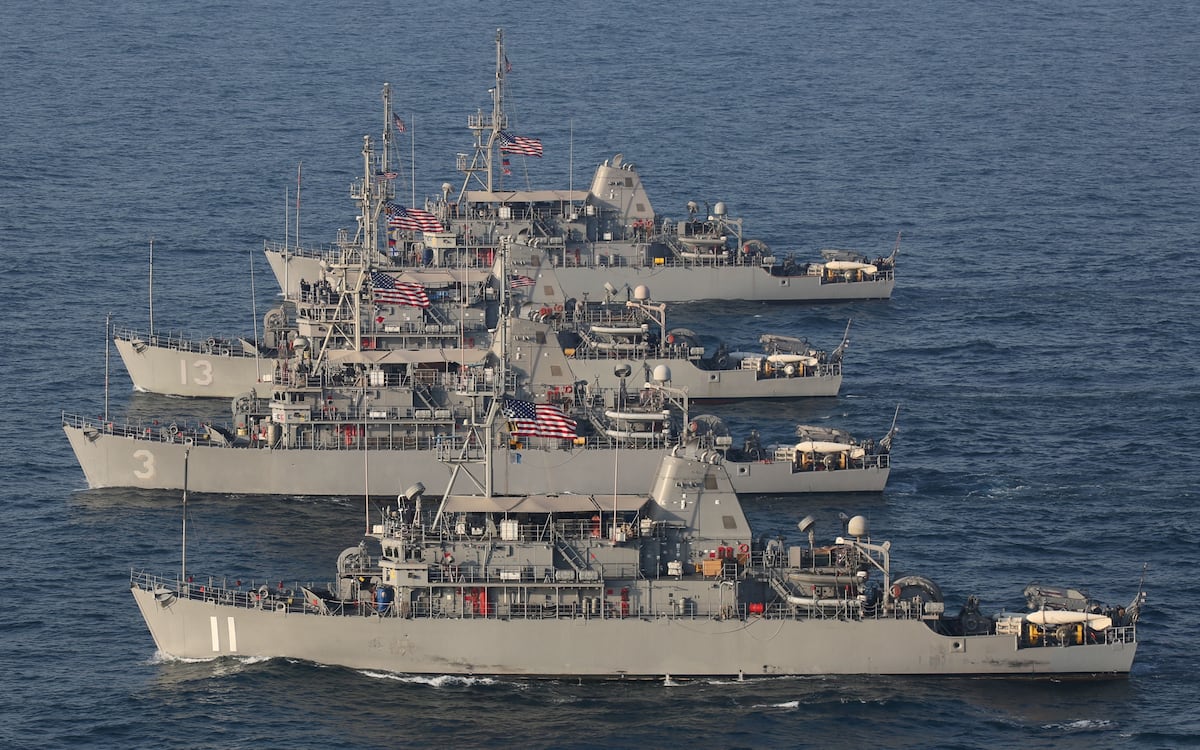
As the United States embarks on clearing mines from the Strait of Hormuz , it could draw on an arsenal of drones , explosive‑laden robots and helicopters to reduce risks, though de‑mining crews could still be vulnerable to Iranian attacks .
The U.S. is trying to secure the strait from mines as part of efforts to end Iran’s disruption of shipping , which has severely curbed global energy supplies since the U.S. and Israel launched strikes against Iran at the end of February.
But while the U.S. can draw on modernized technology to remotely check for and remove mines, clearing a strategic waterway such as the Strait of Hormuz will still be a slow, multi‑step process, former naval officers and industry specialists say.
The U.S. military said over the weekend it had started the mine-clearing operation, sending two warships through the strait, but offered few details about the equipment involved. It said on Saturday that additional forces, including underwater drones, would join the effort in the coming days.
Iran had recently deployed about a dozen mines in the Strait of Hormuz, Reuters reported last month, citing sources familiar with the matter. It is not publicly known where mines may have been laid.
U.S. President Donald Trump said over the weekend that all of Iran’s minelaying ships had been sunk. But there is a risk Tehran could deploy additional devices, some specialists said.
Mine warfare is effective because the devices are cheap, are costly to clear and “even the threat of a minefield is enough to stop ships, especially commercial ships,” said Jon Pentreath, a retired British navy rear admiral who is now a consultant.
Traditionally, the U.S. Navy relied on manned minesweeping ships that physically entered minefields, using sonars to locate the devices and mechanical gear dragged behind the vessel to clear explosives, sometimes supported by human divers. Much of that aging fleet has been retired.
They are being replaced by lighter vessels known as littoral combat ships, which carry modern mine‑hunting equipment such as semi‑autonomous surface and underwater drones as well as remote‑controlled robots that enable crews to distance themselves from the minefield. The navy has three of these in deployment.
BAE Systems' Archerfish mine disposal system, displayed at the Undersea Defence Technology exhibition in London, April 14, 2026. (Cassell Bryan-Low/Reuters)
Two of those ships were undergoing maintenance in Singapore, a senior U.S. official told Reuters in late March. At the time, the U.S. minesweeping capacity in the Middle East included unmanned undersea vehicles, four of the traditional Avenger-class vessels, helicopters and divers, according to the official.
The U.S. Navy did not respond to a comment request on the mine-clearing capability it currently has in the Middle East. U.S. Central Command declined to provide further details.
Tehran is believed to possess several types of maritime mines, former naval officials and other specialists say. These include bottom mines that rest on the seabed and detonate when ships pass above, tethered mines that are anchored but float closer to the surface, drifting mines that move freely on the water, and limpet mines that attach directly to a ship’s hull.
The U.S. operation will likely involve searching for mines using unmanned surface and underwater vehicles equipped with sensors. Once a mine‑like object is detected, the data is typically transferred to crews operating outside the minefield, who identify the device. They then determine how it should be neutralized.
The Navy’s search capability now includes sonar-mounted unmanned surface and undersea vehicles, as well as helicopters that are used to spot mines near the surface, former naval officials say.
To destroy mines, the Navy can deploy systems such as the torpedo‑shaped Archerfish, a remotely operated device about 2 meters long that carries an explosive charge and transmits video back to operators via cable, according to its manufacturer, BAE Systems. Designed to be expendable, it costs tens of thousands of dollars.
The U.S. could also use unmanned boats towing mine‑sweeping sleds that trigger detonations or gather mines, said Bryan Clark, a retired U.S. naval officer and senior fellow at the Hudson Institute. Human divers are also sometimes used, including for intelligence gathering, specialists say.
Clearing the strait could take two or three weeks, Clark said, and Iranian attacks on mine‑clearing crews could slow the process and raise risks. As a result, he said, the U.S. military may deploy defensive measures like ships and airborne drones to defend crews and equipment.
“Finding and destroying mines is very time consuming,” U.S. Admiral Daryl Caudle, chief of naval operations, said in March. That leaves mine‑clearing capability “vulnerable,” he added.
New technologies are being developed to speed up mine clearance, particularly through advances in sensors used for detection, specialists say.
French technology and defense group Thales says its latest sonar can scan a suspected mine from three different angles in one pass, a process that typically requires multiple sweeps.
Advances in artificial intelligence are also enabling more data analysis to be carried out onboard unmanned vessels.
Longer term, the ambition is to deploy groups of unmanned systems that can search for, identify and destroy mines, rather than it being a multi-step process.
“That doesn’t exist today,” said Mark Bock, a retired U.S. Navy captain who is now vice president of business development at Thales’ U.S. Navy business. “But it is what all nations are trying to achieve now.”
随着美国开始清除霍尔木兹海峡的水雷,它可以利用无人机、装载炸药的机器人和直升机等武器库来降低风险,尽管排雷人员仍然可能受到伊朗的袭击。
美国正努力清除海峡上的水雷,以结束伊朗对航运的干扰。自2月底美国和以色列对伊朗发动袭击以来,伊朗的干扰严重限制了全球能源供应。
但前海军军官和行业专家表示,虽然美国可以利用现代化技术远程检查和清除水雷,但清理霍尔木兹海峡等战略水道仍然是一个缓慢的多步骤过程。
美国军方周末表示,已启动扫雷行动,并派遣两艘军舰通过霍尔木兹海峡,但并未透露更多相关装备细节。军方周六表示,包括水下无人机在内的更多部队将在未来几天加入行动。
路透社上月援引知情人士的话报道称,伊朗近期在霍尔木兹海峡布设了约十几枚水雷。目前尚不清楚这些水雷的具体布设地点。
美国总统特朗普周末表示,伊朗的所有布雷船都已被击沉。但一些专家表示,德黑兰仍有可能部署更多布雷装置。
“水雷战之所以有效,是因为这些装置价格低廉,清除成本高昂,而且‘即使只是雷区的威胁也足以阻止船只,尤其是商船’,”英国海军退役少将、现任顾问乔恩·彭特雷斯说道。
传统上,美国海军依靠有人驾驶的扫雷舰进入雷区,利用声呐定位雷区,并拖曳机械设备清除雷区内的爆炸物,有时还会配备潜水员协助作业。这支老旧的舰队大部分已经退役。
它们正被一种名为濒海战斗舰的轻型舰艇所取代,这种舰艇配备了现代化的扫雷设备,例如半自主水面和水下无人机,以及能够帮助船员远离雷区的遥控机器人。海军目前部署了三艘这样的舰艇。
BAE系统公司的“射水鱼”(Archerfish)水雷处理系统于2026年4月14日在伦敦举行的海底防御技术展览会上展出。(Cassell Bryan-Low/路透社)
一位美国高级官员3月下旬告诉路透社,其中两艘舰艇正在新加坡进行维护。这位官员表示,当时美国在中东的扫雷能力包括无人水下航行器、四艘传统的“复仇者”级扫雷舰、直升机和潜水员。
美国海军未回应有关其目前在中东地区扫雷能力的置评请求。美国中央司令部也拒绝提供更多细节。
据前海军官员和其他专家称,德黑兰被认为拥有多种类型的水雷。这些水雷包括:沉在海底、船只经过时引爆的底雷;锚定但漂浮在水面附近的系留水雷;在水面上自由漂移的水雷;以及直接附着在船体上的吸附式水雷。
美军的行动很可能包括使用配备传感器的无人水面和水下航行器搜索水雷。一旦探测到类似水雷的物体,数据通常会传输给雷区外的作业人员,由他们识别该装置,并确定如何将其排除。
前海军官员表示,海军的搜索能力现在包括配备声呐的无人水面和水下航行器,以及用于发现水面附近水雷的直升机。
为了摧毁水雷,海军可以部署诸如“射水鱼”(Archerfish)之类的系统。据其制造商英国航空航天系统公司(BAE Systems)介绍,这是一种长约2米的遥控装置,携带炸药,并通过电缆将视频传回操作员。该装置设计为一次性使用,造价高达数万美元。
美国还可以使用无人艇拖曳扫雷滑橇,这些滑橇可以引爆或收集水雷,美国退役海军军官、哈德逊研究所高级研究员布莱恩·克拉克表示。专家称,有时也会使用潜水员,包括用于情报收集。
克拉克表示,清理海峡可能需要两到三周时间,而伊朗对扫雷队的袭击可能会延缓进程并增加风险。因此,他表示,美军可能会部署舰艇和无人机等防御措施,以保护人员和设备。
美国海军作战部长达里尔·考德尔海军上将3月份表示:“发现和销毁水雷非常耗时。”他补充说,这使得扫雷能力“很脆弱”。
专家表示,目前正在开发新技术来加快排雷速度,特别是通过改进用于探测的传感器。
法国科技和国防集团泰雷兹表示,其最新声呐一次即可从三个不同角度扫描疑似水雷,而通常情况下,这一过程需要多次扫描。
人工智能的进步也使得在无人船上进行更多数据分析成为可能。
从长远来看,目标是部署无人系统组,这些系统可以搜索、识别和摧毁水雷,而不是一个多步骤的过程。
“目前还没有这样的条件,”马克·博克说道,他是一位退役的美国海军上校,现在是泰雷兹美国海军业务部门的业务发展副总裁。“但这正是所有国家现在都在努力实现的目标。”