Crucial ballot decision of Constitutional Court on Monday could upend the government and Thai politics周一宪法法院的关键投票裁决可能颠覆泰国政府和政坛。
Constitutional Court judges could throw Thailand back into election turmoil Monday as they decide whether ballot codes breached voter secrecy and whether February’s entire nationwide… Read More ›
新闻视频
September 27, 2026 at 11:12 am
in Living , Media , Politics , Thailand
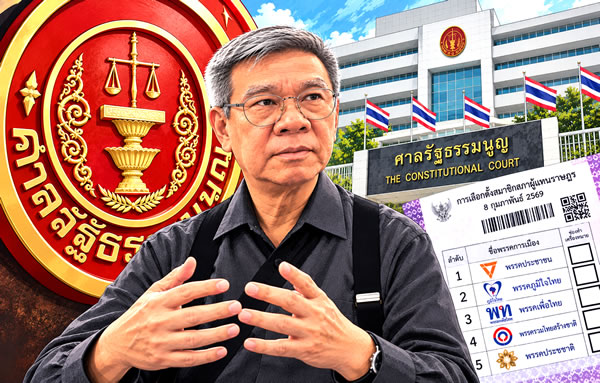
Thailand could be thrown back into a nationwide election on Monday when the Constitutional Court rules on a potentially fatal challenge to the February 8 poll. At stake is whether unique ballot identifiers breached secret voting rules and could expose individual choices. Former Election Commissioner Somchai Srisutthiyakorn says the possibilities range from dismissal to a party-list rerun or complete election annulment. The nine judges have questioned five witnesses and personally inspected ballots, stubs and voter lists. The most severe ruling could wipe out an election held just seven months ago, shake the foundations of the House and push Prime Minister Anutin Charnvirakul’s government into caretaker status.
Former Election Commissioner Somchai Srisutthiyakorn warns Monday’s court ruling could void the February 8 election and force Thailand back to the polls. ( Source: Khaosod )
Thailand faces a potentially seismic Constitutional Court ruling on Monday over the February 8 general election. At its most severe, the judgment could send the entire country back to the polls. The case centres on barcodes and QR codes printed on ballot papers nationwide. Petitioners argue the system could identify individual voters and reveal their choices. Such a finding would strike directly at the constitutional requirement for secret voting.
Crucially, the dispute does not concern one constituency or several polling stations. It concerns the Election Commission’s organisation of a nationwide general election.
The potential remedies therefore extend far beyond correcting an isolated electoral irregularity. Former Election Commissioner Somchai Srisutthiyakorn has outlined four possible outcomes. They range from complete rejection of the complaint to another nationwide general election.
Somchai outlines four outcomes as Thailand awaits a ruling that could force another general election
Somchai published his assessment on Friday, three days before the scheduled judgment. Notably, he presented the four possibilities in increasing order of seriousness. Under the first scenario, the Constitutional Court would find nothing unconstitutional about the ballot papers. The judges could determine that the barcodes could not identify individual voters. Ballot secrecy would remain intact and the February election results would stand.
In that event, no corrective action would follow. Prime Minister Anutin Charnvirakul’s government would continue unaffected. MPs elected on February 8 would remain in office. The Election Commission’s ballot system would also survive the constitutional challenge.
Somchai’s second scenario produces a considerably more serious finding. The Court could decide the numbered ballot system allowed individual votes to be traced. Each ballot carried an individual number corresponding to its ballot stub. In response, the Election Commission maintains that the relevant records were stored separately. It argues individual ballots could not practically be traced back to voters.
Somchai has challenged that defence. In his analysis, identification would not require someone physically matching three sets of stored election documents. Instead, an observer could record the sequence in which voters entered and received ballots. Later, that sequence could potentially be compared with ballot papers photographed during counting. According to Somchai, this could reveal which voter selected which party.
Ballot traceability challenge could condemn the voting system while leaving February result intact
As a result, the constitutional question extends beyond whether anyone actually traced a particular vote. The Court must consider whether the electoral system made such identification possible. Under Somchai’s second scenario, the judges could find that the system breached ballot secrecy. Even so, that finding would not necessarily destroy the February election.
The Court could conclude that no actual damage had been established. Accordingly, it could prohibit the Election Commission from using the same ballot system again. At the same time, the February 8 result could remain intact. Such an outcome would condemn the system without reopening the election.
Somchai’s third scenario would go much further. The Court could find the party-list ballot unconstitutional and order another party-list election. Thailand uses separate constituency and party-list ballots to elect the House of Representatives. Thus, constituency election results could potentially remain intact. The nationwide party-list vote, however, would have to be conducted again.
That outcome could immediately raise questions about the composition of the House. Party-list MPs owe their seats to the nationwide party vote challenged in this case. Yet the exact consequences would depend on the Court’s judgment. The judges could also issue specific directions governing the transition and replacement vote.
Party-list rerun could leave constituency results standing while reshaping the House of Representatives
Somchai’s fourth scenario is dramatically different. Under it, the constitutional defect would infect the entire February 8 election. The Court could consequently declare the general election itself invalid. Thailand would then face an entirely new nationwide vote. Such a ruling would overturn the electoral settlement created only seven months ago.
In parallel, the consequences would reach Parliament, the government and the Election Commission. Political parties could find themselves thrown immediately into another nationwide campaign. Prime Minister Anutin Charnvirakul’s government could meanwhile be forced into caretaker status. Somchai’s four scenarios, however, remain his assessment. They are not signals from the Constitutional Court.
The nine judges have given no public indication of their intended decision. Nevertheless, the possibility of a nationwide rerun has intensified attention before Monday’s judgment. The Constitutional Court will begin deliberations at 9.30 am on Monday, September 28. Its judgment is scheduled to be delivered publicly at 2 pm. The proceedings will also be broadcast live.
The case reached the Constitutional Court following 22 complaints received by the Ombudsman. Specifically, those complaints challenge the Election Commission’s organisation of the February 8 general election. They target barcodes and QR codes printed on ballot papers. Petitioners maintain those identifiers could connect individual voters with their electoral choices. They therefore argue that voting was not genuinely secret.
Full election annulment could send Thailand back to polls seven months after February’s national vote
Several constitutional provisions were cited when the dispute reached the Court. They concern constitutional rights, privacy, elections and the Election Commission’s responsibilities. Significantly, the Constitutional Court did not decide the case through written submissions alone. Instead, it conducted extensive proceedings examining how the election system actually operated.
Five witnesses appeared before the Court on August 26. They included Election Commission Secretary-General Sawaeng Boonmee. The others were Nitriya Rattanathatsani, Worapong Anancharoenkit, Phakphum Phu-udom and Kanyanat Phikunthong. Each confirmed previously submitted statements. Additionally, they answered questions directly from Constitutional Court judges.
The parties were also permitted to question the witnesses. Afterwards, the Court ordered final written statements to be submitted by September 11. Separately, the judges examined physical election materials used during the February poll. That step took the case beyond legal argument and into the mechanics of the voting system.
Five witnesses face judges as Constitutional Court examines how February’s ballot system operated
Constitutional Court judges Wirun Saengthian and Noppadon Theppitak were assigned to conduct the inspection. On August 27, they visited the facility storing Bangkok’s election materials. There, they examined actual ballot papers and corresponding ballot stubs. They also inspected unused ballots, voter lists and other election documents.
Representatives of the parties participated in the inspection. Meanwhile, Sawaeng and other senior Election Commission officials were present. The examination lasted approximately one hour. As part of this, the judges physically inspected the machinery at the centre of the constitutional dispute. They saw the ballots, corresponding stubs and voter lists used during the election.
Monday’s judgment therefore follows direct scrutiny of the system challenged by petitioners. At its core, the dispute turns on one question. Could the identifiers printed on ballots make an individual’s vote traceable? The answer could determine whether February’s election survives intact, partly survives or falls completely.
The Election Commission says the codes served legitimate electoral purposes. They were designed to account for ballot papers and prevent fraud. The Commission acknowledges ballots could theoretically be matched with information contained on their stubs. However, it argues the relevant documents were separately stored. Officials maintain the system therefore did not compromise ballot secrecy in practice.
Judges inspect ballots, stubs and voter lists as Court tests whether individual votes could be traced
Somchai’s argument attacks that defence from another direction. In particular, he says the documents would not necessarily need to be physically reunited. Instead, the sequence of voters could potentially provide the missing link. An observer could record who entered to vote and in what order. Meanwhile, ballot papers could be photographed when opened during counting.
The two sequences could then potentially be compared. On that basis, Somchai argues individual electoral choices could become identifiable. That point could prove critical when the judges rule. The constitutional issue is not necessarily confined to proven cases of votes being traced. Rather, it concerns whether the voting system itself preserved constitutional secrecy.
There is another important element. Verification of the 2023 system found those ballots did not carry individually identifying barcodes. By contrast, the 2026 ballots carried unique identifiers corresponding with serial numbers on their stubs. The challenge therefore focuses on a specific feature used during February’s election.
This distinction separates Somchai’s first and second scenarios. Under the first, the ballot system survives constitutional scrutiny. Under the second, the system fails but the election survives. His third scenario changes part of the election result. His fourth could wipe out the entire poll.
Somchai says voting sequence could expose choices as unique ballot identifiers face constitutional test
For that reason, the remedy could prove as important as the Court’s constitutional finding. The stakes are especially high because February’s election produced Thailand’s current political order. Prime Minister Anutin Charnvirakul’s Bhumjaithai Party won the general election. Subsequently, the party formed the present government.
A nationwide invalidation would strike directly at the election underpinning the existing House and government. Yet an annulled election cannot simply be treated as an ordinary House dissolution. That legal distinction matters. The Constitution provides specific procedures following expiration or dissolution of the House. Monday’s case instead concerns whether the election producing that House was constitutionally valid.
Accordingly, the exact language of the judgment could become decisive. The Court could determine when its ruling takes effect. It could also specify which consequential steps must follow. Existing MPs would immediately be affected by those directions.
If the election is invalidated, the electoral foundation of their mandates would face a constitutional problem. However, every MP cannot presently be assumed to lose office immediately at 2 pm. The Court could prescribe how and when its decision operates. Moreover, it could issue specific instructions governing implementation.
Remedy becomes crucial as nationwide annulment could strike at the House and Anutin’s government
The Election Commission would then have to execute those directions. If another nationwide election is ordered, the Commission would organise it. That would put the electoral body in an extraordinary position. It would replace an election following a constitutional ruling concerning its own ballot system.
On another front, Prime Minister Anutin Charnvirakul’s position would immediately become a central question. The same applies to his Cabinet. Current reporting expects the government to continue in caretaker form following complete invalidation. Such an arrangement would prevent an executive vacuum while another election was organised.
The constitutional mechanism, however, differs from an ordinary House dissolution. An annulled election is not expressly identical to expiry or dissolution. Monday’s judgment could therefore determine the government’s precise legal position. The operative section of the ruling would become particularly important.
Thailand’s Constitution already provides mechanisms allowing outgoing governments to remain temporarily in office. Section 168 provides for an outgoing Council of Ministers to continue under specified circumstances. It remains until a new Cabinet takes office. However, a caretaker government carries substantial constitutional restrictions.
Election Commission could face organising a new poll as Anutin’s caretaker status comes into focus
Section 169 limits what an outgoing Cabinet can do during such periods. For instance, it cannot freely approve projects binding the next government. An exception applies where expenditure has already been authorised through the annual budget. Restrictions also apply to permanent appointments and transfers.
Furthermore, certain decisions require Election Commission approval. Similar controls apply to emergency and contingency spending. State resources and personnel cannot be deployed in ways affecting an election. A nationwide rerun could therefore sharply restrict the government’s freedom to make major decisions.
That issue carries particular significance for Prime Minister Anutin Charnvirakul’s government. It is currently pursuing major economic measures and investment commitments. The government is also handling international negotiations and significant policy decisions. A caretaker period could restrict some longer-term commitments.
The economic implications have also attracted attention. Bloomberg reported that complete invalidation could delay major policy decisions and investment approvals. Elsewhere, Standard Chartered economist Tim Leelahaphan warned about the effects of an extended political transition. The uncertainty would arrive while the economy faces several existing constraints.
Caretaker restrictions could curb major spending, appointments and commitments during another election
Thailand’s economy is projected to expand by approximately 2.5% this year. High household debt remains a significant constraint. Investment also remains weak. Meanwhile, the Stock Exchange of Thailand Index has risen approximately 30% during 2026. Another election would introduce a fresh political variable into that economic picture.
The timing adds another dimension. The February election took place only seven months ago. Complete invalidation would reopen a nationwide political contest almost immediately. Political parties would return to campaigning. Candidates would again seek mandates from voters. Another government formation process would follow the replacement election.
Several procedural questions, however, cannot be settled before Monday. One concerns whether another election would legally constitute an entirely new contest. Alternatively, the Court could frame it as a rerun of the invalidated February poll. That distinction could carry substantial procedural consequences.
For example, it could determine whether candidates must register again. It could also affect party lists and ballot numbers. Likewise, campaign procedures could have to begin again. There is currently no authoritative basis for saying February’s candidates automatically carry into another poll.
Political uncertainty could hit investment decisions as Thailand’s economy faces existing constraints
Until the ruling, that conclusion cannot safely be made. Instead, the Election Commission would have to implement whatever the Constitutional Court orders. The Commission would then establish procedures required for another vote. Those directions could emerge rapidly if the Court orders a nationwide rerun.
Somchai’s third scenario presents a different problem. Under that outcome, only the party-list election would be conducted again. Constituency results could potentially survive. However, the nationwide party-list result would disappear and require replacement.
In turn, that could affect the composition of the House while another vote was organised. The Court could nevertheless provide specific instructions covering the interim period. Once again, the exact wording of Monday’s judgment would determine what happens next.
Thailand also has important precedent for nationwide election annulments. The Constitutional Court annulled the April 2006 general election. Ballot secrecy formed part of the constitutional issues considered in that case. The circumstances, however, differed significantly from today’s dispute.
Polling arrangements in 2006 allowed election officials and party representatives to observe how voters marked ballots. The Court found those arrangements failed to satisfy secret-voting requirements. The judgment therefore demonstrated the constitutional importance attached to ballot secrecy.
Another nationwide contest could force new registrations, party lists and fresh campaign procedures
Eight years later, the February 2014 general election was also invalidated. That case rested on different constitutional grounds. It concerned the requirement for a general election to occur nationwide on the same day. Voting had been disrupted in parts of the country.
Neither precedent determines Monday’s judgment. Still, both demonstrate that nationwide election invalidation has occurred before in Thailand. They also show that procedural constitutional defects can carry national consequences.
The current case, however, turns specifically on secrecy and traceability. Importantly, that issue extends beyond proving somebody actually discovered an individual voter’s choice. The judges must determine whether the ballot system itself complied with constitutional requirements.
Against that background, Somchai’s second scenario becomes especially significant. The Court could identify a constitutional defect without destroying the election. It could rule that the ballot system must never be repeated. Nevertheless, it could allow millions of February votes to stand.
Alternatively, the judges could require another party-list election. Such a decision could leave constituency results untouched while reopening the nationwide party vote. At the furthest extreme, they could conclude the defect contaminated the election as a whole.
Thailand’s 2006 election annulment provides precedent as ballot secrecy returns to constitutional focus
That would produce the most far-reaching outcome. The February 8 general election would fall. The Election Commission would have to organise another nationwide vote. Political parties would return to the campaign trail. The status of the House would require immediate resolution.
At the same time, Prime Minister Anutin Charnvirakul’s government could be pushed into caretaker status. Government powers could consequently become restricted during the election period. Major appointments, spending decisions and long-term commitments could face constitutional limits.
The Election Commission would meanwhile carry responsibility for organising the replacement election. More unusually, it would do so following a judgment concerning its own election procedures. The Court’s physical inspection of election materials therefore assumes particular importance.
This is not simply a dispute over wording in Election Commission regulations. The judges examined documents actually used during the election. They inspected ballots and corresponding stubs. They also inspected voter lists and unused ballot papers.
In addition, they heard directly from Election Commission Secretary-General Sawaeng Boonmee. Four other witnesses also appeared before the judges. Monday’s judgment therefore follows detailed factual and physical examination of the challenged system.
Past annulments frame a case that could preserve February’s vote, rerun party lists or void everything
Ultimately, the decision will answer two separate questions. First, did the February ballot system comply with Thailand’s constitutional guarantee of secret voting? Second, if it did not, what happens to the election conducted using that system?
The first question concerns constitutional legality. The second carries potentially enormous political consequences. Indeed, the difference between Somchai’s four scenarios lies largely in how the Court answers that second question.
For the Election Commission, outcomes range from complete vindication to organising another nationwide election. For MPs, they range from no change to the loss of the election underpinning their mandates. Political parties could meanwhile face another national campaign seven months after the last one.
Prime Minister Anutin Charnvirakul’s government could also continue entirely unchanged. At the opposite extreme, complete invalidation could push his Cabinet into caretaker status. Another election and government formation process would then follow. None of those outcomes, however, can be assumed before the Constitutional Court speaks.
Election Commission faces consequences after judges directly examine the physical voting system at issue
Somchai has instead reduced the possibilities to four clear scenarios. The first leaves the February election untouched. The second condemns the ballot system but preserves the result. The third orders another party-list vote. The fourth sends Thailand back to a full general election.
Monday’s ruling therefore concerns far more than barcodes printed on ballot papers. It concerns the constitutional validity of the voting system used across Thailand. Significantly, the Court has directly examined the physical evidence before reaching its decision.
The nine judges will meet at 9.30 am on Monday to deliberate, consult and vote. At 2 pm, the Constitutional Court will deliver its judgment publicly. Seven months after Thailand voted, the Court will decide whether that election survives intact.
Under Somchai’s most far-reaching scenario, it will not. The February 8 election would fall. Thailand would return to the polls, and the nationwide contest for power would begin again.
Court throws out one bar code case but more serious challenges to the February 8th poll remain in play
Anutin’s full term triumph tempered by new Sword of Damocles as Constitutional Court takes barcode case
Former Justice Minister urges Election agency to act swiftly or risk February 8th poll being seen as fraud
Kla Tham leader warns of ‘nightmares’ for political enemies as his party is excluded from new cabinet
Kla Tham and Thamanat fear being left out in the cold. Deputy PM warns the election is not yet certified
Rising chance Feb 8th General Election will be voided as Ombudsman writes to the Election Commission
Poll could be voided if court cases underway succeed. Public however has faith in Election Commission
People’s Party and Pheu Thai Party call for Election Commission to back up Sunday’s election outcome
Outcry as anomalies and errors detected in Sunday’s General Election. Spontaneous protests break out
Thrilled with the result. PM set to lead a government focused on stability and security. Barter trade in focus
Trade expert warns the government on barter deals with China being pursued by the Commerce Ministry
Joseph Anthony is an expat from Ireland who has lived in Thailand for the last decade. He has worked extensively in the media including editorial positions in Ireland and Thailand. He is focused on economic and business stories in Thailand as well as the expat lifestyle.
All posts by Joseph O' Connor
Oil fund bleeds nearly 5 billion baht a week as the government struggles to cope with Middle East crisis September 23, 2026 Thailand’s Oil Fuel Fund bleeds ฿700 million daily
Interior Ministry probes Israeli network of Chabad in Thailand with reports of southern land purchases September 23, 2026 Polpeera widens Thailand’s Israeli-linked land probe
Concerns for the plight of the King’s third son whose health is reported to have declined in Malaysia September 22, 2026 Dr Chakriwat, King Maha Vajiralongkorn’s third son,
Local government examination scandal moves closer to a crunch. Rangsiman Rome calls on PM for answers September 22, 2026 Pressure mounts on Anutin over the ฿4.5bn local exam
Light at end of the tunnel for Thai flight attendant Meena arrested in Melbourne for drug trafficking offences September 22, 2026 Meena Kondo’s Australian drug case takes a hopeful
Anutin heads to New York but no sign yet of news on the US Thai trade deal as problems simmer at home September 21, 2026 Washington adds a fresh condition to Thailand’s US
Vietnam is taking Thailand’s quality tourists in huge numbers while Bangkok flails about with crackdowns September 21, 2026 Vietnam’s tourism boom is closing the gap on
Serving police officer investigated over commotion and shots fired on Saturday morning at Pattaya condo September 21, 2026 Gunfire tears through a South Pattaya apartment as a
Engineers work through night after Sunday’s fire on Bangkok’s Blue Line saw more damage than thought September 20, 2026 Race to save Bangkok’s Monday commute after MRT fire
Thailand’s Royal Navy announces ambitious South Korean deal to build next frigate partly at home September 20, 2026 Thailand turns to South Korea for a ฿16.73 billion
Irate daughter in law kills mother in law at home and also tried to execute estranged partner and others September 20, 2026 Durian dispute turns deadly as Thanyathorn Songserm
Defence volunteers killed in Narathiwat insurgency bomb and gun ambush. Bangkok seeks peace talks September 19, 2026 Bomb and gun ambush leaves two Volunteer Defence Corps
Anutin urged officials to expel undesirable foreigners. On cemeteries, the PM urged them to die at home September 18, 2026 Anutin tells governors to use new deportation powers
Thai star Lisa hits big time in US with ‘SaWaDiKa’ shooting into the Hot 100 before a Jimmy Fallon spot September 17, 2026 Lisa conquers another US milestone as “SaWaDiKa”
Former minister in Anutin’s first government appears on Congress list for sanctions over scam industry September 17, 2026 Woraphak Thanyawong faces a US sanctions investigation
Udon Thani police hunt killer of a 24 year old woman found naked and strangled with electrical cord September 17, 2026 Phattharawarin “Pim” Piadok, 24, was found naked
Thailand joins minimum tax regime aimed at large global corporations as it hooks into world networks September 16, 2026 Thailand joins the global tax net with a 15% minimum
Digital Minister (36) and heir to powerful Chidchob dynasty has a fortune of hundreds of millions September 23, 2026
Latest cannabis bill agreed by cabinet on Tuesday to rein in the out of control weed industry in Thailand September 23, 2026
Legal heavyweights plan seminar to review Election Commission’s move to let top politicians off the hook September 22, 2026
Culture Minister’s press briefing rebuffs use of 120 year old photo of Thai women by Cambodian Ms Universe pageant September 22, 2026
Family of murdered 35 year old Thai woman in Taiwan seek return of her ashes and financial compensation September 22, 2026
Thai women ‘Freya Ice Queen’ sex trafficking ring smashed by London’s Metropolitan police after tip off September 21, 2026
Spider Man ‘peace’ protest and arrest the latest news from the ongoing Koh Samui animal park controversy September 21, 2026
Assistant Headman dies in Yala attack on night of mayhem in the southern province into Sunday September 20, 2026
Phuket drug checkpoint scandal. Defence Corps unit set up to target the menace is accused of extortion September 20, 2026
Thaksin era minister reflects on Thailand’s 2006 coup d’état. Calls for a democracy dedicated to people September 20, 2026
45 year old Australian Simon Peter Carman is refused bail as he pleaded not guilty to murder in Pattaya September 19, 2026
Time for government to tighten its belt as debt ceiling looms and public debt surges from the pre Covid era September 18, 2026
Thailand prepares to impose a 30% tax on EVs built outside the kingdom in a move to boost its auto base September 18, 2026
Good Samaritan in Pattaya gets punched for his trouble by erratic farang after he lost motorbike keys with girlfriend September 17, 2026
Purchaser of foreclosed Chiang Mai property shocked on Tuesday to find skeletal remains of former owner September 17, 2026
Mother urges police to find Chinese national involved in road traffic crash that claimed her son’s life September 17, 2026
Thaksin seeks injunctive relief from Revenue efforts to collect 17 billion tax judgment in August 2025 September 16, 2026
British man attacked and slashed by drunk motorbike duo on Tuesday as they tried to steal his smartphone September 16, 2026
Election Commission member derails PM Anutin Charnvirakul’s efforts to put senate scandal in the past September 16, 2026
Partnership between Nestlé and the billionaire Mahagitsiri family descends into all out legal warfare September 15, 2026
Four bodies removed Tuesday from a Jewish cemetery in Chachoengsao in new crackdown on illegal burials September 15, 2026
Election Commission exposed based on Monday’s sweeping decisions and judgments warns opposition September 15, 2026
© 2026 Thai Examiner. All rights reserved.
2026年9月27日上午11:12
在生活、媒体、政治、泰国
泰国宪法法院将于周一就一项可能对2月8日大选结果构成致命挑战的案件作出裁决,届时泰国或将再次举行全国大选。争议的焦点在于,独特的选票标识符是否违反了秘密投票规则,并可能泄露个人投票选择。前选举委员会委员颂猜·斯里苏提亚空表示,可能的裁决包括解散选举委员会、举行政党名单制重新选举,甚至宣布整个选举无效。九名法官已询问了五名证人,并亲自检查了选票、存根和选民名单。最严厉的裁决可能使七个月前举行的选举无效,动摇国会的根基,并迫使总理阿努廷·查恩维拉库尔的政府转为看守政府。
前选举委员会委员颂猜·斯里苏提亚空警告称,周一的法院裁决可能使2月8日的选举无效,并迫使泰国重新举行选举。(来源:考索德报)
泰国将于周一面临宪法法院一项可能产生重大影响的裁决,该裁决涉及2月8日的大选。最严重的后果是,判决可能导致全国重新举行大选。此案的核心在于印在全国选票上的条形码和二维码。请愿者认为,该系统可以识别选民身份并泄露其投票选择。如果裁决成立,将直接违反宪法规定的秘密投票原则。
至关重要的是,这场争议并非涉及某个选区或几个投票站,而是涉及选举委员会组织全国大选的问题。
因此,潜在的补救措施远不止纠正个别选举违规行为。前选举委员会委员颂猜·斯里苏提亚空概述了四种可能的结果,从完全驳回投诉到再次举行全国大选,不一而足。
颂猜概述了泰国在等待可能迫使泰国再次举行大选的裁决之际可能出现的四种结果。
颂猜于周五发表了他的评估报告,比预定的判决日期提前了三天。值得注意的是,他按严重程度递增的顺序列出了四种可能性。在第一种情况下,宪法法院不会认定选票有任何违宪之处。法官们可能会认定条形码无法识别单个选民。投票保密性将得到保障,二月份的选举结果将维持不变。
届时,不会采取任何纠正措施。阿努廷·查恩维拉库尔总理的政府将继续运作,不受影响。2月8日当选的议员将继续留任。选举委员会的投票制度也将经受住宪法挑战。
颂猜提出的第二个假设情景会产生更为严重的后果。法院可能会裁定,编号选票系统允许追踪每张选票。每张选票都带有与其票根对应的唯一编号。对此,选举委员会辩称,相关记录是单独存储的。它认为,实际上不可能将每张选票追溯到选民。
颂猜对这种说法提出了质疑。他认为,身份识别并不需要有人亲自比对三份已保存的选举文件。相反,观察员可以记录选民进入投票站并领取选票的顺序。之后,可以将这一顺序与计票过程中拍摄的选票照片进行比对。颂猜认为,这可以揭示哪位选民选择了哪个政党。
对选票追溯性的质疑可能会使投票系统受到谴责,但同时又不会影响二月份的选举结果。
因此,宪法问题不仅限于是否有人实际追踪到特定选票。法院还必须考虑选举制度是否使这种识别成为可能。根据颂猜提出的第二种假设,法官可能会认定该制度违反了投票保密原则。即便如此,这一认定也未必会推翻二月份的选举结果。
法院可能认定并未造成实际损害。据此,法院可以禁止选举委员会再次使用同一投票系统。同时,2月8日的选举结果可以维持不变。这样的结果既可以否定该系统,又无需重新举行选举。
颂猜提出的第三种设想更为极端。法院可能会裁定政党名单选举违宪,并下令重新举行政党名单选举。泰国采用选区选举和政党名单选举两种方式选举众议院议员。因此,选区选举结果可能保持不变。然而,全国范围的政党名单选举则必须重新进行。
这一结果可能立即引发关于议会组成的问题。政党名单议员的席位源于全国范围内的政党选举,而此次选举正是对这一结果提出质疑的焦点。然而,具体后果将取决于法院的判决。法官们也可能就过渡和补选投票发布具体指示。
政党名单重新选举可能会维持原有选区结果,但同时也会重塑众议院的组成。
颂猜提出的第四种设想截然不同。根据这种设想,宪法缺陷将影响到2月8日的整个选举。法院因此可能宣布此次大选无效。泰国将面临重新举行全国大选。这样的裁决将推翻仅仅七个月前达成的选举协议。
与此同时,其后果将波及议会、政府和选举委员会。各政党可能立即被迫卷入另一场全国性竞选活动。总理阿努廷·查恩维拉库尔的政府也可能被迫转为看守政府。然而,颂猜提出的四种情景仍是他个人的评估,并非宪法法院的指示。
九位法官尚未公开表明他们的判决意向。尽管如此,全国范围内可能重审此案的消息,使得周一的判决公布前备受关注。宪法法院将于9月28日星期一上午9点30分开始审议,并计划于下午2点公开宣判。审理过程也将进行现场直播。
监察专员收到22起投诉后,此案最终提交至宪法法院。这些投诉主要质疑选举委员会组织2月8日大选的方式,矛头直指印在选票上的条形码和二维码。请愿者认为,这些识别信息可以将选民与其投票选择关联起来,因此投票并非真正意义上的秘密投票。
全面宣布选举无效可能导致泰国在2月份全国大选七个月后再次举行选举。
该争议提交至宪法法院时,援引了多项宪法条款。这些条款涉及宪法权利、隐私权、选举以及选举委员会的职责。值得注意的是,宪法法院并非仅凭书面陈述就做出裁决,而是进行了广泛的调查,审查了选举制度的实际运作情况。
8月26日,五名证人出庭作证,其中包括选举委员会秘书长萨旺·汶米(Sawaeng Boonmee)、尼特里亚·拉塔纳塔萨尼(Nitriya Rattanathatsani)、沃拉蓬·阿南查伦吉特(Worapong Anancharoenkit)、帕克蓬·普乌东(Phakphum Phu-udom)和卡尼亚纳·皮昆通(Kanyanat Phikunthong)。每位证人均确认了此前提交的证词,并直接回答了宪法法院法官的提问。
双方也被允许质询证人。之后,法院命令双方在9月11日前提交最终书面陈述。此外,法官们还审查了2月份选举中使用的实物选举材料。这一步骤使案件的焦点从法律辩论转移到了投票系统的运作机制上。
五名证人出庭作证,宪法法院正在审查二月份的投票制度运作情况。
宪法法院法官维伦·桑提安和诺帕顿·特皮塔克受命进行此次检查。8月27日,他们视察了曼谷选举物资的存放设施。在那里,他们检查了选票原件和相应的选票存根,以及未使用的选票、选民名单和其他选举文件。
各方代表参加了此次检查。与此同时,萨瓦恩和其他选举委员会高级官员也在场。检查持续了大约一个小时。作为检查的一部分,法官们对引发宪法争议的核心设备进行了实物检查。他们查看了选举中使用的选票、相应的存根和选民名单。
因此,周一的判决是在对请愿者质疑的制度进行直接审查之后作出的。争议的核心在于一个问题:印在选票上的标识符是否会使个人的投票行为可追溯?答案可能决定二月份的选举是完整保留、部分保留还是彻底失败。
选举委员会表示,这些编码服务于合法的选举目的。它们的设计目的是为了清点选票并防止舞弊。委员会承认,理论上可以将选票与其存根上的信息进行匹配。然而,委员会辩称,相关文件是单独存储的。官员们坚持认为,因此该系统实际上并未损害投票的保密性。
法官们检查选票、存根和选民名单,法院以此检验是否可以追踪到每张选票。
颂猜的论点从另一个角度反驳了这种辩护。他特别指出,这些文件未必需要实际重聚。相反,选民的投票顺序或许能提供缺失的线索。观察员可以记录谁进入投票站以及他们的投票顺序。同时,可以在计票过程中拍摄选票打开时的照片。
这样一来,这两个序列就有可能进行比较。基于此,颂猜认为,个人的选举选择就可能被识别出来。这一点在法官做出裁决时可能至关重要。宪法问题并非一定局限于已证实的选票追踪案例,而是关乎投票制度本身是否维护了宪法规定的保密性。
还有另一个重要因素。对2023年系统的核查发现,这些选票没有单独的识别条形码。相比之下,2026年的选票则带有与存根上的序列号相对应的唯一标识符。因此,此次挑战的焦点在于二月份选举中使用的一项特定功能。
这一区别区分了颂猜的第一种方案和第二种方案。在第一种方案中,投票制度经受住了宪法审查。在第二种方案中,制度失效,但选举得以继续进行。他的第三种方案会改变部分选举结果。他的第四种方案则可能彻底推翻整个选举结果。
颂猜表示,投票顺序可能会暴露投票选择,因为独特的选票标识符将面临宪法考验。
因此,这一补救措施可能与法院的宪法裁决同样重要。尤其值得关注的是,二月份的选举形成了泰国目前的政治格局。总理阿努廷·查恩维拉库尔领导的泰自豪党赢得了大选,并随后组建了现任政府。
全国范围内的选举无效宣告将直接打击构成现任众议院和政府基础的选举。然而,被宣告无效的选举不能简单地视为普通的众议院解散。这一法律区别至关重要。《宪法》规定了众议院任期届满或解散后的具体程序。周一的案件则涉及产生该届众议院的选举是否符合宪法规定。
因此,判决书的具体措辞可能至关重要。法院可以决定判决何时生效,还可以具体说明后续必须采取哪些步骤。现任议员将立即受到这些指示的影响。
如果选举结果被宣布无效,议员们的任期基础将面临宪法问题。然而,目前还不能断定所有议员都会在下午2点立即失去职务。法院可以规定其裁决的执行方式和时间,并可发布具体的执行指令。
补救措施至关重要,因为全国范围内的选举无效可能会对众议院和阿努廷政府造成打击。
选举委员会届时必须执行这些指示。如果下令再次举行全国选举,委员会将负责组织。这将使选举机构处于一种非常特殊的境地。它将根据一项关于其自身投票制度的宪法裁决,取代一次原定的选举。
另一方面,总理阿努廷·查恩维拉库尔的职位将立即成为焦点问题。他的内阁也面临同样的问题。目前的报道预计,在政府彻底失效后,政府将以看守政府的形式继续运作。这样的安排可以避免在组织新一轮选举期间出现行政真空。
然而,宪法机制与普通的议会解散有所不同。选举无效并不等同于任期届满或议会解散。因此,周一的判决可能决定政府的具体法律立场。判决的执行部分将尤为重要。
泰国宪法已规定了允许卸任政府暂时留任的机制。第168条规定,在特定情况下,卸任的内阁可以继续留任,直至新内阁就职。然而,看守政府受到诸多宪法限制。
随着阿努廷的代理总统身份逐渐明朗,选举委员会可能面临组织新的选举。
第169条限制了即将卸任的内阁在任期内的权力。例如,内阁不能随意批准对下一届政府具有约束力的项目。但如果支出已通过年度预算获得授权,则不受此限制。此外,永久性任命和人事调动也受到限制。
此外,某些决定需要选举委员会批准。类似的限制也适用于紧急和应急支出。国家资源和人员的部署不得影响选举。因此,全国范围内的重新选举可能会严重限制政府做出重大决策的自由。
这个问题对阿努廷·查恩维拉库尔总理领导的政府意义重大。目前,该政府正在推行多项重大经济措施和投资承诺,同时也在处理国际谈判和做出重要的政策决定。过渡时期可能会限制一些长期承诺的落实。
经济影响也备受关注。彭博社报道称,如果该协议完全失效,可能会推迟重大政策决策和投资审批。渣打银行经济学家蒂姆·利拉哈潘也警告称,政治过渡期延长会带来不利影响。在经济面临诸多现有制约因素的情况下,不确定性将进一步加剧。
看守政府的限制措施可能会在另一次选举期间抑制重大支出、人事任命和承诺。
预计泰国经济今年将增长约2.5%。高企的家庭债务仍然是制约经济增长的重要因素。投资依然疲软。与此同时,泰国证券交易所指数在2026年已上涨约30%。再次举行大选将为经济形势引入新的政治变数。
时机选择更增添了一层复杂性。二月份的选举距今仅七个月。如果选举结果被彻底宣布无效,全国范围内的政治竞争几乎会立即重启。各政党将恢复竞选活动,候选人将再次寻求选民的授权。补选之后,又将启动新一轮的组阁进程。
然而,一些程序性问题在周一之前无法解决。其中一个问题是,再次选举在法律上是否构成一场全新的选举。或者,法院也可以将其视为对二月份那次无效选举的重新选举。这种区别可能会产生重大的程序性后果。
例如,它可能决定候选人是否需要重新登记。它也可能影响政党名单和选票编号。同样,竞选程序可能需要重新开始。目前尚无权威依据表明二月份的候选人会自动进入下一轮选举。
泰国经济面临诸多制约因素,政治不确定性可能会影响投资决策。
在裁决作出之前,尚不能得出确切结论。选举委员会必须执行宪法法院的任何命令。之后,委员会将制定重新投票所需的程序。如果法院下令在全国范围内重新选举,这些程序可能会很快出台。
颂猜提出的第三种方案提出了不同的问题。在这种情况下,只有政党名单选举需要重新举行。选区选举结果或许可以保留,但全国政党名单选举结果将不复存在,需要重新制定。
反过来,这可能会影响众议院的组成,直到组织另一次投票为止。不过,法院可以就过渡时期提供具体指示。同样,周一判决的具体措辞将决定接下来的走向。
泰国在全国性选举无效方面也有重要的先例。宪法法院曾宣布2006年4月的大选无效。投票保密性是该案审理的宪法问题之一。然而,当时的具体情况与今天的争议截然不同。
2006年的投票安排允许选举官员和政党代表观察选民如何填写选票。法院认定这些安排未能满足秘密投票的要求。因此,该判决体现了宪法对投票秘密性的高度重视。
另一场全国性选举可能会迫使选民重新登记、创建政党名单并制定新的竞选程序。
八年后,2014年2月的大选也被宣布无效。该案的依据与之前不同,涉及的是全国大选必须在同一天举行的宪法要求。当时,该国部分地区的投票活动受到了干扰。
这两个先例均不影响周一的判决。不过,它们都表明,泰国此前曾发生过全国性选举无效的情况。它们也表明,程序上的宪法缺陷可能会产生全国性的影响。
然而,本案的关键在于保密性和可追溯性。重要的是,这个问题不仅仅在于证明有人实际发现了某个选民的选择。法官们必须确定投票系统本身是否符合宪法要求。
在此背景下,颂猜提出的第二个设想就显得尤为重要。法院可以在不推翻选举结果的前提下,认定存在宪法缺陷。法院可以裁定该投票制度绝不能再次使用。然而,法院也可以允许二月份数百万张选票有效。
或者,法官可以要求重新举行政党名单选举。这样的决定既能维持选区选举结果不变,又能重新开放全国范围的政党投票。在最极端的情况下,他们甚至可能认定此次选举舞弊影响了整个选举的公正性。
泰国2006年大选结果被宣布无效,为选举保密性再次成为宪法关注的焦点提供了先例。
这将产生影响最为深远的后果。2月8日的大选将取消。选举委员会将不得不组织另一次全国性投票。各政党将重返竞选活动。众议院的现状亟待解决。
与此同时,阿努廷·查恩维拉库尔总理的政府可能转为看守政府。因此,在选举期间,政府权力可能会受到限制。重大任命、支出决策和长期承诺都可能面临宪法限制。
与此同时,选举委员会将负责组织补选。更不寻常的是,此次补选是在其自身选举程序受到判决后进行的。因此,法院对选举材料的实地检查显得尤为重要。
这并非仅仅是对选举委员会规章措辞的争议。法官们审查了选举期间实际使用的文件,包括选票和相应的存根,以及选民名单和未使用的选票。
此外,他们还直接听取了选举委员会秘书长萨旺·汶米的证词。另有四名证人也出庭作证。因此,周一的判决是在对受质疑的系统进行详细的事实和实物检验之后作出的。
过去的选举无效案例为本案提供了可能维持二月份投票结果、重新进行政党名单选举或宣布所有选举无效的理由。
最终,这项决定将回答两个不同的问题。首先,2月份的投票制度是否符合泰国宪法保障的秘密投票原则?其次,如果不符合,那么使用该制度进行的选举将如何处理?
第一个问题涉及合宪性。第二个问题则可能产生巨大的政治影响。事实上,颂猜提出的四种情景之间的区别主要在于法院如何回答第二个问题。
对选举委员会而言,结果可能从完全胜诉到重新组织全国大选不等。对议员而言,结果可能从维持现状到失去赖以维系其任期的选举。与此同时,各政党可能在上次全国大选七个月后再次面临全国竞选。
阿努廷·查恩维拉库尔总理的政府也可能继续维持现状。另一种极端情况是,宪法被彻底废除,内阁可能转为看守政府,随后将再次举行选举并组建新政府。然而,在宪法法院做出裁决之前,所有这些结果都无法确定。
选举委员会在法官直接审查了有争议的实体投票系统后,将面临相应的后果。
颂猜将可能性简化为四种明确的方案。第一种方案维持二月份的选举不变。第二种方案谴责现行投票制度,但保留选举结果。第三种方案下令重新举行政党名单选举。第四种方案则让泰国再次举行全国大选。
因此,周一的裁决远不止关乎选票上的条形码,它关乎泰国全国投票制度的合宪性。值得注意的是,法院在作出裁决前已直接审查了实物证据。
九名法官将于周一上午9点30分开会,进行审议、磋商和投票。下午2点,宪法法院将公开宣判。泰国举行大选七个月后,法院将决定此次选举结果是否有效。
根据颂猜最极端的设想,这种情况不会发生。2月8日的选举将会取消。泰国将重新举行大选,全国范围内的权力角逐将再次开始。
法院驳回了一起条形码案件,但针对2月8日大选的更严重挑战仍然悬而未决。
阿努廷任期圆满结束,但宪法法院受理条形码案件,新的“达摩克利斯之剑”为其蒙上了一层阴影。
前司法部长敦促选举机构迅速采取行动,否则2月8日的选举可能被视为舞弊。
克拉坦党领袖警告称,由于其政党被排除在新内阁之外,政治对手将面临“噩梦”。
克拉·塔姆和塔玛纳担心被冷落。副总理警告说,选举结果尚未得到认证。
监察专员致函选举委员会,2月8日大选结果可能被宣布无效的可能性越来越大。
如果正在进行的诉讼成功,选举结果可能无效。然而,公众对选举委员会抱有信心。
人民党和为泰党呼吁选举委员会确认周日的选举结果。
周日大选出现异常和错误,引发强烈抗议。自发抗议活动爆发。
对结果非常满意。首相将领导一个致力于稳定与安全的政府,并将以物易物贸易作为重点。
贸易专家警告政府,商务部正在推进与中国的易货贸易协议。
约瑟夫·安东尼是一位来自爱尔兰的侨民,过去十年一直居住在泰国。他曾在爱尔兰和泰国的媒体行业担任过编辑职务,拥有丰富的媒体从业经验。他主要关注泰国的经济和商业新闻,以及侨民的生活方式。
约瑟夫·奥康纳的所有帖子
泰国石油基金每周亏损近50亿泰铢,政府疲于应对中东危机 2026年9月23日 泰国石油基金每日亏损7亿泰铢
泰国内政部对以色列在泰国的哈巴德运动网络展开调查,此前有报道称该网络在泰国南部购买土地(2026年9月23日)。泰国内政部扩大了对与以色列有关联的土地的调查范围。
2026年9月22日,马来西亚国王玛哈·哇集拉隆功的第三子查克里瓦特博士健康状况恶化,引发各方关注。
地方政府考试丑闻逼近关键时刻。Rangsiman Rome呼吁首相给出解释(2026年9月22日)。Anutin因45亿泰铢的地方考试丑闻面临越来越大的压力。
泰国空姐米娜因涉嫌贩毒在墨尔本被捕,隧道尽头出现曙光 2026年9月22日 米娜·近藤的澳大利亚毒品案出现希望
阿努廷前往纽约,但美泰贸易协议仍未传出任何消息,国内问题持续发酵。2026年9月21日,华盛顿为泰国的贸易协议附加了新的条件。
越南正大量吸引泰国的优质游客,而曼谷却在打击非法游客方面举步维艰 2026年9月21日 越南旅游业的蓬勃发展正在缩小与泰国的差距
2026年9月21日星期六上午,芭堤雅一处公寓发生骚乱和枪击事件,一名在职警官因此接受调查。枪声响彻芭堤雅南部一处公寓。
2026年9月20日,曼谷地铁蓝线周日发生火灾,损失比预想的更为严重,工程师们连夜抢修。为挽救曼谷地铁周一的通勤,各方争分夺秒。
泰国皇家海军宣布与韩国达成一项雄心勃勃的协议,将在泰国本土部分建造下一代护卫舰(2026年9月20日)。泰国向韩国寻求价值167.3亿泰铢的援助。
2026年9月20日,因榴莲纠纷引发致命冲突,Thanyathorn Songserm 在家中杀害婆婆,并试图处决分居伴侣和其他人。
那拉提瓦府叛乱分子遭炸弹和枪击伏击身亡,两名国防志愿兵丧生。曼谷寻求和平谈判。2026年9月19日,炸弹和枪击伏击导致两名国防志愿兵丧生。
阿努廷敦促官员驱逐不受欢迎的外国人。关于墓地问题,总理敦促他们在家中去世。2026年9月18日,阿努廷指示各省省长使用新的驱逐权。
泰国明星Lisa凭借歌曲《SaWaDiKa》在美国大获成功,该曲迅速跻身Billboard Hot 100榜单,并于2026年9月17日亮相吉米·法伦秀。Lisa凭借《SaWaDiKa》在美国再创佳绩。
阿努廷第一届政府的前部长沃拉帕克·塔尼亚翁因涉嫌诈骗行业被列入国会制裁名单(2026年9月17日)。沃拉帕克·塔尼亚翁面临美国制裁调查。
乌隆他尼警方追捕凶手,一名24岁女子于2026年9月17日被发现赤身裸体,遭电线勒死。死者帕塔拉瓦林·“皮姆”·皮亚多克,24岁,被发现时全身赤裸。
泰国加入针对大型跨国公司的最低税率制度,融入全球税收网络 2026年9月16日 泰国加入全球税收体系,最低税率为15%。
数字部长(36岁)兼强大的奇德乔布王朝继承人拥有数亿美元的财富 2026年9月23日
泰国内阁周二通过最新大麻法案,旨在遏制该国失控的大麻产业(2026年9月23日)
法律界重量级人物计划举办研讨会,审查选举委员会让高层政客免于追究责任的举措(2026年9月22日)
文化部长在新闻发布会上驳斥柬埔寨环球小姐选美大赛使用120年前泰国女性照片的做法 2026年9月22日
2026年9月22日,一名35岁泰国女子在台湾遇害,其家人要求归还骨灰并索要经济赔偿。
2026年9月21日,伦敦警察厅根据线报捣毁了以泰国女子“冰雪女王弗蕾雅”为名的性交易团伙。
蜘蛛侠“和平”抗议及逮捕事件:苏梅岛动物园争议最新进展(2026年9月21日)
2026年9月20日星期日,南部省份亚拉发生骚乱,一名助理村长在当晚的袭击中丧生。
普吉岛毒品检查站丑闻。为打击毒品犯罪而设立的国防军小组被指控敲诈勒索。2026年9月20日
他信时代部长回顾泰国2006年政变,呼吁建立以人民为中心的民主制度。2026年9月20日
2026年9月19日,45岁的澳大利亚男子西蒙·彼得·卡曼在芭堤雅被控谋杀,但他拒不不认罪,保释申请被拒绝。
随着债务上限临近,公共债务较新冠疫情前水平大幅飙升,政府是时候勒紧裤腰带了。(2026年9月18日)
泰国准备对境外生产的电动汽车征收30%的税,以促进其汽车产业发展(2026年9月18日)
2026年9月17日,芭堤雅一名好心人因帮女友找回丢失的摩托车钥匙,被一名行为怪异的外国人殴打。
2026年9月17日,一名买家在清迈购买了一处法拍房产,周二震惊地发现前房主遗骸。
2026年9月17日,一位母亲敦促警方寻找涉嫌造成其儿子死亡的交通事故的中国公民。
他信寻求法院颁布禁令,阻止税务部门在2025年8月追缴170亿比索的税款判决。2026年9月16日
2026年9月16日,一名英国男子周二遭两名醉酒摩托车手袭击并被割伤,当时两人试图抢走他的智能手机。
选举委员会成员阻挠总理阿努廷·查恩维拉库尔平息参议院丑闻的努力 2026年9月16日
雀巢与亿万富翁马哈吉西里家族的合作关系于2026年9月15日演变为全面法律战。
2026年9月15日,在打击非法埋葬的新一轮行动中,四具遗体于周二从北柳府一处犹太人墓地被移走。
反对派警告:根据周一的一系列决定和判决,选举委员会的真面目暴露无遗 2026年9月15日
© 2026 Thai Examiner。版权所有。