Science Talk: Why a greener medication box matters to your health科学讲座:为什么更环保的药品包装盒对您的健康至关重要
Discover how redesigning medication boxes and sustainable practices in healthcare reduce waste, cut costs, and lower carbon emissions without compromising patient safety. Read more at straitstimes.com.
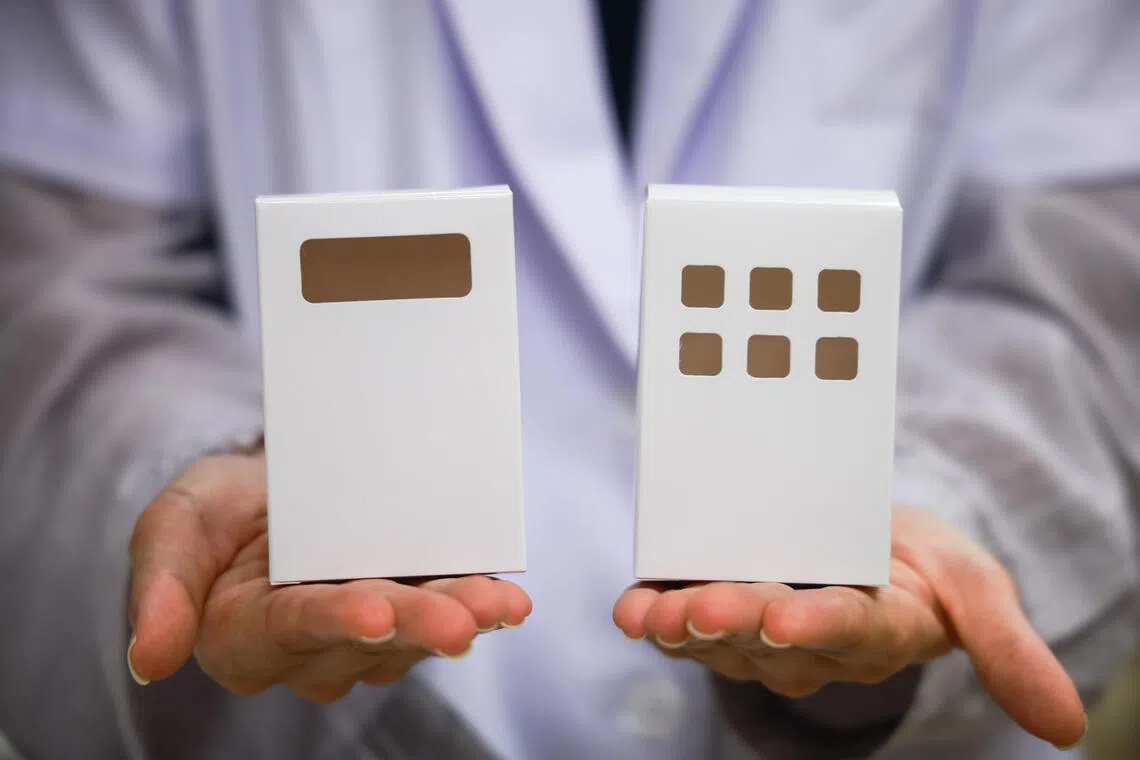
Tan Tock Seng Hospital's pharmacists designed a single-material paper medication box (right) by removing the plastic component, making it suitable for recycling. On the left is the previous box, with a small plastic window.
ST PHOTO: JASON QUAH
Jeannie Tey and Jason Cheah
Published Sep 28, 2026, 05:00 AM
Updated Sep 28, 2026, 05:00 AM
The paper box your medication comes in seems an unlikely place to start a conversation about the future of healthcare sustainability. But it is exactly where one started at Tan Tock Seng Hospital (TTSH), the flagship hospital of NHG Health.
Until recently, that box could not be recycled. The small plastic window on the front, the kind that lets the pharmacist and patient glance in to check the pills, meant the packaging mixed paper and plastic and had to be thrown away.
A team of TTSH’s pharmacists redesigned it into a single-material paper box , while keeping it compatible and sturdy enough to run through automated pharmacy-dispensing machines.
The change was modest. Its impact is not.
With every hospital and polyclinic in Singapore progressively adopting this new design, an estimated 4.36 million boxes can be recycled annually at home in the blue recycling bins located in housing estates and public spaces.
This is expected to reduce about 4,600kg of carbon emissions. That is like 24 round trips between Singapore and Bangkok. It also removes the use of about 1,837kg of plastic each year, equivalent to 122,000 plastic bottles, and trims packaging costs across the healthcare system without compromising patient safety or pharmacy operations.
This example matters because the idea came not from a boardroom or hospital operations blueprint. It came from our front-line pharmacists asking a simple question about something they handled every day. This sets the context of what sustainable healthcare should be .
For healthcare organisations, sustainability is not a future concern. It is already shaping the way we work today. Energy costs are rising, pushed up by carbon taxes and by fragile global fuel supply chains. Ageing healthcare infrastructure needs to be retrofitted without ever disrupting services like ACMV (air-conditioning and mechanical ventilation) systems that keep patients safe.
And the changing climate itself and environmental events are contributing to disease burden, population vulnerability and inequity, and healthcare demand. The young, elderly and those who work outdoors are particularly vulnerable to the impact of extreme heat and air pollution.
This means sustainability is not solely an environmental issue but also a healthcare and financial one, and ultimately about patient care.
Healthcare sits on both sides of these challenges. We treat the harms of a warming climate, yet we also add to the problem, through the energy we use, the buildings we operate, the supplies we buy and the waste we produce.
This gives us both a responsibility and an opportunity to lead. By improving how we use resources, reduce waste and redesign processes, we can strengthen operational resilience, manage costs and improve outcomes.
More than a collection of projects
Meaningful progress requires more than a handful of one-off projects. It requires a system-wide approach.
In Singapore, healthcare facilities are among the most energy-intensive buildings in society. Hospitals operate around the clock and must maintain strict standards for ventilation, infection prevention, temperature control and patient safety.
A large share of that energy goes to the air-conditioning and ventilation systems that keep these spaces safe. Making them more efficient and resilient, renewing older facilities and tapping renewable energy where we can, well-supported by improved monitoring and management of energy use is necessary in maintaining the quality and reliability of care.
But a great deal of healthcare’s carbon footprint lies beyond buildings – in medicine, medical devices, consumables and logistics. We have measured such impact, and high-volume consumables and pharmaceuticals stand out as the biggest sources of waste and emissions.
Addressing them means working more closely with suppliers, industry partners and healthcare institutions to adopt more sustainable solutions and build the habit of weighing the environmental impact when deciding what to purchase.
None of this happens through technology alone. It is our nurses, clinical teams and facilities personnel who turn sustainability goals into daily practice, as the pharmacists at TTSH showed.
Other examples include improving waste segregation at source, reducing avoidable clinical waste and piloting recycling initiatives for selected materials. We are also exploring opportunities for reuse and reduction in high-volume consumables.
We have found that small improvements can accumulate into significant system-wide impact.
Better care and a lighter carbon footprint
The most promising opportunities lie within clinical care itself. For a long time, improving care and caring for the environment were viewed as separate goals. Increasingly, we see that they can pull in the same direction.
Through an approach known as sustainability in quality improvement, teams in NHG Health now weigh three questions together whenever they consider a change: Does it improve patient and population health outcomes, does it reduce cost or use fewer resources, and does it lower environmental impact?
The medication box illustrates how environmental and cost benefits can be achieved while maintaining patient safety and quality of care. So do surgical teams who have redesigned surgical supply kits and streamlined workflows.
Other initiatives, such as appropriate prescribing and teleconsultation for suitable patients, have demonstrated how improvements in access, patient experience and resource efficiency can be achieved alongside environmental benefits.
These examples show that better care, responsible resource use and environmental sustainability need not compete with one another. When clinical teams consider all three together, improvements in one area can often reinforce the others.
These innovations are not compliance exercises handed down from the top. They are led by clinicians and are grounded in evidence and focused on delivering high-quality patient care.
Often, the most sustainable healthcare is care that a patient never needs. Prevention, population health management and keeping people well reduce avoidable demand on the whole system, which is why sustainability and getting better value from healthcare are the same pursuit.
Preparing for a changing climate
Reducing our environmental footprint is only half the task. We must also prepare for a climate that is already changing, rapidly.
Healthcare organisations increasingly face risks associated with extreme heat, haze, evolving disease patterns and potential disruptions to supply. We are integrating these risks into our long-term planning, strengthening resilience of our infrastructure and our ability to keep our services running without disruption.
One effort reduces future risks; the other prepares us for those that we cannot avoid.
As healthcare systems face rising demand, finite resources and a changing climate, sustainability can help us make better decisions about how we deliver care, steward resources and build resilience for the future.
The transition to sustainable healthcare will require more than new technologies or greener infrastructure. It calls for sustained commitment and a willingness to learn and rethink how care is designed and delivered, from the planning of infrastructure and the purchase of supplies right down to the bedside.
This means considering sustainability not as an additional priority, but as part of the everyday work of healthcare. From designing facilities and procuring supplies to improving clinical pathways and strengthening population health, the question is increasingly the same: How can we achieve the greatest value for patients while using resources responsibly and reducing environmental impact?
The pharmacists who redesigned that medication box were not tasked with solving climate change. They simply paid attention to something they handled every day and asked if it could be done better. The answer demonstrates how small improvements, multiplied across a healthcare system, can generate meaningful impact.
If this mindset of curiosity, continuous improvement and action becomes second nature to every healthcare professional in each ward, clinic, and operating theatre in Singapore, the cumulative effect will be far greater than what any top-down sustainability programme could achieve.
Healthcare is about protecting and improving lives. Sustainability, at its core, is no different. Our aspiration for healthcare is not to run a sustainability programme alongside the work of care, but to make this way of thinking inseparable from it.
Jeannie Tey is senior consultant in the department of epidemiology and preventive medicine at Tan Tock Seng Hospital and also serves as the hospital’s director of corporate planning and chief sustainability officer. Jason Cheah is deputy group chief executive officer of strategy, planning and resourcing at NHG Health and chair of the NHG Health environmental, social and governance council.
陈笃生医院的药剂师设计了一种单一材质的纸质药品盒(右图),去除了塑料部件,使其更易于回收利用。左图是之前的药品盒,带有一个小的塑料窗口。
《海峡时报》摄影:JASON QUAH
Jeannie Tey 和 Jason Cheah
发布于 2026 年 9 月 28 日上午 5:00
更新于2026年9月28日上午5:00
药品包装盒似乎不太可能成为探讨医疗保健可持续发展未来的切入点。然而,在NHG Health的旗舰医院陈笃生医院(TTSH),这恰恰是他们讨论的起点。
直到最近,这种药盒还无法回收利用。药盒正面有一个小小的塑料窗口,方便药剂师和病人查看药片,这意味着包装盒内混合了纸张和塑料,最终只能被丢弃。
陈笃生医院的药剂师团队将其重新设计成单一材料的纸盒,同时保持其兼容性和坚固性,使其能够通过自动药房配药机。
改变幅度不大,但影响却不小。
随着新加坡每家医院和综合诊所逐步采用这种新设计,预计每年将有 436 万个纸箱可以在住宅区和公共场所的蓝色回收箱中回收利用。
预计这将减少约4600公斤的碳排放,相当于新加坡和曼谷之间24次往返。此外,每年还能减少约1837公斤塑料的使用,相当于12.2万个塑料瓶,并在不影响患者安全或药房运营的前提下,降低整个医疗保健系统的包装成本。
这个例子之所以重要,是因为这个想法并非来自董事会或医院运营蓝图,而是来自我们一线药剂师提出的一个关于他们日常工作中遇到的问题。这为可持续医疗保健的本质奠定了基础。
对于医疗机构而言,可持续发展并非遥不可及的未来问题,它已然影响着我们当下的工作方式。能源成本不断攀升,碳税和脆弱的全球燃料供应链都推高了能源价格。老化的医疗基础设施需要进行改造升级,同时还必须确保空调和机械通风(ACMV)系统等保障患者安全的服务不受影响。
气候变化和环境事件本身正在加剧疾病负担、人口脆弱性和不平等现象,并增加医疗保健需求。儿童、老年人和户外工作者尤其容易受到极端高温和空气污染的影响。
这意味着可持续性不仅是一个环境问题,也是一个医疗保健和金融问题,最终关乎患者护理。
医疗保健行业正处于这些挑战的两面。我们一方面应对气候变暖带来的危害,另一方面,我们自身也在加剧这个问题,这体现在我们消耗的能源、运营的建筑、购买的物资以及产生的废物等方面。
这既赋予我们责任,也赋予我们引领的机遇。通过改进资源利用方式、减少浪费和重新设计流程,我们可以增强运营韧性、控制成本并改善结果。
不仅仅是一系列项目
取得实质性进展需要的不仅仅是几个零散的项目,而需要系统性的方法。
在新加坡,医疗机构是社会上能源消耗最高的建筑之一。医院24小时运转,必须严格遵守通风、感染防控、温度控制和患者安全标准。
大部分能源都用于维持这些场所安全的空调和通风系统。为了提高这些系统的效率和韧性,更新老旧设施,尽可能利用可再生能源,并辅以更完善的能源使用监测和管理,对于保障医疗服务的质量和可靠性至关重要。
但医疗保健行业的碳足迹很大一部分并非来自建筑物,而是来自药品、医疗器械、耗材和物流。我们已经对这些影响进行了测量,结果显示,大批量消耗品和药品是造成浪费和排放的最大来源。
解决这些问题意味着与供应商、行业合作伙伴和医疗机构更紧密地合作,采用更可持续的解决方案,并养成在决定购买什么时权衡环境影响的习惯。
这一切并非仅靠技术就能实现。正如陈笃生医院的药剂师们所展现的那样,正是我们的护士、临床团队和后勤人员将可持续发展目标转化为日常实践。
其他例子包括从源头上改进垃圾分类、减少不必要的医疗垃圾以及试点针对特定材料的回收利用计划。我们还在探索重复利用和减少大批量消耗品的机会。
我们发现,微小的改进可以累积起来,对整个系统产生重大影响。
更好的护理和更轻的碳足迹
最有前景的机遇蕴藏在临床护理本身。长期以来,改善医疗服务和保护环境被视为两个独立的目标。但我们越来越发现,它们其实可以朝着同一个方向发展。
通过一种被称为质量改进可持续性的方法,NHG Health 的团队现在在考虑任何改变时都会同时权衡三个问题:它是否能改善患者和人群的健康结果,它是否能降低成本或减少资源消耗,以及它是否能降低对环境的影响?
药品包装盒的例子表明,如何在保障患者安全和医疗质量的同时,实现环境效益和成本效益。手术团队重新设计了手术用品包并简化了工作流程,也体现了这一点。
其他举措,例如为合适的患者提供适当的处方和远程咨询,已经证明,在改善医疗服务可及性、提升患者体验和提高资源效率的同时,还能带来环境效益。
这些例子表明,更好的医疗服务、负责任的资源利用和环境可持续性并非相互冲突。当临床团队将这三者结合起来考虑时,一个领域的改进往往能够促进其他领域的进步。
这些创新并非自上而下颁布的合规措施,而是由临床医生主导,以循证医学为基础,并专注于提供高质量的患者护理。
通常,最可持续的医疗保健方式是患者根本不需要的医疗服务。预防、人群健康管理和保持人们健康可以减少整个系统不必要的负担,因此,可持续性和提高医疗保健价值是同一目标。
为应对气候变化做好准备
减少环境足迹只是任务的一半。我们还必须为正在快速变化的气候做好准备。
医疗机构日益面临极端高温、雾霾、疾病模式演变以及潜在的物资供应中断等风险。我们将这些风险纳入长期规划,增强基础设施的韧性,确保服务不间断运行。
一种努力可以降低未来的风险;另一种努力则让我们为无法避免的风险做好准备。
随着医疗保健系统面临日益增长的需求、有限的资源和不断变化的气候,可持续性可以帮助我们更好地决定如何提供医疗服务、管理资源以及为未来建立韧性。
向可持续医疗保健转型需要的不仅仅是新技术或更环保的基础设施。它需要持续的投入,以及学习和重新思考医疗保健设计和交付方式的意愿,从基础设施规划和物资采购,一直到床边护理,都需要重新审视和调整。
这意味着要将可持续性视为医疗保健日常工作的一部分,而不是额外的优先事项。从设施设计、物资采购到改进临床路径、增强人群健康,我们面临的问题越来越一致:如何在负责任地利用资源、减少环境影响的同时,为患者创造最大价值?
重新设计药品包装盒的药剂师们并非肩负着解决气候变化的重任。他们只是关注着自己每天都要接触的物品,并思考是否可以做得更好。答案表明,医疗保健系统中的微小改进,如果能够成倍增长,就能产生意义深远的影响。
如果这种好奇心、持续改进和行动的心态成为新加坡每个病房、诊所和手术室中每位医护人员的第二天性,那么其累积效果将远远大于任何自上而下的可持续发展计划所能取得的成就。
医疗保健的本质在于保护和改善生命。可持续发展的核心也与之并无二致。我们对医疗保健的愿景并非在医疗工作之外再开展可持续发展项目,而是将这种理念融入医疗工作之中,使其不可分割。
Jeannie Tey是陈笃生医院流行病学和预防医学科的高级顾问,同时也是该医院的企业规划总监和首席可持续发展官。Jason Cheah是NHG Health集团战略、规划和资源副首席执行官,也是NHG Health环境、社会和治理委员会主席。