'A proving ground': Why F&B founders take a chance on incubator spaces with short leases and uncertain odds“试验场”:为什么餐饮业创始人愿意冒险选择租期短、前景不明的孵化器空间?
For budding F&B entrepreneurs, temporary spaces serve as a place to test their concepts and to learn the realities of running a business.
新闻视频
For budding F&B entrepreneurs, temporary spaces serve as a place to test their concepts and to learn the realities of running a business.
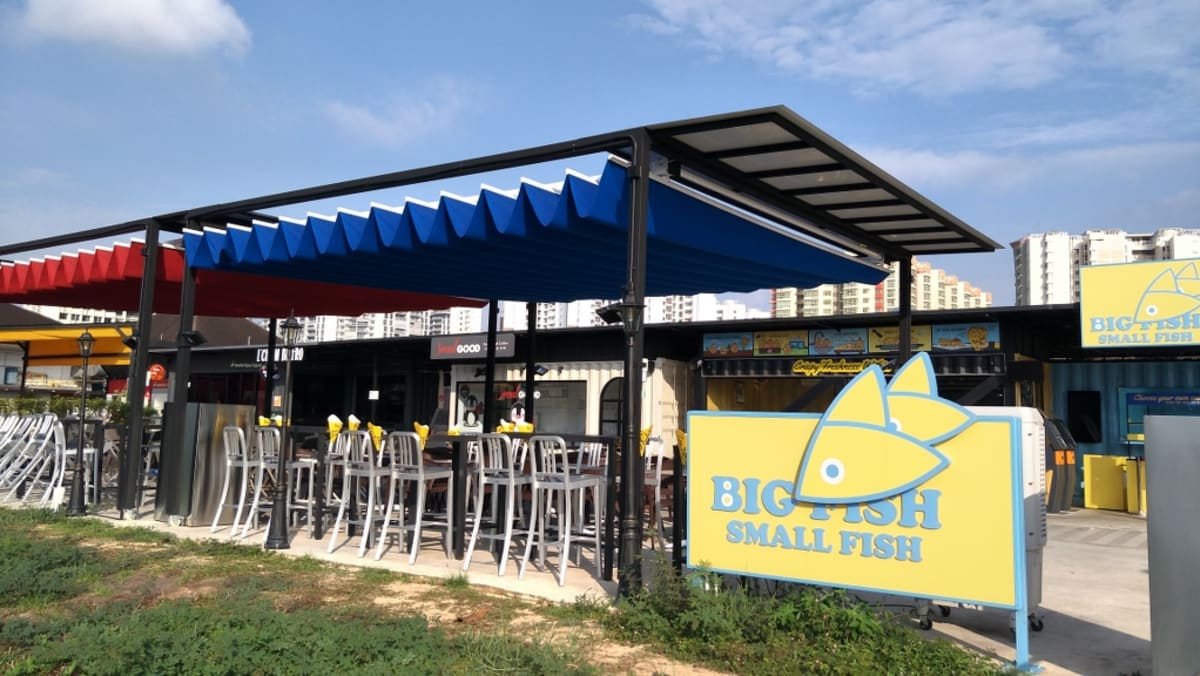
Popular eatery Big Fish Small Fish's roots trace to the Punggol East Container Park where it opened in 2017. (Photo: Big Fish Small Fish)
This audio is generated by an AI tool.
SINGAPORE: Chef Peter Smit's journey to opening his restaurant Dirty Supper began on the rooftop of his former flat.
His partner at that time was running a ceramics business and had a studio set up at the rooftop to conduct lessons. They also had a wood-fired barbeque grill which he used to whip up food for friends and family.
Before long, the rooftop became the setting for a "fun supper club". He would go on to test-drive the concept first at an incubator space before running Dirty Supper as a full-fledged restaurant on a one-and-a-half-year lease within the iconic Hua Bee Restaurant.
His restaurant is now a permanent fixture at the Tiong Bahru establishment.
CNA Games Guess Word Crack the word, one row at a time Buzzword Create words using the given letters Mini Sudoku Tiny puzzle, mighty brain teaser Mini Crossword Small grid, big challenge Word Search Spot as many words as you can Show More Show Less Yet, had it not been for the lower-risk options he had with the incubator space and the short-term lease, the 42-year-old reckoned he would not have opened his restaurant. "I wouldn't have actively sought out a space because I don't want to be 'half a million dollars minimum' in debt to open a restaurant. The way that Dirty Supper has happened from the rooftop to now, I've been very, very lucky, and I've just happened to have kind of the right conversations with the right people at the right time. "If it wasn't for those conversations, I most likely wouldn't have Dirty Supper here, and I probably wouldn't be in Singapore," said the Australian-born chef.
Yet, had it not been for the lower-risk options he had with the incubator space and the short-term lease, the 42-year-old reckoned he would not have opened his restaurant.
"I wouldn't have actively sought out a space because I don't want to be 'half a million dollars minimum' in debt to open a restaurant. The way that Dirty Supper has happened from the rooftop to now, I've been very, very lucky, and I've just happened to have kind of the right conversations with the right people at the right time.
"If it wasn't for those conversations, I most likely wouldn't have Dirty Supper here, and I probably wouldn't be in Singapore," said the Australian-born chef.
Originally a supper club, Chef Peter Smit's restaurant Dirty Supper is now permanent fixture within the Hua Bee Restaurant in Tiong Bahru. (Photo: Rachel Tan)
Mr Smit is among a number of F&B business owners in Singapore who got their start through incubators or other temporary spaces before moving on to something more permanent.
That pathway is in the spotlight following recent news that the popular Punggol East container park will close to make way for public housing. Its lease is due to expire at the end of 2026, with occupants required to vacate by Oct 31.
As the F&B tenants mulled the impending loss of the businesses they have built, netizens also questioned why anyone would sink capital into short-term tenancies with no guarantee of longevity.
The site originally began in 2016 as a social enterprise incubator under non-profit Social Innovation Park before evolving into a dining enclave leased by social enterprise City Sprouts in 2022.
At the time, the understanding was that City Sprouts would not hold on to the site for the long term.
Nevertheless, the incubator aspect of the Punggol East container park played a part in birthing several successful F&B businesses, helping them build a fan following and eventually finding permanent footing elsewhere.
Other F&B incubators have emerged in various forms over the years run by private companies, individual restaurant owners, as well as a government-managed scheme meant for hawkers.
While the models differ, they generally offer aspiring entrepreneurs a lower-risk entry into the industry. Some provide shorter tenures and subsidised rents, giving participants room to experiment before deciding whether to take the plunge.
For budding F&B owners, these spaces can be a testing ground to find out whether their concept works, learn the realities of running a business and discover whether they are cut out for the demands of the job.
In 2016, the Singapore-based non-profit Social Innovation Park transformed the vacant plot in Punggol into a space for social innovation that would eventually become the container park.
Under its "social contract" model, tenants received business and financial support in exchange for supporting a social mission of their choice.
Big Fish Small Fish was among the businesses that took a chance on the space, opening there in February 2017.
Co-founder and general manager Ong Wei Sheng was initially drawn to the outdoor concept, where diners could eat amid the park surroundings and unwind after work. It is a relaxing setting and one that worked especially well in Singapore, he said.
But the lower rents were another factor.
"Beyond the appeal of the space itself, the cost was lower compared to other locations, which let us test our concept without over committing early on," said the 41-year-old.
The company still invested a few hundred thousand dollars in the outlet, though Mr Ong did not give an exact figure. But the relatively short commitment made the gamble easier to take.
"What made that easier to commit to is a view we still hold today: there is really no such thing as a forever lease," he said. "Every space is temporary in some sense, so what matters is measuring the risk properly and making the space work for the period you have it.
"Seen that way, a shorter commitment was not a compromise, it was a sensible way to prove demand before taking on longer ones."
Big Fish Small Fish moved out of the container park at the end of their five-year lease in 2022, and has since expanded to four outlets in Singapore.
Big Fish Small Fish was at the Punggol East Container Park from 2017 to 2022. (Photo: Big Fish Small Fish)
For Mr Smit, the opportunity to test Dirty Supper came almost by chance.
He was still working full-time as a head chef when a "random conversation" with bar and restaurant owner Jay Gray led to an opportunity at an F&B incubator that Mr Gray ran.
The incubator, which was later named Ghostwriter, was launched as a space for aspiring F&B entrepreneurs to test their ideas for about three months at a nominal rent of about S$3,000 (US$2,300).
Mr Smit became its first entrepreneur, running his concept there for about 10 months. During his stint, another door opened when he got to know the owner of Unlisted Collection, which has a portfolio of restaurants and boutique hospitality concepts across Singapore, Ireland, and the United Kingdom.
Several months later, Mr Smit learnt that a restaurant operating within Hua Bee Restaurant was closing. He was offered the space to run Dirty Supper for the remainder of its lease – about 1.5 years.
"The original agreement … was (that) I just run Dirty Supper until the lease runs out, and when the lease runs out, then we see what happens," he said.
"It just so happened that we were successful and we were quite busy. So they said, 'Hey, if you want to keep going, keep going'. So even where I am now, it kind of was, without being an advertised incubator, it was still a bit of an incubator (where) you have this space for a short amount of time."
The space used for the first edition of Mr Jay Gray's food incubator, Ghostwriter. (Photo: Jay Gray)
The limited runway did not deter him. He was "bored of having to please investors", he said, and doubted he could have found one willing to back Dirty Supper in the form he envisioned.
The restaurant's concept has evolved to focus on whole-animal cooking, an approach which aims to use all parts of an animal as much as possible. While the concept itself was not new, Mr Smit did not think many restaurants were doing it the same way.
"I wouldn't have been able to find an actual investor that would have been happy to work the way that we work," he said, adding that the short lease gave him a chance to run his concept the way he wanted.
"It's just kind of like a proving ground. Not everything works, so if it didn't work, then I would go back to the drawing board and then go, okay, maybe that doesn't work here. So then, what can we do next?
"You don't really have overheads … I only had to worry about basically making money to cover my wage and cover my food and make a little bit of profit without all the rest of the overheads."
Mr Peter Smit preparing a brunch menu item at his restaurant Dirty Supper. (Photo: Rachel Tan)
Mr Gray, who is behind several Singapore cocktail bars including Low Tide and Sago House, launched Ghostwriter around 2023.
"Many talented young individuals were looking to take their ideas and put it all on the line. Having done this several times over, to varying degrees of success, I thought it would be a great idea to use a space we had at 98 Club Street to test drive ideas," he said.
After Mr Smit's stint, Mr Gray decided to open the space to others, putting out a simple call on Instagram for entrepreneurs.
The arrangement was kept straightforward: the entrepreneurs paid for their rent and goods, while Mr Gray covered the remaining costs. The profits went to the entrepreneurs.
He also did away with deposits and other administrative requirements, allowing participants to concentrate on their concepts and customers.
"The idea is to prepare people for the reality, not to hide it from them. They needed to understand that this was an opportunity to focus on the things you won't have time to when you're running full tilt to make wage and rent," he said.
"We allowed them to focus on what their guests want - or don't want. Test drive ideas, drinks, events, nights. Things you can't normally take risks on."
Six budding businesses went through the incubator. All six eventually opened permanent outlets, although some did so under different brand names.
Mr Gray is now preparing to launch Ghostwriter 2.0 in November, with a greater focus on education and collaboration to bring people together, such as a chef with a bartender and both with suppliers.
As part of the Chef X programme, participants take over a commercial restaurant at Clarke Quay Central for about four or eight weeks. (Photo: Far East Organization)
Other incubators have taken a similarly low-risk approach.
Far East Organization launched Baker X in December 2021 to help home-based bakers who wanted to move from their home kitchens into commercial spaces but were hesitant due to the risks involved, said Ms Deborah Tan, director for operations and marketing for the company's commercial group.
That concept later evolved into Chef X, launched in April 2024 to give aspiring chefs hands-on experience running a commercial restaurant.
Located at Clarke Quay Central, participants take over a fully equipped 24-seat restaurant for four or eight weeks, handling everything from dine-in and takeaway orders to interacting with customers and managing food and drinks.
This allows them to test and showcase their culinary concepts in a real-world setting with minimal financial risk, the Far East Organization told CNA.
Their main cost for the space is a S$250 monthly maintenance fee for the commercial kitchen equipment.
Each participant also receives guidance from a veteran industry mentor on areas such as menu development, food presentation and managing a business and its staff.
To date, 14 chefs have gone through Chef X, serving concepts ranging from modern Japanese and Korean food to local and fusion fare. Five have since opened their own outlets, according to the Far East Organization.
INCUBATION SCHEME FOR HAWKERS
Unlike incubators such as Ghostwriter and Chef X, which give F&B entrepreneurs temporary spaces to experiment with their concepts, the National Environment Agency's (NEA) Incubation Stall Programme is geared specifically towards better supporting aspiring hawkers and sustaining the hawker trade.
Launched in 2018, the programme offers eligible participants pre-fitted hawker stalls and subsidised stall rental for 15 months, lowering their start-up costs to allow them to test their business plans, refine recipes and hone their cooking skills, an NEA spokesperson told CNA.
As of Jun 30, 109 stalls had been allocated to aspiring hawkers, with about half of the participants going on to become full-fledged hawkers after completing the programme, the agency added.
Among them are sisters Serene and Danielle Tan, who started Butter Town, a hawker bakery specialising in shio pan, or Japanese salt bread.
They initially considered opening a cafe but were deterred by the higher overheads. With shio pan still relatively unfamiliar in Singapore at the time they were thinking of starting a business, the sisters wanted to test demand before committing.
"If we wanna test it out, we do it somewhere where maybe the cost is lower," said Ms Serene Tan, 34. They applied for the NEA programme in 2022 and took over a stall at Holland Drive Food Centre in May 2023.
Butter Town’s bakes, including the signature shio pans, displayed at its hawker stall at Holland Drive Market and Food Centre on Sep 9, 2026. (Photo: CNA/Ooi Boon Keong)
Their rent, which ranged from S$1,200 to S$1,800, was subsidised by 50 per cent for the first six months and 25 per cent for the next six. They still had to pay for their own equipment and other expenses such as an oven and packaging items, investing about S$24,000 between them.
"From the start, it was more of a testing. We wanted to see how it goes," said Ms Serene Tan. Ms Danielle Tan added: "Because we don't know what will happen. Maybe next month, there's another trend that's coming out."
The gamble paid off. Butter Town built a base of regular customers at Holland Drive and continued operating there after the programme. They also expanded and have a retail outlet at CT Hub 2, a business centre in the Kallang District, to their name.
Sisters and co-owners of Butter Town, Serene Tan (left), 34, and Danielle Tan (right), 30, in front of their hawker stall at Holland Drive Market and Food Centre on Sep 9, 2026. (Photo: CNA/Ooi Boon Keong)
The sisters also operate shio pan vending machines, or ATMs as they call it, at Woodleigh Village hawker centre, Hillion mall and Our Tampines Hub to reach out to more customers "at the lowest possible cost".
Despite their wish to expand further, rent remains a major constraint.
Looking back, Ms Danielle Tan, 30, said she was grateful to have gone through the incubator route. "I don't need to go through the normal route with the bidding of the stall which can go up to S$4,000 to S$5,000.
"I think it will take some time to recoup and break even or start to earn some money. I think the programme is really helpful if you really want to try out as a young entrepreneur."
Get our pick of top stories and thought-provoking articles in your inbox
Stay updated with notifications for breaking news and our best stories
Join our channel for the top reads for the day on your preferred chat app
对于初出茅庐的餐饮企业家来说,临时空间是检验其理念和了解经营业务实际情况的场所。
人气餐厅“大鱼小鱼”起源于榜鹅东集装箱公园,于2017年开业。(图片:大鱼小鱼)
这段音频由人工智能工具生成。
新加坡:厨师 Peter Smit 开设 Dirty Supper 餐厅的历程始于他以前公寓的屋顶。
他当时的合伙人经营着一家陶瓷店,并在屋顶设立了一个工作室授课。他们还有一个柴火烧烤架,他经常用它来为亲朋好友烹制美食。
不久之后,屋顶就成了“趣味晚餐俱乐部”的场所。他先在一个孵化空间试水,之后在标志性的华比餐厅租下了一年半的店面,正式开设了 Dirty Supper 餐厅。
他的餐厅现在已成为中峇鲁地区的一家常驻餐厅。
CNA游戏猜词游戏:逐行破解单词;流行词游戏:用给定的字母组成单词;迷你数独:小巧的谜题,强大的脑力挑战;迷你填字游戏:小方格,大挑战;单词搜索:尽可能多地找出单词。显示更多 显示更少 然而,这位42岁的厨师表示,如果不是因为孵化器空间和短期租赁带来的低风险选择,他可能不会开这家餐厅。“我不会主动寻找场地,因为我不想为了开一家餐厅而背负至少50万美元的债务。Dirty Supper从屋顶到现在的发展历程,我非常非常幸运,只是碰巧在合适的时间与合适的人进行了合适的对话。”这位出生于澳大利亚的厨师说道,“如果没有这些对话,我可能就不会在这里开Dirty Supper,我可能也不会在新加坡。”
然而,这位 42 岁的男子认为,如果不是因为孵化器空间和短期租赁提供了风险较低的选择,他就不会开这家餐厅。
“我不会主动寻找店面,因为我不想为了开一家餐厅而背负至少五十万美元的债务。从屋顶到现在,Dirty Supper 的发展历程让我非常非常幸运,我只是恰好在合适的时间与合适的人进行了合适的对话。”
“如果不是那些对话,我可能就不会在这里开办 Dirty Supper 餐厅,而且我可能也不会来到新加坡,”这位出生于澳大利亚的厨师说道。
彼得·史密特主厨的餐厅 Dirty Supper 最初是一家私人晚宴俱乐部,如今已成为中峇鲁华美餐厅的固定门店。(图片:Rachel Tan)
史密特先生是新加坡众多餐饮企业主之一,他们最初都是通过孵化器或其他临时场所起步,然后再转向更稳定的经营模式。
近日,颇受欢迎的榜鹅东集装箱公园即将关闭,为公共住房建设腾出空间,这一消息令这条通道备受关注。该公园的租约将于2026年底到期,住户须在10月31日前搬离。
餐饮租户们正在思考他们辛辛苦苦建立起来的生意即将失去,与此同时,网友们也质疑,为什么有人会把资金投入到没有长期保障的短期租赁中。
该网站最初于 2016 年作为非营利组织 Social Innovation Park 旗下的社会企业孵化器而成立,之后于 2022 年发展成为由社会企业 City Sprouts 租赁的餐饮场所。
当时的共识是,City Sprouts 不会长期持有该地块。
尽管如此,榜鹅东集装箱公园的孵化器功能在孕育几家成功的餐饮企业方面发挥了作用,帮助它们建立起粉丝群,并最终在其他地方找到了永久立足之地。
多年来,其他餐饮孵化器以各种形式涌现,由私人公司、个体餐馆老板运营,还有政府为小贩设立的管理计划。
尽管模式各异,但它们通常都能为有志创业者提供风险较低的行业准入途径。有些模式提供较短的租期和租金补贴,让参与者有时间进行尝试,然后再决定是否真正投入。
对于有抱负的餐饮业主来说,这些空间可以成为一个试验场,看看他们的理念是否可行,了解经营企业的实际情况,并发现自己是否能够胜任这份工作的要求。
2016 年,总部位于新加坡的非营利组织社会创新园将榜鹅的一块空地改造成社会创新空间,最终发展成为集装箱公园。
根据其“社会契约”模式,租户通过支持他们选择的社会使命来换取商业和财政支持。
Big Fish Small Fish 是众多冒险入驻该店面的商家之一,于 2017 年 2 月开业。
联合创始人兼总经理王伟生最初被户外用餐的概念所吸引,食客们可以在公园环绕的环境中用餐,并在工作之余放松身心。他表示,这种轻松的氛围在新加坡尤其受欢迎。
但较低的租金也是另一个因素。
“除了场地本身的吸引力之外,与其他地点相比,成本也更低,这让我们能够在早期不投入过多资金的情况下测试我们的概念,”这位 41 岁的负责人说道。
虽然翁先生没有透露具体数字,但该公司仍然在该门店投资了数十万美元。不过,由于投资期限相对较短,因此这项投资更容易承担。
“让我们更容易做出这个决定的原因是我们至今仍然坚持的观点:实际上并不存在永久租赁,”他说。“从某种意义上说,每个空间都是暂时的,所以重要的是要正确评估风险,并在你拥有空间的这段时间内充分利用它。”
“从这个角度来看,较短的合同期限并非妥协,而是一种在签订长期合同之前证明市场需求的明智方式。”
Big Fish Small Fish 在 2022 年五年租约到期后搬出了集装箱公园,此后在新加坡扩展至四家分店。
Big Fish Small Fish 于 2017 年至 2022 年在榜鹅东集装箱公园展出。(图片:Big Fish Small Fish)
对于史密特先生来说,试吃 Dirty Supper 的机会几乎是偶然获得的。
当时他还在一家酒吧担任主厨,一次与酒吧和餐厅老板杰伊·格雷的“偶然谈话”让他获得了在格雷先生经营的餐饮孵化器工作的机会。
该孵化器后来被命名为 Ghostwriter,其成立的目的是为有抱负的餐饮企业家提供一个空间,让他们可以以约 3,000 新元(2,300 美元)的象征性租金,在大约三个月的时间里测试他们的想法。
斯密特先生成为该店的首位创业者,在那里经营了他的餐饮理念约 10 个月。在此期间,他结识了 Unlisted Collection 的老板,该公司在新加坡、爱尔兰和英国拥有多家餐厅和精品酒店,这为他打开了另一扇机会之门。
几个月后,斯密特先生得知华比餐厅内的一家餐厅即将关门。餐厅方面提出让他接手该店面,继续经营“脏晚餐”餐厅,直至租约到期——大约一年半。
“最初的协议是……我只要继续经营 Dirty Supper 餐厅,直到租约到期,租约到期后,我们再看看会发生什么,”他说。
“碰巧我们很成功,也很忙。所以他们说,‘嘿,如果你想继续,那就继续吧’。所以即使是我现在所在的地方,虽然没有正式宣传,但仍然有点像个孵化器,(在那里)你可以短暂地拥有这样一个空间。”
这是杰伊·格雷先生的食品孵化器“Ghostwriter”首期项目所用的空间。(照片:杰伊·格雷)
资金有限并没有让他气馁。他说,他“厌倦了取悦投资者”,而且怀疑自己是否能找到愿意以他设想的形式支持 Dirty Supper 的投资者。
这家餐厅的理念已经发展到专注于整只动物烹饪,这种方法旨在尽可能地利用动物的各个部位。虽然这个概念本身并不新鲜,但斯密特先生认为很少有餐厅以这种方式来实践。
“我根本找不到愿意按照我们这种方式合作的真正投资者,”他说道,并补充说,短期租赁让他有机会按照自己想要的方式经营他的项目。
“这就像是试验场。不是所有方法都有效,所以如果行不通,我就得重新审视,然后想,好吧,也许这种方法在这里行不通。那么,我们接下来该怎么办呢?”
“你其实没有太多开销……我只需要担心如何赚钱来支付工资、伙食费,还能赚点小钱,而不用考虑其他所有开销。”
彼得·史密特先生正在他的餐厅“Dirty Supper”准备早午餐菜单上的菜品。(摄影:Rachel Tan)
Gray 先生是新加坡多家鸡尾酒吧的幕后推手,包括 Low Tide 和 Sago House,他于 2023 年左右推出了 Ghostwriter。
“许多才华横溢的年轻人都想把自己的想法付诸实践。我之前也多次尝试过,虽然成功程度不一,但我认为利用我们在俱乐部街98号的场地来检验这些想法是个好主意,”他说。
在史密斯先生离开后,格雷先生决定将这个空间开放给其他人,他在 Instagram 上向创业者发出了一个简单的邀请。
安排很简单:创业者支付租金和货款,格雷先生承担其余费用。利润归创业者所有。
他还取消了保证金和其他行政要求,让参与者能够专注于他们的理念和客户。
他说:“我们的想法是让人们做好面对现实的准备,而不是对他们隐瞒现实。他们需要明白,这是一个让他们专注于那些在全力以赴挣工资和交房租时无暇顾及的事情的机会。”
“我们让他们专注于客人想要什么——或者不想要什么。尝试各种想法、饮品、活动和晚宴。这些都是你通常不敢冒险尝试的事情。”
六家初创企业通过了孵化器项目。这六家企业最终都开设了永久门店,尽管其中一些使用了不同的品牌名称。
格雷先生目前正准备在 11 月推出 Ghostwriter 2.0,更加注重教育和协作,将人们聚集在一起,例如厨师与调酒师以及他们与供应商。
作为 Chef X 计划的一部分,参与者将在克拉码头中心的一家商业餐厅掌管餐厅约四周至八周。(图片:远东机构)
其他孵化器也采取了类似的低风险策略。
远东机构商业集团运营及市场总监Deborah Tan女士表示,远东机构于2021年12月推出了Baker X,旨在帮助那些想要从家庭厨房搬到商业空间,但由于存在风险而犹豫不决的家庭烘焙师。
后来,这一概念演变为 Chef X,于 2024 年 4 月推出,旨在为有抱负的厨师提供经营商业餐厅的实践经验。
餐厅位于克拉码头中心,参与者将接管一家设备齐全的 24 座餐厅,为期四周或八周,负责从堂食和外卖订单到与顾客互动以及管理食品和饮料的一切事宜。
远东机构告诉亚洲新闻台,这使得他们能够在真实环境中测试和展示他们的烹饪理念,并将财务风险降到最低。
他们租用该场地的主要成本是每月 250 新元的商用厨房设备维护费。
每位参与者还会得到一位资深行业导师的指导,指导内容包括菜单开发、食品摆盘以及企业及其员工的管理。
迄今为止,已有14位厨师参加了“厨师X”项目,他们的菜品涵盖了现代日式、韩式料理、本地特色菜以及融合菜肴等多种风格。据远东机构称,其中五位厨师之后开设了自己的餐厅。
小贩孵化计划
与 Ghostwriter 和 Chef X 等孵化器不同,这些孵化器为餐饮企业家提供临时空间来试验他们的理念,国家环境局 (NEA) 的孵化摊位计划专门用于更好地支持有抱负的小贩和维持小贩贸易。
国家环境局发言人告诉亚洲新闻台,该计划于 2018 年启动,为符合条件的参与者提供预先装修好的小贩摊位和 15 个月的摊位租金补贴,降低他们的创业成本,使他们能够测试商业计划、改进食谱和磨练烹饪技能。
该机构补充说,截至 6 月 30 日,已有 109 个摊位分配给了有志成为小贩的人,其中约有一半的参与者在完成该计划后成为了正式的小贩。
其中包括 Serene 和 Danielle Tan 姐妹,她们创办了 Butter Town,这是一家专门制作盐面包(日式盐面包)的小贩面包店。
她们最初考虑过开咖啡馆,但因运营成本较高而作罢。当时盐片在新加坡还相对不为人知,姐妹俩想先试探市场需求再做决定。
“如果我们想试一试,我们会选择成本可能较低的地方,”34岁的陈思琳女士说。她们于2022年申请了国家环境局的这项计划,并于2023年5月接管了荷兰路美食中心的一个摊位。
2026年9月9日,Butter Town在荷兰大道巴刹与熟食中心的小贩摊位上展示了其烘焙食品,包括招牌盐味面包。(图片:CNA/Ooi Boon Keong)
他们的租金在1200新元到1800新元之间,前六个月政府补贴50%,后六个月补贴25%。他们仍然需要支付设备和其他费用,例如烤箱和包装用品,两人总共投资约24000新元。
“从一开始,这更像是一次测试。我们想看看效果如何,”陈思琳女士说道。丹妮尔·陈女士补充道:“因为我们不知道未来会发生什么。也许下个月就会出现新的趋势。”
这次冒险取得了成功。Butter Town在荷兰大道积累了一批稳定的顾客群,并在节目结束后继续在那里营业。他们还拓展了业务,在加冷区的商业中心CT Hub 2开设了一家零售店。
2026年9月9日,姐妹俩兼Butter Town摊位的共同所有人,34岁的Serene Tan(左)和30岁的Danielle Tan(右)在荷兰大道巴刹与熟食中心的摊位前合影。(图片:CNA/Ooi Boon Keong)
姐妹俩还在伍德利村小贩中心、希利恩购物中心和淡滨尼天地经营盐片自动售货机(她们称之为 ATM),以便“以尽可能低的成本”接触到更多顾客。
尽管他们希望进一步扩张,但租金仍然是一个主要制约因素。
30岁的丹妮尔·谭女士回顾往事时表示,她很庆幸自己选择了孵化器这条路。“我不需要走正常的摊位竞标流程,摊位费可能高达4000到5000新元。”
“我认为需要一些时间才能恢复元气,收支平衡或者开始盈利。如果你真的想尝试做一名年轻企业家,我认为这个项目真的很有帮助。”
订阅我们的邮件,即可获取精选热点新闻和引人深思的文章。
订阅通知,第一时间获取突发新闻和精彩报道。
加入我们的频道,即可在您常用的聊天应用上获取当日热门文章。