Semiconductor firm VSMC opens first S$8.5 billion plant in Singapore, expected to create 1,600 jobs半导体公司VSMC在新加坡开设首家投资85亿新元的工厂,预计将创造1600个就业岗位。
The site in Tampines is set to produce 44,000 wafers per month when it reaches full capacity by 2029.
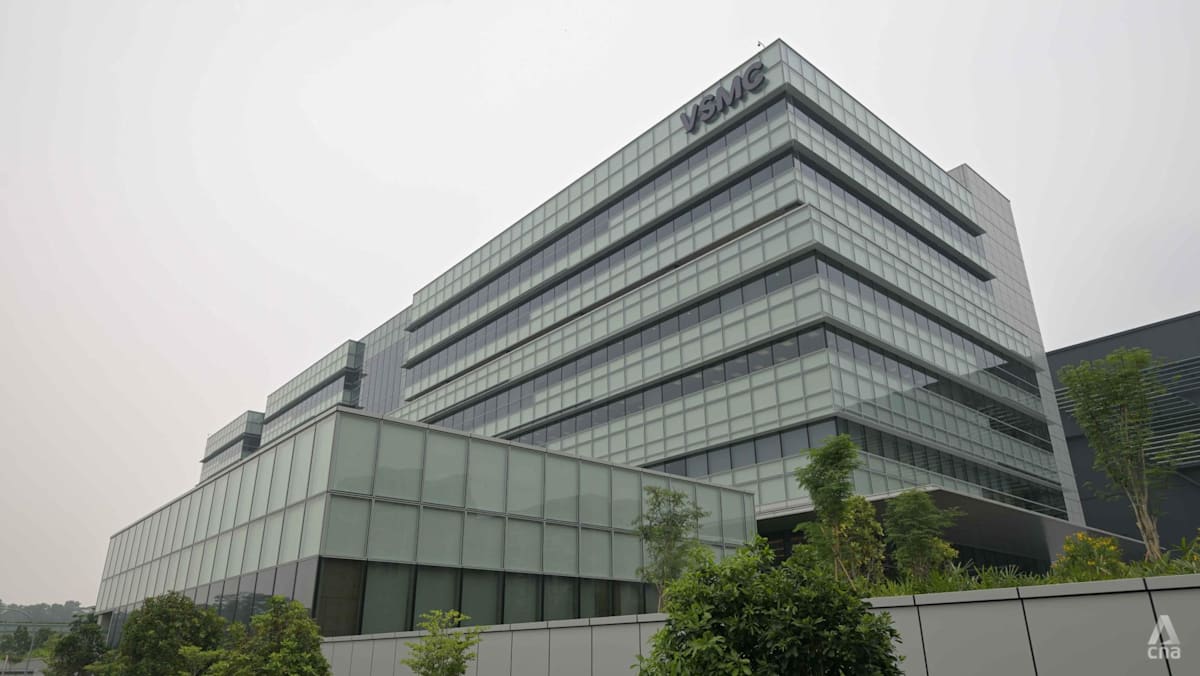
The site in Tampines is set to produce 44,000 wafers per month when it reaches full capacity by 2029.
The exterior of VisionPower Semiconductor Manufacturing Company on Sep 28, 2026. (Photo: CNA/Lim Li Ting)
This audio is generated by an AI tool.
SINGAPORE: Backed by semiconductor firms from Taiwan and the Netherlands, VisionPower Semiconductor Manufacturing Company (VSMC) opened its first S$8.5 billion (US$6.7 billion) wafer fabrication plant in Singapore on Monday (Sep 28), which is expected to create 1,600 new jobs.
Set to begin volume production in the first quarter of 2027, the Tampines facility will be able to produce 44,000 silicon wafers per month when it reaches full capacity by 2029.
Instead of the semiconductor chips used in artificial intelligence typically produced using the two-nanometre or smaller process, VSMC's Singapore plant is set to produce the 40- to 130-nanometre chips that are still in high demand, such as for mixed-signal, power management and interposer applications.
These will serve the high-performance computing, mobile, automotive, industrial and consumer markets, the company said in a press release.
CNA Games Guess Word Crack the word, one row at a time Buzzword Create words using the given letters Mini Sudoku Tiny puzzle, mighty brain teaser Mini Crossword Small grid, big challenge Word Search Spot as many words as you can Show More Show Less VSMC is a joint venture between Taiwan’s TSMC -backed Vanguard International Semiconductor (VIS) and the Netherlands' NXP Semiconductors. The VSMC facility, which has taken 22 months to build, will be fabricating 300mm wafers. A wafer – a thin, circular disk made out of silicon – is the foundation needed to build microchips, semiconductors and integrated circuits.
VSMC is a joint venture between Taiwan’s TSMC -backed Vanguard International Semiconductor (VIS) and the Netherlands' NXP Semiconductors.
The VSMC facility, which has taken 22 months to build, will be fabricating 300mm wafers. A wafer – a thin, circular disk made out of silicon – is the foundation needed to build microchips, semiconductors and integrated circuits.
A semiconductor wafer on display at VisionPower Semiconductor Manufacturing Company on Sep 28, 2026. (Photo: CNA/Lim Li Ting)
Speaking at the opening ceremony, Minister for Trade and Industry (Energy and Industry) Dr Tan See Leng said that while much of the attention today is on the most advanced logic chips that power artificial intelligence, specialty semiconductors are just as essential.
Noting that the semiconductor industry is set to double to US$1.6 trillion by 2030, he added that demand for specialty chips is growing with trends like electrification, connected devices and industrial automation.
The plant will contribute significantly to Singapore’s semiconductor manufacturing capabilities and reinforce its role as a trusted node in the global semiconductor supply chain, said Dr Tan.
Of the 1,600 new jobs, 75 per cent will be for professional, managerial, executive and technician roles, said Dr Tan.
These include engineers, chemists and data scientists who will operate advanced manufacturing equipment, develop and fabricate wafers and optimise the manufacturing process, he added.
“These roles will give Singaporeans opportunities to build deep skills and meaningful careers in an important, growing industry.”
The semiconductor industry presently contributes close to 6 per cent of Singapore’s economy and employs more than 35,000 people, according to a factsheet from the Economic Development Board.
Singapore accounts for about one in every 10 chips made globally . The country also produces one-fifth of global semiconductor equipment annually.
A model of VisionPower Semiconductor Manufacturing Company on Sep 28, 2026. (Photo: CNA/Lim Li Ting)
Chairman of VSMC and VIS Leuh Fang stressed the importance of reliable manufacturing and resilient supply chains as demand for semiconductors continues to grow.
For VSMC, Singapore is a long-term strategic partner, and the investment reflects its confidence in the country’s role in the global semiconductor industry.
President and CEO of NXP Semiconductors Rafael Sotomayor noted that the world is entering an era where artificial intelligence is moving beyond the cloud and into the physical world, with physical AI applications to vehicles, robots and factories.
“Semiconductors are at the heart of this transformation, providing the foundation for trusted physical AI and facilities like VSMC are essential to enable it,” he added.
Get our pick of top stories and thought-provoking articles in your inbox
Stay updated with notifications for breaking news and our best stories
Join our channel for the top reads for the day on your preferred chat app
位于淡滨尼的工厂预计在 2029 年全面投产时,每月可生产 44,000 片晶圆。
2026年9月28日,VisionPower半导体制造公司外景。(图片:CNA/林丽婷)
这段音频由人工智能工具生成。
新加坡:在台湾和荷兰半导体公司的支持下,威能半导体制造公司(VSMC)于周一(9月28日)在新加坡开设了其首个价值85亿新元(67亿美元)的晶圆制造厂,预计将创造1600个新的就业岗位。
淡滨尼工厂计划于 2027 年第一季度开始批量生产,到 2029 年达到满负荷运转时,每月可生产 44,000 片硅片。
与人工智能领域通常采用 2 纳米或更小工艺生产的半导体芯片不同,VSMC 的新加坡工厂将生产 40 至 130 纳米的芯片,这些芯片仍然有很高的需求,例如用于混合信号、电源管理和中介层应用。
该公司在一份新闻稿中表示,这些产品将服务于高性能计算、移动、汽车、工业和消费市场。
CNA游戏 猜词游戏 逐行破解单词 流行词游戏 用给定的字母组成单词 迷你数独 小谜题,脑力挑战 迷你填字游戏 小方格,大挑战 单词搜索 尽可能多地找出单词 显示更多 显示更少 VSMC是台湾台积电支持的先锋国际半导体(VIS)与荷兰恩智浦半导体的合资企业。VSMC工厂历时22个月建成,将生产300毫米晶圆。晶圆——一种由硅制成的薄圆形圆盘——是制造微芯片、半导体和集成电路的基础。
VSMC 是台湾台积电支持的先锋国际半导体(VIS)与荷兰恩智浦半导体(NXP Semiconductors)的合资企业。
VSMC工厂历时22个月建成,将生产300毫米晶圆。晶圆是一种由硅制成的薄圆形片,是制造微芯片、半导体和集成电路的基础。
2026年9月28日,VisionPower半导体制造公司展出的半导体晶圆。(图片:CNA/林丽婷)
在开幕式上,贸工部长(能源与工业)陈思龙博士表示,虽然如今人们的注意力大多集中在驱动人工智能的最先进的逻辑芯片上,但特种半导体同样至关重要。
他指出,到 2030 年,半导体行业的规模将翻一番,达到 1.6 万亿美元;他还补充说,随着电气化、互联设备和工业自动化等趋势的发展,对特种芯片的需求也在增长。
陈博士表示,该工厂将极大地提升新加坡的半导体制造能力,并巩固其作为全球半导体供应链中值得信赖的节点的地位。
陈博士表示,在新增的1600个工作岗位中,75%将是专业人员、管理人员、行政人员和技术人员的职位。
他还补充说,这些人包括工程师、化学家和数据科学家,他们将操作先进的制造设备,开发和制造晶圆,并优化制造过程。
“这些职位将为新加坡人提供机会,让他们在一个重要且不断发展的行业中培养深厚的技能并拥有有意义的职业生涯。”
根据新加坡经济发展局的一份情况说明书,半导体产业目前对新加坡经济的贡献接近 6%,并雇佣了超过 35,000 名员工。
全球每生产10个芯片,新加坡就生产一个左右。该国每年还生产全球五分之一的半导体设备。
2026年9月28日,VisionPower半导体制造公司的模型。(图片:CNA/林丽婷)
VSMC 和 VIS 董事长吕芳强调,随着半导体需求的持续增长,可靠的制造和有韧性的供应链至关重要。
对于VSMC而言,新加坡是其长期战略合作伙伴,这项投资体现了VSMC对新加坡在全球半导体行业中地位的信心。
恩智浦半导体总裁兼首席执行官拉斐尔·索托马约尔指出,世界正在进入一个人工智能超越云端、进入物理世界的时代,物理人工智能应用领域包括车辆、机器人和工厂。
“半导体是这一变革的核心,为可信的物理人工智能提供了基础,而像VSMC这样的设施对于实现这一目标至关重要,”他补充道。
订阅我们的邮件,即可获取精选热点新闻和引人深思的文章。
订阅通知,第一时间获取突发新闻和精彩报道。
加入我们的频道,即可在您常用的聊天应用上获取当日热门文章。