Lecturers get an inside look into how news for youth is made at ST News Literacy Champions event在《海峡时报》新闻素养冠军活动中,讲师们深入了解了面向青少年的新闻是如何制作的。
Lecturers explore how ST creates youth news content to engage young audiences and enhance news literacy through tailored resources and workshops. Read more at straitstimes.com.
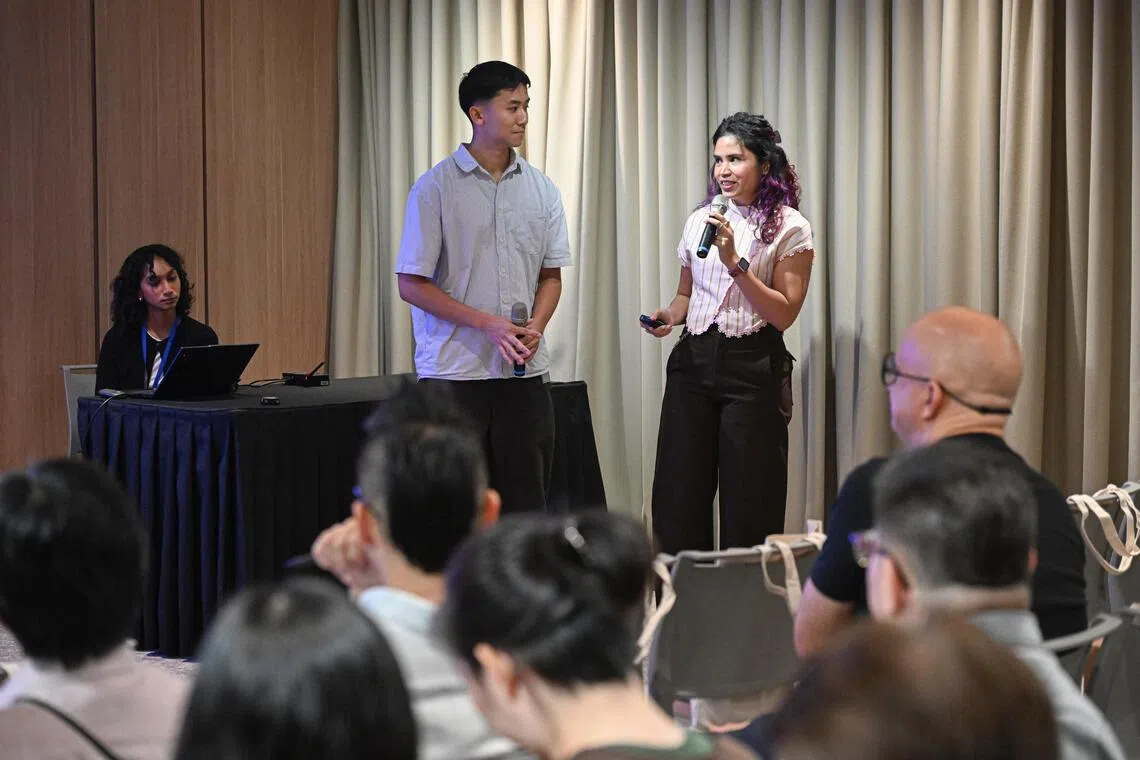
ST journalist Wong Yang (left) and executive producer Farzanah Friday conducting the professional development workshop at the News Centre on Sept 28 as part of The Straits Times’ News Literacy Champions programme.
ST PHOTO: AZMI ATHNI
Published Sep 28, 2026, 07:31 PM
Updated Sep 28, 2026, 07:31 PM
Lecturers from polytechnics and ITE attended a workshop to learn what goes into ST's youth news content, especially engaging, fast, and visually appealing formats like videos and TikToks.
The ST News Literacy Champions programme supports educators with tailored resources and free ST subscriptions to help integrate current affairs and news literacy into their teaching effectively.
Attending lecturers found the workshop useful for understanding changing student news consumption, emphasising video content as a tool, and valued connecting with peers on educational approaches.
SINGAPORE – Lecturers from tertiary institutions got an inside look at how everything from tongue-in-cheek TikToks to viral videos covering Parliament and the 2025 General Election were made, from some of the main faces behind ST’s news coverage for youth, on Sept 28.
Journalist Wong Yang, also known as “Gerry” from ST’s “Gerry and Mandy” short-form video series, said: “The demands have really changed – younger audiences want their news to be fast, engaging, relatable and digestible. News might also be something they prefer to watch rather than read.
“It’s made me think about telling stories visually and in a way that speaks to viewers more sincerely, instead of telling them ‘here’s what you need to know’.”
Executive producer Farzanah Friday said: “Creating content for our young audiences requires us to stay updated on fast-evolving trends and the topics that matter most to our young, while also experimenting with different content styles helps us identify what fits best.”
The 1½-hour workshop held on Sept 28 at News Centre in Toa Payoh North, was attended by 41 lecturers from the polytechnics and the Institute of Technical Education.
The event was part of this year’s edition of the ST News Literacy Champions programme — a free, year-long programme that supports lecturers so they can better infuse current affairs and build news literacy in their classrooms.
Lecturers who participate in the programme receive curated resource packages individually tailored to the modules they teach and free ST subscriptions to be able to better integrate the news into their daily teaching.
Attending lecturers said that they found the event helpful in learning about how to use news in the classroom.
Charlotte Char, a lecturer at Republic Polytechnic’s Centre for Foundational Studies, said: “It was a great opportunity to find out more about how to engage young people with the news.
“We already use some video content in our classroom, but we may want to have another look at the type and length of the videos that we use as a hook for our lessons.”
Rebecca Lim, a lecturer at Temasek Polytechnic’s School of Humanities and Social Sciences added that she noticed the way her students consume the news had been changing.
She said: “Sometimes, it’s a struggle for (our students) to read long-form articles so I really liked the suggestion of using videos as a hook so our students engage with different forms of media.”
ST journalist Wong Yang (left) and executive producer Farzanah Friday taking a wefie with polytechnic and ITE lecturers at the Sept 28 workshop. ST PHOTO: AZMI ATHNI
ST journalist Wong Yang (left) and executive producer Farzanah Friday taking a wefie with polytechnic and ITE lecturers at the Sept 28 workshop.
For James Sharpe, a lecturer at Ngee Ann Polytechnic’s School of Film and Media Studies, the session was reassurance that “the direction that the industry is headed in is in line with the young journalists in the mass communication diploma and the content they want to create”.
He added that the session was also a chance for him to connect with other educators: “Educational institutions tend to be quite siloed so being able to come together and hear questions from like-minded educators is very fascinating and positive.”
ST editor Jaime Ho said: “We’ve been working with polytechnic and ITE lecturers over the past year with the aim of making news and current affairs more relatable to younger people.”
“We’re of course deeply aware that as with others, younger Singaporeans will get their news from a wide variety of sources and formats, especially on social and video platforms. We’re therefore collaborating with these lecturers to help young people evoke an interest in the world around them, and to understand how to engage on each of these platforms through which they get their news.”
Dillon Loh is a journalist covering the youth beat at The Straits Times.
ST Schools programme
《海峡时报》记者黄扬(左)和执行制片人法扎娜·弗莱迪于 9 月 28 日在新闻中心举办专业发展研讨会,这是《海峡时报》新闻素养冠军计划的一部分。
ST 摄影:AZMI ATHNI
发布于 2026 年 9 月 28 日晚上 7:31
更新于2026年9月28日晚上7:31
来自理工学院和工艺教育学院的讲师参加了一个研讨会,学习《海峡时报》青年新闻内容的制作过程,特别是视频和TikTok等引人入胜、节奏快、视觉效果吸引人的形式。
《海峡时报》新闻素养倡导者计划为教育工作者提供量身定制的资源和免费的《海峡时报》订阅,以帮助他们有效地将时事和新闻素养融入教学中。
参加研讨会的讲师们认为,该研讨会有助于了解学生新闻消费习惯的变化,强调视频内容作为一种工具的重要性,并重视与同行交流教育方法。
新加坡——9月28日,来自高等院校的讲师们有机会深入了解《海峡时报》面向青年的新闻报道背后的一些主要人物是如何制作各种内容的,从略带讽刺意味的TikTok视频到报道国会和2025年大选的病毒式视频。
记者黄阳(Wong Yang),也就是《海峡时报》短视频系列“Gerry and Mandy”中的“Gerry”,表示:“需求确实发生了变化——年轻观众希望新闻快速、引人入胜、贴近生活且易于理解。他们可能也更喜欢看新闻而不是读新闻。”
“这让我思考如何用视觉方式讲述故事,如何用更真诚的方式与观众交流,而不是告诉他们‘这是你需要知道的’。”
执行制片人法扎娜·弗莱迪表示:“为我们的年轻观众创作内容需要我们不断更新快速变化的趋势和年轻人最关心的话题,同时尝试不同的内容风格也能帮助我们找到最合适的内容。”
9 月 28 日在大巴窑北新闻中心举行的 1.5 小时研讨会,有来自理工学院和工艺教育学院的 41 位讲师参加。
此次活动是今年《海峡时报》新闻素养冠军计划的一部分——这是一项为期一年的免费计划,旨在支持讲师更好地将时事融入课堂,培养学生的新闻素养。
参与该计划的讲师将收到根据他们所教课程量身定制的精选资源包,以及免费的《海峡时报》订阅,以便更好地将新闻融入到他们的日常教学中。
出席的讲师们表示,他们发现这次活动有助于学习如何在课堂上使用新闻。
共和理工学院基础研究中心讲师夏洛特·查尔表示:“这是一个很好的机会,可以更多地了解如何让年轻人参与到新闻中来。”
“我们已经在课堂上使用了一些视频内容,但我们可能需要重新审视一下我们用作课程导入的视频类型和时长。”
淡马锡理工学院人文与社会科学学院讲师 Rebecca Lim 补充说,她注意到学生们获取新闻的方式正在发生变化。
她说:“有时候,(我们的学生)很难阅读长篇文章,所以我非常喜欢用视频作为切入点的建议,这样我们的学生就可以接触到不同形式的媒体。”
《海峡时报》记者黄扬(左)和执行制片人法扎娜·弗莱迪在9月28日的研讨会上与理工学院和工艺教育学院的讲师们合影。《海峡时报》摄影:阿兹米·阿特尼
《海峡时报》记者黄扬(左)和执行制片人法扎娜·弗莱迪在9月28日的研讨会上与理工学院和工艺教育学院的讲师们合影。
对于义安理工学院电影与媒体研究学院的讲师詹姆斯·夏普来说,这次会议让他确信“该行业的发展方向与大众传播文凭课程的年轻记者以及他们想要创作的内容是一致的”。
他还补充说,这次会议也是他与其他教育工作者交流的机会:“教育机构往往各自为政,所以能够聚在一起,听取志同道合的教育工作者提出的问题,是一件非常有趣和积极的事情。”
《海峡时报》编辑何杰明表示:“过去一年,我们一直与理工学院和工艺教育学院的讲师合作,旨在让新闻和时事更贴近年轻人的生活。”
“我们当然非常清楚,和其他人一样,新加坡的年轻人会从各种各样的渠道和形式获取新闻,尤其是在社交和视频平台上。因此,我们正在与这些讲师合作,帮助年轻人激发对周围世界的兴趣,并了解如何在他们获取新闻的各个平台上进行互动。”
Dillon Loh 是《海峡时报》负责报道青年新闻的记者。
ST 学校计划