Speaking multiculturalism in Singapore – literally在新加坡谈论多元文化——字面意义上的多元文化
The colloquial variant of Singapore English is a proud representation of our mix of races, cultures and languages. Read more at straitstimes.com.
新闻视频
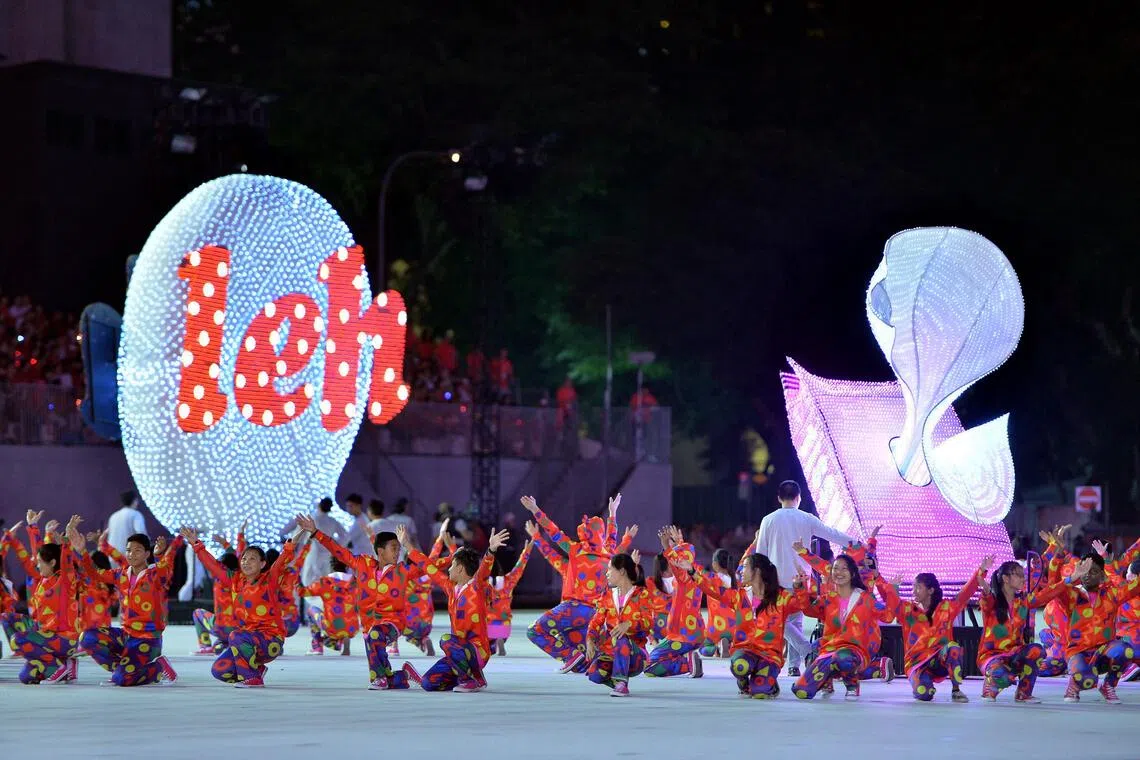
With its unique mix of local words, grammar and sentence structures, the colloquial variant of Singapore English is a proud representation of our mix of races, cultures and languages.
One of the performances during the National Day Parade preview held at the Padang on Aug 1, 2015.
PHOTO: BERITA HARIAN
Published Sep 29, 2026, 05:30 AM
Updated Sep 29, 2026, 05:30 AM
While doing a course on linguistics recently, I was surprised to hear many younger classmates championing the use of Singlish . In fact, the use of the local, colloquial form of English was not only acceptable to them, but also something that they were proud of. “It represents our local culture” was a common refrain.
Some couldn’t even fathom how anyone could see Singlish as a poorer cousin of “standard” English, or why anyone would restrict its use, as long as speakers were able to code-switch between Singlish and more “proper” English in appropriate situations.
Their comments evoked in me a strange mix of validation and discomfort. Since I was young, I had been taught to regard Singlish as “bad English”, and was constantly reminded by parents, teachers and the media to speak “proper” English.
This meant obeying the textbook rules of British grammar and pronunciation strictly; broken grammar, poor pronunciation and particles like “lah” or “lor” were out. In secondary school, the casual request, “Teacher, go toilet”, earned us the coldest gaze and the sarcastic reply, “No, I’m not going to the toilet”.
This official stance was understandable when Singapore was in the earlier stages of its goal to go global. Speaking “good English” was seen as critical: If Singaporeans couldn’t speak a standard of English understood by foreigners, it was argued, how could they do business and interact with the world outside?
It was also believed that allowing people to speak colloquial English, or popularising it in media and entertainment, would hinder efforts to improve their English. Hence the Speak Good English campaigns, with even poor Phua Chu Kang being told to go back to school.
There was a part of me, however, that always wanted to question this tough approach.
A growing acceptance of Singapore English
It was thus comforting when I learnt just how much had changed since then.
Today, much of the linguistic fraternity regards Singlish – or, to go by its technical term, “Singapore Colloquial English” – as a legitimate variant of “Singapore English”, which is itself considered a variety of English, like, say, Indian or Hong Kong English. The other variant is “Singapore Standard English”, which is more formal and closer to British English.
While both variants are seen as a distinctive part of Singapore’s linguistic identity, it is the colloquial variant, with its grammar, vocabulary and syntax drawn from English, Malay, Mandarin, Hokkien and Cantonese, that is seen as truly embodying Singapore’s multiracial, multicultural character.
A typical Singlish sentence could mix words and grammar from any number of these local languages, demonstrating the extent – and beauty – of our “rojak” culture.
While it might not technically be an example of Singlish, my favourite representation of this unique Singaporean mix comes from the kopitiam code of ordering coffee or tea, which features an absolute host of vernacular languages, including Malay, Hokkien, Hainanese and Cantonese.
In one phrase alone, “kopi-C siew dai peng”, incorporates elements of Malay (kopi), Cantonese (siew dai, or “less base”), Hokkien (peng, or “ice”), and possibly Hainanese (the “C” or “si” apparently either referring to “fresh” in Hainanese, or the Carnation brand of evaporated milk) to describe an order of iced coffee with evaporated milk and less sugar.
What could be more local than that?
In line with the linguistic recognition of the value of Singapore English, there is the growing embracement of this local form of English as Singapore’s very own.
An Institute of Policy Studies study has found more Singaporeans using Singlish in everyday life , with 80 per cent of younger folk saying that they speak it well. That statement alone says plenty – I can’t imagine daring to say that I spoke Singlish “well” when I was young.
There is also a greater confidence in the Singaporean accent, with its distinctively un-British and un-American and unique pronunciation patterns that once used to be denounced as “wrong”.
And what could give more pride than seeing the Oxford English Dictionary take in more Singapore English words into the hallowed lexicon ? Eleven more, including “jialat” and “wayang”, were added this year, taking the count to more than 30 (see infobox).
The growing acceptance of Singapore English indicates a coming of age, not just of our linguistic confidence, but also a pride in our multi-identity.
Our unique mix of races, languages and cultures is well reflected in the assortment of words and sentence structures that make up Singlish, such that speaking and hearing it reminds us that we are simultaneously Chinese, Malay, Indian and others.
The language of unity and home
One of the rationales behind the promotion of English, apart from its value as a global lingua franca, was that it was a neutral language for a fledgling nation whose populace mostly spoke only Malay, Tamil and Chinese. English was then clearly a colonial import, but now, this unique form of English feels truly local, giving us a common language that unites the races. What could make us feel more “together” than speaking a language that respects and celebrates the contributions of the different communities?
It’s often observed that nothing evokes “home” or a sense of unity more than hearing a Singaporean accent in a far-flung territory .
I’ll never forget how, on a tour some years back, our Singaporean tour guide had made sure to speak in “proper”, neutrally accented English for the benefit of several British fellow travellers – until the latter left for their home on an earlier flight. When he switched back to Singapore English (with great relief), the rest of the bus practically erupted in cheers. We were not home yet, but we felt that we were halfway there already.
It was thus a landmark event when the 2015 National Day Parade featured floats portraying the quintessential “lah” and “chope”, and then Prime Minister Lee Hsien Loong said in a Facebook post: “I’m glad that at 50, we are less ‘blur like sotong’, and more confident and comfortable with everything that makes us Singaporean.”
In many ways, it represented not just an official turnaround from the earlier hardline approach against Singlish, but also a recognition of our increasing comfort with our identity. In recent years, the Speak Good English Movement has moved from seeking to eradicate Singlish to acknowledging the differences between “standard” English, “broken” English and Singlish.
Of course, educators – and many parents, probably – would still like to stress the importance of being proficient in “standard” English when required. Which means code-switching – the practice of alternating between language or language variants as needed – could become as essential a skill as speaking “good” English.
What I think may be more worrying, however, is what kind of future Singapore English may have.
One of the many supporters of Singlish is author Gwee Li Sui, who has translated four children’s classics into Singlish. His book, Winnie-da-Pooh, is a translation of A.A. Milne’s Winnie-the-Pooh. PHOTO: ST FILE
One of the many supporters of Singlish is author Gwee Li Sui, who has translated four children’s classics into Singlish. His book, Winnie-da-Pooh, is a translation of A.A. Milne’s Winnie-the-Pooh.
The future of Singapore English
It would seem that today, new and successive waves of millennial and Gen-Z slang are sweeping onto local shores. Where previous generations used to fret over their children not being able to speak English, younger parents today are likely to be more worried about not being able to speak their kids’ lingo.
In an age of globalisation and social media influences, could Singapore English be at risk of being overtaken by the latest slang?
While we still have Mr Brown championing local speak, could “skibidi Ohio”, “slay” and other trendy phrases edge out our “lahs” and “lors”? Might some parts of Singapore English become extinct one day, just like some Chinese dialects?
Languages are alive and constantly evolving, and their importance – and survival – ultimately depends on the people speaking it.
If a language expresses our identity and culture, then I can only hope that the reverse is true: that a continual pride and conviction in our multiracial, multicultural personality will compel us to keep Singapore English going strong. In a world of growing division and uncertainty, what may keep us united and sure is... Singlish.
Singapore English words in Oxford
The Oxford English Dictionary features dozens of Singapore English words. They include:
Assam laksa – sour, spicy noodle soup
Agak-agak – to estimate, guess
Boleh – to have the power or ability to do something successfully
BTO – to apply for a new HDB flat
Jialat – tiresome, strenuous
Kaypoh – nosy, interfering, prying
Play play – to trifle with, mess around, or take things lightly
Wayang – pretence, false display aimed at deceiving
Blur – ignorant, confused, unaware
Lepak – to relax, hang out, do something in an unrushed manner
Shiok – superb, enjoyable, excellent
Sabo – to play a trick, cause an inconvenience, or get someone into trouble
Sotong – a clumsy or ignorant person (see “blur”)
Elevated insights from seasoned perspectives. Crafted by journalists. Powered by Purpose: The Straits Times Signature Series is a new editorial project helmed by experienced journalists to shine a light on people, themes and ideas that rarely get the attention they deserve in everyday news cycles.
This article is part of a special collaboration between The Straits Times and Nexus – the lead agency that drives Singapore’s national education and Total Defence efforts – to spotlight national issues.
The writer was a journalist at The Straits Times’ political desk and news desk.
新加坡英语的口语变体以其独特的本地词汇、语法和句式结构而著称,自豪地展现了我们种族、文化和语言的融合。
2015年8月1日,在政府大厦草场举行的国庆庆典预演期间的表演之一。
图片来源:《每日新闻》
发布于 2026 年 9 月 29 日上午 5:30
更新于2026年9月29日上午5:30
最近上语言学课时,我惊讶地发现很多年轻的同学都推崇使用新加坡式英语(Singlish)。事实上,他们不仅接受这种本地化的口语英语,还为此感到自豪。“它代表了我们当地的文化”是他们经常挂在嘴边的一句话。
有些人甚至无法理解,为什么有人会把新加坡式英语视为“标准”英语的低等版本,或者为什么有人会限制它的使用,只要说话者能够在适当的情况下在新加坡式英语和更“正式”的英语之间进行语码转换。
他们的评论让我感到既认同又不安,这种感觉很奇妙。从小我就被灌输新加坡式英语是“糟糕的英语”这种观念,父母、老师和媒体也总是提醒我要说“标准”英语。
这意味着要严格遵守英式语法和发音的教科书规则;语法错误、发音不准以及像“lah”或“lor”这样的助词都是不被允许的。在中学,一句随意的请求“老师,我去趟厕所”会换来老师最冷漠的眼神和讽刺的回答:“不,我不去厕所。”
新加坡在早期阶段致力于走向全球化时,这种官方立场是可以理解的。当时,说一口流利的英语被视为至关重要:有人认为,如果新加坡人不能说外国人能听懂的英语,他们又如何开展业务并与外界互动呢?
人们还认为,允许人们说口语化的英语,或者在媒体和娱乐界推广口语化的英语,会阻碍他们提高英语水平的努力。因此,才有了“讲好英语”运动,甚至连贫困的普楚康也被要求重返校园。
然而,我内心深处始终对这种强硬的做法抱有质疑。
新加坡英语越来越受欢迎
因此,当我了解到自那时以来发生了多么大的变化时,我感到很欣慰。
如今,语言学界普遍认为新加坡式英语(Singlish,或更准确地说是“新加坡口语英语”)是“新加坡英语”的一种合法变体,而“新加坡英语”本身也被视为一种英语变体,例如印度英语或香港英语。另一种变体是“新加坡标准英语”,它更为正式,也更接近英式英语。
虽然两种变体都被视为新加坡语言身份的独特组成部分,但口语变体因其语法、词汇和句法取材于英语、马来语、普通话、福建话和粤语,而被认为真正体现了新加坡多种族、多元文化的特征。
一个典型的新加坡式英语句子可以混合多种本地语言的词汇和语法,展现了我们“罗惹”文化的广度和魅力。
虽然严格来说它可能不是新加坡式英语的例子,但我最喜欢的这种独特的新加坡混合语的代表是咖啡店点咖啡或茶的语言,其中包含了大量的方言,包括马来语、福建话、海南话和粤语。
仅“kopi-C siew dai peng”这一个短语就融合了马来语(kopi)、粤语(siew dai,或“少糖”)、福建话(peng,或“冰”)以及可能还有海南语(“C”或“si”显然是指海南语中的“新鲜”,或雀巢牌淡奶)的元素,用来描述一杯加淡奶和少糖的冰咖啡。
还有什么比这更具本地特色的呢?
随着新加坡英语的价值在语言学界得到认可,这种本土英语形式正日益被接受为新加坡独有的语言。
新加坡政策研究所的一项研究发现,越来越多的新加坡人在日常生活中使用新加坡式英语(Singlish),80%的年轻人表示他们能说一口流利的新加坡式英语。单凭这一点就足以说明问题——我年轻的时候可不敢说自己能说一口流利的新加坡式英语。
新加坡人对自己的口音也更有信心,新加坡口音有着明显不同于英国和美国的口音,其独特的发音模式曾经被斥为“错误”。
还有什么比看到更多新加坡英语词汇被纳入牛津英语词典更令人自豪的呢?今年新增了11个词汇,包括“jialat”和“wayang”,使新加坡英语词汇的数量超过了30个(见信息框)。
新加坡英语日益被接受,这不仅标志着我们在语言自信方面的成熟,也标志着我们对自身多元身份的自豪。
我们独特的种族、语言和文化融合体现在新加坡式英语的各种词汇和句式结构中,以至于说和听新加坡式英语会让我们意识到,我们同时是华人、马来人、印度人和其他人。
团结与家园的语言
除了英语作为全球通用语的价值之外,推广英语的另一个理由是,对于一个当时人口主要只讲马来语、泰米尔语和汉语的新兴国家来说,英语是一种中立语言。当时的英语显然是殖民时期引进的,但如今,这种独特的英语形式却给人一种真正本土化的感觉,它赋予我们一种能够团结不同种族的共同语言。还有什么比使用一种尊重并颂扬不同社群贡献的语言更能让我们感到“团结”呢?
人们常常发现,在遥远的异国他乡听到新加坡口音,最能唤起“家”的感觉或团结感。
我永远不会忘记几年前的一次旅行中,我们的新加坡导游为了照顾几位英国同伴,特意用“标准”的、口音中性的英语讲解——直到其中一位英国游客搭乘更早的航班回家。当他(如释重负地)切换回新加坡英语时,车上的其他人几乎都欢呼起来。虽然我们还没到家,但感觉已经走了一半的路。
因此,2015 年国庆庆典的花车上出现了典型的“啦”和“嗬”的形象,这成为了一个里程碑式的事件。时任总理李显龙在 Facebook 上发帖说:“我很高兴,在建国 50 周年之际,我们不再像‘鱿鱼’那样模糊不清,而是对所有让我们成为新加坡人的事物更加自信和自在。”
在许多方面,这不仅标志着官方对早期强硬的新加坡式英语态度的转变,也体现了我们对自身身份认同感的日益增强。近年来,“讲好英语运动”的目标已从根除新加坡式英语转向承认“标准”英语、“不规范”英语和新加坡式英语之间的差异。
当然,教育工作者——以及许多家长——可能仍然会强调在需要时熟练掌握“标准”英语的重要性。这意味着语码转换——根据需要交替使用不同语言或语言变体——可能成为与说一口流利英语同等重要的技能。
但我认为更令人担忧的是,新加坡英语的未来会是什么样子。
新加坡式英语的众多支持者之一是作家郭立绥,他已将四部儿童经典作品翻译成新加坡式英语。他的译作《小熊维尼》(Winnie-da-Pooh)改编自A·A·米尔恩的《小熊维尼》。图片:海峡时报档案
新加坡式英语的众多支持者之一是作家郭立绥,他已将四部儿童经典作品翻译成新加坡式英语。他的著作《小熊维尼》(Winnie-da-Pooh)是A·A·米尔恩的《小熊维尼》(Winnie-the-Pooh)的新加坡式英语译本。
新加坡英语的未来
如今,千禧一代和Z世代的俚语似乎正一波又一波地席卷本土。过去几代人担心孩子不会说英语,而如今的年轻父母则更担心自己不会说孩子的语言。
在全球化和社交媒体影响的时代,新加坡英语是否有可能被最新的俚语所取代?
虽然布朗先生仍在倡导使用本地语言,但“skibidi Ohio”、“slay”和其他时髦短语会不会取代我们的“lah”和“lors”呢?新加坡英语的某些部分会不会有一天像某些汉语方言一样消失呢?
语言是鲜活的,并且不断发展演变,其重要性和生存最终取决于使用它的人们。
如果一种语言表达了我们的身份和文化,那么我衷心希望反过来也是如此:我们对自身多元种族、多元文化身份的持续自豪和信念,能够激励我们让新加坡英语蓬勃发展。在这个日益分裂和充满不确定性的世界里,或许能让我们团结一致、充满信心的,正是……新加坡式英语。
牛津英语词汇表中的新加坡英语单词
《牛津英语词典》收录了数十个新加坡英语词汇,其中包括:
阿萨姆叻沙——酸辣面汤
Agak-agak – 估计、猜测
Boleh – 拥有成功完成某事的能力或权力
BTO(预购组屋)——申请新的组屋
焦拉特——令人疲惫的,费力的
Kaypoh——爱管闲事的,干涉的,窥探的
玩闹玩乐——戏弄、胡闹或轻视某事
Wayang – 伪装、虚假展示,旨在欺骗
模糊——无知、困惑、不知情
Lepak——放松、闲逛、悠闲地做某事
Shiok——极好、令人愉悦、出色
Sabo——指耍花招、制造不便或使某人陷入麻烦。
Sotong——笨拙或无知的人(参见“模糊”)
资深记者以独到的视角,带来深刻的见解。由资深记者精心打造,秉持“使命驱动”的理念:《海峡时报》特色系列是《海峡时报》推出的全新编辑项目,旨在聚焦那些在日常新闻报道中鲜少获得应有关注的人物、主题和观点。
本文是《海峡时报》与新加坡国家教育和全民防卫牵头机构 Nexus 合作推出的特别专题报道的一部分,旨在聚焦国家议题。
作者曾是《海峡时报》政治版和新闻版的记者。