First North Korea-Russia road bridge nearly complete, symbolizing new era of military cooperation首座朝俄公路桥即将竣工,象征着两国军事合作新时代的到来
The first-ever road bridge linking North Korea and Russia across the Tumen River appears close to completion, according to satellite imagery reviewed by De
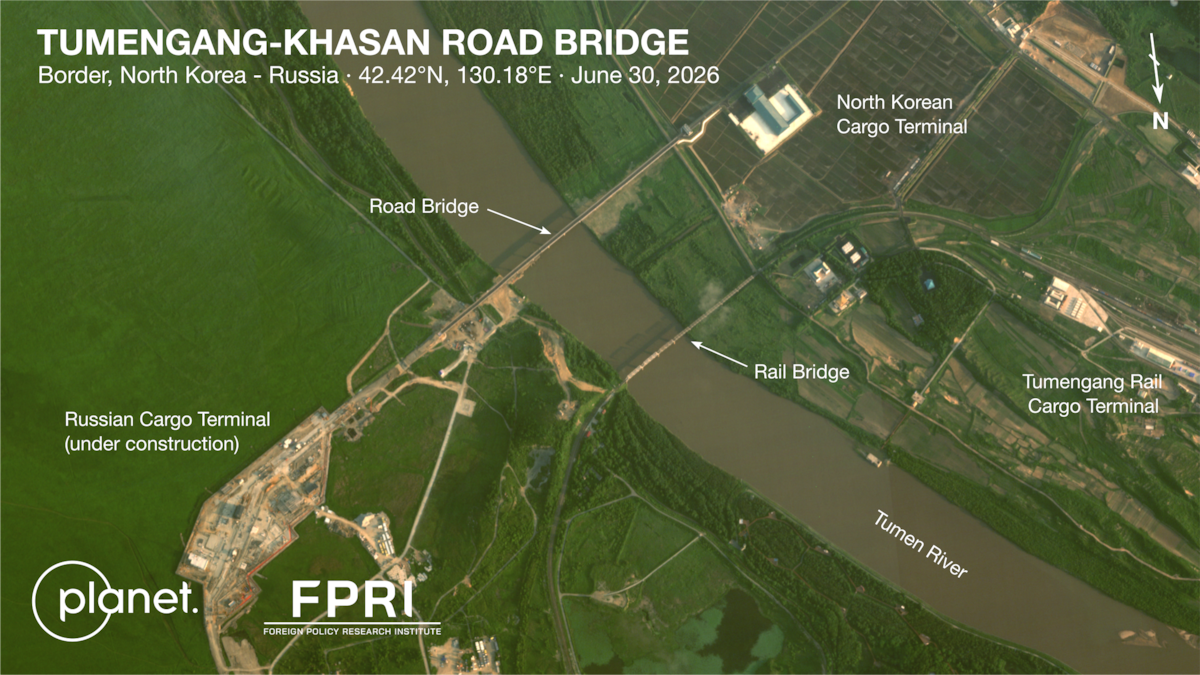
VIENNA — The first-ever road bridge linking North Korea and Russia across the Tumen River appears close to completion, according to satellite imagery reviewed by Defense News, though construction on the Russian side lags behind Pyongyang’s finished part. It is a visible manifestation of the two countries’ tightening relationships , driven by Pyongyang’s military support for Russia in its war against Ukraine.
Half-meter resolution Planet imagery captured in recent weeks shows the North Korean approach to the bridge fully built, including a customs building and a controlled entry point several hundred meters from the riverbank. Work on the Russian side, by contrast, is still continuing, with construction on border facilities and even the road itself still visibly ongoing. While the footprint for a large customs building and the gravel for a future highway have been laid, at present, the border is still far from opening to commercial traffic on the Russian side.
The crossing sits at Tumangang, a longstanding rail hub on the North Korean-Russian border that handled Soviet-era bulk trade before falling largely dormant after 1991. Activity there has picked up sharply since 2022, coinciding with Pyongyang’s decision to supply Moscow with artillery shells and troops for its war in Ukraine, and Russia’s decision to turn a blind eye to the application of UN sanctions against the Kim regime that Moscow had originally helped to put in place.
The border between North Korea and Russia is just 17 kilometers, or 11 miles, long, but increasingly geopolitically significant.
“It’s clear that Kim Jong Un has decided, ‘Our way forward is with Russia,’ and this is emergent proof of it,” said John Ford, a research fellow at the Foreign Policy Research Institute, who has tracked North Korean infrastructure and arms production for years. Ford noted that Pyongyang had sought a symbolic road bridge at the crossing for decades, only for Moscow to rebuff the idea until the diplomatic fallout from its full-scale invasion of Ukraine reshaped the relationship.
According to Ford, in addition to the symbolic value, the bridge may aim to address a persistent bottleneck at Tumangang’s existing rail link, where North Korea’s lack of standardized ISO shipping containers has forced cargo to be transloaded by hand between rail cars − a slow process that has instead pushed much of the ammunition trade through the port of Rason, then by sea to Russia’s Dunai terminal.
A functioning road crossing could let trucks bypass that chokepoint, though Ford cautioned it remains unclear whether it would primarily move Russian goods into North Korea, or North Korean goods, including munitions, out.
“The most surprising thing is that it seems functional,” Ford said, pointing to the impractical location of the construction site. It sits far away from any major urban center in Russia’s far east, and even for North Korea, Tumangang is in a remote corner of the country. Existing transport options, primarily by ship from the nearby port of Rason, seem like the obvious choice. He also noted that Russian truckers are unlikely to drive deep into North Korea given the unpredictable and potentially hostile environment, making a river-adjacent transfer point more plausible to him than a true cross-border logistics route.
What is for certain, though, is that Russia and the country officially called the Democratic People’s Republic of Korea have moved much closer together on the world stage since Putin’s 2022 decision to invade Ukraine.
The two countries signed a “Comprehensive Strategic Partnership” in 2024, which includes a mutual defense clause committing both countries to defend the other in times of war, and many stipulations for cooperation ranging from nuclear to spaceflight.
Ford also pointed to symbolic markers of the deepening alignment, including the restoration of Lenin and Marx portraits at North Korea’s Military Officers Political Academy and Kim’s 2023 visit to Vladivostok, as evidence Pyongyang is betting on a durable partnership with Moscow that could outlast the war in Ukraine.
Whether the bridge meaningfully expands cross-border throughput, Ford said, will only become clear once construction wraps and analysts can watch for signs of actual truck traffic.
Linus Höller is Defense News' Europe correspondent and OSINT investigator. He reports on the arms deals, sanctions, and geopolitics shaping Europe and the world. He holds master’s degrees in WMD nonproliferation, terrorism studies, and international relations, and works in four languages: English, German, Russian, and Spanish.
维也纳——据《防务新闻》查阅的卫星图像显示,连接朝鲜和俄罗斯的首座图们江公路桥似乎已接近完工,但俄罗斯一侧的建设进度落后于平壤一侧的完工进度。这座桥梁是两国关系日益密切的显著体现,而这种密切关系的推动力源于平壤在乌克兰战争中对俄罗斯的军事支持。
最近几周,Planet卫星拍摄的分辨率为半米的卫星图像显示,朝鲜一侧通往大桥的道路已经全部建成,包括一座海关大楼和一个距离河岸数百米的管制入境点。相比之下,俄罗斯一侧的工程仍在进行中,边境设施甚至道路本身的建设仍在进行。虽然大型海关大楼的地基和未来高速公路的碎石已经铺设完毕,但目前俄罗斯一侧的边境距离正式开放商业交通仍遥遥无期。
该过境点位于图满江,这是朝鲜-俄罗斯边境上一个历史悠久的铁路枢纽,在苏联时期曾处理过大量贸易,但在 1991 年后基本处于停滞状态。自 2022 年以来,该过境点的活动急剧增加,这与平壤决定向莫斯科提供炮弹和军队以支持其在乌克兰的战争,以及俄罗斯决定对联合国对金正恩政权的制裁视而不见(而这些制裁最初是由莫斯科帮助实施的)不谋而合。
朝鲜和俄罗斯之间的边界只有 17 公里(11 英里)长,但其地缘政治意义却日益重要。
“很明显,金正恩已经决定‘我们前进的方向是与俄罗斯合作’,而这正是这一决定的最新证据,”外交政策研究所研究员约翰·福特说道。多年来,他一直追踪朝鲜的基础设施和武器生产情况。福特指出,平壤几十年来一直寻求在过境点修建一座象征性的公路桥,但莫斯科一直拒绝这一提议,直到俄罗斯全面入侵乌克兰引发的外交危机重塑了朝俄关系。
福特表示,除了象征意义之外,这座桥可能旨在解决图芒江现有铁路连接中长期存在的瓶颈问题。由于朝鲜缺乏标准化的 ISO 集装箱,货物不得不在铁路货车之间进行人工转运——这是一个缓慢的过程,导致大部分弹药贸易不得不通过罗先港,然后经海路运往俄罗斯的杜奈码头。
一条功能完好的公路通道可以让卡车绕过这个咽喉要道,不过福特警告说,目前还不清楚这条通道主要是将俄罗斯货物运往朝鲜,还是将朝鲜货物(包括弹药)运出朝鲜。
福特指出,施工地点位置偏僻,却“最令人惊讶的是它似乎还能正常运作”。它位于俄罗斯远东地区,远离任何主要城市中心,即使对朝鲜而言,图满江也是该国一个偏远角落。现有的运输方式,主要是从附近的罗先港海运,似乎是显而易见的选择。他还指出,考虑到朝鲜境内环境变幻莫测且可能充满敌意,俄罗斯卡车司机不太可能深入朝鲜腹地,因此在他看来,在河边设立转运点比真正的跨境物流路线更可行。
但可以肯定的是,自普京在 2022 年决定入侵乌克兰以来,俄罗斯和正式名称为朝鲜民主主义人民共和国的国家在国际舞台上的关系变得更加密切。
两国于 2024 年签署了“全面战略伙伴关系”协议,其中包括一项共同防御条款,承诺两国在战争时期互相保卫,以及从核能到太空飞行等诸多合作规定。
福特还指出,朝鲜军事政治学院恢复列宁和马克思的画像,以及金正恩2023年访问符拉迪沃斯托克等象征性标志,都表明双方关系正在加深,平壤押注于与莫斯科建立持久的伙伴关系,这种伙伴关系可能会在乌克兰战争结束后继续存在。
福特表示,这座桥梁是否能显著提高跨境通行能力,只有在施工完成后,分析师们才能观察实际卡车交通的迹象,从而确定。
林努斯·霍勒是《防务新闻》的欧洲记者和开源情报调查员。他报道影响欧洲乃至全球的军火交易、制裁和地缘政治。他拥有大规模杀伤性武器不扩散、恐怖主义研究和国际关系三个硕士学位,并精通英语、德语、俄语和西班牙语四种语言。