Construction begins for Singapore’s long-delayed fourth egg farm新加坡筹建已久的第四个养鸡场终于开工。
When fully built, the farm is expected to produce more than 500 million eggs yearly, which is almost a quarter of Singapore's current annual egg consumption.
When fully built, the farm is expected to produce more than 500 million eggs yearly, which is almost a quarter of Singapore's current annual egg consumption.
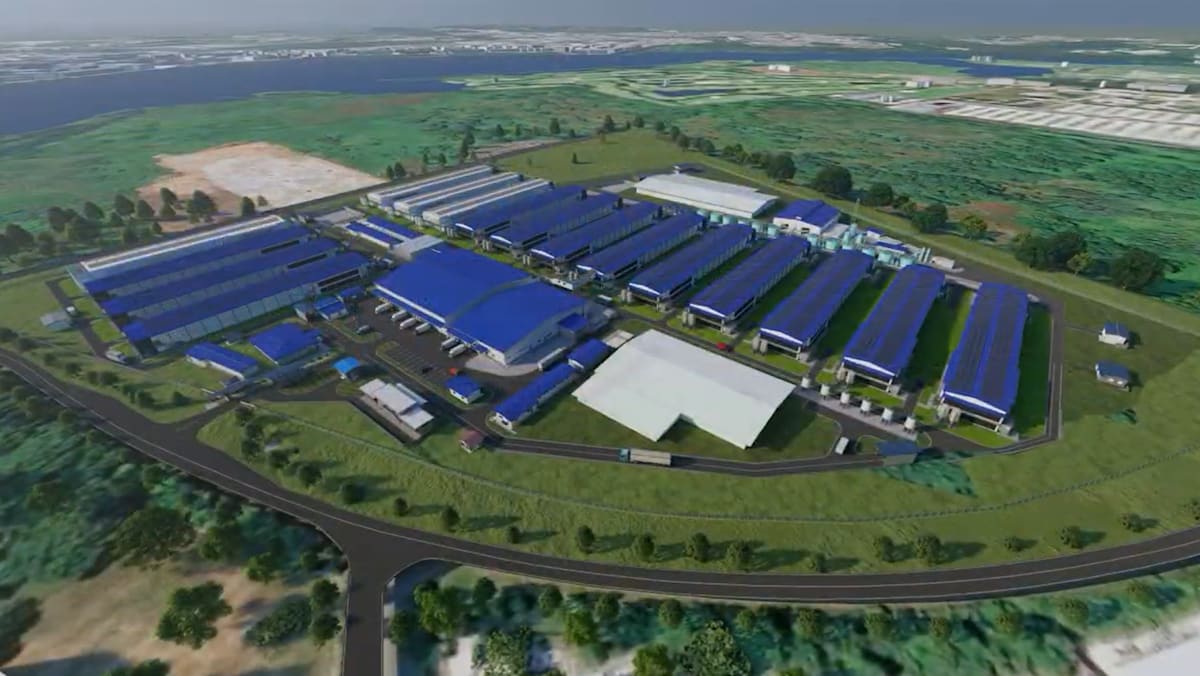
An artist’s impression of how the 15ha layer and pullet farm at Kranji Way will look like. (Image: ISE Foods Holdings)
This audio is generated by an AI tool.
SINGAPORE: Construction began in Lim Chu Kang on Tuesday (Sep 29) on Singapore's long-delayed fourth egg farm , which will be able to produce about 380 million eggs a year when its first phase is completed in less than two years.
The first eggs from the new DoMo Farm are expected to hit store shelves in 2028.
The farm, which is operated by Singapore firm ISE Foods Holdings, is projected to yield more than 500 million eggs annually when it reaches full capacity, which is equivalent to nearly a quarter of the country's current annual demand.
This also meant that at full production, locally produced eggs could meet half of Singapore's needs, Minister for Sustainability and the Environment Grace Fu said at the groundbreaking ceremony.
Singapore consumed more than 2.2 billion eggs last year, with three existing local egg farms, Seng Choon, N&N Agriculture and Chew's Agriculture, supplying about one-third of domestic consumption. The rest was supplied through imports.
Ms Fu said that the development of upstream parent stock and hatchery capabilities for day-old chick production in the farm's next phase is significant.
Day-old chicks eventually mature to become the layer chickens that produce eggs. Having such a facility will reduce reliance on imported chicks, further strengthening Singapore’s resilience, said Ms Fu, who is also Minister-in-charge of Trade Relations.
“During periods of disruption, our local farms provide an additional layer and buffer by providing a domestic source of eggs, vegetables, and seafood to ensure we continue to have food on our tables,” she said.
CNA Games Guess Word Crack the word, one row at a time Buzzword Create words using the given letters Mini Sudoku Tiny puzzle, mighty brain teaser Mini Crossword Small grid, big challenge Word Search Spot as many words as you can Show More Show Less
Minister for Sustainability and the Environment Grace Fu officiates the groundbreaking ceremony of DoMo Farm, Singapore's fourth egg farm at Lim Chu Kang on Sep 29, 2026. (Photo: CNA/Raydza Rahman)
ISE Foods Holdings chairman David Ong Kim Huat said the name DoMo reflected the company's aim to "do more with less".
"In land- and resource-scarce Singapore, we must become smarter and more productive with the resources available to us.
"We are designing DoMo Farm from the ground up as a next-generation egg farm, leveraging AI, smart sensors and the Internet of Things to improve efficiency, boost productivity and raise standards across every part of our operation," said Mr Ong, who is a former Member of Parliament for Jurong GRC and Bukit Batok SMC.
Chairman of ISE Foods Holdings David Ong Kim Huat giving a speech at the groundbreaking ceremony of DoMo Farm at Lim Chu Kang on Sep 29, 2026. (Photo: CNA/Raydza Rahman)
The farm occupies two plots of land in Lim Chu Kang on 30-year leases: a 15ha layer and pullet farm on Kranji Way and a 4ha parent stock and hatchery farm on Neo Tiew Crescent.
Layer hens produce eggs for consumption, while pullets are young female chickens less than a year old that have not started laying eggs.
The parent stock and hatchery farm will breed and hatch chicks that will eventually become layer hens.
In the first phase, nine layer houses and three pullet houses will be built at the Kranji Way facility, housing about 1.35 million layer hens and 450,000 pullets respectively. This will give the farm an annual production capacity of about 380 million eggs.
An artist's impression of DoMo Farm, Singapore's fourth egg farm ahead of its groundbreaking ceremony on Sep 29, 2026. (Image: ISE Foods Holdings)
The parent stock and hatchery farm at Neo Tiew Crescent is expected to be completed in the subsequent phase.
The 12 layer houses and four pullet houses could house 1.8 million layers and 600,000 pullets respectively when the farm is fully built.
The Kranji Way site will also have a grading and packaging plant, a liquid egg plant and a manure treatment plant, with a food processing plant planned for the future.
The future site of DoMo Farm, Singapore's upcoming fourth commercial egg farm at Lim Chu Kang on Sep 29, 2026. (Photo: CNA/Raydza Rahman)
The farm comes about five years after ISE Foods Holdings first signed an agreement with the Singapore Food Agency (SFA) in 2021 to develop the farm.
Construction was initially slated for 2022, with three plots of land across Lim Chu Kang, Sungei Tengah and Tuas planned for the facilities. The 10ha commercial egg farm in Lim Chu Kang was meant to be operational by 2024.
However, the project was confronted by challenges including the COVID-19 pandemic, supply chain disruptions and inflationary pressures from geopolitical tensions, according to filings on the Singapore Exchange by Ellipsiz, the parent company of ISE Foods Holdings.
Mr Kenneth Ho, chief executive of Ellipsiz, said the project had to contend with uncertainties emerging from the pandemic and geopolitical tensions, including the war between Ukraine and Russia.
"Then the energy crisis caused escalation and supply chain disruption," Mr Ho told CNA ahead of the groundbreaking ceremony.
Biosecurity concerns added to the delays as the company reconsidered the farm's design to better protect chickens from diseases affecting birds spreading around the region.
Mr Ho said more land had to be allocated to the farm for greater separation between poultry houses. A larger site would also accommodate bigger poultry houses.
Ellipsiz CEO Kenneth Ho Siew Keong, speaks to CNA during the groundbreaking ceremony of DoMo Farm, Singapore's fourth egg farm, at Lim Chu Kang on Sep 29, 2026. (Photo: CNA/Raydza Rahman)
As a result, the space needed for the farm grew from the initial planned 10ha to 15ha, which is equivalent to about 21 football fields.
Larger layer houses would allow the farm to scale production capacity from the initial target of about 360 million eggs annually to more than 500 million when fully developed.
The delays prompted the company to reassess the viability of the project in its earlier stages.
Asked what led to the decision to proceed, Mr Ho said the company conducted a feasibility study examining the economics of the farm across its operating life, including its scale, technology and management, which he said would help increase yields and keep operating expenses manageable.
The years-long delay gave the farm an opportunity to incorporate technologies into its design from the outset.
Mr Ho described the delay as a "blessing in disguise", pointing to how artificial intelligence technologies have become more mature and cost-effective.
"So the AI part in terms of health, the layer hens health management, monitoring, preventive measure, predictive measures all come into place," Mr Ho said.
When completed, the farm will deploy technologies such as advanced optics and heat-detection sensors paired with AI models that will capture and analyse operational data. Patrol robots that use AI will also operate within each layer house to monitor the health of hens round the clock.
Other parts of the operation will also be automated, such as feeding, egg collection and grading.
While most of the processes will be automated, around 150 employees will still be needed to handle livestock for processes such as vaccination.
LOCAL DEMAND FOR EGGS
Mr Ho said that the layer farm is expected to cost about S$110 million (US$86 million) to develop.
The development is partially financed by Maybank through a term loan facility of up to S$65 million, with the bank serving as the farm’s sole financing partner. Unicore Agri and Vertex Exploratory Fund are co-investors.
Ms Fu said that DoMo is one of the local farms to have tapped SFA’s Agri-Food Cluster Transformation Fund 2. SFA launched a new tranche of S$70 million under the fund earlier this year.
Asked whether continuing geopolitical tensions could drive the cost of construction even higher, Mr Ho said the farm has largely locked in these costs with contractors and subcontractors.
He said the farm had kept capital expenditure similar to what was budgeted for the original 10ha site, while increasing production yield on the expanded 15ha farm.
"So more or less the budget, the cost, they are in place already," he said.
A 1:200 scale model of DoMo Farm at its groundbreaking ceremony at Lim Chu Kang on Sep 29, 2026. (Photo: CNA/Raydza Rahman)
He noted that the farm's high upfront capital expenditure could help keep operating expenses low, but said these could still be affected by global conditions.
With such an investment, Mr Ho said the company believes there would be sufficient demand from consumers given Singapore's high per capita egg consumption.
In her speech on Tuesday, Ms Fu said as Singapore ramps up supply of local produce, it is equally important to ensure sufficient and sustained demand off-take.
"Businesses and retailers have an important role in supporting our local farms by using local produce. Consumers too can contribute by choosing local produce, (and) thereby help to sustain local farms," she said.
To this, Mr Ho said Singapore's large appetite for eggs leaves room in the market for DoMo Farm's offerings.
"Gradually, I think we will see more consumers do not only go for price, especially for perishable things.
"They also go for freshness, reliability, food safety, and so on and so forth," said Mr Ho, adding that these factors give local egg farmers an advantage.
Get our pick of top stories and thought-provoking articles in your inbox
Stay updated with notifications for breaking news and our best stories
Join our channel for the top reads for the day on your preferred chat app
该农场建成后,预计每年将生产超过 5 亿枚鸡蛋,这几乎相当于新加坡目前每年鸡蛋消费量的四分之一。
这是艺术家绘制的位于克兰芝路(Kranji Way)的15公顷蛋鸡和育成鸡养殖场的效果图。(图片:ISE Foods Holdings)
这段音频是由人工智能工具生成的。
新加坡:新加坡筹建已久的第四个养鸡场于周二(9月29日)在林厝港开工建设。该养鸡场一期工程预计在不到两年的时间内完工,届时每年可生产约3.8亿枚鸡蛋。
来自新的 DoMo 农场的第一批鸡蛋预计将于 2028 年上架商店货架。
该农场由新加坡 ISE Foods Holdings 公司运营,预计满负荷运转后每年将生产超过 5 亿枚鸡蛋,相当于该国目前年需求量的近四分之一。
新加坡永续发展与环境部长傅海燕在奠基仪式上表示,这也意味着,全面投产后,本地生产的鸡蛋可以满足新加坡一半的需求。
新加坡去年消费了超过22亿枚鸡蛋,其中三家本地养鸡场——成春养鸡场、N&N农业养鸡场和周氏农业养鸡场——供应了约三分之一的国内消费量,其余部分则通过进口获得。
傅女士表示,农场下一阶段发展上游亲鸡种群和孵化能力,以生产一日龄雏鸡,意义重大。
傅海燕女士表示,雏鸡最终会成长为产蛋鸡。拥有这样的设施将减少对进口雏鸡的依赖,进一步增强新加坡的抵御能力。傅海燕女士同时也是主管贸易关系的部长。
她说:“在供应中断时期,我们当地的农场通过提供国内的鸡蛋、蔬菜和海鲜来源,提供了一层额外的保障和缓冲,以确保我们餐桌上继续有食物。”
CNA游戏 猜词游戏 逐行破解单词 流行词游戏 用给定的字母组成单词 迷你数独 小小谜题,挑战你的大脑 迷你填字游戏 小方格,大挑战 单词搜索 尽可能多地找出单词 显示更多 显示更少
2026年9月29日,新加坡永续发展及环境部长傅海燕在林厝港主持新加坡第四家养鸡场DoMo农场的奠基仪式。(图片:CNA/Raydza Rahman)
ISE Foods Holdings 董事长 David Ong Kim Huat 表示,DoMo 这个名字反映了公司“以更少的资源做更多的事情”的目标。
“在土地和资源匮乏的新加坡,我们必须更聪明、更高效地利用现有资源。”
“我们正在从零开始设计 DoMo 农场,将其打造成为下一代养鸡场,利用人工智能、智能传感器和物联网来提高效率、提升生产力并提高我们运营各个环节的标准,”曾任裕廊集选区和武吉巴督单选区国会议员的王先生说道。
ISE Foods Holdings 主席 David Ong Kim Huat 于 2026 年 9 月 29 日在林厝港 DoMo 农场奠基仪式上发表讲话。(图片:CNA/Raydza Rahman)
该农场在林厝港租用了两块土地,租期为 30 年:一块位于克兰芝路的 15 公顷的蛋鸡和育成鸡养殖场,以及一块位于新堤弯的 4 公顷的种鸡和孵化场。
蛋鸡产蛋供人食用,而育成鸡是指不到一岁、尚未开始产蛋的年轻雌鸡。
亲鸡和孵化场将进行繁殖和孵化,这些小鸡最终将成为蛋鸡。
第一阶段,克兰芝路养殖场将建造9座蛋鸡舍和3座育成鸡舍,分别可饲养约135万只蛋鸡和45万只育成鸡。这将使该养殖场的年产蛋能力达到约3.8亿枚鸡蛋。
这是新加坡第四家养鸡场 DoMo Farm 在 2026 年 9 月 29 日举行奠基仪式前的效果图。(图片:ISE Foods Holdings)
位于 Neo Tiew Crescent 的种畜和孵化场预计将在下一阶段完工。
该农场全部建成后,12座蛋鸡舍和4座育成鸡舍分别可容纳180万只蛋鸡和60万只育成鸡。
克兰芝路厂址还将建有分级包装厂、液态蛋制品厂和粪便处理厂,未来还计划建有食品加工厂。
2026年9月29日,新加坡第四家商业养鸡场DoMo Farm的未来选址在林厝港。(图片:CNA/Raydza Rahman)
该农场的建成距离 ISE Foods Holdings 于 2021 年首次与新加坡食品局 (SFA) 签署开发该农场的协议已经过去了大约五年。
该项目最初计划于2022年开工建设,选址在林厝港、双溪登加和图阿斯的三块地皮上。位于林厝港的10公顷商业养鸡场原计划于2024年投入运营。
然而,根据 ISE Foods Holdings 的母公司 Ellipsiz 在新加坡交易所提交的文件,该项目面临着包括 COVID-19 疫情、供应链中断和地缘政治紧张局势带来的通胀压力在内的挑战。
Ellipsiz 首席执行官 Kenneth Ho 先生表示,该项目必须应对疫情和地缘政治紧张局势带来的不确定性,包括乌克兰和俄罗斯之间的战争。
“随后能源危机导致事态升级和供应链中断,”何先生在奠基仪式前告诉亚洲新闻台。
由于生物安全问题,该公司重新考虑了农场的设计,以更好地保护鸡免受在该地区传播的禽类疾病的影响,这加剧了延误。
何先生表示,需要为农场划拨更多土地,以便更好地分隔鸡舍。更大的场地也能容纳更大的鸡舍。
2026年9月29日,Ellipsiz首席执行官何秀强在新加坡第四家养鸡场DoMo Farm于林厝港举行的奠基仪式上接受CNA采访。(图片:CNA/Raydza Rahman)
因此,农场所需的空间从最初计划的 10 公顷增加到 15 公顷,相当于大约 21 个足球场。
更大的蛋鸡舍将使农场能够将生产能力从最初的每年约 3.6 亿枚鸡蛋的目标扩大到完全建成后的每年 5 亿枚以上。
延误促使该公司在项目早期阶段重新评估其可行性。
当被问及是什么促使他们做出推进该项目的决定时,何先生表示,公司进行了一项可行性研究,考察了该农场在其整个运营周期内的经济效益,包括其规模、技术和管理,他表示这将有助于提高产量并控制运营成本。
长达数年的延误使农场有机会从一开始就将各种技术融入到设计中。
何先生将此次延误描述为“因祸得福”,并指出人工智能技术已经变得更加成熟且更具成本效益。
“因此,人工智能在健康方面的作用,例如蛋鸡的健康管理、监测、预防措施和预测措施,都得以应用,”何先生说。
建成后,该农场将部署先进光学技术和热探测传感器,并结合人工智能模型,用于采集和分析运营数据。此外,每个蛋鸡舍内还将配备人工智能巡逻机器人,全天候监测母鸡的健康状况。
运营的其他部分也将实现自动化,例如喂料、鸡蛋收集和分级。
虽然大部分流程将实现自动化,但仍需要大约 150 名员工来处理牲畜,例如进行疫苗接种等流程。
当地对鸡蛋的需求
何先生表示,该蛋鸡养殖场的开发预计耗资约 1.1 亿新元(8600 万美元)。
该项目的部分开发资金由马来亚银行提供,金额高达6500万新元,马来亚银行是该农场的唯一融资伙伴。优尼科农业公司和Vertex探索基金是共同投资者。
傅女士表示,DoMo是利用新加坡食品局第二期农业食品集群转型基金的本地农场之一。新加坡食品局今年早些时候启动了该基金下的新一期7000万新元的资金。
当被问及持续的地缘政治紧张局势是否会导致建设成本进一步上涨时,何先生表示,农场已基本与承包商和分包商锁定了这些成本。
他表示,该农场在扩大到 15 公顷的农场后,提高了产量,同时保持了与最初 10 公顷农场预算类似的资本支出。
“所以预算和成本基本上都已经确定了,”他说。
2026年9月29日,在林厝港举行的DoMo农场奠基仪式上,展示了1:200比例的DoMo农场模型。(图片:CNA/Raydza Rahman)
他指出,农场前期较高的资本支出有助于降低运营成本,但表示这些成本仍可能受到全球形势的影响。
何先生表示,鉴于新加坡人均鸡蛋消费量很高,公司相信这样的投资会带来足够的消费者需求。
傅女士在周二的演讲中表示,随着新加坡加大本地农产品的供应,确保充足和持续的需求同样重要。
她表示:“企业和零售商通过使用本地产品,在支持本地农场方面发挥着重要作用。消费者也可以通过选择本地产品来做出贡献,从而帮助维持本地农场的运营。”
对此,何先生表示,新加坡对鸡蛋的巨大需求为DoMo Farm的产品在市场上留下了空间。
“我认为,我们将会逐渐看到,越来越多的消费者不再仅仅关注价格,尤其是在购买易腐品时。
“他们还会考虑新鲜度、可靠性、食品安全等等,”何先生说,并补充道,这些因素使当地养鸡户具有优势。
订阅我们的邮件,即可获取精选热点新闻和引人深思的文章。
订阅通知,第一时间获取突发新闻和精彩报道。
加入我们的频道,即可在您常用的聊天应用上获取当日热门文章。