S’pore’s fourth egg farm supplying Japanese eggs breaks ground after four-year delay新加坡第四座供应日本鸡蛋的养鸡场在延误四年后破土动工
The delay was due to the need to implement biosecurity measures while maintaining production targets. Read more at straitstimes.com.
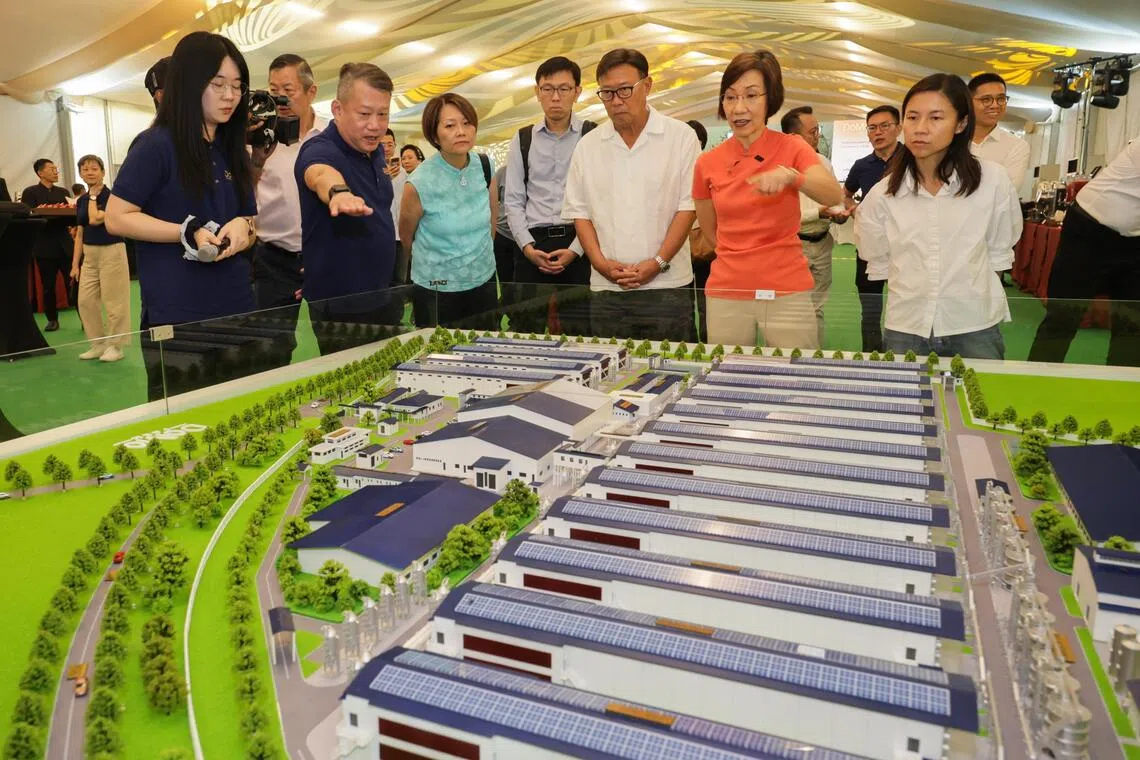
Minister of Sustainability and the Environment Grace Fu (second from right) and Senior Parliamentary Secretary for Sustainability and the Environment Goh Hanyan (right) viewing the scale model of the DoMo farm on Sept 29.
Published Sep 29, 2026, 02:00 PM
Updated Sep 29, 2026, 02:00 PM
Singapore’s fourth egg farm, DoMo Farm, will start production in 2028 after a four-year delay to meet strict biosecurity standards.
The $110 million farm will produce Japanese-grade eggs with advanced AI monitoring, aiming for about 380 million eggs annually.
Delays were due to higher costs and supply chain shocks; the farm received government support.
SINGAPORE - Singapore’s fourth egg farm, which was initially slated to become operational in 2024, will now commence production in 2028.
DoMo Farm aims to bring Japanese-grade eggs - which have a deep orange yolk and are safe to eat raw - to Singapore consumers by that year .
Due to the strict hygiene and safety standards required for egg production, t he delay in the farm’s construction was to ensure that adequate biosecurity measures can be put in place without compromising the farm’s production targets, the farm’s owner ISE Foods Holdings told The Straits Times on Sept 24.
Higher construction costs due to supply chain shocks caused by the post-pandemic period and Russia-Ukraine war also contributed to the delay, said its executive director Kenneth Ho.
“We had a lot of time to do detailed (planning and design), so we are able to cap the cost from what we had budgeted in the earlier days, but with a higher production capacity now,” Ho said, adding that the farm’s delay ended up being a blessing in disguise.
“ We believe that food security and commercial sustainability should go hand in hand.”
ISE Foods Holdings is a subsidiary of engineering and service solutions firm Ellipsiz, which Ho is also chief executive of .
He was speaking to ST at ISE Foods Holdings’ office , ahead of the $110 million farm’s groundbreaking at Lim Chu Kang on Sept 29. Minister for Sustainability and the Environment Grace Fu was guest-of-honour.
Currently, Singapore has three egg farms - Chew’s Agriculture, Seng Choon Farm and N&N Agriculture. In 2025, they produced more than 736 million eggs, and the country’s total egg consumption that year was over 2.2 million eggs.
When operational in 2028, DoMo Farm would be able to produce about 380 million eggs a year. Ho said it plans to expand production to more than 500 million eggs a year.
When that target is reached, local eggs could account for more than half of the number of eggs consumed in 2025.
Ho said DoMo Farm’s eggs will be priced competitively against those produced by local farms, with prices ranging from $3.35 to $ 7 on FairPrice and Cold Storage’s websites.
Delay first reported in 2024
In 2024, ST reported that ISE’s review of biosecurity measures and development costs may entail modifications to the farm’s design or layout, which may lead to delays in the farm’s completion.
This delay was discovered through Ellipsiz’s update to the Singapore Stock Exchange in September 2023 and its half-yearly results report for FY2024.
However, details on what these measures entail were not clear then as the farm declined to comment.
Ho revealed more information in the interview, saying that the initial 10ha farming plot it was allocated in Kranji Way was too small to meet biosecurity measures while meeting the initial annual production target of 360 million eggs .
At that time, the farm - which will be the first in Singapore to have a hatchery and breeder facility to reduce reliance on imported chicks - were planned to be scattered across four locations.
They include a 10ha egg laying facility and a 0.6ha hatchery in two Lim Chu Kang sites.
It will also have a farm in Tuas to raise chicks from the hatchery into laying hens, and a parent breeder facility in Sungei Tengah to produce fertilised eggs for the hatchery.
Some of the biosecurity measures that would need to be in place include ensuring that the egg-laying houses are spaced a certain distance apart , usually the width of each house, said Ho.
This is to maintain ventilation and prevent contaminated air - such as in case of a disease outbreak in one house - from entering another house.
Trucks that transport “clean” items such as chicken feed, and those that carry “dirty” items such as manure cannot drive on the same road, he added, pointing to the farm’s need for more space .
To meet these biosecurity needs, Ellipsiz and ISE Foods Holdings requested to the Singapore Food Agency for more land, and eventually they received a new 15ha plot .
The move also consolidated the farm’s operations into two sites instead of four.
The 15ha site will host the egg-laying houses and pullet houses, where the chicks from the hatchery grow to become egg-laying hens. This site will also host a manure treatment facility that uses fermentation to turn the waste into organic fertiliser, said Ho.
The hatchery and the chicken breeder facility to produce fertilised eggs will be housed on a separate 4ha land in Neo Tiew Crescent, in DoMo Farm’s next phase post-2028.
Ho declined to reveal a specific timeline for these two facilities, and the location of the 4ha plot, adding that the focus is on completing the egg-laying facilities.
Since the hatchery will not be built by 2028, DoMo Farm’s initial eggs will be produced by hens imported from Malaysia as day-old chicks - similar to the other three farms.
Overcoming rising costs and supply chain shocks
In 2024, it was reported that ISE Foods Holdings was exploring cost-effective options for equipment and materials in the light of rising construction costs due to heightened geopolitical tensions and inflationary pressures.
Ho told ST that the farm was announced during the post-pandemic period when the Russia-Ukraine war and the resulting energy crisis occurred. That also led to economic uncertainties and supply chain disruptions .
But one silver lining of the delay was that it allowed artificial intelligence (AI) technologies to mature, allowing them to be more applicable to farming operations over the past couple years, said Ho .
For example, the egg-laying houses will have patrol robots that will run up, down and across the cages to keep an eye on the hens’ health. Each house will have 150,000 hens in six rows of 10-tiered cages.
The robots are equipped with AI-powered predictive health monitoring capabilities, heat-detecting sensors and cameras to constantly check the condition of each hen. This will allow prompt intervention to limit disease spread.
In 2022, Seng Choon Farm, one of the three egg farms, had a Newcastle disease outbreak, which caused egg production to temporarily drop.
The highly contagious H5 strain of bird flu also remains a threat as it has spread to all continents, devastating poultry farms and even infecting more than 50 species of mammals.
DoMo Farm also applied for in late-202 5 and received the Singapore Food Agency’s second Agri-Food Cluster Transformation Fund.
This fund helps local farms offset the cost of energy efficient infrastructure and invest in advanced technologies. Ho did not disclose how much funding the farm received.
At DoMo Farm’s groundbreaking ceremony on Sept 29, MSE’s Fu highlighted that the farm will rely on solar power and have an automated egg warehouse, alongside climate-controlled facilities.
She said:“As a country that imports most of our food, events around the world are felt on our food shelves. Strengthening our food resilience is therefore not a matter of choice, but a matter of necessity.”
Shabana Begum is a correspondent, with a focus on environment and science, at The Straits Times.
SFA/Singapore Food Agency
9月29日,永续发展及环境部长傅海燕(右二)和永续发展及环境部高级政务次长吴汉彦(右)参观了DoMo农场的比例模型。
发布于 2026 年 9 月 29 日下午 2:00
更新于2026年9月29日下午2:00
新加坡第四家养鸡场 DoMo Farm 因需满足严格的生物安全标准而推迟四年,将于 2028 年开始生产。
这座耗资 1.1 亿美元的农场将采用先进的人工智能监控技术生产日本品质的鸡蛋,目标是每年生产约 3.8 亿枚鸡蛋。
延误是由于成本上升和供应链冲击造成的;该农场获得了政府支持。
新加坡——新加坡第四个养鸡场原计划于 2024 年投入运营,现在将于 2028 年开始生产。
DoMo Farm的目标是到当年将日本品质的鸡蛋(蛋黄呈深橙色,可安全生食)带给新加坡消费者。
9月24日,农场所有者ISE Foods Holdings告诉《海峡时报》,由于鸡蛋生产需要严格的卫生和安全标准,农场建设的延迟是为了确保能够采取足够的生物安全措施,而不会影响农场的生产目标。
执行董事何建明表示,疫情后时期供应链冲击导致建设成本上升以及俄乌战争也造成了工期延误。
“我们有足够的时间进行详细的(规划和设计),因此我们能够将成本控制在早期预算之内,而且现在的生产能力也更高,”何先生说,并补充说,农场的延误最终反而成了因祸得福。
“我们认为粮食安全和商业可持续性应该齐头并进。”
ISE Foods Holdings 是工程和服务解决方案公司 Ellipsiz 的子公司,何先生同时也是该公司的首席执行官。
在9月29日林厝港价值1.1亿美元的农场破土动工之前,他在ISE Foods Holdings的办公室接受了《海峡时报》的采访。可持续发展与环境部长傅海燕是主宾。
目前,新加坡有三家养鸡场——周氏农业、成春农场和N&N农业。2025年,它们共生产了超过7.36亿枚鸡蛋,而当年新加坡的鸡蛋总消费量超过220万枚。
多摩农场预计于2028年投产,届时每年可生产约3.8亿枚鸡蛋。何先生表示,农场计划将年产量扩大到5亿枚以上。
如果达到这一目标,到 2025 年,本地鸡蛋的消费量可能占到鸡蛋消费总量的一半以上。
何先生表示,多摩农场的鸡蛋定价将与当地农场生产的鸡蛋具有竞争力,在 FairPrice 和 Cold Storage 的网站上售价为 3.35 美元至 7 美元不等。
最早报告的延误时间为2024年
2024 年,ST 报告称,ISE 对生物安全措施和开发成本的审查可能需要对农场的设计或布局进行修改,这可能会导致农场竣工延期。
这一延误是通过 Ellipsiz 在 2023 年 9 月向新加坡证券交易所提交的更新报告及其 2024 财年半年业绩报告发现的。
然而,由于农场拒绝置评,这些措施的具体细节当时尚不清楚。
何先生在采访中透露了更多信息,称该公司最初在克兰芝路分配到的 10 公顷农场面积太小,无法在满足最初每年 3.6 亿枚鸡蛋的生产目标的同时,满足生物安全措施的要求。
当时,该农场计划分散在四个地点,这将是新加坡第一个拥有孵化场和育种设施的农场,以减少对进口雏鸡的依赖。
其中包括位于林厝港两处地点的 10 公顷蛋鸡养殖场和 0.6 公顷孵化场。
它还将在大士建一个农场,将孵化场的雏鸡养成产蛋母鸡;并在双溪登加建一个种鸡场,为孵化场生产受精卵。
何先生表示,需要采取的一些生物安全措施包括确保产蛋鸡舍之间保持一定的距离,通常是每个鸡舍的宽度。
这是为了保持通风,防止受污染的空气(例如,在一个家庭爆发疾病的情况下)进入另一个家庭。
他还补充说,运输鸡饲料等“清洁”物品的卡车和运输粪便等“脏”物品的卡车不能在同一条路上行驶,这表明农场需要更多的空间。
为了满足这些生物安全需求,Ellipsiz 和 ISE Foods Holdings 向新加坡食品局申请了更多土地,最终他们获得了一块新的 15 公顷土地。
此举还将农场的运营地点从四个合并为两个。
何先生表示,这片占地15公顷的场地将用于建造蛋鸡舍和育成鸡舍,孵化场的雏鸡将在这里长成蛋鸡。该场地还将建有一座粪便处理厂,利用发酵技术将粪便转化为有机肥料。
孵化场和用于生产受精卵的鸡种鸡场将建在 Neo Tiew Crescent 一块独立的 4 公顷土地上,这是 DoMo 农场在 2028 年之后的下一阶段计划。
何先生拒绝透露这两个设施的具体时间表以及4公顷地块的位置,并补充说,重点是完成产蛋设施。
由于孵化场在 2028 年之前不会建成,DoMo 农场最初的鸡蛋将由从马来西亚进口的雏鸡(一日龄雏鸡)生产——与其他三个农场类似。
克服成本上升和供应链冲击
2024 年有报道称,由于地缘政治紧张局势加剧和通胀压力导致建筑成本上升,ISE Foods Holdings 正在探索具有成本效益的设备和材料方案。
何先生告诉《海峡时报》,该农场项目是在疫情后时期宣布的,当时正值俄乌战争及其引发的能源危机。这也导致了经济的不确定性和供应链中断。
何先生表示,延迟带来的一个好处是,它使人工智能(AI)技术得以成熟,使其在过去几年中能够更好地应用于农业生产。
例如,蛋鸡舍将配备巡逻机器人,它们会在鸡笼间上下穿梭,密切关注母鸡的健康状况。每个蛋鸡舍将饲养15万只母鸡,分为六排,每排十层。
这些机器人配备了人工智能驱动的预测性健康监测功能、热感应传感器和摄像头,可以持续监测每只母鸡的健康状况。这将有助于及时干预,限制疾病传播。
2022年,三家养鸡场之一的盛春农场爆发了新城疫,导致鸡蛋产量暂时下降。
传染性极强的H5型禽流感仍然构成威胁,因为它已经蔓延到各大洲,摧毁了家禽养殖场,甚至感染了50多种哺乳动物。
DoMo Farm 也于 2025 年底申请并获得了新加坡食品局的第二笔农业食品集群转型基金。
这项基金旨在帮助当地农场抵消节能基础设施的成本,并投资于先进技术。何女士并未透露农场获得了多少资助。
在9月29日DoMo农场的奠基仪式上,MSE的傅先生强调,该农场将依靠太阳能发电,并拥有自动化鸡蛋仓库以及气候控制设施。
她说:“作为一个食品进口大国,世界各地的事件都会影响到我们的食品供应。因此,增强我们的食品韧性不是一种选择,而是一种必然。”
沙巴娜·贝古姆是《海峡时报》的记者,主要关注环境和科学领域。
新加坡食品局