Competition watchdog takes action against fake review provider, 45 businesses for fabricating online reviews竞争监管机构对虚假评论提供商和45家企业采取行动,指控其捏造网络评论。
Parties involved have agreed to cease their unfair practices, remove the fake reviews and publish a public apology. Read more at straitstimes.com.
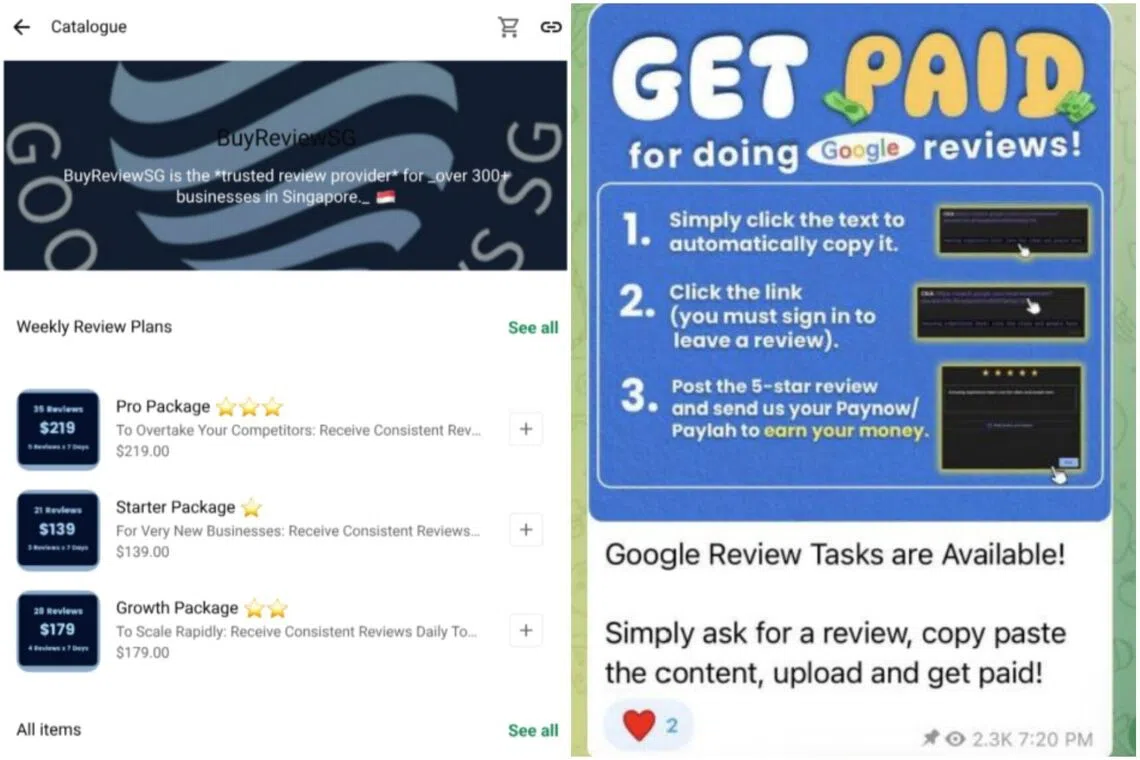
Screengrab images show businesses purchasing fake review packages (left) and individuals being recruited via Telegram to post them in exchange for payment (right).
PHOTOS: COMPETITION AND CONSUMER COMMISSION OF SINGAPORE
Published Sep 30, 2026, 12:45 PM
Updated Sep 30, 2026, 12:46 PM
SINGAPORE – A fake review provider and 45 businesses that had procured the service have been taken to task by the Republic’s competition watchdog for fabricating online reviews.
In a statement on Sept 30, the Competition and Consumer Commission of Singapore (CCS) said two websites – BuyReviewSG and GetReviewSG – were found to have provided fake review services to about 100 businesses.
The websites were operated by Julian Tung Yan Kai, who is the sole director of Reputifly.
This marks the commission’s largest fake review investigation to date in terms of the number of businesses involved, prompting a two-phase probe.
The first phase covers the fake review provider and 47 businesses that had procured its services.
Of these, 45 businesses admitted they had purchased fake reviews from the provider.
They have agreed to cease their unfair practices, remove the fake reviews and publish a public apology for six months on their websites, social media accounts and at their physical premises.
The fake review service provider admitted to aiding and abetting these unfair practices by generating fake review content, recruiting and paying reviewers, and taking steps to make the reviews appear authentic.
It has also committed to putting a stop to providing such services and publish ing a public apology on Reputifly’s website for six months. It has also voluntarily committed to donating proceeds obtained from its fake review services to a charity.
Two of the businesses, however, declined to provide undertakings on the commission’s required terms. CCS said it will continue its investigations into these two firms and take firmer enforcement action if necessary.
Meanwhile, the second phase of the investigation, which extends beyond the remaining businesses to other businesses that may have procured fake review services, is ongoing.
Reputifly has committed to putting a stop to providing fake review services and publishing a public apology on its website for six months. PHOTO: SCREENGRAB FROM REPUTIFLY WEBSITE
Reputifly has committed to putting a stop to providing fake review services and publishing a public apology on its website for six months.
PHOTO: SCREENGRAB FROM REPUTIFLY WEBSITE
Alvin Koh, the chief executive of CCS, said: “In the digital age, consumers increasingly rely on online reviews to decide what to buy and which businesses to trust. They should be able to expect that these reviews reflect genuine experiences, not manufactured ones.
“Fake reviews deceive consumers, distort competition and disadvantage businesses that compete honestly.”
He warned that CCS will “pursue not only those who buy (the fake reviews), but also those who profit from supplying them”.
In its statement, the commission urged other fake review providers, as well as businesses that bought fake reviews, to come forward voluntarily.
It added that those who do so before CCS commences investigations will have their cooperation viewed favourably.
How the fake review operation worked
CCS investigations found that Tung started providing the fake review services in or before 2023, eventually expanding his services to about 100 businesses.
The fake reviews would be posted on online review platforms including Google, Facebook, Tripadvisor, Carousell, Yelp and Trustpilot.
Companies could purchase packages of fake reviews to be posted periodically. They could even use a rating calculator to determine how many five-star reviews were needed to reach their desired Google rating.
To make the reviews resemble genuine customer experiences, the provider used generative artificial intelligence.
The technology was used to vary writing styles and sentence structures, incorporate details specific to the Singapore context, and introduce natural imperfections. Clients were also able to edit the generated reviews before publication.
As the operation grew more sophisticated, an online dashboard was introduced to generate, manage, and track the fake reviews.
The dashboard could draw from a business’ existing four- and five-star Google reviews to generate new ones containing relevant details.
Some fake reviews deliberately described initial reservations before recounting a positive experience, creating an illusion of authenticity.
Generative AI was used to make the reviews resemble genuine customer experiences. PHOTO: COMPETITION AND CONSUMER COMMISSION OF SINGAPORE
Generative AI was used to make the reviews resemble genuine customer experiences.
PHOTO: COMPETITION AND CONSUMER COMMISSION OF SINGAPORE
To recruit individuals to post the reviews, Telegram channels were used, with payment offered in exchange for posting the prepared content and ratings. These reviewers were instructed to avoid duplicating reviews to reduce the risk of detection.
The provider also offered to replace reviews that were removed by online platforms.
Customers could have been misled into believing the businesses or their products and services were more popular or positively received than they actually were, CCS said.
The 45 businesses found to have procured fake reviews include:
Certified Translation Services
Dots ‘n’ Tots Interior
First Security & Private Investigation
For the Love of Laundry
Groupasia Hospitality
Harmony Funeral Care
Integral Facilities Management (IFM)
Label-Line Corporation
Picasso Hair Boutique
Torio Japanese Restaurant
UniWise Admissions Consulting
Under Singapore’s Consumer Protection (Fair Trading) Act, posting or buying false reviews is an unfair practice because it deceives or misleads consumers.
The Straits Times has contacted CCS for more information.
CCCS/Competition and Consumer Commission of Singapore
屏幕截图显示,商家购买虚假评论套餐(左图),以及个人通过 Telegram 被招募发布虚假评论以换取报酬(右图)。
图片来源:新加坡竞争与消费者委员会
发布于 2026 年 9 月 30 日下午 12:45
更新于2026年9月30日下午12:46
新加坡——一家虚假评论提供商和45家购买了该服务的企业因捏造网络评论而受到新加坡竞争监管机构的处罚。
新加坡竞争与消费者委员会 (CCS) 在 9 月 30 日的一份声明中表示,发现 BuyReviewSG 和 GetReviewSG 这两个网站向约 100 家企业提供虚假评论服务。
这些网站由瑞普特飞的唯一董事 Julian Tung Yan Kai 运营。
就涉案企业数量而言,这是该委员会迄今为止规模最大的虚假评论调查,因此展开了分两个阶段的调查。
第一阶段涵盖了虚假评论提供商和购买了其服务的 47 家企业。
其中,45 家企业承认他们从该供应商处购买了虚假评论。
他们已同意停止不公平的做法,删除虚假评论,并在其网站、社交媒体账户和实体店面发布公开道歉声明,为期六个月。
这家虚假评论服务提供商承认,他们通过生成虚假评论内容、招募和支付评论员费用以及采取措施使评论看起来真实可信,从而协助和教唆了这些不公平的做法。
该公司还承诺停止提供此类服务,并在其网站上发布公开道歉声明,为期六个月。此外,该公司还自愿承诺将虚假评论服务所得收益捐赠给慈善机构。
然而,其中两家企业拒绝按照委员会要求的条件作出承诺。中国证券及市场监管局(CCS)表示,将继续对这两家企业进行调查,并在必要时采取更强有力的执法行动。
与此同时,调查的第二阶段正在进行中,该阶段的调查范围已从剩余的企业扩大到可能购买了虚假评论服务的其他企业。
Reputifly承诺停止提供虚假评论服务,并将在其网站上发布公开道歉声明,为期六个月。图片:Reputifly网站截图
Reputifly承诺停止提供虚假评论服务,并在其网站上发布公开道歉声明,为期六个月。
图片:截图来自信誉良好的网站
CCS首席执行官许文杰表示:“在数字时代,消费者越来越依赖在线评论来决定购买什么以及信任哪些商家。他们应该能够期望这些评论反映的是真实的体验,而不是人为捏造的。”
“虚假评论会欺骗消费者,扭曲竞争,并使那些诚实竞争的企业处于不利地位。”
他警告说,CCS不仅会追究购买(虚假评论)的人,还会追究那些从提供虚假评论中获利的人。
该委员会在声明中敦促其他虚假评论提供商以及购买虚假评论的企业主动站出来。
声明还补充说,在中央刑事法院开始调查之前这样做的人,其合作将被视为有利。
虚假评论行动是如何运作的
CCS调查发现,Tung在2023年或之前就开始提供虚假评论服务,最终将其服务扩展到约100家企业。
这些虚假评论将被发布在包括谷歌、Facebook、Tripadvisor、Carousell、Yelp 和 Trustpilot 在内的在线评论平台上。
企业可以购买虚假评论套餐,定期发布。他们甚至可以使用评分计算器来确定需要多少条五星好评才能达到理想的谷歌评分。
为了使评论更贴近真实的客户体验,该服务提供商使用了生成式人工智能。
这项技术用于改变写作风格和句式结构,融入新加坡特有的细节,并引入自然的瑕疵。客户还可以在发布前编辑生成的评论。
随着操作越来越复杂,引入了在线控制面板来生成、管理和跟踪虚假评论。
该仪表盘可以利用企业现有的四星和五星谷歌评论生成包含相关详细信息的新评论。
有些虚假评论故意先描述最初的保留意见,然后再讲述积极的体验,从而营造出真实性的假象。
生成式人工智能技术被用于使评论更贴近真实的客户体验。图片:新加坡竞争与消费者委员会
利用生成式人工智能技术,使评论更贴近真实的客户体验。
图片来源:新加坡竞争与消费者委员会
为了招募人员发布评论,我们使用了 Telegram 频道,并支付报酬以换取他们发布准备好的内容和评分。这些评论者被要求避免重复评论,以降低被发现的风险。
该服务提供商还提出可以替换被网络平台删除的评论。
CCS表示,顾客可能被误导,认为这些企业或其产品和服务比实际情况更受欢迎或更受好评。
被发现购买虚假评论的45家企业包括:
认证翻译服务
Dots 'n' Tots 内部
第一安全与私人调查
热爱洗衣
Groupasia Hospitality
和谐殡仪服务
整体设施管理 (IFM)
标签线公司
毕加索美发精品店
Torio日式餐厅
UniWise招生咨询
根据新加坡《消费者保护(公平交易)法》,发布或购买虚假评论属于不公平行为,因为它欺骗或误导消费者。
《海峡时报》已联系CCS以获取更多信息。
新加坡竞争与消费者委员会