From personalised health dashboard to body servicing: Inside S’pore’s massive healthy ageing experiment从个性化健康仪表盘到身体护理:走进新加坡的大规模健康老龄化实验
Singapore leads in healthy longevity research, developing scalable, low-cost solutions to help residents age healthily and delay chronic conditions through early prevention. Read more at straitstimes.com.
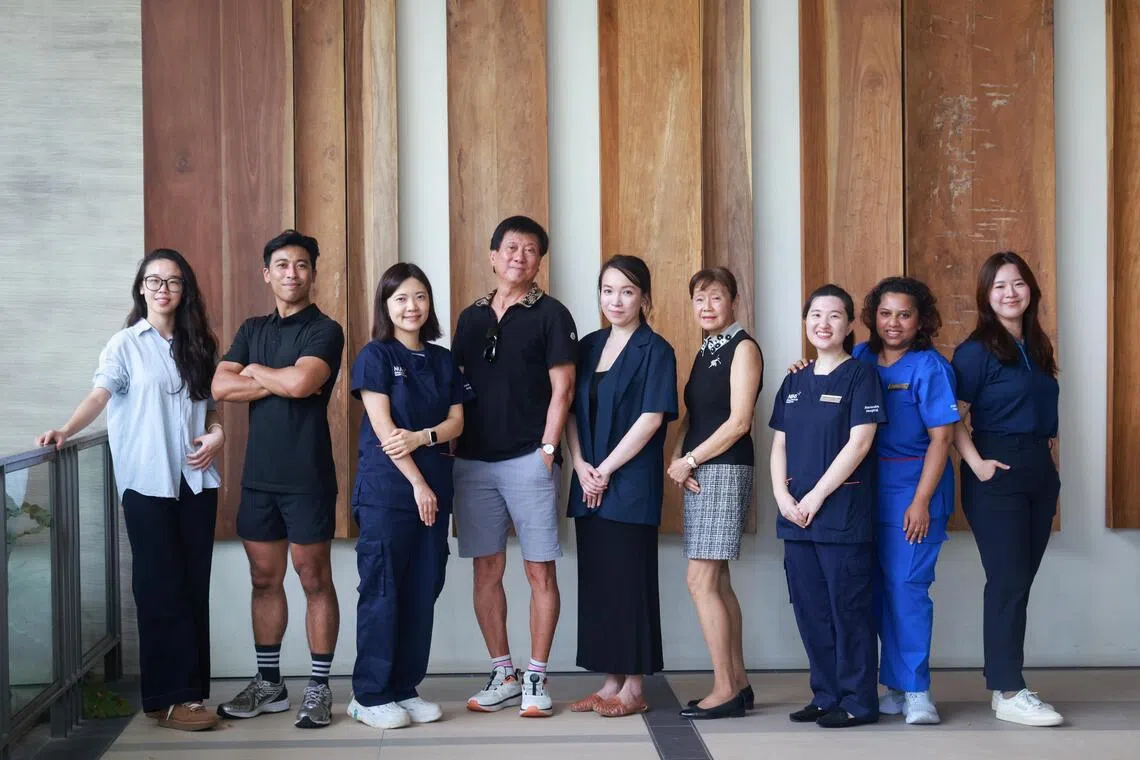
The team members at Alexandra Hospital’s Healthy Longevity Research Clinic (HLRC) with some participants (from left): research assistant He Qian; exercise physiologist Saiful Anwar; Michelle Liao, a doctor; participant Ivan Low; Laureen Wang, head of HLRC; participant Lee Siu Yin; Grace Chiang, a family medicine consultant with HLRC; senior staff nurse Eswari Sundrasagaran; and health coach Cheryl Tan.
ST PHOTO: JASON QUAH
Published Sep 05, 2026, 05:00 AM
Updated Sep 05, 2026, 05:00 AM
Singapore is investing $350 million in research to extend healthy lifespan by focusing on early detection and prevention of ageing-related decline.
The Healthy Longevity Grand Challenge aims to develop affordable biomarkers and interventions tailored for Asian populations to detect and slow ageing.
Singapore plans to integrate precision geromedicine into primary care, making longevity medicine accessible and scalable for all residents.
SINGAPORE - Imagine reaching your 70s and beyond with the strength to get up from the floor without using your hands, or the stamina to hike mountain trails across China or the Andes.
In super-aged Singapore , where seniors aged 65 and above will constitute one in four residents by 2030 and centenarians are more common than ever, this vision represents the future of ageing.
The country is shifting from sick care to preventive care, aiming to add more healthy years to life and to shorten the years spent in poor health, disability and dependence.
The strategy is being propelled by a massive research push that aims to convert the nation into a test bed for extending healthspan – the number of years someone lives in good health – enabling Singaporeans to start managing their health early.
The $350 million longevity bet under the Research, Innovation and Enterprise 2030 (RIE2030) framework was launched in May 2026.
Although biological age clocks, which test cellular health rather than calendar years, and geroscience, the study of the biological causes of ageing, represent its cutting-edge roots, the strategy spans much further. Crucially, it also addresses the socio-environmental factors that influence how we age.
The aim of this grand challenge is to help Singaporeans age more healthily , with a focus on safeguarding mental sharpness and physical mobility, to help prevent conditions like dementia or frailty.
lt brings together research institutions, healthcare partners and enterprises to develop solutions, ranging from diagnostic tools to biomarkers – biological molecules found in blood, other body fluids or tissues, that tell doctors what is going on in the body and whether it is normal.
It will also look at health monitoring technologies and assistive rehabilitation, and address key ageing challenges such as cognitive impairment and physical function decline.
Under Singapore’s Healthier SG preventive care initiative , residents can step into a general practitioner (GP) clinic to get a personalised health plan, though doctors today are largely limited to tracking standard health screenings like blood pressure, cholesterol, mammograms, and stool tests to rule out diseases, and recommending simple lifestyle habits such as exercise or community activities.
Within several years, however, things could look different. Residents could potentially visit a GP to test for early cognitive decline, receive a biological age assessment to find out if they are ageing faster or slower than expected, followed by a precision plan to target physiological decline before illness or frailty sets in.
Chong Yap Seng, the executive director of the Grand Challenge on Maximising Healthy and Successful Longevity compares this proactive prevention approach to routine vehicle maintenance. “You don’t bring your car in only when you have an accident or (when) it stops working; you advise people (to send it) for regular servicing. We need that for humans as well,” he said.
Democratising longevity
Over the next five years, the health longevity grand challenge, which is led by the National Research Foundation, in partnership with the Ministry of Health, will establish baseline data on how Singapore’s population ages at a biological level.
This means looking beyond chronological age to see how cells, tissues, and molecular systems gradually deteriorate over time. For example, scientists can track chemical changes in DNA (epigenetic clocks) to evaluate cellular health or measure inflammatory proteins released by lingering, damaged cells that wear down the body over time.
The goal is to validate new biomarkers and screening tools for brain health and physical function, and interventions that can be effectively deployed across the broader population, said Chong.
“This means that for the average Singaporean, instead of getting diagnosed with dementia or sarcopenia (loss of muscle mass) when it is already quite advanced, your GPs might potentially be able to detect and intercept these conditions much earlier,” he said.
“Overall, we are also likely to have more evidence, based on our biology, genetics, environment and lifestyle patterns, on healthy longevity interventions that actually work for Singaporeans.”
These interventions can range from lifestyle modifications and social or digital innovations to the use of supplements or prescription medications, he added.
For example, if physical function tests show early signs of muscle loss, doctors could possibly prescribe a targeted plan using specific exercise regimens and supplements to slow the biological decline.
In contrast to expensive longevity clinics around the world that target affluent clients with costly packages, unvalidated therapies, and high-tech options such as hyperbaric oxygen chambers or red light treatment, the Singapore Government is pursuing an approach focused on democratising healthcare – making it available to all.
Brian Kennedy, director of the Centre for Healthy Longevity at the National University Health System (NUHS), said: “We’re not studying $100,000 interventions at the university. We’re doing things we can scale, like repurposed drugs and supplements... and biomarker (tests) that cost $200 or less.”
Chong said that while global scientists can easily publish promising longevity research in academic papers, most nations fail to move the needle because they lack a way to scale these discoveries to the general public.
Director of the Centre for Healthy Longevity at NUHS Brian Kennedy (left) and executive director of the Grand Challenge on Maximising Healthy and Successful Longevity Chong Yap Seng. ST PHOTO: MARK CHEONG
Director of the Centre for Healthy Longevity at NUHS Brian Kennedy (left) and executive director of the Grand Challenge on Maximising Healthy and Successful Longevity Chong Yap Seng.
ST PHOTO: MARK CHEONG
Here, the network of active ageing centres (AACs), which are community hubs that keep seniors socially and physically engaged, are a “wonderful platform for the distribution of public goods”, he said.
These centres form a core pillar of Age Well SG , a $3.5 billion national programme aimed at helping Singaporeans age well in the community over the next decade.
While Age Well SG serves as an operational and infrastructural system, the ageing grand challenge is the research engine that could come up with the breakthroughs to further power it.
Integrating the grand challenge’s research into AACs ensures that scientific breakthroughs in brain and muscle health don’t stay in university labs, but are delivered directly to seniors near their homes.
Kennedy, who is chief scientist of the healthy longevity grand challenge, highlighted Singapore’s unprecedented financial and strategic commitment.
“I would say Singapore is becoming a leader in Asia, and one of the unique things we do is we have the whole system. We have mechanistic studies (lab research exploring the cellular drivers of ageing), we have preclinical studies (testing therapies on cells and lab models), and then we have clinical approaches too. And so we can run the whole spectrum,” he said.
An expert in the biology of ageing, Kennedy is Distinguished Professor in Biochemistry and Physiology at NUS Medicine. Before coming to Singapore, he was president and CEO of the Buck Institute for Research on Ageing in California, one of the world’s premier independent research institutions dedicated entirely to geroscience.
“When I came (to Singapore) nine years ago, they were already talking about what we can do about ageing... My goal is to help the population of Singapore have a longer healthspan, and I think this is an ideal place to be a role model for how to age in a healthy and happy way.”
Spotting decline before symptoms appear
Research indicates that curing all cancers, for instance, would only raise global life expectancy by roughly three years, because patients soon succumb to other age-related conditions, Kennedy said.
Instead, geroscience targets the underlying biological network of ageing that triggers these conditions in the first place, delaying the onset of multiple chronic illnesses, he said.
Many people, however, neglect to go for health screenings, which is a first step before going into longevity medicine, he stressed.
Because individuals age at different rates, tracking baseline biomarkers such as blood sugar, cholesterol, and blood pressure helps doctors catch silent physiological decline early.
When combined with wearable tracking, body composition analysis, and simple tests like handgrip strength, these metrics can detect muscle loss, assess cellular resilience, and predict overall mortality risk years before clinical symptoms appear, and in time for the person to do something about it.
This proactive philosophy is already taking shape on the ground. At Alexandra Hospital’s Healthy Longevity Research Clinic, Laureen Wang and her team have demonstrated that they can identify cardiometabolic risk before overt disease sets in, and improve health risk factors.
Rather than relying on high-tech quick fixes, much of this progress comes down to driving sustainable behaviour changes such as optimising sleep, nutrition, and exercise, and increasing patient engagement.
“This in turn has helped to improve the physical function, biomarkers, gut health and ‘biological age’ of some of the participants,” said Wang, a consultant cardiologist who heads the clinic.
“Whether this translates to additional healthy years requires much longer follow-up data but we measure for now what we can measure.”
Wang said the clinic’s goal isn’t unique to longevity clinics.
“It is the goal of every good preventive medicine practice where we are identifying risk early, modifying it, and trying to compress the period of disease or reduce the harm it causes and disability at the end of life.”
“The vocabulary has changed to ‘gero-diagnostics’, ‘gero-therapeutics’, ‘healthspan’ but the underlying game plan is older than the branding.”
Tracking biological age
The healthy longevity grand challenge will validate a set of health measures that primary care doctors would be able to use to track whether a person is ageing faster or slower than expected, allowing doctors to spot those at higher risk of early cognitive or physical decline, before major problems appear.
It is not clear what these tests are yet, but they could include things like biological age clocks, the use of wearable data to track someone’s lifestyle habits that contribute to health, gait evaluation and brief cognitive assessments.
A key priority for the grand challenge is to get a reliable measure of one’s biological age or biological resilience that is validated for Asian populations, as no single clock is currently the undisputed gold standard for telling us how far or close we are to a natural death.
A reliable biological clock is also essential for testing new anti-ageing treatments. Instead of waiting decades to see if a treatment extends a person’s life, scientists can use biological age tests to prove whether an intervention is successfully slowing down ageing.
Director of the Centre for Healthy Longevity at NUHS Brian Kennedy supervising research assistant Grace Keh as she extracts RNA from tissue samples treated with geroprotective compounds on Aug 27. ST PHOTO: MARK CHEONG
Director of the Centre for Healthy Longevity at NUHS Brian Kennedy supervising research assistant Grace Keh as she extracts RNA from tissue samples treated with geroprotective compounds on Aug 27.
Chong said most people are blind to their physiological decline, so seeing their biological age on a clock can serve as a moment of awakening that drives real lifestyle or medical changes.
He shared the story of a 50-year-old researcher who ran a biological clock test on himself, expecting his biological age to be much younger because he was very fit and had no family history of heart disease.
Instead, the test revealed his biological age was 51, and flagged that it was his cardiovascular system that was making him older than he should be, said Chong.
This prompted a heart scan that detected early, hidden arterial blockage, allowing his doctor to prescribe statins to stave off a potential heart attack before symptoms ever appeared.
Unlike chronological age, biological age is adaptable and can potentially be reversed through healthy lifestyle habits and targeted wellness interventions.
Andrea Maier, the co-founder and director of the NUS Academy for Healthy Longevity at the National University of Singapore and a world-renowned researcher in precision geromedicine, said biological age is rarely a single, static figure.
Andrea Maier, the co-founder and director of the NUS Academy for Healthy Longevity, said biological age is rarely a single, static figure. PHOTO: NUS MEDICINE
Andrea Maier, the co-founder and director of the NUS Academy for Healthy Longevity, said biological age is rarely a single, static figure.
Because different organs age at varying paces, diverse biological clocks, ranging from DNA and blood protein tests to standard clinical blood panels, evaluate distinct biological processes inside the body and can yield different numbers for the same person.
“We cannot rely on a single metric for age. In electric vehicles, for instance, the battery and the engine age separately,” she explained.
“We have to create a body dashboard where you get the different signals, and then it’s up to you if you’re going to intervene or not.”
Testing the anti-ageing pipeline
To move beyond general health advice, local institutions are testing targeted clinical interventions that target biological decline.
While lab studies show that inflammation, metabolic dysregulation, and physiological stress drive unhealthy ageing, therapies that ameliorated these effects in preclinical models are now being tested on humans.
At the NUS Academy of Healthy Longevity’s PROMETHEUS (Precision germedineme: Tailored healthy ageing with lifestyle, supplements and drugs) study, for instance, researchers test precision geromedicine interventions tailored to adults aged 50 to 80, to measure whether specific lifestyle protocols and certain supplements actively slow down the ageing trajectory.
The project is competing in XPRIZE Healthspan , a mega US$101 million (S$128 million) global contest to restore muscle, brain, and immune function by 10 to 20 years, by measuring outcomes in participants aged 65 to 80.
The NUS academy is also conducting a one-year trial to evaluate whether daily multivitamins reduce biological age in adults aged 40 to 60 whose biological markers outpace their chronological years. “Supplements can play a huge role in ageing… but they should be given to individuals who need them. We need to measure this,” said Maier.
In addition to supplements, Maier has designed a trial for low-dose rapamycin, a leading longevity candidate, to determine if the immunosuppressant can delay biological ageing.
Decoding Asian biology
One-size-fits-all medical advice is rarely effective in preventing decline because everyone ages differently. Crucially, localising healthy ageing research is essential because Western longevity metrics do not always fit Asian populations.
Chong said: “Most of what we know about ageing comes from Western populations, Western lifestyles, and Western genetics.
“But Asians age differently. Our biology is different, and the risk profiles are different.”
Lisa Ooi, assistant chief executive of A*STAR’s Biomedical Research Council, pointed to local evidence showing that more than one in four healthy-weight young Chinese women in Singapore possesses low muscle mass and lower bone density despite appearing healthy by conventional body mass index standards.
This thin phenotype risk represents a silent precursor to frailty that standard international metrics easily miss, she said.
To address issues like this, Singapore is looking at data across a number of research cohorts, including those from SG100K, a major population health study that maps and analyses the genetic data, lifestyle, and health outcomes of 100,000 multi-ethnic residents, and the long-term birth cohort Growing Up in Singapore Towards Healthy Outcomes (GUSTO) study.
A regional test bed for global longevity care
To prepare future physicians, Chong, who is dean of NUS Medicine, said the school is now embedding lifestyle medicine into the core medical curriculum, so that doctors aren’t taught only to diagnose and treat diseases but also to optimise health.
Doctors need to be able to measure health, so that they can help to optimise it. It need not be complicated, as it can be measured using simple tests like grip strength or gait speed, he said.
“How fast you walk is probably one of the best measures of how healthy you are, because it requires your whole body to function in a particular way,” he said.
Staying healthy as we grow old requires at least four things – eat healthy, stay active, sleep well, and find purpose, he said, noting that individuals who lose purpose in life often lose their health and die much earlier.
The school also recently launched global-first programmes, including a Master of Science in Nutrition and Lifestyle Medicine and certificate courses in healthy longevity.
“Upskilling healthcare professionals in a broader way (will enable Singapore to) democratise health longevity medicine in the end, because that’s what we want, that’s what we stand for,” Maier said.
“We built a framework to be one of the global leaders in the field of geroscience and geromedicine, and especially, globally, we are leading in the implementation into clinical practice.”
As part of this effort, the healthy longevity grand challenge is tasked with developing a Singapore Healthy and Successful Longevity Index, which will comprise a large suite of indicators – including measures of physical function – that show, at a population level, whether the country as a whole is ageing healthily and successfully.
By uniting cutting-edge geroscience with low-cost, accessible primary care checks, Singapore is building an inclusive public health framework that proves living better for longer can be made available to everyone.
“We are very well positioned to be the regional test bed for scaleable, data-driven, culturally adapted models for global longevity care,” said Chong.
“Not just in theory, but in real life.”
If Singapore succeeds, reaching old age will not be measured by the number of chronic conditions managed, but by the next mountain waiting to be climbed, or the next adventure that’s calling.
Joyce Teo is senior health correspondent at The Straits Times and the host of ST podcast series Health Check.
Keeping Singapore Healthy 2020
亚历山大医院健康长寿研究诊所 (HLRC) 的团队成员与部分参与者合影(从左至右):研究助理何倩;运动生理学家 Saiful Anwar;医生 Michelle Liao;参与者 Ivan Low;HLRC 负责人 Laureen Wang;参与者 Lee Siu Yin;HLRC 家庭医学顾问 Grace Chiang;高级护士 Eswari Sundrasagaran;以及健康教练 Cheryl Tan。
《海峡时报》摄影:JASON QUAH
发布于 2026 年 9 月 5 日上午 5:00
更新于2026年9月5日上午5:00
新加坡正投资 3.5 亿美元用于研究,以延长健康寿命,重点是早期发现和预防与衰老相关的衰退。
健康长寿大挑战旨在开发价格合理的生物标志物和针对亚洲人群量身定制的干预措施,以检测和延缓衰老。
新加坡计划将精准老年医学融入基层医疗,使长寿医学能够惠及所有居民并得到推广应用。
新加坡——想象一下,到了 70 岁甚至更高龄,仍然有能力不用手就能从地上站起来,或者有足够的耐力去徒步穿越中国或安第斯山脉的山路。
在老龄化程度极高的新加坡,到 2030 年,65 岁及以上的老年人将占居民总数的四分之一,百岁老人也比以往任何时候都更加常见,这一愿景代表了老龄化的未来。
该国正在从疾病治疗转向预防保健,旨在延长人们的健康寿命,缩短人们处于疾病、残疾和依赖状态的年限。
这项战略的推进得益于一项大规模的研究计划,该计划旨在将新加坡变成延长健康寿命(即一个人健康生活的年数)的试验场,使新加坡人能够尽早开始管理自己的健康。
2026 年 5 月,一项在“研究、创新和企业 2030 (RIE2030)”框架下投资 3.5 亿美元的长期发展计划正式启动。
尽管生物钟(检测细胞健康而非日历年份)和衰老科学(研究衰老生物学原因的学科)代表了其前沿基础,但该策略的范围远不止于此。至关重要的是,它还关注影响我们衰老的社会环境因素。
这项重大挑战的目标是帮助新加坡人更健康地老去,重点是保持思维敏捷和身体灵活,以帮助预防痴呆症或体弱等疾病。
它汇集了研究机构、医疗保健合作伙伴和企业,共同开发解决方案,从诊断工具到生物标志物(存在于血液、其他体液或组织中的生物分子),这些生物分子可以告诉医生身体发生了什么以及是否正常。
它还将研究健康监测技术和辅助康复,并解决认知障碍和身体机能下降等关键的老龄化挑战。
在新加坡的“更健康的新加坡”预防保健计划下,居民可以前往全科医生诊所获得个性化的健康计划,但如今医生主要仅限于跟踪血压、胆固醇、乳房X光检查和粪便检查等标准健康筛查,以排除疾病,并推荐简单的生活方式习惯,例如锻炼或社区活动。
然而,几年后情况可能会有所不同。居民或许可以去全科医生那里进行早期认知能力下降的测试,接受生物年龄评估以确定他们的衰老速度是快于还是慢于预期,然后制定精准的计划,在疾病或虚弱出现之前,针对生理衰退进行干预。
“健康长寿大挑战”执行主任张业生将这种积极主动的预防方法比作车辆的日常保养。“你不会等到车子出了事故或者坏了才去修;你会建议车主定期保养。人类也需要这样做。”他说道。
让长寿大众化
在接下来的五年里,由国家研究基金会牵头,与卫生部合作开展的“健康长寿大挑战”项目,将建立新加坡人口在生物学层面衰老的基线数据。
这意味着要超越生理年龄,去观察细胞、组织和分子系统如何随着时间推移逐渐衰退。例如,科学家可以追踪DNA中的化学变化(表观遗传时钟)来评估细胞健康状况,或者测量那些由残留的受损细胞释放的炎症蛋白,这些炎症蛋白会随着时间的推移而损害身体机能。
Chong表示,目标是验证大脑健康和身体功能的新生物标志物和筛查工具,以及可以有效推广到更广泛人群的干预措施。
“这意味着,对于普通新加坡人来说,与其等到痴呆症或肌肉减少症(肌肉量减少)发展到相当严重的程度才被诊断出来,不如让全科医生更早地发现并干预这些疾病,”他说。
“总的来说,基于我们的生物学、遗传学、环境和生活方式模式,我们可能也会有更多证据证明,健康长寿的干预措施对新加坡人确实有效。”
他补充说,这些干预措施可以包括生活方式的改变、社会或数字创新,以及使用补充剂或处方药。
例如,如果身体机能测试显示肌肉流失的早期迹象,医生可能会制定有针对性的计划,使用特定的锻炼方案和补充剂来减缓生物衰退。
与世界各地针对富裕客户、提供昂贵套餐、未经证实的疗法以及高压氧舱或红光治疗等高科技选择的昂贵长寿诊所不同,新加坡政府正在推行一种以医疗保健民主化为重点的方法,让所有人都能获得医疗保健服务。
新加坡国立大学健康系统(NUHS)健康长寿中心主任布莱恩·肯尼迪表示:“我们大学研究的不是耗资10万美元的干预措施,而是可以规模化推广的项目,例如重新利用的药物和补充剂……以及成本在200美元或以下的生物标志物(检测)。”
钟表示,虽然全球科学家可以很容易地在学术论文中发表有前景的长寿研究,但大多数国家却未能取得进展,因为他们缺乏将这些发现推广到普通大众的方法。
新加坡国立大学健康科学中心健康长寿中心主任布莱恩·肯尼迪(左)和“最大化健康长寿”重大挑战项目执行主任张业生。海峡时报摄影:张马克
新加坡国立大学健康长寿中心主任 Brian Kennedy(左)和“最大限度地提高健康长寿”重大挑战执行主任 Chong Yap Seng。
《海峡时报》照片:张马克
他表示,这里的活跃老龄化中心(AAC)网络是让老年人保持社交和身体参与的社区中心,是“公共产品分配的绝佳平台”。
这些中心是 Age Well SG 的核心支柱,Age Well SG 是一项耗资 35 亿新元的国家计划,旨在帮助新加坡人在未来十年内在社区中安享晚年。
虽然 Age Well SG 作为一个运营和基础设施系统发挥作用,但老龄化这一重大挑战在于研究引擎,它可以带来突破,从而进一步推动该系统的发展。
将重大挑战的研究成果融入 AAC 系统,可以确保大脑和肌肉健康方面的科学突破不会停留在大学实验室,而是直接惠及老年人的家附近。
肯尼迪是健康长寿重大挑战的首席科学家,他强调了新加坡前所未有的财政和战略投入。
“我认为新加坡正在成为亚洲的领军者,我们独特的优势之一在于我们拥有完整的体系。我们有机制研究(探索衰老细胞驱动因素的实验室研究),我们有临床前研究(在细胞和实验室模型上测试疗法),我们也有临床应用。因此,我们可以涵盖所有方面,”他说道。
肯尼迪是衰老生物学领域的专家,现任新加坡国立大学医学院生物化学与生理学特聘教授。在来新加坡之前,他曾担任加州巴克衰老研究所的总裁兼首席执行官,该研究所是世界顶尖的独立研究机构之一,致力于衰老科学的研究。
“九年前我来到新加坡时,人们已经在讨论如何应对老龄化问题了……我的目标是帮助新加坡人民拥有更长的健康寿命,我认为这里是树立健康快乐老龄化榜样的理想之地。”
在症状出现前发现衰退迹象
肯尼迪说,研究表明,即使治愈所有癌症,也只能使全球预期寿命延长大约三年,因为患者很快就会死于其他与年龄相关的疾病。
他表示,衰老科学并非针对这些疾病本身,而是着眼于引发这些疾病的潜在生物衰老网络,从而延缓多种慢性疾病的发生。
他强调,然而,许多人却忽视了健康检查,而健康检查是进入长寿医学领域的第一步。
由于个体衰老速度不同,追踪血糖、胆固醇和血压等基线生物标志物有助于医生及早发现无症状的生理衰退。
结合可穿戴设备追踪、身体成分分析和握力等简单测试,这些指标可以检测肌肉流失、评估细胞恢复力,并在临床症状出现前数年预测总体死亡风险,从而使患者有时间采取措施。
这种积极主动的理念已经在实践中初见成效。在亚历山大医院的健康长寿研究诊所,劳伦·王和她的团队已经证明,他们能够在明显疾病出现之前识别出心血管代谢风险,并改善健康风险因素。
与其依赖高科技的快速解决方案,不如说这种进步很大程度上归功于推动可持续的行为改变,例如优化睡眠、营养和运动,以及提高患者的参与度。
“这反过来又帮助改善了一些参与者的身体机能、生物标志物、肠道健康和‘生物年龄’,”该诊所负责人、心脏病顾问王说道。
“这是否能转化为更多的健康年限,还需要更长时间的后续数据,但目前我们只能衡量我们能够衡量的。”
王表示,该诊所的目标并非长寿诊所独有。
“所有优秀的预防医学实践的目标都是尽早发现风险,加以控制,并努力缩短病程或减少疾病造成的伤害以及生命末期的残疾。”
“虽然词汇已经变成了‘老年诊断’、‘老年治疗’、‘健康寿命’,但其背后的战略规划比品牌包装的历史还要悠久。”
追踪生物年龄
健康长寿大挑战将验证一系列健康指标,初级保健医生可以使用这些指标来跟踪一个人的衰老速度是快于还是慢于预期,从而使医生能够在出现重大问题之前发现那些认知或身体早期衰退风险较高的人。
目前还不清楚这些测试具体是什么,但可能包括生物年龄钟、利用可穿戴设备数据跟踪影响健康的生活习惯、步态评估和简短的认知评估等。
应对这一重大挑战的关键优先事项是找到一种可靠的衡量一个人生物年龄或生物恢复力的方法,并使其适用于亚洲人群,因为目前还没有任何单一的时钟是无可争议的黄金标准,可以告诉我们距离自然死亡还有多远或多近。
可靠的生物钟对于测试新的抗衰老疗法至关重要。科学家无需等待数十年才能观察某种疗法是否能延长寿命,而是可以利用生物年龄测试来证明某种干预措施是否能有效延缓衰老。
新加坡国立大学健康科学中心长寿研究中心主任布莱恩·肯尼迪(Brian Kennedy)指导研究助理格蕾丝·柯(Grace Keh)于8月27日从经抗衰老化合物处理的组织样本中提取RNA。(海峡时报摄影:马克·张)
8 月 27 日,新加坡国立大学健康长寿中心主任 Brian Kennedy 指导研究助理 Grace Keh 从用抗衰老化合物处理的组织样本中提取 RNA。
钟表示,大多数人对自己的生理衰退视而不见,因此在时钟上看到自己的生物年龄可以成为一个觉醒的时刻,从而促使人们真正改变生活方式或进行医疗改变。
他分享了一个 50 岁研究人员的故事,这位研究人员对自己进行了生物钟测试,因为他身体非常健康,而且没有心脏病家族史,所以他认为自己的生理年龄会年轻得多。
钟说,测试结果显示他的生理年龄是 51 岁,并指出是他的心血管系统让他看起来比实际年龄要老。
这促使医生进行了一次心脏扫描,从而发现了早期隐匿的动脉阻塞,使医生能够在症状出现之前就给他开具他汀类药物,以预防潜在的心脏病发作。
与实际年龄不同,生理年龄是可以适应的,并且有可能通过健康的生活方式习惯和有针对性的健康干预措施而逆转。
新加坡国立大学健康长寿学院联合创始人兼院长、世界知名的精准老年医学研究员安德里亚·迈尔表示,生物年龄很少是一个单一的、静态的数字。
新加坡国立大学健康长寿学院联合创始人兼院长安德里亚·迈尔表示,生物年龄很少是一个单一的、静止的数字。图片:新加坡国立大学医学院
新加坡国立大学健康长寿学院联合创始人兼院长安德里亚·迈尔表示,生物年龄很少是一个单一的、静态的数字。
由于不同器官的衰老速度不同,从 DNA 和血液蛋白质测试到标准临床血液检查,各种生物钟评估体内不同的生物过程,因此对同一个人可能会得出不同的数值。
“我们不能只依赖单一指标来判断车龄。例如,在电动汽车中,电池和发动机的车龄是分开计算的,”她解释说。
“我们必须创建一个人体仪表盘,让用户能够接收到不同的信号,然后由用户自行决定是否进行干预。”
测试抗衰老流程
为了超越一般的健康建议,地方机构正在测试针对生物衰退的有针对性的临床干预措施。
实验室研究表明,炎症、代谢紊乱和生理压力会导致不健康的衰老,而目前在临床前模型中能够改善这些影响的疗法正在人体上进行测试。
例如,在新加坡国立大学健康长寿学院的 PROMETHEUS(精准老年医学:通过生活方式、补充剂和药物量身定制的健康老龄化)研究中,研究人员测试了针对 50 至 80 岁成年人量身定制的精准老年医学干预措施,以衡量特定的生活方式方案和某些补充剂是否能有效减缓衰老进程。
该项目正在参加 XPRIZE Healthspan 竞赛,这是一项奖金高达 1.01 亿美元(1.28 亿新元)的全球性竞赛,旨在通过测量 65 至 80 岁参与者的结果,将肌肉、大脑和免疫功能恢复 10 至 20 年。
新加坡国立大学学院正在进行一项为期一年的试验,评估每日服用多种维生素是否能降低40至60岁成年人的生物年龄,这些成年人的生物标志物已超过其实际年龄。“补充剂在延缓衰老方面可以发挥巨大作用……但它们应该提供给真正需要的人。我们需要对此进行评估,”迈尔说道。
除了补充剂之外,迈尔还设计了一项低剂量雷帕霉素(一种领先的长寿候选药物)的试验,以确定这种免疫抑制剂是否可以延缓生物衰老。
解读亚洲生物学
千篇一律的医疗建议很少能有效预防衰老,因为每个人的衰老过程都不尽相同。至关重要的是,健康老龄化研究必须因地制宜,因为西方的长寿指标并不总是适用于亚洲人群。
钟说:“我们对衰老的了解大多来自西方人口、西方生活方式和西方遗传学。”
“但亚洲人的衰老方式不同。我们的生理构造不同,风险状况也不同。”
新加坡科技研究局生物医学研究理事会助理首席执行官 Lisa Ooi 指出,本地证据表明,新加坡超过四分之一的体重健康的年轻华裔女性虽然按照传统的体重指数标准看起来很健康,但她们的肌肉量和骨密度却很低。
她表示,这种瘦弱的表型风险代表了一种隐匿的虚弱前兆,而标准的国际指标很容易忽略这一点。
为了解决此类问题,新加坡正在研究多个研究队列的数据,包括 SG100K(一项大型人口健康研究,旨在绘制和分析 10 万多种族居民的基因数据、生活方式和健康结果)和长期出生队列研究“在新加坡健康成长”(GUSTO)。
一个区域性的全球长寿护理试验平台
为了培养未来的医生,新加坡国立大学医学院院长庄教授表示,该校目前正在将生活方式医学融入核心医学课程,以便医生不仅能诊断和治疗疾病,还能优化健康。
他说,医生需要能够测量健康状况,以便帮助患者优化健康状况。这并不需要很复杂,因为可以通过一些简单的测试来测量,例如握力或步速。
他说:“走路的速度可能是衡量你健康状况的最佳指标之一,因为它要求你的整个身体以特定的方式运作。”
他表示,想要在年老时保持健康至少需要四件事——健康饮食、保持活力、充足睡眠和找到人生目标。他还指出,那些失去人生目标的人往往会失去健康,并且过早去世。
该校近期还推出了全球首创的课程,包括营养与生活方式医学理学硕士学位和健康长寿证书课程。
“从更广泛的层面提升医疗保健专业人员的技能,最终将使新加坡能够实现健康长寿医学的普及,因为这正是我们所希望的,也是我们所坚持的,”迈尔说。
“我们构建了一个框架,力争成为老年科学和老年医学领域的全球领导者之一,尤其是在全球范围内,我们在临床实践的实施方面处于领先地位。”
作为这项工作的一部分,“健康长寿大挑战”的任务是制定新加坡健康成功长寿指数,该指数将包含一系列指标(包括身体机能指标),这些指标将从人口层面显示整个国家是否正在健康成功地老龄化。
新加坡将尖端老年科学与低成本、便捷的初级保健检查相结合,正在构建一个包容性的公共卫生框架,证明每个人都能活得更长久、更健康。
“我们完全有能力成为可扩展、数据驱动、文化适应性强的全球长寿护理模式的区域试验场,”Chong说道。
“不仅在理论上,而且在现实生活中也是如此。”
如果新加坡成功了,那么衡量老年的标准将不再是控制了多少慢性病,而是下一座等待攀登的高峰,或是下一个召唤着他的冒险。
Joyce Teo 是《海峡时报》的高级健康记者,也是《海峡时报》播客系列节目“健康检查”的主持人。
2020年新加坡健康指南