From robots to cancer screenings, Asia’s next wave of AI startups is moving into the real world从机器人到癌症筛查,亚洲下一波人工智能初创企业正在走向现实世界。
More than half of the 30 companies showcased at the NextGen Tech 30 event are applying AI to physical industries, marking a shift from the software-focused firms in previous cohorts.
新闻视频
More than half of the 30 companies showcased at the NextGen Tech 30 event are applying AI to physical industries, marking a shift from the software-focused firms in previous cohorts.
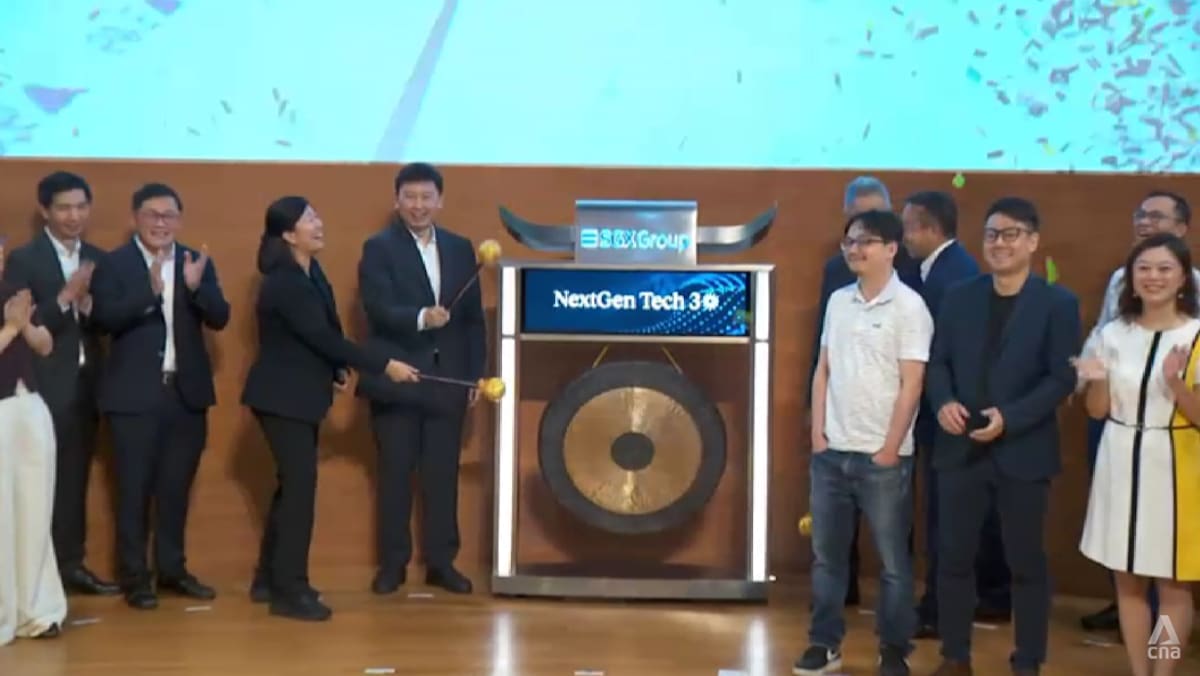
Minister for National Development and deputy chairman of the Monetary Authority of Singapore, Chee Hong Tat, sounds the gong to open the trading day at the Singapore Exchange (SGX), joined by founders of companies honoured at the NextGen Tech 30 event. (Image: CNA)
This audio is generated by an AI tool.
SINGAPORE: From underwater drones and cancer screening to industrial maintenance and real-time fraud detection, Asian startups are taking artificial intelligence beyond software and into the real world.
Thirty of these companies were showcased on Wednesday (Sep 30) at the NextGen Tech 30 (NGT30), an initiative that recognises and supports growth-stage technology companies from across the region.
More than half of this year’s honourees are applying AI to physical industries such as wind farms, warehouses, pharmacies, construction sites and low-Earth orbit, marking a shift from the software-focused firms that dominated previous cohorts.
They are also developing technologies ranging from custom silicon and humanoid robots to hyperspectral satellites and sustainable aviation fuel systems.
CNA Games Guess Word Crack the word, one row at a time Buzzword Create words using the given letters Mini Sudoku Tiny puzzle, mighty brain teaser Mini Crossword Small grid, big challenge Word Search Spot as many words as you can Show More Show Less Now in its third edition, NGT30 is led by Singapore-based private capital platform Granite Asia in partnership with the Singapore Exchange (SGX), bringing together investors, government agencies and industry players to help promising companies scale globally from Asia. Nearly half of the startups recognised this year are headquartered in Singapore, while a third are from Japan. The remaining firms are from China, India, Malaysia and South Korea. Speaking at the event, Minister for National Development and Monetary Authority of Singapore (MAS) deputy chairman Chee Hong Tat said the firms “illustrate the growing depth and breadth of Asia’s innovation base”, with the potential to “reshape business models and transform industries”. But recognition is only the beginning, he said, with the next challenge being to turn promising startups into companies capable of competing internationally.
Now in its third edition, NGT30 is led by Singapore-based private capital platform Granite Asia in partnership with the Singapore Exchange (SGX), bringing together investors, government agencies and industry players to help promising companies scale globally from Asia.
Nearly half of the startups recognised this year are headquartered in Singapore, while a third are from Japan. The remaining firms are from China, India, Malaysia and South Korea.
Speaking at the event, Minister for National Development and Monetary Authority of Singapore (MAS) deputy chairman Chee Hong Tat said the firms “illustrate the growing depth and breadth of Asia’s innovation base”, with the potential to “reshape business models and transform industries”.
But recognition is only the beginning, he said, with the next challenge being to turn promising startups into companies capable of competing internationally.
“A startup has to prove that an idea can work. A scale-up has to make it work repeatedly, across different markets beyond domestic shores, and at a much greater scale,” Mr Chee said.
This requires capital that can grow with a company, organisational capabilities that can keep pace and the ability to adapt to different markets, he added.
“Our aim is to create an enabling environment where companies can build from Singapore, progress from startup to scale-up, and become regional and global leaders,” he said.
AI MOVES INTO THE REAL WORLD
Granite Asia senior managing partner Jenny Lee sees this year’s cohort as part of a broader evolution of AI.
“We’re now going into what we call AI 3.0,” she told CNA, describing a shift beyond frontier models and AI agents towards their deployment in real-world environments.
“This year’s awardees … are actually leveraging AI models to transform industries. And that’s the excitement.”
Among this year's honourees is Singapore-based Menlo Research, which is developing an open-source humanoid robot named Asimov, as well as an AI agent called Jan.
Asimov has attracted an international community of developers and enthusiasts who are customising and improving the open-source robot, according to the company.
But putting the advances seen in generative AI into a physical machine presents a very different challenge, said the firm's founder Daniel Ong.
While AI systems can process enormous amounts of information, robots still struggle with tasks humans perform intuitively, such as interacting with objects, he added.
Menlo Research founder Daniel Ong. (Image: CNA)
“To put AI into a robot body and for it to understand physical space is actually really difficult,” Mr Ong said.
“How do we train an AI with an intuitive understanding of physics … and be able to navigate the world and do real things like ... pick up something from the floor?”
AI & EARLY CANCER DETECTION
Another firm in this year’s lineup is Japanese startup Craif, which is applying AI to cancer screening.
The company has developed technology that extracts microRNA from urine and uses AI to analyse its profile for signs associated with multiple cancers, including pancreatic, lung and breast cancer.
CEO and co-founder Ryuichi Onose said the technology can detect cancer with about 90 per cent accuracy.
Having already launched its test in Japan and expanded to the United States, the firm is now eyeing Southeast Asia.
"We've been preparing to launch our product in Singapore," said Mr Onose. The company hopes to make the test available here next year.
Mr Onose sees NGT30 as a way to help Craif expand beyond Japan.
“Asia is the most important market for us, and outside Japan, we need support, we need partnerships in terms of medical institutions and healthcare providers,” he said. “So, this platform is very important for us to step outside of Japan.”
Craif CEO and co-founder Ryuichi Onose. (Image: CNA)
CAPITAL FOR THE NEXT STAGE
As companies grow, access to capital becomes another part of the scaling challenge.
Mr Chee said companies’ financing needs change as they develop, from early-stage investment to larger pools of growth capital and, for some, eventually the public markets.
“We are working to strengthen Singapore’s growth capital ecosystem and connect promising companies with the pools of capital they need as they scale,” he said.
Earlier this year, MAS and the Ministry of Trade and Industry convened the Growth Capital Workgroup to look at ways to strengthen Singapore’s growth capital ecosystem.
Mr Chee also pointed to increased IPO activity and other efforts to strengthen Singapore’s equities market as potential avenues for companies seeking capital as they mature.
Menlo Research open-source humanoid robot Asimov. (Image: CNA)
SGX Group senior managing director Pol de Win said Singapore offers companies access to global investors, alongside a local investment community familiar with markets across Southeast Asia and the wider region.
Public markets can also provide growing companies with “very efficient access to permanent capital”, he added.
Mr de Win said recent efforts to strengthen the market were showing early signs of progress, but would take time to have their full effect.
“We’re still early days,” he said. “But I’m very optimistic for, let’s say, the next three to five years ahead.”
A STRONGER ECOSYSTEM
Capital, however, is only one part of what emerging technology companies need to scale.
Menlo Research’s Mr Ong said companies need to be surrounded by suppliers, talent and other businesses developing complementary technologies.
He pointed to robotics clusters such as Shenzhen in China and Odense in Denmark as examples of the density needed to support the industry.
Singapore has some advantages, he said.
“It’s a meeting point … where eastern hardware excellence and manufacturing know-how meets Western brains,” he said. “(But) what I worry about is whether we can have a sufficiently dense robotics ecosystem.”
He added that targeted government support and investors willing to take risks on emerging technologies can provide a platform for entrepreneurs to succeed.
“One swallow does not a summer make, it takes a village,” he said.
Get our pick of top stories and thought-provoking articles in your inbox
Stay updated with notifications for breaking news and our best stories
Join our channel for the top reads for the day on your preferred chat app
在 NextGen Tech 30 活动中展示的 30 家公司中,超过一半正在将人工智能应用于实体行业,这标志着与之前几届以软件为中心的公司相比,发生了转变。
新加坡国家发展部长兼新加坡金融管理局副主席徐芳达在新加坡交易所(SGX)敲响开市锣,与他一同出席的还有在“下一代科技30强”活动中获奖的企业创始人。(图片:CNA)
这段音频由人工智能工具生成。
新加坡:从水下无人机和癌症筛查到工业维护和实时欺诈检测,亚洲初创企业正在将人工智能从软件领域带入现实世界。
周三(9 月 30 日),NextGen Tech 30 (NGT30) 活动上展示了其中 30 家公司。该活动旨在表彰和支持来自该地区的成长阶段科技公司。
今年超过一半的获奖者正在将人工智能应用于风力发电场、仓库、药店、建筑工地和近地轨道等实体行业,这标志着与以往以软件公司为主的获奖者群体相比,发生了转变。
他们还在开发各种技术,包括定制硅基和人形机器人、高光谱卫星和可持续航空燃料系统。
CNA游戏猜词游戏:逐行破解单词;流行词游戏:用给定的字母组成单词;迷你数独:小巧的谜题,强大的脑力挑战;迷你填字游戏:小方格,大挑战;单词搜索:尽可能多地找出单词。显示更多 显示更少 NGT30现已举办至第三届,由总部位于新加坡的私募股权平台Granite Asia与新加坡交易所(SGX)合作举办,汇聚投资者、政府机构和行业参与者,帮助有潜力的亚洲企业走向全球。今年获得认可的初创企业中,近一半总部位于新加坡,三分之一来自日本。其余企业来自中国、印度、马来西亚和韩国。新加坡国家发展部长兼新加坡金融管理局(MAS)副主席徐芳达在活动上表示,这些企业“展现了亚洲创新基础的日益深厚和广度”,并具有“重塑商业模式和变革行业的潜力”。但他指出,获得认可仅仅是开始,下一个挑战是如何将这些有潜力的初创企业发展成为能够在国际舞台上竞争的公司。
NGT30 现已举办至第三届,由总部位于新加坡的私募资本平台 Granite Asia 与新加坡交易所 (SGX) 合作牵头,汇聚投资者、政府机构和行业参与者,帮助有前途的公司从亚洲走向全球。
今年获得认可的初创企业中,近一半总部位于新加坡,三分之一来自日本。其余企业分别来自中国、印度、马来西亚和韩国。
新加坡国家发展部长兼新加坡金融管理局副主席徐芳达在活动上表示,这些公司“展现了亚洲创新基础日益增长的深度和广度”,并有可能“重塑商业模式和变革行业”。
但他表示,获得认可仅仅是开始,接下来的挑战是将有前途的初创企业发展成为能够在国际上竞争的公司。
Chee先生说:“初创企业必须证明其理念可行。而规模化企业则必须反复证明其理念可行,不仅要在国内市场以外,还要在更大的规模上取得成功。”
他补充说,这需要能够与公司共同成长的资本、能够跟上步伐的组织能力以及适应不同市场的能力。
“我们的目标是创造一个有利的环境,让企业能够从新加坡起步,从初创企业发展壮大,最终成为区域和全球领导者,”他说。
人工智能走向现实世界
Granite Asia 高级管理合伙人 Jenny Lee 认为,今年的学员是人工智能更广泛发展的一部分。
“我们现在正进入所谓的 AI 3.0 时代,”她告诉 CNA,并描述了从前沿模型和 AI 代理向在现实世界环境中部署它们的转变。
“今年的获奖者……正在利用人工智能模型来变革各行各业。这才是最令人兴奋的地方。”
今年的获奖者包括总部位于新加坡的 Menlo Research 公司,该公司正在开发一款名为 Asimov 的开源人形机器人,以及一款名为 Jan 的人工智能代理。
据该公司称,Asimov 吸引了一个国际开发者和爱好者社区,他们正在定制和改进这款开源机器人。
该公司创始人丹尼尔·翁表示,将生成式人工智能的进步应用到物理机器中,则面临着截然不同的挑战。
他补充说,虽然人工智能系统可以处理海量信息,但机器人仍然难以完成人类凭直觉执行的任务,例如与物体互动。
Menlo Research创始人Daniel Ong。(图片来源:CNA)
“将人工智能放入机器人身体中,并使其理解物理空间,这实际上非常困难,”翁先生说。
“我们如何训练人工智能,使其对物理学有直观的理解……并能够在现实世界中自由探索,做一些真实的事情,比如……从地上捡起东西?”
人工智能与癌症早期检测
今年入选的另一家公司是日本初创公司 Craif,该公司正在将人工智能应用于癌症筛查。
该公司开发了一种技术,可以从尿液中提取微小RNA,并利用人工智能分析其特征,以寻找与多种癌症(包括胰腺癌、肺癌和乳腺癌)相关的迹象。
首席执行官兼联合创始人小野濑龙一表示,该技术可以以约 90% 的准确率检测出癌症。
该公司已在日本启动测试,并扩展到美国,现在正将目光投向东南亚。
“我们一直在为在新加坡推出我们的产品做准备,”小野先生说。该公司希望明年能在新加坡提供这项检测服务。
小野濑先生认为 NGT30 是帮助 Craif 向日本以外地区扩张的一种方式。
他说:“亚洲是我们最重要的市场,在日本以外,我们需要医疗机构和医疗保健服务提供商方面的支持和合作。因此,这个平台对我们走出日本市场至关重要。”
Craif首席执行官兼联合创始人小野濑龙一。(图片来源:CNA)
下一阶段所需的资金
随着公司发展壮大,获得资金成为规模化发展面临的又一挑战。
Chee 先生表示,随着公司的发展,其融资需求也会发生变化,从早期投资到更大的增长资本池,最终,对于一些公司而言,还会进入公开市场。
他说:“我们正在努力加强新加坡的增长资本生态系统,并将有发展前景的公司与它们在扩大规模过程中所需的资金池联系起来。”
今年早些时候,新加坡金融管理局和贸易及工业部召集了增长资本工作组,探讨加强新加坡增长资本生态系统的方法。
Chee先生还指出,IPO活动的增加以及其他加强新加坡股票市场的举措,是成熟企业寻求融资的潜在途径。
Menlo Research 开发的开源人形机器人 Asimov。(图片来源:CNA)
新加坡交易所集团高级董事总经理波尔·德·温表示,新加坡为企业提供了接触全球投资者的渠道,同时还拥有熟悉东南亚及更广泛地区市场的本地投资群体。
他还补充说,公开市场还可以为成长型公司提供“非常有效的获得永久资本的途径”。
德温先生表示,最近为加强市场所做的努力已经初见成效,但还需要时间才能产生全部效果。
“现在还处于早期阶段,”他说。“但我对未来三到五年非常乐观。”
更强大的生态系统
然而,资金只是新兴科技公司实现规模化发展所需条件的一部分。
Menlo Research 的 Ong 先生表示,企业需要被供应商、人才和其他开发互补技术的企业所包围。
他以中国的深圳和丹麦的欧登塞等机器人产业集群为例,说明了支撑该产业所需的密度。
他说,新加坡有一些优势。
他说:“这是一个交汇点……东方卓越的硬件技术和制造工艺与西方的智慧在这里相遇。(但是)我担心的是,我们能否拥有一个足够完善的机器人生态系统。”
他还补充说,有针对性的政府支持和愿意承担新兴技术风险的投资者可以为创业者提供成功的平台。
他说:“一燕不成夏,需要整个村庄的力量。”
订阅我们的邮件,即可获取精选热点新闻和引人深思的文章。
订阅通知,第一时间获取突发新闻和精彩报道。
加入我们的频道,即可在您常用的聊天应用上获取当日热门文章。