Retailers race to label or remove unmarked stock as beverage container return scheme’s transition period ends随着饮料容器回收计划过渡期结束,零售商纷纷加码或下架未贴标签的库存。
Despite offering steep discounts and having six months of lead time, some retailers say they have struggled to offload non-compliant products in time.
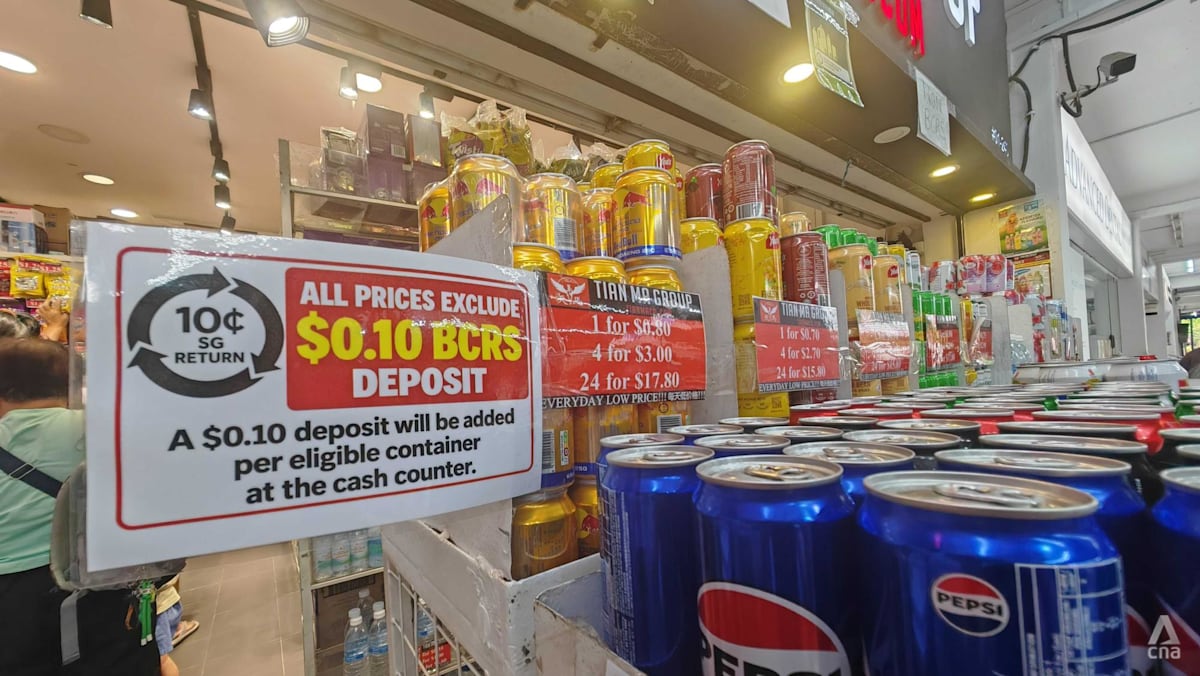
Despite offering steep discounts and having six months of lead time, some retailers say they have struggled to offload non-compliant products in time.
Tian Ma Group has placed signs at its retail stores to inform customers of the 10-cent deposit applying to drinks under the Beverage Container Return Scheme. (Photo: CNA/Koh Wan Ting)
This audio is generated by an AI tool.
SINGAPORE: As the Beverage Container Return Scheme (BCRS) enters full implementation on Thursday (Oct 1), retailers across Singapore raced against the clock to pull unmarked drinks from shelves and restock their inventory with compliant products .
While major supermarket chains made it in time to replace the non-compliant stock on their shelves, some smaller heartland operators and provision stores have found themselves needing more time to refresh their inventories with drinks that bear the BCRS mark.
This comes despite a six-month transition period and steep fire sales to clear older stock before Oct 1.
To get more breathing room, more than 2,000 merchants - mostly provision shops, neighbourhood convenience stores and standalone food stores — applied for a one-month grace period which the National Environment Agency (NEA) announced less than two weeks before the deadline.
CNA Games Guess Word Crack the word, one row at a time Buzzword Create words using the given letters Mini Sudoku Tiny puzzle, mighty brain teaser Mini Crossword Small grid, big challenge Word Search Spot as many words as you can Show More Show Less NEA on Tuesday said it had approved around 85 per cent of the more than 1,600 applications processed so far and is “expediting” the remaining ones. Under the nationwide scheme, suppliers and producers charge a 10-cent (US$0.78) deposit on eligible metal and plastic drink containers. Consumers pay the deposit at purchase and can reclaim it by returning empty containers to Return Right reverse vending machines. Eligible containers carry deposit marks to indicate that the additional deposit applies. During the transition period, both marked and unmarked containers have been available on shelves, causing some confusion among consumers. After the deadline has passed, regulated beverage products supplied in Singapore must carry the deposit mark, except for those sold by smaller retailers granted the one-month grace period. SCRAMBLING TO MEET DEADLINE A couple of days before Oct 1, CNA visited 18 retail stores and coffee shops and saw a mixture of marked and unmarked beverage containers still on shelves. Scarlett, a chain specialising in Chinese products, still had a large proportion of unmarked drinks at an outlet CNA visited on Wednesday – a day before the deadline. A staff member, who was applying deposit mark stickers to containers, said she would spend the rest of her shift doing so, before staff on the night shift continued the work. The outlet will remove from its shelves any drinks for which BCRS stickers had yet to arrive by Wednesday night. The employee, who declined to be named, said she had been applying stickers to products since last month but still had a few hundred more to go. Most new stock would come with the deposit mark already applied by suppliers, she said. The outlet had also run "buy one free one" promotions in a bid to clear unmarked beverages. Several outlets of Don Don Donki also had unmarked drink bottles and cans on Tuesday, though they were labelled as non-BCRS items and came with discounts ranging from about 30 per cent to more than 60 per cent. On Wednesday, staff at a Don Don Donki outlet in Northpoint City were spotted applying deposit mark stickers to beverages, as well as replacing product and price labels on the shelves to indicate that products were covered by the BCRS.
NEA on Tuesday said it had approved around 85 per cent of the more than 1,600 applications processed so far and is “expediting” the remaining ones.
Under the nationwide scheme, suppliers and producers charge a 10-cent (US$0.78) deposit on eligible metal and plastic drink containers. Consumers pay the deposit at purchase and can reclaim it by returning empty containers to Return Right reverse vending machines.
Eligible containers carry deposit marks to indicate that the additional deposit applies. During the transition period, both marked and unmarked containers have been available on shelves, causing some confusion among consumers.
After the deadline has passed, regulated beverage products supplied in Singapore must carry the deposit mark, except for those sold by smaller retailers granted the one-month grace period.
SCRAMBLING TO MEET DEADLINE
A couple of days before Oct 1, CNA visited 18 retail stores and coffee shops and saw a mixture of marked and unmarked beverage containers still on shelves.
Scarlett, a chain specialising in Chinese products, still had a large proportion of unmarked drinks at an outlet CNA visited on Wednesday – a day before the deadline.
A staff member, who was applying deposit mark stickers to containers, said she would spend the rest of her shift doing so, before staff on the night shift continued the work.
The outlet will remove from its shelves any drinks for which BCRS stickers had yet to arrive by Wednesday night.
The employee, who declined to be named, said she had been applying stickers to products since last month but still had a few hundred more to go.
Most new stock would come with the deposit mark already applied by suppliers, she said. The outlet had also run "buy one free one" promotions in a bid to clear unmarked beverages.
Several outlets of Don Don Donki also had unmarked drink bottles and cans on Tuesday, though they were labelled as non-BCRS items and came with discounts ranging from about 30 per cent to more than 60 per cent.
On Wednesday, staff at a Don Don Donki outlet in Northpoint City were spotted applying deposit mark stickers to beverages, as well as replacing product and price labels on the shelves to indicate that products were covered by the BCRS.
Bottled drinks without the BCRS mark being sold at discounted prices at Don Don Donki in Orchard Central on Sep 29, 2026. (Photo: CNA/Charmaine Jacob)
A few employees at a Don Don Donki outlet were seen applying deposit mark stickers to beverages on Sep 30, 2026, a day before the transition period ended. (Photo: CNA/Koh Wan Ting)
Similarly, a Little Farms outlet at Serangoon Gardens on Wednesday had more than 100 cans from international drink brands, such as Cove Soda and Olipop, that were unmarked. The supermarket chain has also applied for the one-month extension.
The store manager told CNA that the supermarket had received the BCRS stickers and planned to apply them on the unmarked drinks by the end of the day.
Staff members can finish labelling them in about an hour during non-peak periods and do not find the process particularly troublesome, she added.
Cans of Cove Soda and Olipop drinks before the BCRS stickers were pasted on them at Little Farms in Serangoon Gardens. (Photo: CNA/Charmaine Jacob)
A Sheng Siong spokesperson said the company recognised that any new system takes time for everyone to get used to.
"We appreciate our customers’ patience and feedback during this transition period. We are working closely with BCRS and our partners to improve the operations and customer experience at the collection points," the spokesperson said.
When asked about its old stock in the week before the deadline, FairPrice Group said it was "making good progress" in its preparations and was working closely with suppliers to transition to BCRS-compliant products and manage existing inventory.
Cold Storage and Giant, which belong under their parent company Macrovalue, said they had worked closely with suppliers to accelerate sell-through of products.
The supermarket operator said it was confident of complying with the Oct 1 deadline, adding that their stocks of unmarked drinks had been largely depleted.
"Our suppliers are now supplying only BCRS-eligible products within the regulated categories," a spokesperson said.
Beverage containers without the deposit mark are displayed alongside the same products bearing the mark at a Giant outlet (left) and at a FairPrice outlet (right) on Sep 30, 2026. (Photo: CNA/Koh Wan Ting)
MUCH-NEEDED GRACE PERIOD
For the businesses that needed more time to clear old stock or wait for deposit stickers to arrive, the extra month for the grace period offers a much-needed buffer and will help to avert business losses.
One retailer with thousands of unmarked drinks still in stock is Koryo Mart, or K-Market, a Korean products retailer with nine outlets across Singapore.
K-Market sells a range of drinks from Korea, including canned coffee and cinnamon punch, as well as bottled rice and vinegar drinks and teas. When CNA visited an outlet at Northpoint City on Wednesday — a day before the deadline, most of the drinks had yet to be labelled.
Assistant manager Samuel Lee said that K-Market had been granted the one-month extension.
The business has been running clearance promotions for beverages without the deposit mark since Sep 16.
As of Sunday, the company still held 6,159 units of products that it had decided to discontinue. Another 12,739 units were products that the retailer intended to continue selling, but their BCRS stickers had yet to arrive.
"In the meantime, we are continuing our clearance efforts and monitoring stock at each outlet,” Mr Lee said.
Meanwhile, minimart Tian Ma Group Holdings, which operates 20 retail outlets in the heartlands, was not granted the one-month grace period meant for smaller retailers, but had asked NEA for an extension of a few more days.
"The haze and rainy weather for the past week has affected the projections that we had to clear everything by Sep 30. Hence, we had to ask for extension for a couple of days," director Devang Bafna said, adding that sales had been impacted significantly.
Mr Bafna said that Tian Ma had been helping other smaller retailers clear their old stock and still had thousands of unmarked drinks still unsold as of Wednesday.
With no grace period for Tian Ma, Mr Bafna said the company was prepared to remove all its remaining unmarked drinks from its 20 outlets by the end of Wednesday.
To avoid running afoul of the BCRS rules, Tian Ma’s staff were instructed to continue selling the remaining stock until the stores closed at 10pm on Wednesday. The unsold stock of non-compliant products was packed into cartons, labelled as non-BCRS goods and returned to the company's warehouse.
Tian Ma Group separated its BCRS and non-BCRS stock. It offered discounts on non-BCRS drinks bought in bulk, as seen on Sep 30, 2026, a day before all regulated beverage containers are required to carry deposit marks. (Photo: CNA/Koh Wan Ting)
Mr Bafna said the operation involved about 60 employees — around three-quarters of the company's workforce, with many likely needing to work overtime.
Where possible, Tian Ma intends to register products under the scheme and apply the required stickers before putting them back on sale. Others could be exported to overseas buyers who have expressed interest.
The transition could also leave some products temporarily unavailable while they undergo registration and wait for BCRS stickers to be printed and applied. Mr Bafna said the process could take a few weeks for some products.
Responding to CNA’s queries, NEA said that apart from the grace period, it has put in place measures to help businesses manage the costs and operational adjustments associated with the transition.
These include extending the original transition period from three to six months and introducing a Producer Transition Grant of up to S$2,500 for eligible producers to offset costs such as product registration fees, producer fees and scheme stickers.
“Producers that are unable to print the required information directly on their beverage containers can use compliant scheme stickers, ordered directly from BCRS Ltd,” said NEA.
A customer buying a soft drink from Tian Ma Group's stock that does not have the deposit mark, on Sep 30, 2026. (Photo: CNA/Koh Wan Ting)
EATERIES AND COFFEE SHOPS
On Wednesday, CNA also saw how F&B outlets are complying with the BCRS deadline.
Most did not foresee an issue, given that they generally have a smaller inventory of older stocks relative to the larger retailers and supermarkets.
At Mr Teh Tarik’s four eating houses and more than 10 restaurants and cafes, all drinks sold were already BCRS-compliant, said business development manager Tommy Ng. The transition had been smooth, with new stock starting to arrive two months ago.
"We don't really stock up that much because we don't have that kind of facility or storage, so we try not to," said Mr Ng.
The outlets replenish their stock every week or so due to limited storage space, he said. They also carry relatively few pre-packaged beverages, with freshly brewed drinks proving more popular among customers.
Owner of Yuet Sing Seafood in Chinatown, Ms Sandy Ng, said the coffee shop only had bottled mineral water without the BCRS mark left in stock.
However, she was not worried about clearing them, citing a “friendly relationship” with her supplier who had agreed to take back the remaining bottles and replace them with BCRS-labelled ones at no extra cost.
The chiller display at one of the mini marts CNA visited that had beverage containers with and without the deposit mark displayed next to each other on Sep 30, 2026. (Photo: CNA/Charmaine Jacob)
At R.K. Eating House in Serangoon Gardens, manager Asangani, who goes by one name, said the coffee shop had completely cleared its old stock. All the drinks in its display chiller and storeroom already bore the BCRS mark.
He said the coffee shop carried only about seven types of canned drinks, as most customers opted for homemade drinks served in plastic cups, such as lime juice. As a result, clearing the old stock was not difficult.
When customers leave their cans behind, staff would also collect them and deposit them at a reverse vending machine, he said.
For GK Minimart in Kovan, manager Sundhar Pandiyean said the store still had about 100 cans of soft drinks without the BCRS mark, but had already applied for an extension to clear the stock.
He said the store was not worried about selling the remaining drinks as it sees a decent footfall, and had no plans to offer discounts for now.
Nevertheless, there were some, like Mr Poh Cher Tian, owner of Chinatown Coffeeshop on Temple Street, who said they had earlier purchased a large amount of unmarked stock to reap the economies of scale, but now have trouble trying to offload them.
Days before the deadline, Mr Poh still has at least 100 cartons of 24 non-BCRS canned drinks each. He estimated that about 80 per cent of his current stock was non-BCRS, while the remaining 20 per cent bore the BCRS mark.
“Even with the one-month extension, it’s still too short,” said Mr Poh, who had yet to apply for the extension but planned to do so.
Mr Poh said offering discounts had done little to help sell the drinks.
“This is a tourist area. Tourists don’t care about BCRS.”
Hundreds of canned drinks at Chinatown Coffeeshop that did not bear the BCRS mark on Sep 29, 2026. (Photo: CNA/Charmaine Jacob)
NAVIGATING THE NEW SYSTEM
With the need to comply with the BCRS requirements, drinks importers said it could be less sustainable to bring niche and specialty drinks into Singapore, as these are typically imported in lower volumes.
Ms Corinne Chia, co-founder of The Drinking Partners, which distributes craft beers and drinks, said the firm is relooking at how compliance hurdles impact its decision to import seasonal and limited-edition beverages.
"We are actively assessing the full impact of BCRS on our portfolio. Decisions on individual brands or (individual products) will follow once that assessment is complete."
For Drink Free Co, an online business that imports most of its alcohol-free products, its founder Dan Whitmore said he used to regularly test the reception of new products in the Singapore market before making them part of the company’s permanent offerings.
But doing so has become more challenging given the cost and administrative work involved in registering and labelling each new product, especially for smaller businesses.
Despite this, Mr Whitmore said he supported the intent of the scheme and described it as a good idea.
"It's very expensive to bring in a guest series to try to see if people like it or not with the cost of the stickers.
"It makes it more difficult to sell the product at a competitive price, and there is a delay from stock arriving to when you can sell it because you have to go through the registration process," added Mr Whitmore.
Registration requires the physical product to be in Singapore, he said.
"You have to label an empty can and take photos of it, showing the measurement dimensions of the sticker, and showing the can on top of the scale confirming its weight," he said, adding that the process could take more than a week currently.
Going forward, Mr Whitmore expects to cut back on trials of new products because of the additional administrative work involved.
Similarly, Tian Ma sells less commonly seen variants of popular drinks, including smaller bottles and products in special packaging from overseas markets.
Despite the added compliance costs, Mr Bafna said the company intends to continue importing these drinks and making them BCRS-compliant for now, while monitoring how consumers respond to them.
On the issue of importing drinks, NEA told CNA that the arrangements for registering international barcodes provide a pathway for parallel importers to continue supplying their products under the scheme.
In developing the scheme, NEA said it had considered potential competition concerns, including those affecting importers, and consulted the Competition and Consumer Commission of Singapore (CCS).
“Safeguards have been incorporated into the scheme’s governance and implementation arrangements to support fair participation by businesses of different sizes,” said the authority.
These include requiring representation of smaller producers on the scheme operator’s board so that their perspectives are represented, NEA said.
Get our pick of top stories and thought-provoking articles in your inbox
Stay updated with notifications for breaking news and our best stories
Join our channel for the top reads for the day on your preferred chat app
尽管提供了大幅折扣并提前六个月备货,但一些零售商表示,他们仍然难以及时处理不合规产品。
天马集团已在其零售门店张贴告示,告知顾客根据饮料容器回收计划,购买饮料需缴纳10分钱押金。(图片:CNA/许婉婷)
这段音频由人工智能工具生成。
新加坡:随着饮料容器回收计划(BCRS)于周四(10月1日)全面实施,新加坡各地的零售商争分夺秒地将未贴标签的饮料从货架上撤下,并用符合规定的产品重新补充库存。
虽然大型连锁超市及时更换了货架上不合规的商品,但一些规模较小的乡村地区经营者和杂货店却发现,他们需要更多时间来更新库存,以补充带有 BCRS 标志的饮料。
尽管有六个月的过渡期,并且在 10 月 1 日之前会进行大幅度的清仓甩卖来清理旧库存,但这种情况仍然发生了。
为了争取更多喘息之机,超过 2000 家商户(主要是杂货店、社区便利店和独立食品店)申请了一个月的宽限期,国家环境局 (NEA) 在截止日期前不到两周宣布了这一消息。
CNA游戏 猜词游戏 逐行破解单词 流行词游戏 用给定的字母组成单词 迷你数独 小谜题,脑力挑战 迷你填字游戏 小方格,大挑战 单词搜索 尽可能多地找出单词 显示更多 显示更少 新加坡国家环境局(NEA)周二表示,已批准目前处理的1600多份申请中的约85%,并正在“加快”剩余申请的处理。根据这项全国性计划,供应商和生产商需对符合条件的金属和塑料饮料容器收取10分(0.78美元)的押金。消费者在购买时支付押金,并可通过将空容器退回Return Right自动回收机来取回押金。符合条件的容器带有押金标记,表明需缴纳额外押金。在过渡期内,货架上既有带标记的容器也有不带标记的容器,这给消费者造成了一些困惑。截止日期过后,在新加坡供应的受监管饮料产品必须带有押金标记,但小型零售商销售的产品除外,这些小型零售商可获得一个月的宽限期。为赶在截止日期前完成贴标,CNA在10月1日前几天走访了18家零售店和咖啡店,发现货架上仍然摆放着贴有标签和未贴标签的饮料容器。专营中国商品的连锁店Scarlett在CNA周三(截止日期前一天)走访的一家分店,发现大量饮料仍未贴标签。一位正在给饮料容器贴押金标签的员工表示,她将在当天剩余时间里完成这项工作,之后由夜班员工接手。该店将于周三晚间之前下架所有尚未贴上押金标签的饮料。这位不愿透露姓名的员工表示,她从上个月就开始给商品贴标签,但仍有几百个待贴。她说,大部分新进的商品供应商都会已经贴好押金标签。该店还推出了“买一送一”的促销活动,以清理未贴标签的饮料。周二,唐吉诃德(Don Don Donki)的几家门店也出现了未贴标签的瓶装和罐装饮料,尽管这些饮料被标明为非BCRS商品,并打折,折扣幅度从30%到60%以上不等。周三,有人看到北角城(Northpoint City)一家唐吉诃德门店的员工在饮料上贴上了押金标签,并更换了货架上的商品和价格标签,以表明这些商品属于BCRS的覆盖范围。
新加坡国家环境局周二表示,已批准目前处理的 1600 多份申请中的约 85%,并正在“加快”处理剩余的申请。
根据这项全国性计划,供应商和生产商对符合条件的金属和塑料饮料容器收取10美分(约合0.78美元)的押金。消费者在购买时支付押金,之后可以通过将空容器退回Return Right回收机来取回押金。
符合条件的容器带有押金标记,表明需缴纳额外押金。过渡期间,货架上既有带标记的容器,也有不带标记的容器,这给消费者造成了一些困惑。
截止日期过后,在新加坡供应的受监管饮料产品必须带有押金标记,但获准一个月宽限期的小型零售商销售的产品除外。
争分夺秒赶工
10 月 1 日前几天,CNA 走访了 18 家零售店和咖啡店,发现货架上仍然摆放着各种贴有标签和未贴标签的饮料容器。
专营中国商品的连锁店 Scarlett 在 CNA 周三(截止日期前一天)走访的一家分店中,仍有大量未贴标签的饮料。
一名正在给容器贴押金标记贴纸的工作人员表示,她将在剩余的班次时间里完成这项工作,之后夜班工作人员将继续这项工作。
该商店将从货架上移除所有在周三晚上之前尚未贴上 BCRS 标签的饮料。
这位不愿透露姓名的员工表示,她从上个月就开始给产品贴标签,但还有几百个标签没贴完。
她表示,大部分新进的商品都已由供应商贴上了押金标签。该店还曾推出“买一送一”的促销活动,以清理未贴标签的饮料。
周二,唐吉诃德的几家门店也出售未贴标签的瓶装和罐装饮料,尽管它们被标记为非BCRS商品,并有大约30%到60%以上的折扣。
周三,有人发现北角城一家唐吉诃德门店的员工在饮料上贴上了押金标记贴纸,并更换了货架上的产品和价格标签,以表明这些产品已纳入BCRS的保障范围。
2026年9月29日,乌节中央城唐吉诃德(Don Don Donki)门店出售未贴有BCRS标志的瓶装饮料,价格优惠。(图片:CNA/Charmaine Jacob)
2026年9月30日,过渡期结束前一天,有人看到唐吉诃德(Don Don Donki)一家门店的几名员工在饮料上贴押金标签。(图片:CNA/Koh Wan Ting)
同样,周三在实龙岗花园的一家Little Farms超市也发现了100多罐未贴标签的国际饮料品牌,例如Cove Soda和Olipop。该超市连锁店也已申请将禁令延长一个月。
商店经理告诉 CNA,超市已经收到了 BCRS 贴纸,并计划在当天结束前将它们贴到没有标签的饮料上。
她补充说,在非高峰时段,工作人员大约一个小时就能完成贴标签的工作,而且他们并不觉得这个过程特别麻烦。
在实龙岗花园的小农场,Cove Soda 和 Olipop 饮料罐上尚未贴上 BCRS 贴纸。(图片:CNA/Charmaine Jacob)
昇菘超市发言人表示,公司意识到任何新系统都需要时间让大家适应。
发言人表示:“我们感谢客户在此过渡期间的耐心和反馈。我们正与BCRS及合作伙伴紧密合作,以改善收款点的运营和客户体验。”
在截止日期前一周被问及旧库存情况时,职总平价集团表示,其准备工作“进展顺利”,并正与供应商密切合作,过渡到符合 BCRS 标准的产品,并管理现有库存。
隶属于母公司 Macrovalue 的 Cold Storage 和 Giant 表示,他们已与供应商密切合作,加快产品销售。
该超市运营商表示,他们有信心遵守 10 月 1 日的最后期限,并补充说,他们未贴标签的饮料库存已基本售罄。
一位发言人表示:“我们的供应商现在只供应符合BCRS认证标准的受监管类别的产品。”
2026年9月30日,在Giant超市(左)和FairPrice超市(右)中,未贴押金标签的饮料容器与贴有押金标签的同类产品并排展示。(图片:CNA/Koh Wan Ting)
急需的宽限期
对于那些需要更多时间来清理旧库存或等待押金标签到货的企业来说,额外一个月的宽限期提供了急需的缓冲,并将有助于避免业务损失。
韩国商品零售商高丽超市(Koryo Mart,又称 K-Market)在新加坡拥有九家分店,目前仍有数千瓶未贴标签的饮料库存。
K-Market出售一系列韩国饮品,包括罐装咖啡、肉桂饮料、瓶装米醋饮和茶饮。亚洲新闻台(CNA)记者周三(截止日期前一天)走访了位于北角城(Northpoint City)的一家K-Market门店,发现大部分饮品尚未贴标签。
助理经理 Samuel Lee 表示,K-Market 已获准延期一个月。
该企业自 9 月 16 日起开始对不含押金的饮料进行清仓促销。
截至周日,该公司仍有6159件已决定停售的产品库存。另有12739件产品是该零售商计划继续销售的产品,但其BCRS标签尚未到货。
李先生表示:“与此同时,我们正在继续进行清仓工作,并监控每个门店的库存情况。”
与此同时,在居民区经营 20 家零售店的迷你超市天马集团控股有限公司,没有获得为小型零售商提供的一个月宽限期,而是向国家环境局申请再延长几天。
“过去一周的雾霾和降雨天气影响了我们原定于9月30日前完成所有清理工作的计划。因此,我们不得不申请延期几天,”董事Devang Bafna说道,并补充说销售额受到了严重影响。
巴夫纳先生表示,天马一直在帮助其他小型零售商清理旧库存,截至周三,仍有数千瓶未贴标签的饮料尚未售出。
由于没有给天马任何宽限期,巴夫纳先生表示,该公司准备在周三结束前,从其 20 家门店撤下所有剩余的未贴标签的饮料。
为避免违反BCRS规定,天马超市员工被指示继续销售剩余库存,直至周三晚上10点门店关门。未售出的不合规产品被装入纸箱,贴上“非BCRS商品”标签,并退回公司仓库。
天马集团将受监管饮料容器(BCRS)和非受监管饮料容器(非BCRS)的库存分开。如图所示,在2026年9月30日,也就是所有受监管饮料容器必须加贴押金标记的前一天,天马集团对批量购买的非BCRS饮料提供折扣。(图片:CNA/许婉婷)
巴夫纳先生表示,此次行动涉及约 60 名员工——约占公司员工总数的四分之三,其中许多人可能需要加班。
天马计划尽可能地将产品注册到该计划下,并贴上所需的标签后再重新上架销售。其余产品则可能出口给已表示感兴趣的海外买家。
过渡期间,部分产品可能需要等待注册、印制和粘贴BCRS标签,在此期间可能会暂时无法销售。巴夫纳先生表示,部分产品的注册流程可能需要几周时间。
针对亚洲新闻台的询问,国家环境局表示,除了宽限期外,还制定了相关措施,帮助企业应对过渡期间产生的成本和运营调整。
这些措施包括将原有的过渡期从三个月延长至六个月,并为符合条件的生产者提供最高 2500 新元的生产者过渡补助金,以抵消产品注册费、生产者费用和计划贴纸等成本。
新加坡国家环境局表示:“无法直接在饮料容器上印刷所需信息的生产商可以使用符合规定的贴纸,这些贴纸可以直接从BCRS有限公司订购。”
2026年9月30日,一名顾客从天马集团的库存中购买了一瓶没有押金标记的软饮料。(图片:CNA/许婉婷)
餐馆和咖啡馆
周三,CNA 还了解了餐饮场所如何遵守 BCRS 的最后期限。
大多数人并未预见到会出现问题,因为与大型零售商和超市相比,他们的旧库存通常较少。
Teh Tarik先生旗下的四家餐馆和十多家餐厅及咖啡馆,所有售卖的饮品均已符合BCRS标准,业务发展经理Tommy Ng表示。过渡过程十分顺利,新库存已于两个月前开始到货。
“我们其实不会囤积那么多东西,因为我们没有那种设施或存储空间,所以我们尽量不囤积,”吴先生说。
他表示,由于存储空间有限,这些门店大约每周都会补货一次。此外,他们销售的预包装饮料也相对较少,鲜泡饮料更受顾客欢迎。
牛车水悦星海鲜店的老板吴珊迪女士表示,该咖啡店目前只剩下没有BCRS标志的瓶装矿泉水了。
不过,她并不担心清理这些瓶子,因为她与供应商关系“友好”,供应商同意收回剩余的瓶子,并免费更换为贴有 BCRS 标签的瓶子。
2026年9月30日,CNA记者走访了一家便利店,在冷藏柜中,带有押金标记和没有押金标记的饮料容器并排陈列。(图片:CNA/Charmaine Jacob)
位于实龙岗花园的RK Eating House咖啡店经理阿桑加尼(Asangani,他只有这一个名字)表示,该咖啡店已彻底清空了旧库存。冷藏柜和储藏室里的所有饮品都已贴上了BCRS标志。
他说,咖啡店只供应大约七种罐装饮料,因为大多数顾客都喜欢用塑料杯盛装的自制饮料,比如青柠汁。因此,清理旧库存并不困难。
他说,如果顾客把易拉罐留在店里,工作人员也会收集起来,并将它们存入自动回收机。
位于高文的 GK Minimart 的经理 Sundhar Pandiyean 表示,该店还有大约 100 罐没有 BCRS 标志的软饮料,但已经申请延期清理库存。
他说,由于客流量不错,商店并不担心剩余饮料的销售,目前也没有提供折扣的计划。
不过,也有一些人,比如唐人街茶室店(位于庙街)的老板 Poh Cher Tian 先生,表示他们之前购买了大量未贴标签的商品,以期获得规模经济效益,但现在却很难将它们卖出去。
距离截止日期还有几天,Poh先生仍然至少有100箱,每箱24罐,没有BCRS认证标志的饮料。他估计,他目前的库存中约有80%没有BCRS认证标志,而剩下的20%则带有BCRS认证标志。
“即使延期一个月,时间还是太短了,” Poh 先生说,他还没有申请延期,但计划申请。
Poh先生表示,提供折扣对促进饮料销售几乎没有任何作用。
“这里是旅游区。游客不会关心BCRS。”
2026年9月29日,唐人街咖啡店数百罐饮料未贴有BCRS标志。(图片:CNA/Charmaine Jacob)
熟悉新系统
由于需要遵守 BCRS 的要求,饮料进口商表示,将小众和特色饮料引入新加坡可能不太可持续,因为这些饮料的进口量通常较低。
精酿啤酒和饮料分销商 The Drinking Partners 的联合创始人 Corinne Chia 女士表示,该公司正在重新审视合规障碍如何影响其进口季节性和限量版饮料的决定。
“我们正在积极评估BCRS对我们产品组合的全面影响。关于具体品牌或产品的决定将在评估完成后做出。”
Drink Free Co 是一家在线企业,其大部分无酒精产品都是进口的。创始人 Dan Whitmore 表示,他过去常常在新加坡市场测试新产品的接受度,然后再将其纳入公司的永久产品系列。
但考虑到注册和贴标每种新产品所涉及的成本和行政工作,这样做变得越来越具有挑战性,尤其是对于小型企业而言。
尽管如此,惠特莫尔先生表示他支持该计划的初衷,并称其为一个好主意。
“引进一系列嘉宾来试水,看看人们是否喜欢,成本非常高,还要加上贴纸的费用。”
惠特莫尔先生补充道:“这使得以有竞争力的价格销售产品变得更加困难,而且从库存到可以销售之间会有延迟,因为你必须完成注册流程。”
他说,注册时实物产品必须位于新加坡。
他说:“你必须给一个空罐贴上标签,然后拍照,显示标签的尺寸,并把罐子放在秤上确认重量。”他还补充说,目前这个过程可能需要一周多的时间。
展望未来,惠特莫尔先生预计会减少新产品的试验,因为试验会涉及额外的行政工作。
同样,天妈也出售一些不太常见的流行饮料,包括小瓶装和来自海外市场的特殊包装产品。
尽管合规成本有所增加,但巴夫纳先生表示,公司目前打算继续进口这些饮料并使其符合 BCRS 标准,同时密切关注消费者的反应。
关于饮料进口问题,国家环境局告诉亚洲新闻台,注册国际条形码的安排为平行进口商提供了一条途径,使其能够继续根据该计划供应产品。
新加坡国家环境局表示,在制定该方案时,已考虑了潜在的竞争问题,包括影响进口商的问题,并咨询了新加坡竞争与消费者委员会(CCS)。
该机构表示:“该计划的治理和实施安排中已纳入保障措施,以支持不同规模的企业公平参与。”
国家环境局表示,这些措施包括要求小型生产商在方案运营商董事会中拥有代表席位,以便他们的意见能够得到体现。
订阅我们的邮件,即可获取精选热点新闻和引人深思的文章。
订阅通知,第一时间获取突发新闻和精彩报道。
加入我们的频道,即可在您常用的聊天应用上获取当日热门文章。