No nitrites added? Why some processed meats in Singapore contain them despite the claim未添加亚硝酸盐?为什么新加坡的一些加工肉类明明声称未添加亚硝酸盐,却仍然含有亚硝酸盐?
Bacon, ham and sausages may be marketed as “nitrite-free” or “no nitrite added”, but the labels can get complicated. Talking Point tests nine of these products and gets dietary advice.
新闻视频
Bacon, ham and sausages may be marketed as “nitrite-free” or “no nitrite added”, but the labels can get complicated. Talking Point tests nine of these products and gets dietary advice.
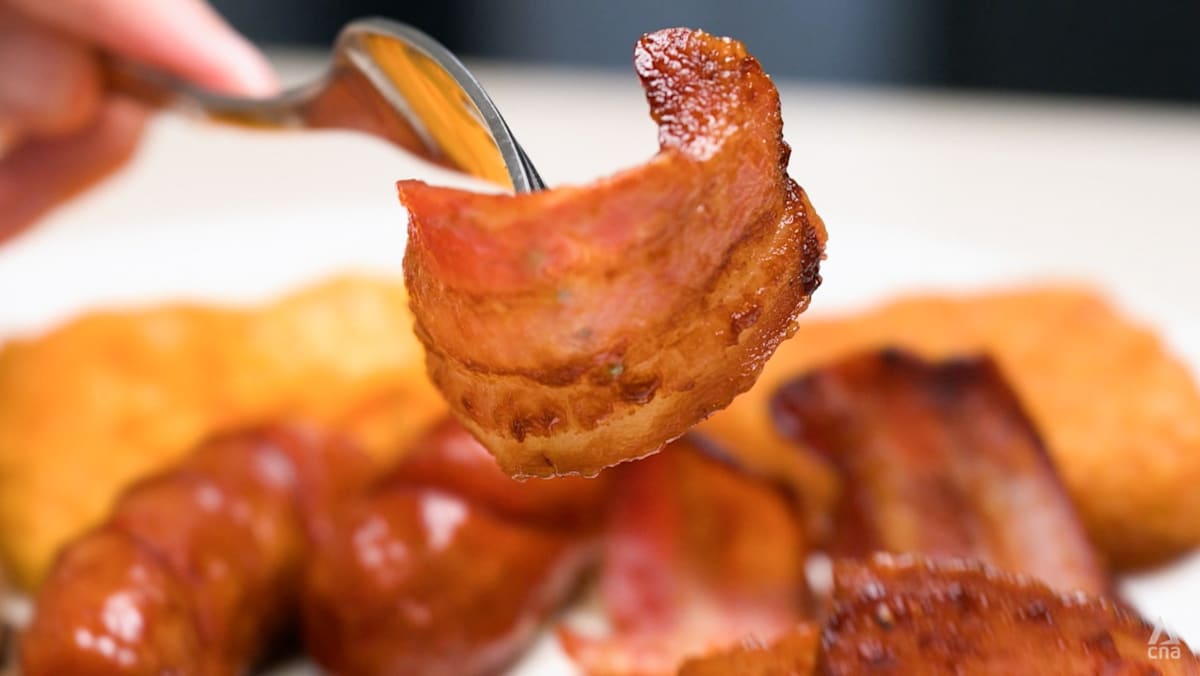
Bacon fared the best in the lab test measuring nitrite levels in clean-label processed meats.
This audio is generated by an AI tool.
SINGAPORE: Consumption of processed meat has been a long-standing public health concern. In 2015, the World Health Organization’s cancer agency found that eating 50g of processed meat daily increased the risk of colorectal cancer by 18 per cent.
Then in January, researchers in France published their findings that higher exposure to some common food preservatives, including sodium nitrite, was associated with a greater risk of Type 2 diabetes.
In Singapore, the prevalence of diabetes is already high, according to the latest National Population Health Survey.
Against that backdrop, some processed meats are being marketed as nitrite-free alternatives. But the label “nitrite-free” or “no nitrites added” may not tell the whole story.
CNA Games Guess Word Crack the word, one row at a time Buzzword Create words using the given letters Mini Sudoku Tiny puzzle, mighty brain teaser Mini Crossword Small grid, big challenge Word Search Spot as many words as you can Show More Show Less
An example of the claims made on retail packaging.
When CNA’s Talking Point got nine “clean label” products tested — three samples of ham, bacon and sausage each — nitrite was detected in two hams and one sausage.
One of the hams even contained more nitrite than a regular ham that was tested for comparison. The same was true of a pork wiener labelled as “no nitrite added”.
What do these claims really mean? Why is nitrite used in processed meat in the first place? And how can nitrates or nitrites turn up in products that are not supposed to have any added, Talking Point asks.
THE ROLE OF NITRITES
One of the additives used to preserve meats is sodium nitrate, a white compound resembling salt that will be converted into sodium nitrite by bacteria, which is naturally present in meat.
A glass of sodium nitrate.
Sodium nitrite, also known as E250, is the active compound that inhibits the growth of Clostridium botulinum, a bacterium that produces a toxin that can lead to serious illness and even death.
The compound also gives cured meat its pink hue and keeps the colour stable for “several weeks to months”, said National University of Singapore lecturer and food chemist Yeo Hui Qi. Without nitrites, meat oxidises over time and gradually turns greyish or brown.
Sodium nitrite also gives meat a saltier taste, “which consumers crave in their foods”, she noted.
The thing is, nitrites can react with amino acids naturally present in meat to form nitrosamines, the “vast majority” of which are cancer-causing, she highlighted.
These compounds form more quickly at higher temperatures, such as during grilling and frying. “They also form during digestion under acidic conditions,” she added.
Talking Point host Steven Chia with Dr Yeo Hui Qi, a lecturer in the National University of Singapore’s food science and technology department.
If nitrite helps to flavour processed meat, however, one question is whether consumers will taste a difference when it comes to the alternatives that are nitrite-free or have no added nitrites as claimed on their labels?
To find out, Talking Point served members of the public the two versions of ham, bacon and sausages without telling them what the difference was.
The taste test showed near equal results: 54 people preferred the regular meats, and 52 chose the clean-label alternatives.
WHAT THE LABELS ARE SUPPOSED TO MEAN
Given the taste test results, what is really in the clean-label processed meats?
The nine pork and chicken products Talking Point sent to a laboratory for testing all contained varying levels of nitrate, although the tests could not really ascertain whether it was naturally occurring or not.
Raw meat can contain a trace amount of nitrate, which is present in water or plant-based feed that livestock consume and is also part of the animal’s metabolic processes.
Nanyang Polytechnic senior specialist Henry Leung cited a 2012 study that found natural nitrate present in some fresh pork samples (10 to 15 mg/kg) but no detectable residues in chicken. As for nitrite, the study did not detect any residues.
In the lab tests done for Talking Point, the clean-label alternatives generally contained less nitrite than the regular processed meats that were also tested, except for one of the hams and the pork wiener.
Jill’s Sausages, whose sausage it was, offered an explanation. Its sausages are flavoured with herbs and spices, including cumin, paprika, pepper and garlic powder, said founder Nicholas Lee.
Chia with Jill’s Sausages founder Nicholas Lee, 42.
So some of the naturally occurring nitrates in plants could have been converted into nitrites after the ingredients were ground and mixed into the meat.
“When I first got the email from you guys, it was quite a shock for me because I built this brand entirely on the premise that we don’t use any synthetic nitrates or nitrites,” Lee told programme host Steven Chia.
To preserve its products, the company uses dried vinegar and polyphenols (plant-based compounds), together with vacuum sealing and refrigeration. Shelf-life tests show that its chilled products can last up to 60 days, he added.
So, what does “no added nitrite” mean on a label? Chew Chon Mun, who teaches food legislation at Singapore Polytechnic, said it means nitrites are not intentionally added during the manufacturing process.
Chia going through various food labels with Chew Chon Mun, the chair of Singapore Polytechnic’s advanced diploma course in applied food science.
It does not necessarily mean the product is devoid of nitrites, as naturally occurring nitrates in ingredients can convert into nitrites during processing or storage.
“Nitrite-free”, meanwhile, refers to the final product and suggests that it contains no detectable nitrites or only a negligible amount.
“(The claims) sound quite similar, but consumers may actually perceive them quite differently,” Chew said, adding that labels should make clear the use of any ingredients with naturally occurring nitrates, such as celery powder.
The Singapore Food Agency also told Talking Point manufacturers need not declare nitrates or nitrites if they were not intentionally added as additives, although food labels must not be false or misleading.
HOW MUCH IS CONSIDERED SAFE?
Across the products tested, including regular processed meats, none exceeded Singapore’s legal limit for sodium nitrite: 125 mg/kg. The highest level recorded in Talking Point’s tests was 41.6 mg/kg.
How much nitrite, however, is considered safe to consume each day? The Joint Food and Agriculture Organization/World Health Organization Expert Committee on Food Additives puts the acceptable daily intake at 0 to 0.07 mg/kg of body weight.
This is the amount a person can consume daily over a lifetime without any toxic effects.
Chia wanted to know how much processed meat he could safely consume in a day.
For Chia, who weighs about 80 kg, that works out at 5.6 mg a day. Novi Health senior dietitian and health coach Diane Seto applied this to one of the ham samples, whose nitrite content was 22.02 mg/kg.
A typical 50g serving, or two to three slices, contained around 1.1 mg, which was almost a fifth of Chia’s acceptable daily intake.
The daily figure is not a target consumers should aim for, she stressed. “This is the safety limit. In fact, the less the better.”
Nitrite is also only one consideration when it comes to managing one’s intake of processed meats. Other compounds present can contribute to health risks, she said, which is why she recommends eating even the lower-nitrite products sparingly.
She said: “It’s about trying to reduce our intake as much as possible and not have it regularly in the diet.”
Watch this episode of Talking Point here . The programme airs on Channel 5 on Thursdays at 9.30pm.
CNA's best current affairs documentaries with a deeper look at issues affecting Asia, sent to your inbox weekly.
Get our pick of top stories and thought-provoking articles in your inbox
Stay updated with notifications for breaking news and our best stories
Join our channel for the top reads for the day on your preferred chat app
培根、火腿和香肠可能会标榜“不含亚硝酸盐”或“未添加亚硝酸盐”,但标签信息可能非常复杂。《谈话要点》栏目测试了其中九种产品,并提供了膳食建议。
在实验室对清洁标签加工肉类进行亚硝酸盐含量测试时,培根表现最佳。
这段音频由人工智能工具生成。
新加坡:食用加工肉类一直是长期存在的公共卫生问题。2015年,世界卫生组织癌症机构发现,每天食用50克加工肉类会使患结直肠癌的风险增加18%。
随后在 1 月份,法国的研究人员发表了他们的研究结果,指出接触一些常见的食品防腐剂(包括亚硝酸钠)越多,患 2 型糖尿病的风险就越高。
根据最新的全国人口健康调查,新加坡的糖尿病患病率已经很高。
在此背景下,一些加工肉类产品被宣传为不含亚硝酸盐的替代品。但“不含亚硝酸盐”或“未添加亚硝酸盐”的标签可能并不能说明全部情况。
CNA游戏 猜词游戏 逐行破解单词 流行词游戏 用给定的字母组成单词 迷你数独 小小谜题,挑战你的大脑 迷你填字游戏 小方格,大挑战 单词搜索 尽可能多地找出单词 显示更多 显示更少
零售包装上所作声明的一个例子。
CNA 的《谈话要点》栏目对九种“清洁标签”产品进行了测试——火腿、培根和香肠各三个样品——结果在两种火腿和一种香肠中检测到了亚硝酸盐。
其中一块火腿的亚硝酸盐含量甚至比作为对比的普通火腿还要高。标有“未添加亚硝酸盐”的猪肉香肠也存在同样的问题。
这些说法究竟意味着什么?为什么加工肉类中要添加亚硝酸盐?“谈话要点”栏目提出疑问:为什么不应该添加硝酸盐或亚硝酸盐的产品中会出现这些物质?
亚硝酸盐的作用
用于保存肉类的添加剂之一是硝酸钠,这是一种类似盐的白色化合物,会被细菌转化为亚硝酸钠,而亚硝酸钠天然存在于肉类中。
一杯硝酸钠溶液。
亚硝酸钠,又称 E250,是抑制肉毒梭菌生长的活性化合物。肉毒梭菌是一种会产生毒素的细菌,这种毒素会导致严重的疾病甚至死亡。
新加坡国立大学讲师兼食品化学家杨慧琪表示,这种化合物还能赋予腌肉粉红色泽,并使其颜色保持稳定“数周至数月”。如果没有亚硝酸盐,肉类会随着时间推移氧化,逐渐变成灰褐色。
她指出,亚硝酸钠还能使肉类更有咸味,“这是消费者所渴望的食物味道”。
她强调,问题在于亚硝酸盐可以与肉类中天然存在的氨基酸发生反应,形成亚硝胺,而其中“绝大多数”都是致癌物。
这些化合物在较高温度下会更快形成,例如在烧烤和油炸过程中。“它们也会在酸性条件下消化过程中形成,”她补充道。
《谈话要点》节目主持人 Steven Chia 与新加坡国立大学食品科学与技术系讲师 Yeo Hui Qi 博士进行了对话。
然而,如果亚硝酸盐有助于给加工肉类增添风味,那么一个问题是,消费者在品尝不含亚硝酸盐或标签上声称未添加亚硝酸盐的替代品时,是否能尝出区别?
为了找出答案,《谈话要点》节目组向公众提供了两种不同版本的火腿、培根和香肠,但没有告诉他们有什么区别。
口味测试结果显示,两种肉类产品几乎势均力敌:54 人更喜欢普通肉类,52 人选择了清洁标签替代品。
标签的含义
根据口味测试结果,标榜“清洁标签”的加工肉类产品中究竟含有哪些成分?
Talking Point 送检的九种猪肉和鸡肉产品均含有不同程度的硝酸盐,但测试无法真正确定它是天然存在的还是人为添加的。
生肉可能含有微量的硝酸盐,这种物质存在于牲畜饮用的水或植物性饲料中,也是动物代谢过程的一部分。
南洋理工学院高级专家梁先生引用了2012年的一项研究,该研究发现一些新鲜猪肉样本中含有天然硝酸盐(10至15毫克/千克),但鸡肉中未检测到残留。至于亚硝酸盐,该研究也未检测到任何残留。
在 Talking Point 进行的实验室测试中,清洁标签替代品通常比同时测试的普通加工肉类含有更少的亚硝酸盐,但其中一种火腿和猪肉香肠除外。
涉事香肠的生产商吉尔香肠公司对此作出了解释。创始人尼古拉斯·李表示,他们的香肠是用香草和香料调味的,包括孜然、辣椒粉、胡椒粉和大蒜粉。
Chia with Jill's Sausages 的创始人 Nicholas Lee,42 岁。
因此,植物中一些天然存在的硝酸盐可能在食材被研磨并与肉类混合后转化为亚硝酸盐。
“当我第一次收到你们的邮件时,我感到非常震惊,因为我创立这个品牌的初衷就是不使用任何合成硝酸盐或亚硝酸盐,”李告诉节目主持人史蒂文·谢。
为了保存产品,该公司采用干醋和多酚(植物化合物),并结合真空密封和冷藏技术。他补充说,保质期测试表明,其冷藏产品可保存长达60天。
那么,标签上的“不添加亚硝酸盐”是什么意思呢?新加坡理工学院食品法规教授周俊文表示,这意味着在生产过程中没有故意添加亚硝酸盐。
Chia 与新加坡理工学院应用食品科学高级文凭课程主任 Chew Chon Mun 一起查看各种食品标签。
但这并不一定意味着产品不含亚硝酸盐,因为原料中天然存在的硝酸盐在加工或储存过程中会转化为亚硝酸盐。
“不含亚硝酸盐”指的是最终产品,表示该产品不含可检测的亚硝酸盐或仅含有微量亚硝酸盐。
“(这些说法)听起来很相似,但消费者的实际感受可能截然不同,”周先生说,并补充说,标签应该明确标明使用了任何含有天然硝酸盐的成分,例如芹菜粉。
新加坡食品局也告诉《谈话要点》栏目,如果硝酸盐或亚硝酸盐并非有意添加作为添加剂,则生产商无需申报,但食品标签不得虚假或误导。
多少才算安全?
在所有受测产品中,包括普通加工肉类,没有一款产品的亚硝酸钠含量超过新加坡的法定限值:125毫克/千克。Talking Point 的测试中记录到的最高含量为41.6毫克/千克。
然而,每天摄入多少亚硝酸盐才算安全呢?联合国粮食及农业组织/世界卫生组织食品添加剂联合专家委员会建议,每日可接受摄入量为每公斤体重0至0.07毫克。
这是一个人一生中每天可以摄入而不会产生任何毒性作用的量。
Chia想知道他一天可以安全食用多少加工肉类。
对于体重约80公斤的Chia来说,这意味着每天摄入5.6毫克亚硝酸盐。Novi Health的高级营养师兼健康教练Diane Seto将这一比例应用于其中一份火腿样本,该样本的亚硝酸盐含量为22.02毫克/公斤。
一份典型的 50 克奇亚籽(两到三片)含有约 1.1 毫克钙,这几乎是奇亚籽每日可接受摄入量的五分之一。
她强调,每日摄入量并非消费者应该追求的目标。“这只是安全限度。事实上,越少越好。”
她还指出,在控制加工肉类摄入量时,亚硝酸盐只是需要考虑的因素之一。其他化合物也可能带来健康风险,因此她建议即使是低亚硝酸盐含量的产品也要适量食用。
她说:“关键是要尽可能减少摄入量,不要经常在饮食中食用。”
点击此处观看本期《谈话要点》节目。该节目每周四晚9点30分在第五频道播出。
每周将 CNA 精选的、深入探讨影响亚洲问题的时事纪录片发送到您的邮箱。
订阅我们的邮件,即可获取精选热点新闻和引人深思的文章。
订阅通知,第一时间获取突发新闻和精彩报道。
加入我们的频道,即可在您常用的聊天应用上获取当日热门文章。