Ex-defense minister’s futuristic ‘Army of Robots’ raises eyebrows in Ukraine乌克兰前国防部长的未来主义“机器人军队”计划引发关注
A splashy promo video published by Mykhailo Fedorov envisions humanoid robots in combat, but not everyone is convinced it's the right play.
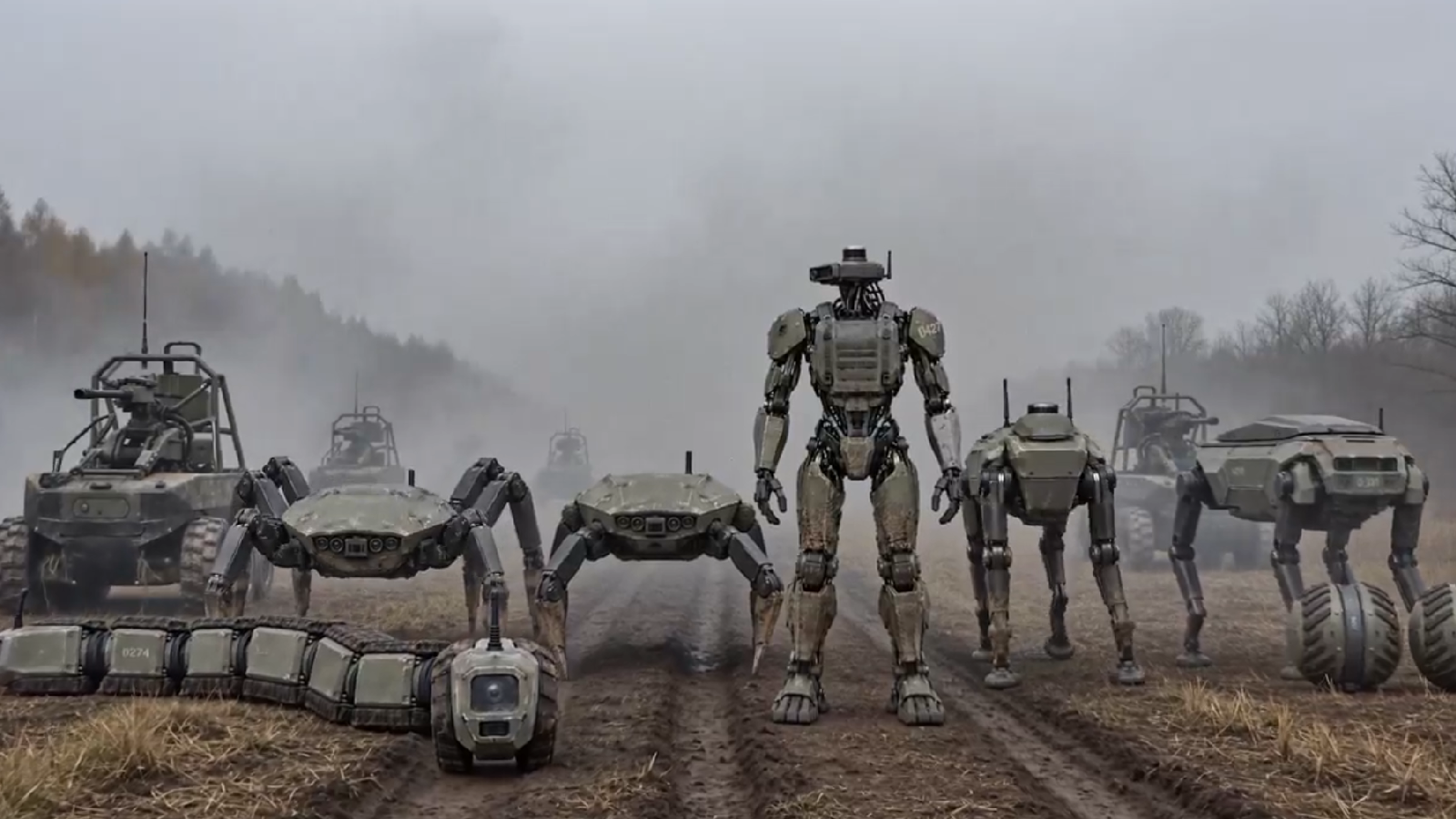
A screengrab from a video published by former Ukrainian Defense Minister Mykhailo Fedorov featuring an envisioned "Army of Robots". (Screengrab)
LVIV, Ukraine — Ukraine’s former Minister of Defense Mykhailo Fedorov has launched a new project to build a robotic army, including humanoid soldiers, intended to largely replace soldiers on the battlefield.
He contends the initiative will “save lives,” but it has also sparked mixed reactions at the IT Arena conference here and beyond.
During the conference, which took place here from Sept. 25-27, Fedorov, who was controversially dismissed in July by Ukraine’s President Volodymyr Zelenskyy, unveiled an envisioned “Army of Robots” with a sleek, CGI video showing humanoid robots aiming rifles, fighting in trenches, and marching in a massive formation.
“In 2022, we launched the Army of Drones. […] Today, drones account for more than 95% of strikes,” Fedorov said in a social media post on Sept. 26. “But technological warfare does not stand still. We need the next breakthrough. Our bet is on the robotization of warfare. The mission of the Army of Robots is to save lives.”
During his conference speech, he explained that the future battlefield he envisions would be one where sensors detect threats first, followed by the deployment of robots, based on the belief that robotic platforms “should fight instead of people.”
Fedorov announced in August that he was launching his own defense company, with few details about what it would entail, except that its first major investor would be Palantir CEO Alex Karp.
In his speech here, Fedorov did not say what role his company would play, but emphasized that his vision would not be supported by one single company anyway. Rather, he saw an “ecosystem” that will involve investments in defense companies, R&D capabilities, testing alongside the military and scaling of effective systems.
Localizing tactical communications for sovereign, NATO-ready C3I
Beyond foreign sales, Rafael’s model enables tech transfer, local engineering, and is a template for NATO partners.
Fedorov also outlined an ambitious goal: achieving the first “confirmed battlefield result using a humanoid robot” within six months — in other words, the first enemy kill carried out by a two-footed robot during this timeframe. Over the next 12 months, under this initiative, the army of robots is further expected to conduct “an assault operation,” during which the robotic platforms will execute the deadliest parts of the mission independently of infantry.
The idea of humanoid soldiers is as old as science fiction, but technological advances have put working models within reach like never before. Earlier this year, China hosted a robotic Olympics, featuring humanoid bots performing superhuman feats (and also crashing spectacularly ). The US Army appears interested in the technology, hosting what it called the xTechHumanoid competition earlier this month to explore how “emerging commercial humanoid technologies could contribute to future military operations.”
At the event here , however, the project launch met mixed responses. Borys Drozhak, founder of Ukrainian unmanned ground vehicle (UGV) manufacturer Rovertech, questioned the practicality of humanoid robots in particular.
“Our main goal at Rovertech is not to make the best UGVs ever, but to make the best possible outcome for our country. That requires making technologies that are easy to scale and fast, that should be cheap and last as long as possible on the battlefield,” Drozhak said. “I hope Fedorov knows exactly how to handle the mathematics of war with his new project, but if you go to humanoid robots, these elements are harder to achieve, especially when considering that the chances that something might go wrong when you go on two feet rather than on wheels are higher because it is more unstable and much costlier.”
Tracked or wheeled UGVs have played a central role in a wide variety of missions across the Ukrainian battlefield over the last few years, from rescuing wounded soldiers to now being used as a strike platform. However, they are not frequently used in fully autonomous mode, generally relying on Starlink to connect to a human operator.
In contrast, as of 2026, fully humanoid robots have never been deployed in active military combat, making their effectiveness hard to assess. Fedorov’s press team did not respond to a request for comment for this report.
Another Ukrainian official who said she was taken somewhat off guard by the new project is Kateryna Chernohorenko, former Deputy Minister of Defense for Digital Transformation of Ukraine from 2023 to 2025. She worked closely under Fedorov for several years and was a key member of his reform team at the Ministry of Digital Transformation from 2019 to 2023.
“It was a surprise for me, the launch of this project. What has been proposed is a difficult endeavour. It is not exactly the same model as building an army of drones, which we managed to achieve successfully,” she told Breaking Defense in an interview on the sidelines of the conference on Sept. 26.
Beyond the tech itself, Chernohorenko explained, the main challenge in accomplishing this project is having the right environment and structures in place.
“If we speak about an army of robots, we talk about the training of operators, which should’ve started yesterday. You need to have the suitable infrastructure and coordination centres in place yesterday to support this,” she added.
She added that while she is not skeptical that Ukraine can build such systems, given the country’s highly proficient R&D and engineering base, she does not necessarily view them as the most urgent need for the war-torn country over other, more urgently needed weapons.
“I think we need to have priorities, and for me that would be cheaper cruise missiles. I think this year will be the year of cheaper cruise missiles and air defenses, as Russia is much more vulnerable to these. If we speak about air-land-economy, the strategy of our army, they need to have, firstly, cheap cruise missiles over [humanoid] robots,” Chernohorenko said.
Chernohorenko warned that scaling production of these types of robots would be more challenging than first-person-view drones, for instance.
“We need to have a component supply chain base for these platforms as well,” she said.
Federico Borsari, a fellow with the Transatlantic Defense and Security Program at the Center for European Policy Analysis, suggested that Fedorov’s latest project also needs to be considered in the context of his dismissal from his previous function at the MoD.
“Announcing such an ambitious project was a way to draw attention to his work and signal that he remains an influential player in Ukraine’s economic and political landscape — he likely seeks to develop a technology that can be dual-use and have market prospects beyond defense,” Borsari said.
From a military perspective, the analyst concurred with Drozhak and Chernohorenko that Ukraine needs validated, reliable robotic platforms that are easy to use and can be quickly repaired or upgraded.
He added that while humanoid robots may play a role on future battlefields, he sees this as a distant prospect, largely because militaries lack the doctrines or frameworks to use them.
“To put this into perspective, most countries are still figuring out how to adjust and develop doctrines for the current generation of uncrewed systems, after four years of intensive use. … As Chernohorenko said, Ukraine [instead] needs prompter, longer-range effectors and cheaper cruise missiles to engage Russian targets in depth,” Borsari said.
这是乌克兰前国防部长米哈伊洛·费多罗夫发布的一段视频的截图,视频中展示了他设想的“机器人军队”。(截图)
乌克兰利沃夫——乌克兰前国防部长米哈伊洛·费多罗夫启动了一项新项目,旨在建造一支机器人军队,其中包括人形士兵,以期在很大程度上取代战场上的士兵。
他认为这项举措将“拯救生命”,但它也在本次 IT Arena 大会及其他场合引发了不同的反响。
在9月25日至27日于此地举行的会议上,费多罗夫(他于7月被乌克兰总统泽连斯基颇具争议地解职)公布了他设想的“机器人军队”,并播放了一段流畅的CGI视频,展示了人形机器人瞄准步枪、在战壕中作战以及以庞大的队形行进。
“2022年,我们组建了无人机部队。[…]如今,无人机已占到打击行动的95%以上,”费多罗夫9月26日在社交媒体上发文称。“但技术战争不会停滞不前。我们需要下一个突破。我们押注于战争的机器人化。机器人部队的使命是拯救生命。”
在他的会议演讲中,他解释说,他设想的未来战场将是传感器首先探测威胁,然后部署机器人,其依据是机器人平台“应该代替人作战”。
费多罗夫在 8 月份宣布,他将创办自己的国防公司,但并未透露太多细节,只表示其首位主要投资者将是 Palantir 的首席执行官 Alex Karp。
费多罗夫在演讲中并未说明他的公司将扮演何种角色,但他强调,他的愿景无论如何都不会由一家公司独立实现。相反,他设想的是一个“生态系统”,其中包括对国防企业的投资、研发能力的提升、与军方联合测试以及有效系统的规模化应用。
为主权、符合北约标准的C3I系统实现战术通信本地化
除了对外销售,拉斐尔的模式还实现了技术转让和本地工程,并为北约合作伙伴提供了一个模板。
费多罗夫还提出了一个雄心勃勃的目标:在六个月内取得“人形机器人首次在战场上取得确认战果”——换句话说,就是在此期间,由双足机器人完成首次敌方击杀。在接下来的12个月里,根据这项计划,机器人部队还将进行一次“突击行动”,届时机器人平台将独立于步兵执行任务中最具杀伤力的部分。
人形士兵的概念由来已久,几乎与科幻小说一样古老,但技术的进步使实用型人形机器人的实现比以往任何时候都更加触手可及。今年早些时候,中国举办了机器人奥运会,参赛的人形机器人展现了超乎常人的能力(当然,也出现了令人瞠目结舌的碰撞)。美国陆军似乎对这项技术很感兴趣,并在本月初举办了名为“xTechHumanoid”的竞赛,旨在探索“新兴的商用人形机器人技术如何为未来的军事行动做出贡献”。
然而,在本次活动上,该项目的启动却遭遇了褒贬不一的反响。乌克兰无人地面车辆(UGV)制造商Rovertech的创始人博里斯·德罗扎克(Borys Drozhak)尤其对人形机器人的实用性提出了质疑。
“Rovertech 的主要目标并非制造出最好的无人地面车辆,而是为我们的国家创造最佳战果。这需要我们研发易于规模化、快速部署、成本低廉且在战场上尽可能持久耐用的技术,”Drozhak 表示。“我希望 Fedorov 的新项目能够精准把握战争的数学规律,但如果转向人形机器人,这些要素就更难实现,尤其考虑到双足行走比轮式行走更容易出故障,因为双足行走更不稳定,成本也更高。”
在过去几年里,履带式或轮式无人地面车辆在乌克兰战场的各种任务中发挥了核心作用,从营救受伤士兵到如今用作打击平台。然而,它们很少以完全自主模式使用,通常依赖星链(Starlink)与操作员连接。
相比之下,截至2026年,全人形机器人尚未在实际军事行动中部署,因此其效能难以评估。费多罗夫的新闻团队未回复本报道的置评请求。
另一位表示对新项目有些措手不及的乌克兰官员是卡捷琳娜·切尔诺霍连科,她曾于2023年至2025年担任乌克兰国防部负责数字化转型的副部长。她曾在费多罗夫手下密切合作多年,并于2019年至2023年担任数字化转型部改革团队的重要成员。
“这个项目的启动让我感到意外。它提出的方案难度很大。这和我们成功打造的无人机大军模式并不完全相同,”她在9月26日会议间隙接受Breaking Defense采访时表示。
切尔诺霍连科解释说,除了技术本身之外,完成这个项目的主要挑战是拥有合适的环境和结构。
她补充说:“如果我们谈到机器人大军,就不得不谈到操作员的培训,而这项工作本应从昨天就开始了。我们需要合适的配套基础设施和协调中心,这些设施和中心昨天就应该到位,才能支持这项工作。”
她补充说,虽然她并不怀疑乌克兰有能力制造这样的系统,因为该国拥有高度熟练的研发和工程基础,但她并不一定认为对于这个饱受战争蹂躏的国家来说,这些系统是目前最迫切需要的,而其他更迫切需要的武器则不然。
切尔诺霍连科说:“我认为我们需要分清轻重缓急,对我来说,首要任务是研发更便宜的巡航导弹。我认为今年将是研发更便宜的巡航导弹和防空系统的一年,因为俄罗斯更容易受到这些武器的攻击。如果我们谈到空地一体化经济战略,也就是我们军队的战略,那么首先需要的是价格低廉的巡航导弹,而不是(人形)机器人。”
切尔诺霍连科警告说,扩大这类机器人的生产规模将比第一人称视角无人机等更具挑战性。
“我们也需要为这些平台建立零部件供应链基础,”她说。
欧洲政策分析中心跨大西洋防务与安全项目研究员费德里科·博尔萨里认为,费多罗夫的最新项目也需要结合他此前在国防部任职期间被解雇的背景来考虑。
博尔萨里说:“宣布这样一个雄心勃勃的项目是为了引起人们对他工作的关注,并表明他仍然是乌克兰经济和政治领域的重要人物——他可能寻求开发一种可以两用且在国防之外具有市场前景的技术。”
从军事角度来看,这位分析人士同意德罗扎克和切尔诺霍连科的观点,即乌克兰需要经过验证、可靠的机器人平台,这些平台易于使用,并且可以快速维修或升级。
他补充说,虽然人形机器人可能会在未来的战场上发挥作用,但他认为这是一个遥远的前景,主要是因为军队缺乏使用它们的理论或框架。
“从这个角度来看,大多数国家在密集使用当前一代无人系统四年后,仍在摸索如何调整和发展相关作战理论。……正如切尔诺霍连科所说,乌克兰(反而)需要反应更快、射程更远的作战武器和更便宜的巡航导弹来纵深打击俄罗斯目标,”博尔萨里说道。