U.S. Mimics “Decoupled” Nuclear Detonation By Blowing Up A Tunnel Conventionally美国以常规方式炸毁隧道,模拟“脱钩”核爆炸
The aim of the experiment is to help the U.S. better spot a kind of nuclear testing that China is alleged to be conducting in secret.
新闻视频
By Joseph Trevithick
Published Oct 1, 2026 12:05 PM EDT
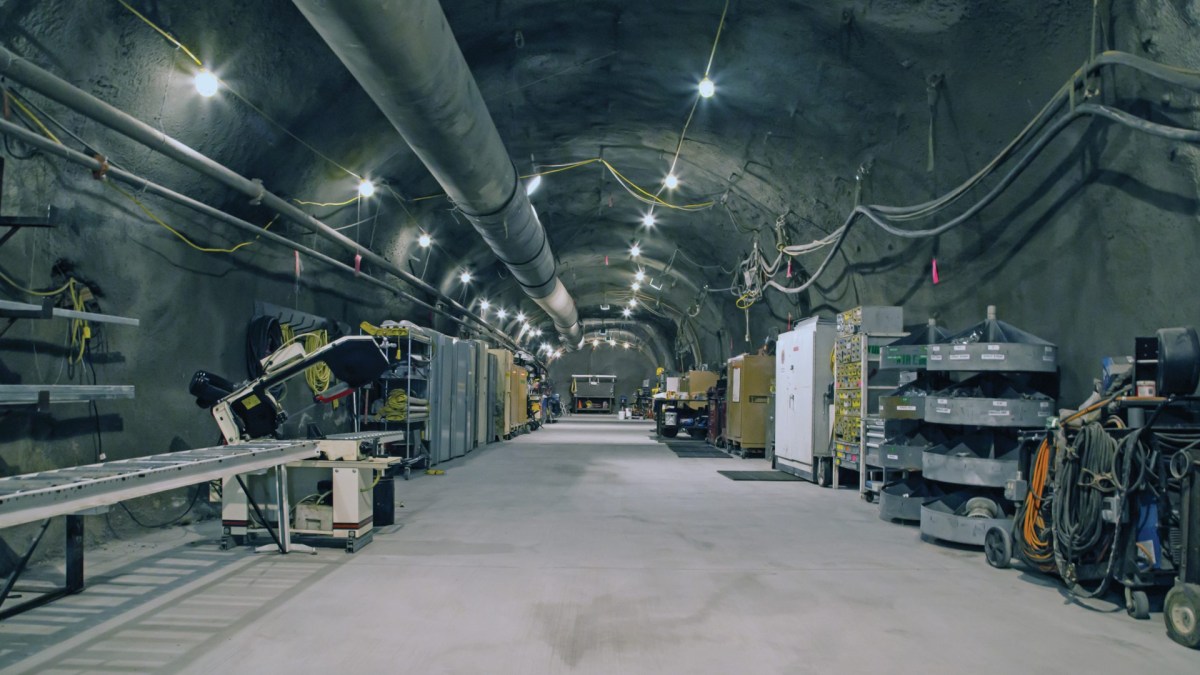
A view inside the U1a underground facility at the Nevada National Security Site. NNSA
The U.S. government set off conventional explosives inside a tunnel deep in the Nevada desert this week in a test designed to replicate a so-called “decoupled” nuclear detonation . Data collected is now being used to help improve methods for detecting this kind of nuclear testing. Just earlier this year, American authorities accused China of using decoupling to conceal new nuclear tests despite the country’s stated moratorium on such activities.
The test, which involved the use of chemical high-explosives and radiotracers, was conducted yesterday inside P Tunnel in Area 12 of the Nevada National Security Site (NNSA), according to a press release from the National Nuclear Security Administration (NNSA). The NNSS, which is situated within the boundaries of the U.S. Air Force’s Nevada Test and Training Range (NTTR), is used for a wide variety of testing purposes today . An agency under the Department of Energy, NNSA’s main jobs are to oversee the development and production of nuclear weapons, as well as manage America’s nuclear deterrent stockpile.
A map giving the general sense of the location of the NNSS with the NTTR. Center for Radiological Nuclear Training
Another map showing the specific testing areas within the NNSS. Area 12 is at the northern end of the complex. United States Geological Survey
“This experiment is especially focused on further enhancing the U.S. capabilities to detect a ‘decoupled’ explosion,” per NNSA’s release. “Data collected from the experiment will be used to validate scientific models and refine algorithms that are critical to U.S. nuclear explosion detection efforts.”
“Just as a stealth aircraft looks smaller on radar, decoupling can greatly muffle the signals detected by nuclear detection sensors, making a large explosion appear smaller,” the release explains. “In a conventional, or ‘coupled,’ underground nuclear test, a device is placed deep in a hole in close contact with the rock, allowing much of the explosion’s shockwave to reach sensors. In a decoupled test, by contrast, the device is detonated inside a large underground chamber, substantially reducing the explosion’s seismic signature.”
“In this experiment, researchers gathered measurements using a broad suite of advanced sensors, including accelerometers, seismometers, infrasound sensors, electromagnetic sensors, chemical and radiotracer samplers, and meteorological sensors,” it adds. ”Together, these measurements will improve scientists’ understanding of the signatures produced by underground explosions and strengthen the United States’ ability to detect and characterize nuclear explosive events.”
The U.S. already maintains a U.S. Atomic Energy Detection Systems (USAEDS) network, which is overseen by the U.S. Air Force Technical Applications Center (AFTAC). USAEDS is made up of more than 3,600 sensors positioned around the world. USAEDS is also tied in with the International Monitoring System (IMS), which is managed by the organization responsible for overseeing the Comprehensive Nuclear-Test-Ban Treaty (CTBT). AFTAC also supports the mission to monitor for potential nuclear testing globally using a fleet of specially configured WC-135R Constant Phoenix aircraft. In addition, those planes are used to help keep watch for unusual spikes in atmospheric radiation that could point to nuclear or radiological accidents or other incidents leading to the spread of potentially dangerous radioactive material.
With regard to the USAEDS network specifically, “once a disturbance is detected underground, underwater, in the atmosphere or in space, the event is analyzed for nuclear identification, and the findings are reported to command authorities,” according to AFTAC’s website .
As mentioned, the U.S. government has accused its Chinese counterparts of using decoupling to conceal new nuclear testing, and NNSA’s press release draws explicit attention to these allegations. At the annual Conference on Disarmament in Geneva, Switzerland, in February, Thomas DiNanno, Under Secretary of State for Arms Control and International Security, said that China had conducted at least one such test at Lop Nur on June 22, 2020 . The Comprehensive Nuclear-Test-Ban Treaty Organization (CTBTO) subsequently said the IMS had not detected an event matching that description at that location on that date. For its part, the Chinese government has denied the accusation.
The social media posts below include satellite imagery showing activity at Lop Nur that could point to new nuclear testing activities in recent years.
参考 Satellite Imagery Analysis of China’s Alleged 2020 Nuclear Test at Lop Nur https://t.co/aafvU5Szh7 CSIS 20260213 ROLES SAT ANALYSIS No.7 中国に核実験実施の動き ー Lop Nur核実験場の画像分析 ー https://t.co/n66yYk0hLg ROLES 20250522 — KAROTASU (@type36512) May 24, 2026
参考 Satellite Imagery Analysis of China’s Alleged 2020 Nuclear Test at Lop Nur https://t.co/aafvU5Szh7 CSIS 20260213 ROLES SAT ANALYSIS No.7 中国に核実験実施の動き ー Lop Nur核実験場の画像分析 ー https://t.co/n66yYk0hLg ROLES 20250522
While China is a signatory to the CTBT, the country has never ratified it. The Chinese government last acknowledged a critical-level nuclear test in 1996, after which a self-imposed moratorium was put in place, at least publicly. As an aside, the United States has also signed, but never ratified, the CTBT, and has a similar self-imposed moratorium on nuclear testing since 1992. It is worth noting that the treaty does not ban so-called sub-critical testing, which involves fissile material, but does not result in a full-fledged nuclear reaction.
Last week, The Wall Street Journal reported that the Trump administration has been holding new talks with the Chinese government regarding various aspects of the country’s massively and rapidly expanding nuclear arsenal , including the testing allegations. That story immediately preceded a state visit by China’s President Xi Jinping to Washington, D.C., to meet with Trump.
President Donald Trump (at left) and President Xi Jinping (at right) walk together at the White House last week. White House/Joyce N. Boghosian
“The discussions between American and Chinese officials have centered on measures to reduce nuclear risks and haven’t been aimed at negotiating a formal arms-control pact, an effort Beijing has sharply rebuffed in the past,” according to that report. “The Trump administration has begun to highlight the possibility of implementing new verification measures.”
“Independent experts say seismic instruments might be placed on or near test sites,” The Journal ‘s story also noted. “Another possibility, which was floated during the Biden administration, is to install radiation-detection equipment at test sites.”
NNSA’s announcement about the test at the Nevada National Security Site is certainly an example of the development underway already of new means of verification that could be deployed at sites around the world.
The United States has separately accused Russia of conducting lower-yield nuclear testing in secret in the past. Russia is a signatory to the CTBT and had previously ratified it. In 2023, President Vladimir Putin revoked that ratification in line with the provisions of a law passed by the country’s parliament, or Duma.
Russian President Vladimir Putin (at left) together with President Trump during their summit in Alaska in 2025. White House
President Trump has also floated the idea of the resumption of U.S. nuclear testing in response to Russian and Chinese activities, though other U.S. officials have downplayed the possibility of doing so . The United States is otherwise in the midst of a huge nuclear modernization effort that impacts the air , sea , and land-based legs of the deterrent triad. American authorities are also now pursuing these efforts in an environment fully unbounded by relevant arms control agreements following the sunset of the New Strategic Arms Reduction Treaty (New START) earlier this year.
The Russian government has said it is ready to conduct new nuclear tests if the United States pursues this course of action. The last official nuclear test in Russia came in 1990 right before the fall of the Soviet Union.
“It takes nuclear expertise to detect nuclear activities and experiments like these ensure America remains unmatched in detection,” NNSA Administrator Brandon Williams said in a statement yesterday in light of the test in Nevada. “The Trump Administration has made it clear that the United States will lead from a position of strength. You cannot evade American innovation. With this experiment, we are sending a clear message: under this administration, America will never be outmatched.”
Contact the author: joe@twz.com
Comments couldn’t be loaded. Please refresh the page.
作者:约瑟夫·特雷维西克
发布于美国东部时间2026年10月1日下午12:05
内华达国家安全基地U1a地下设施内部景象。(图片来源:美国国家核安全管理局)
本周,美国政府在内华达州沙漠深处的一条隧道内引爆了常规炸药,进行模拟所谓“脱钩”核试验。目前收集到的数据正被用于改进此类核试验的探测方法。就在今年早些时候,美国当局指责中国利用“脱钩”来掩盖其新的核试验,尽管中国已公开宣布暂停此类活动。
根据美国国家核安全管理局(NNSA)发布的新闻稿,此次试验使用了化学高爆炸药和放射性示踪剂,于昨日在内华达国家安全基地(NNSA)12区P隧道内进行。NNSA位于美国空军内华达试验训练场(NTTR)内,目前用于开展各种类型的试验。NNSA隶属于美国能源部,其主要职责是监督核武器的研发和生产,以及管理美国的核威慑力量。
一张地图大致显示了核能训练系统(NNSS)与核能训练中心(NTTR)的位置关系。
另一张地图显示了NNSS内的具体测试区域。12号区域位于该综合体的北端。美国地质调查局
美国国家核安全管理局(NNSA)发布的消息称:“这项实验的重点在于进一步提升美国探测‘脱钩’爆炸的能力。实验收集的数据将用于验证科学模型,并改进对美国核爆炸探测工作至关重要的算法。”
“就像隐形飞机在雷达上看起来更小一样,解耦技术可以大大降低核探测传感器接收到的信号,使大型爆炸看起来更小,”新闻稿解释道。“在传统的或‘耦合式’地下核试验中,装置被放置在与岩石紧密接触的深坑中,这使得爆炸的大部分冲击波能够到达传感器。相比之下,在解耦试验中,装置在大型地下密闭舱内引爆,从而大幅降低了爆炸的地震信号。”
声明还补充道:“在这项实验中,研究人员利用一系列先进的传感器收集了测量数据,包括加速度计、地震仪、次声波传感器、电磁传感器、化学和放射性示踪剂采样器以及气象传感器。这些测量数据将有助于科学家更好地了解地下爆炸产生的特征,并增强美国探测和分析核爆炸事件的能力。”
美国已建立美国原子能探测系统(USAEDS)网络,由美国空军技术应用中心(AFTAC)负责监管。USAEDS由遍布全球的3600多个传感器组成。USAEDS还与国际监测系统(IMS)相连,IMS由负责监督《全面禁止核试验条约》(CTBT)的机构管理。AFTAC还利用一支经过特殊改装的WC-135R“恒常凤凰”飞机机队,支持在全球范围内监测潜在核试验的任务。此外,这些飞机还用于监测大气辐射的异常峰值,这些峰值可能预示着核事故、放射性事故或其他导致潜在危险放射性物质扩散的事件。
具体到美国原子能防御系统(USAEDS)网络,“一旦在地下、水下、大气层或太空中检测到扰动,就会对该事件进行核识别分析,并将结果报告给指挥当局”,AFTAC 网站如此写道。
如前所述,美国政府指责中国利用“脱钩”政策掩盖新的核试验,而美国国家核安全管理局(NNSA)的新闻稿也明确提及了这些指控。今年2月在瑞士日内瓦举行的裁军谈判会议上,美国负责军控和国际安全的副国务卿托马斯·迪南诺表示,中国于2020年6月22日在罗布泊至少进行了一次核试验。全面禁止核试验条约组织(CTBTO)随后表示,其国际监测系统(IMS)并未在同一日期于该地点探测到符合上述描述的事件。中国政府则否认了这一指控。
以下社交媒体帖子包含卫星图像,显示罗布泊的活动可能表明近年来该地区进行了新的核试验活动。
参考中国涉嫌2020年在罗布泊进行核试验的卫星图像分析 https://t.co/aafvU5Szh7 CSIS 20260213 ROLES SAT ANALYSIS No.7 中国に核実験実施の动き ー 罗布泊核実験场の画像分析 ー https://t.co/n66yYk0hLg角色 20250522 — KAROTASU (@type36512) 2026 年 5 月 24 日
参考中国涉嫌2020年在罗布泊进行核试验的卫星图像分析 https://t.co/aafvU5Szh7 CSIS 20260213 ROLES SAT ANALYSIS No.7 中国に核実験実施の动き ー 罗布泊核実験场の画像分析 ー https://t.co/n66yYk0hLg角色 20250522
尽管中国是《全面禁止核试验条约》(CTBT)的缔约国,但从未批准该条约。中国政府上一次承认进行临界核试验是在1996年,此后至少在公开场合,中国自行暂停了核试验。顺便一提,美国也签署了CTBT,但从未批准,并且自1992年以来也自行暂停了核试验。值得注意的是,该条约并未禁止所谓的次临界核试验,即使用裂变材料但不会导致完全核反应的核试验。
上周,《华尔街日报》报道称,特朗普政府已与中国政府就中国迅速扩张的庞大核武库的各个方面展开新一轮会谈,其中包括有关核试验的指控。该报道发布后不久,中国国家主席习近平便对华盛顿进行国事访问,并与特朗普会晤。
上周,美国总统唐纳德·特朗普(左)和国家主席习近平(右)在白宫并肩而行。白宫/乔伊斯·N·博戈西安
报告称,“美中官员之间的讨论主要集中在降低核风险的措施上,并未旨在谈判达成正式的军控协议,而北京过去曾强烈拒绝这一努力。”报告还指出,“特朗普政府已开始强调实施新的核查措施的可能性。”
《华尔街日报》的报道还指出,“独立专家表示,地震仪可能会放置在试验场内或附近。” “拜登政府时期曾提出过另一种可能性,即在试验场安装辐射探测设备。”
美国国家核安全管理局宣布在内华达州国家安全基地进行测试,这无疑是目前正在开发的新验证手段的一个例子,这些手段可以部署在世界各地的基地。
美国曾单独指责俄罗斯过去秘密进行过低当量核试验。俄罗斯是《全面禁止核试验条约》(CTBT)的缔约国,并已批准该条约。2023年,俄罗斯总统弗拉基米尔·普京根据俄罗斯国家杜马通过的法律撤销了对俄罗斯的批准。
俄罗斯总统弗拉基米尔·普京(左)与美国总统特朗普于2025年在阿拉斯加举行峰会。白宫
特朗普总统也曾提出恢复美国核试验以回应俄罗斯和中国的核活动,但其他美国官员淡化了这种可能性。与此同时,美国正处于一项大规模核现代化计划之中,该计划影响到其三位一体核威慑力量的空中、海上和陆基部分。此外,随着今年早些时候《新削减战略武器条约》(新START)的失效,美国当局目前正处于完全不受相关军控协议约束的环境中,继续推进这些计划。
俄罗斯政府表示,如果美国继续采取这种行动,俄罗斯准备进行新的核试验。俄罗斯上一次官方核试验是在1990年,也就是苏联解体前夕。
“探测核活动需要核技术专长,而此类实验确保美国在探测领域保持无与伦比,”美国国家核安全管理局局长布兰登·威廉姆斯昨日就内华达州的核试验发表声明称。“特朗普政府已明确表示,美国将凭借实力引领世界。美国的创新能力不容忽视。通过此次试验,我们传递了一个明确的信息:在本届政府的领导下,美国永远不会落后。”
联系作者:joe@twz.com
评论加载失败,请刷新页面。