Here’s What This Panoramic Windowed Room Does On American Aircraft Carriers美国航空母舰上的全景窗房间有什么作用?
You may have never noticed it before, but you have probably seen some of its work.
Published Mar 18, 2020 9:59 PM EDT
Aircraft carrier island superstructures are complex and ever-changing steel castles that are bristling with appendages and pockmarked with apertures. Over the years, a carrier’s island can morph dramatically as new technologies and capabilities are integrated over a ship’s long service life—half a century for American nuclear-powered supercarriers. Upon close examination, one feature on American aircraft carriers’ islands that stands out is a seamless, wrap-around windowed room that juts out over the flight deck below. The panoramic window looks out of place next to all the smaller, armored windows that cover various sections of the island. Still, you may have never noticed or thought about this unique enclosure before, but you probably aware of the products it produces.
The Island Camera Room has served an essential role aboard U.S. aircraft carriers over decades. Inside, a sailor mans a television studio-like camera that has the ability to pan across the entire flight deck, sweeping a radial arch that is mirrored by the glass surrounding them.
Inside the Island Camera Room., USN
All flight operations are recorded from this place, with each launch and recovery being documented for a number of reasons. These include providing situational awareness to crew scattered around the inside of the ship to provide a visual record of events should disaster strike. The latter has resulted in some of the most horrifying and spectacular footage in aviation history.
The panoramic windowed pod of sorts seems to have been deployed as part of a refit initiative that occurred sometime in the 1980s with the installation showing up on all classes of carriers, from the Forestall class USS Ranger to the first-in-their-class USS Kitty Hawk and USS Midway to the unique USS Enterprise to the Nimitz class of supercarriers. Still, the general concept goes back even farther than that, to the early 1960s, as far as we can tell, when flat-pained semi-enclosed trapezoidal or square structures provided a similar capability.
The Forrestal class USS Independence seen sometime in 1969-1970 with a three-sided filming partial enclosure. , Navsource.com
USS Kitty Hawk in the early 1980s. Notice the glazed square enclosure at the back at the island. , USN
You can see the original convertible configuration on the Nimitz class carriers and how they are outfitted today below:
USS Nimitz around 1990., National Archives
USS Abraham Lincoln around 1990. Note the camera enclosure is closed up. , National Archives
USS Nimitz today, with its reworked island superstructure featuring a full Island Camera Room. , USN
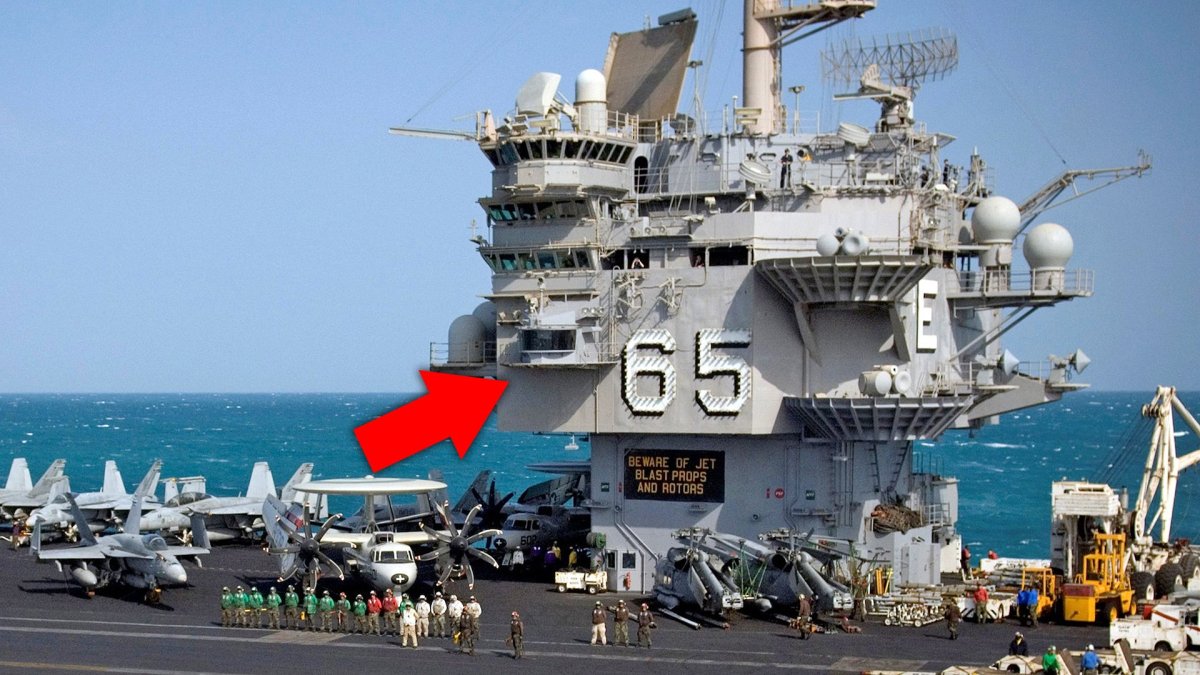
Like everything else, USS Enterprise (CNV-65) was unique. Its original island didn’t gain any sort of camera room enclosure until after being commissioned. Later, after her deep refit, she received an Island Camera Room that jutted out from her box-like island.
Enterprise circa 1962 with no camera enclosure. , USN/Wikicommons
Enterprise circa 1966 with a trapezoidal camera enclosure mounted very high atop the island., US Navy
Enterprise’s island after her refit. , USN via Seaforces.org
The Island Camera Room on its cantilever support attached to the Enterprise’s island., Seaforces.org
Before those enclosures became common on American carriers, sailors would film operations while totally exposed to the elements, which was not a pleasant experience when the ship was being pounded by heavy weather.
The video captured here feeds into the ship’s Integrated Launch And Recovery Television Surveillance system, which has multiple video feeds monitoring launch and recovery operations around the deck, including a camera embedded in the ship’s deck and centered on the landing glideslope that is usually referred to as the Pilots Landing Air Television, or PLAT.
Interior Communications Electrician 3rd Class Britney M. Subbs monitors the integrated launch and recovery television surveillance system aboard the aircraft carrier USS George H.W. Bush (CVN 77). , USN
The Island Camera Room is set to one day become a thing of the past. The new Ford class supercarrier does not have this feature. It seems that it is hard to justify it with current technology, where a series of fixed close circuit cameras could cover the entire deck in high-definition and provide the ability to digitally zoom in on things of interest during or after a recording has taken place. In other words, a single camera wouldn’t be limited to recording one area at a time. It would also eliminate the need for an actual camera operator. Even a remote gimballed camera with an operator in the loop would eliminate the need for such a unique facility altogether.
USS Gerald R. Ford’s island superstructure. , US Navy via Seaforces.org
So, now you know where all those crazy carrier aircraft operations videos come from. A room with literally the best view of flight operations on the entire ship.
Contact the author: Tyler@thedrive.com
Comments couldn’t be loaded. Please refresh the page.
发布于美国东部时间2020年3月18日晚上9:59
航空母舰的舰岛上层建筑是复杂且不断变化的钢铁堡垒,布满附属结构和孔洞。多年来,随着新技术和新能力的不断集成,航母的舰岛会发生巨大的变化——对于美国核动力超级航母而言,服役期长达半个世纪。仔细观察,你会发现美国航母舰岛上一个引人注目的特征:一个无缝环绕的舷窗房间,它从下方的飞行甲板延伸而出。这个全景舷窗与舰岛上其他较小的装甲舷窗相比,显得格格不入。或许你以前从未注意到或思考过这个独特的封闭空间,但你很可能了解它所生产的产品。
几十年来,舰上航母的舰岛摄像室一直发挥着至关重要的作用。在摄像室内,一名水兵操作着一台类似电视演播室的摄像机,这台摄像机能够环视整个飞行甲板,形成一道弧形,与周围的玻璃幕墙遥相呼应。
岛屿摄像室内部,美国海军
所有飞行作业均在此处进行记录,每次起飞和回收都会被记录下来,原因有很多。其中包括为分散在舰内各处的船员提供态势感知,以便在灾难发生时提供事件的影像记录。后者也造就了航空史上一些最恐怖、最震撼的影像资料。
这种全景舷窗舱似乎是上世纪80年代某次改装计划的一部分,从福雷斯托尔级“游骑兵”号到同级首舰“小鹰”号和“中途岛”号,再到独一无二的“企业”号,以及尼米兹级超级航母,所有级别的航母都安装了这种装置。不过,据我们所知,这种设计的总体概念可以追溯到更早的20世纪60年代初,当时一些半封闭的梯形或方形平顶结构就具备类似的功能。
1969-1970年间,福莱斯特级航空母舰“独立”号(USS Independence)被拍到,当时它被改装成三面封闭式拍摄用房。(图片来源:Navsource.com)
20世纪80年代初的“小鹰”号航空母舰。请注意舰岛后方的方形玻璃围墙。(美国海军)
您可以在下方看到尼米兹级航母最初的可转换配置以及它们现在的装备情况:
1990 年左右的尼米兹号航空母舰,美国国家档案馆
约摄于1990年的“亚伯拉罕·林肯”号航空母舰。请注意,摄像机舱门已关闭。(美国国家档案馆)
今天,尼米兹号航空母舰经过改造,其舰岛上层建筑配备了完整的舰岛摄像室。
如同其他一切一样,企业号星舰(CNV-65)也是独一无二的。它的舰岛在服役后才加装了摄像室。后来,经过深度改装后,舰岛上增设了一个从其箱形舰岛突出出来的摄像室。
1962年左右的企业号航母,没有相机舱。,美国海军/维基共享资源
1966 年左右的“企业”号航母,其梯形摄像机舱安装在舰岛顶部很高的位置。(美国海军)
企业号航母改装后的舰岛。(图片来自美国海军Seaforces.org)
位于企业号航母舰岛上的岛屿摄像室,其悬臂式支架与舰岛相连。(Seaforces.org)
在这些封闭式拍摄装置在美国航母上普及之前,水兵们会在完全暴露于恶劣天气的情况下拍摄作业,当船只遭受恶劣天气的袭击时,这是一种非常不愉快的体验。
这里拍摄的视频被传输到舰艇的综合发射和回收电视监控系统,该系统有多个视频流监控甲板周围的发射和回收作业,其中包括嵌入舰艇甲板并以着陆滑行道为中心的摄像头,通常被称为飞行员着陆空中电视(PLAT)。
美国海军三级内勤通信电工布兰妮·M·萨布斯负责监控“乔治·H·W·布什”号航空母舰(CVN 77)上的集成发射和回收电视监控系统。
岛屿摄像室终将成为历史。新型福特级超级航母就没有配备这项设施。以目前的技术水平来看,似乎很难证明其存在的必要性。一系列固定式闭路电视摄像头就能以高清画质覆盖整个甲板,并在录制过程中或录制后对感兴趣的区域进行数字放大。换句话说,单个摄像头不再局限于一次只能录制一个区域。而且,这样一来,就无需配备专门的摄像操作员。即使是配备操作员的远程云台摄像机,也能完全取代这种特殊的设施。
“杰拉尔德·R·福特”号航空母舰的舰岛上层建筑。(图片来自美国海军,Seaforces.org)
现在你知道那些精彩绝伦的航母舰载机作业视频都来自哪里了吧。那是一个房间,拥有整艘航母上最佳的飞行作业视野。
联系作者:Tyler@thedrive.com
评论加载失败,请刷新页面。