Senior-proofing made stylish: How to buy and renovate your retirement-era home打造时尚舒适的老年住宅:如何购买和翻新您的退休房
Discover how retirees can stylishly senior-proof and renovate their homes for comfort, safety, and convenience in their retirement years. Read more at straitstimes.com.
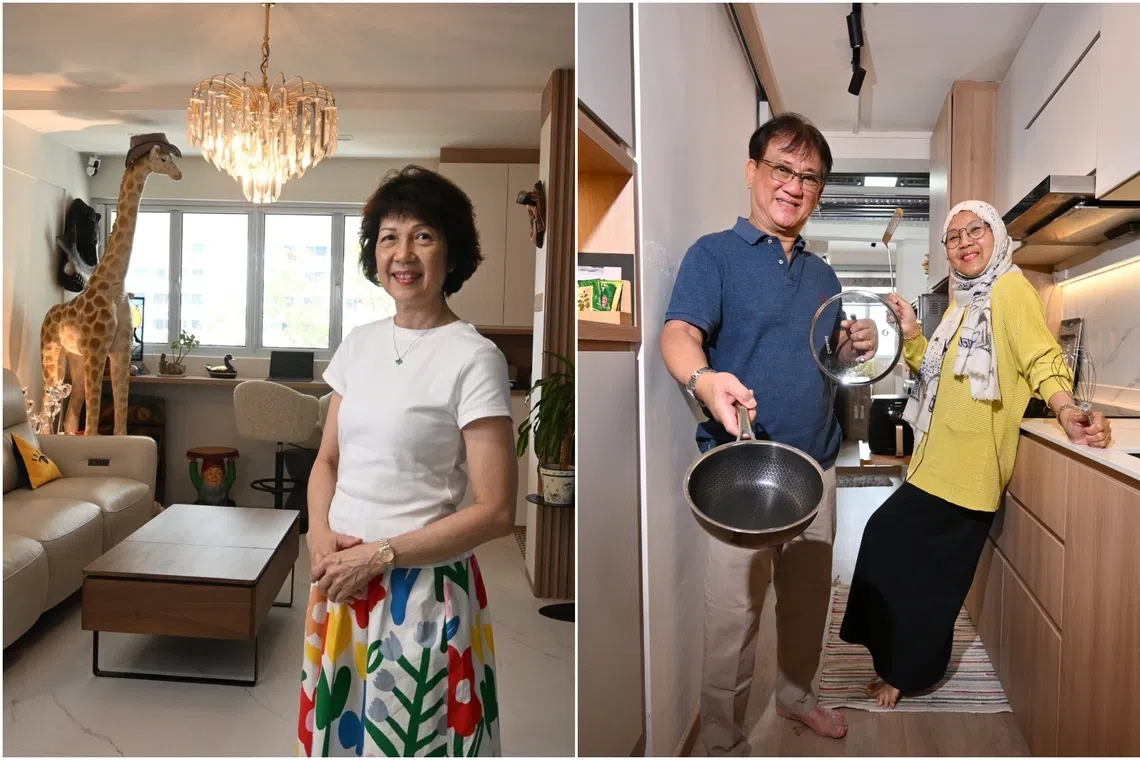
You can enjoy your dream home even when you are in your late 60s or older.
ST PHOTOS: CHONG JUN LIANG, LIM YAOHUI
Published Oct 02, 2026, 10:20 AM
Updated Oct 02, 2026, 05:21 PM
When buying and renovating your retirement-era home, it is good to prioritise convenience, accessibility, and independence.
Senior-proofing features like level floors, wider doorways, grab bars, and anti-slip flooring can be designed subtly to maintain a stylish, comfortable home.
Practical details, such as those enhancing natural light and storage, can help homeowners enjoy safe, bright, and cosy living spaces even in their twilight years.
Buying and renovating a new home are, for many people, challenging at best and torturous at worst.
Beyond the financial burdens, both are projects that often take a psychological and emotional toll because of the many different tasks they entail – from deciding which tiles to get to preparing the pile of documents needed to take ownership of your next abode.
Given these circumstances, it seems even more fraught to buy a residence in your 60s or later, when you should ideally be enjoying your retirement.
But for retiree Chris Leong, 68, it was about practicality.
She and her 78-year-old husband moved into their 1,044 sq ft four-room HDB resale flat in Clementi in 2025, downsizing from a three-storey, three-bedroom terraced house in Pasir Panjang, where they had lived for more than 10 years.
“We didn’t want to wait until one of us became much less mobile and then be forced to make a decision. We preferred to plan while we still had the choice,” she says.
Of course, finances were also a consideration.
“Maintaining a large landed property for two people wasn’t necessary. By moving to a smaller home, we could have something much easier to manage while freeing up money for our retirement.”
Given that her daughter, 47, lives overseas with her family, “it was important to me that we chose a home where my husband and I could continue living independently and comfortably”, Leong says.
Finding one that ticks the right boxes
She spent almost a year searching because she was quite particular about what she wanted.
For one thing, the new place had to be conveniently located near public transport options and everyday amenities such as markets, supermarkets and hawker centres.
Retiree Chris Leong in her four-room flat in Clementi. ST PHOTO: CHONG JUN LIANG
Retiree Chris Leong in her four-room flat in Clementi.
ST PHOTO: CHONG JUN LIANG
Having enjoyed the privacy afforded by a landed home for more than a decade, Leong was also keen to emulate that experience as much as possible – even within the confines of an HDB flat.
“This unit that we chose in the end is unusual because the lift landing serves only two units. I have only one immediate neighbour, so it feels quite private,” she says.
The 49-year-old flat ticked all of her boxes. “It was quiet, the price was reasonable, and, importantly for me, it had a good-sized kitchen.”
The kitchen in Leong’s flat. ST PHOTO: CHONG JUN LIANG
The kitchen in Leong’s flat.
The location also suits her well, Leong adds.
“I can go for walks in the nearby parks, groceries are easily accessible, and there is plenty of food and shopping within easy reach via Clementi Mall and Jem, which is one MRT stop away.”
The unit was almost entirely overhauled. The existing floors and walls were hacked so that the flat could be rebuilt around how Leong and her husband wanted to live out their later years.
The final bill came to around $113,000.
“My designer, Yvonne Loh, understood our needs, and she did a wonderful job in redesigning the flat’s layout to suit our lifestyle.”
One of the showers has grab bars, along with a foldable shower seat. ST PHOTO: CHONG JUN LIANG
One of the showers has grab bars, along with a foldable shower seat.
For example, there are no steps or kerbs within the home. The doorways are also wide enough to accommodate a wheelchair, should the couple require one in the future. One of the showers also has grab bars, along with a foldable shower seat.
Anti-slip flooring was also used throughout the home.
But these touches are mostly subtle, Leong says.
“I didn’t want accessibility to dominate the appearance of the home. I wanted these features to quietly become part of the design,” she says.
There are no steps or kerbs within the home. ST PHOTO: CHONG JUN LIANG
There are no steps or kerbs within the home.
Given the significant downsizing, storage was also a major consideration during the renovation.
But Loh was very creative in finding spaces to incorporate some of their sentimental treasures, says Leong. For instance, a large gold-trimmed antique mirror is now the statement piece of the walk-in closet.
When lease length meets life stage
All public housing flats are on 99-year leases, meaning tenure is a crucial consideration when buying a resale Housing Board flat.
Take, for instance, some flats in the Mountbatten neighbourhood of Jalan Batu.
Most of the blocks were completed between 1969 and 1970, leaving them with less than 50 years on their leases.
As such, they may not be suitable for younger couples or families looking for a long-term place to live – or perhaps even to pass down to their children.
But for retired couple Asiah Kassim, 67, and Roland Hoe, 72, their 700 sq ft two-room resale flat in Jalan Batu is perfect.
Retired couple Asiah Kassim and Roland Hoe in their two-room flat in Jalan Batu. ST PHOTO: LIM YAOHUI
Retired couple Asiah Kassim and Roland Hoe in their two-room flat in Jalan Batu.
ST PHOTO: LIM YAOHUI
As with Leong’s Clementi flat, the remaining lease on their retirement-era home will cover them until the recommended age of 95.
As their three children – now aged 36, 38 and 41 – have already settled into their own households, it “made sense” for the couple to “rightsize to a smaller place” in 2023.
Because older tenure flats also tend to be cheaper, the couple were able to use proceeds from the sale of their previous 1,520 sq ft HDB maisonette, along with some Central Provident Fund money, to pay for their new home in full. Likewise, Leong and her husband paid for their flat in full from their savings.
Hoe says: “It fits the current stage of our life. This is a central area, which is close to two MRT lines: Thomson-East Coast and Circle. We can even walk to East Coast Park. Shops, clinics and a hawker centre are also close by.”
Asiah says: “A small home has meant less cleaning, lower bills and less maintenance.”
They also worked with designer Loh, who slightly reconfigured the layout to maximise its functionality and cosiness.
This involved enlarging the toilet and, therefore, shifting the galley kitchen to the other side of the aisle.
The bedroom entrance was also relocated so that a decorative nook could be created to display Asiah’s favourite items, such as a vintage Hertel Jacob Bavaria hand-painted teacup set that has survived both World Wars I and II.
Asiah admits she and her husband were concerned about how the renovation – for which the final bill was around $49,000 – would turn out.
“There were some things we just could not imagine based on Yvonne’s explanations or drawings. We had to see it in real life to understand her vision.”
(From left) Designer Yvonne Loh with Asiah and Hoe. ST PHOTO: LIM YAOHUI
(From left) Designer Yvonne Loh with Asiah and Hoe.
If the couple have one piece of advice to give to other retirees looking to buy and renovate their “last homely home”, it is to go with a smaller footprint.
Hoe dispenses a sage bit of wisdom accordingly: “A small home can hold a bigger life.”
Meanwhile, Leong urges other seniors not to wait until they have no choice.
“People sometimes think about where they want to spend their retirement only after their health has deteriorated or when climbing stairs has already become impossible. I think it’s better to do it earlier, when you’re still able to take your time, look around and choose the home you genuinely want,” she says.
“Don’t just look at the size or price of the flat. Think about your daily life 10 or 15 years from now. Can you walk to get food? Is public transport nearby?
“Can a wheelchair pass through the doors? Is there a step into the bathroom? Is the floor slippery? How much cleaning will there be? And look at the surroundings too, not just the inside of the unit.”
Senior-proofing made stylish
From an interior design perspective, there are a few factors to think about when selecting and renovating a “twilight home”.
Senior proofing is at the top of the list. Loh says: “At both homes, we sought to level the flooring so that the home owners could move around without navigating thresholds or even small steps up or down, given that these are common hazards for older people.”
There was also a need to creatively reconfigure the layouts of both homes to make the “rightsizing” aspect of the move easier on both sets of home owners. “This could mean larger-scale hacking and construction, such as expanding the bathrooms and bathroom entryways, as we did for both homes.”
For retirees with mobility issues, it is still possible to design a home that is both functional and beautiful.
Subash Satapha, a designer with Reborn Interior, says: “The accessibility feature can also be the design statement.”
In 2024, he managed a design and renovation project for a wheelchair-using retiree in her late 60s, who was being cared for by her daughter. The duo live in an 807 sq ft three-room HDB flat in Tampines. A design highlight in the space is a sintered stone peninsula in the kitchen-living area.
“It has a rounded end, a soft radius corner and open knee space, so a wheelchair can roll right under it. It also doubles as the dining table, which replaces a full dining set in a smaller home,” Satapha says.
“Because it was made using sintered stone with a curved end panel, it looks like a sculptural piece rather than a mobility aid.”
For retirees with mobility issues, it is still possible to design a home that is both functional and beautiful. PHOTO: COURTESY OF REBORN INTERIOR
PHOTO: COURTESY OF REBORN INTERIOR
More generally, he adds that when designing for seniors, lighting and finishes can also make a difference.
“Warm-neutral light (3000-4000K) will keep the cosy mood, and a colour contrast between materials – between countertops, cabinets and floors – will also help ageing eyes tell where surfaces begin and end.”
In the Jalan Batu flat, a window overlooking the utility area was added to make the bathroom brighter and provide better air ventilation.
Vinyl flooring, which carries a more slip-resistant surface underfoot, also makes for a warmer and more comfortable surface for an older person to step on, in contrast to tile flooring.
For Leong, such small touches go a long way to making her Clementi flat a cosy escape, even as she misses the spaciousness of her previous landed property.
“But I’ve realised that at this stage of life, convenience is worth more to us than having rooms that are bigger than we actually need,” she says. “And I don’t want our daughter to be constantly worrying about us managing a large house on our own when she’s not here,” she adds.
“I’ve had the opportunity to design my dream retirement home. Make it one where you actually enjoy living in.”
Yamini Chinnuswamy is a correspondent at The Straits Times. She covers lifestyle news and features, with a focus on pop culture and design.
即使到了六十多岁甚至更老,你仍然可以享受你的梦想家园。
ST 照片:CHONG JUN LIANG、LIM YOOHUI
发布于2026年10月2日上午10:20
更新于2026年10月2日下午5:21
在购买和翻新退休住宅时,最好优先考虑便利性、可达性和独立性。
诸如平整的地板、更宽的门道、扶手和防滑地板等防老年人设施,可以通过巧妙的设计来保持家居的时尚和舒适。
诸如增强自然采光和储物空间等实用细节,可以帮助房主即使在晚年也能享受安全、明亮、舒适的居住空间。
对许多人来说,购买和装修新房充其量是充满挑战的,最坏的情况则是痛苦不堪的。
除了经济负担之外,这两个项目往往还会造成心理和情感上的负担,因为它们涉及许多不同的任务——从决定购买哪些瓷砖到准备拥有下一处住所所需的大量文件。
鉴于这些情况,在 60 多岁或以后购买房产似乎更加令人担忧,因为理想情况下,那时你应该享受退休生活。
但对于 68 岁的退休人士 Chris Leong 来说,这关乎实用性。
2025年,她和78岁的丈夫搬进了位于金文泰的一套1044平方英尺的四房式组屋转售组屋,此前他们住在巴西班让的一栋三层三卧室排屋里,在那里住了10多年。
“我们不想等到我们其中一人行动非常不便时才被迫做出决定。我们宁愿在还有选择余地的时候就做好计划,”她说。
当然,经济因素也是一个考虑因素。
“对我们两个人来说,维护一处大型房产是没有必要的。搬到小一点的房子后,我们不仅更容易打理,还能省下钱用于退休。”
梁女士说,鉴于她47岁的女儿和家人住在海外,“对我来说,选择一个我和丈夫可以继续独立舒适地生活的房子非常重要”。
找到一个完全符合所有条件的。
她花了将近一年的时间寻找,因为她对想要的东西非常挑剔。
首先,新址必须位置便利,靠近公共交通设施和日常便利设施,如市场、超市和小贩中心。
退休人士梁克里斯(Chris Leong)在金文泰的四房式组屋中。(海峡时报照片:梁崇俊)
退休人士梁克里斯住在金文泰的四房式组屋里。
《海峡时报》照片:梁崇俊
梁先生在独立式住宅中享受了十多年的私密生活,因此他也渴望尽可能地复制这种体验——即使是在组屋的限制范围内。
“我们最终选择的这套房子很特别,因为电梯厅只服务于两户人家。我只有一个邻居,所以感觉很私密,”她说。
这套49岁的公寓完全符合她的所有要求。“这里很安静,价格也合理,而且对我来说最重要的是,它有一个大小合适的厨房。”
梁家的厨房。(海峡时报摄影:梁崇俊)
梁家的厨房。
梁女士补充说,这个地方也很适合她。
“我可以去附近的公园散步,买菜也很方便,而且从这里到金文泰购物中心和Jem购物中心(距离这里只有一站地铁)就能轻松到达,那里有很多美食和购物场所。”
这套公寓几乎完全翻新了。原有的地板和墙壁都被拆除,以便根据梁女士和她丈夫希望如何安度晚年来重建这套公寓。
最终账单总额约为 113,000 美元。
“我的设计师Yvonne Loh了解我们的需求,她出色地重新设计了公寓的布局,使其更符合我们的生活方式。”
其中一间淋浴间设有扶手和可折叠淋浴座椅。(海峡时报照片:梁崇俊)
其中一个淋浴间配有扶手和可折叠淋浴座椅。
例如,屋内没有台阶或路沿。门也足够宽敞,方便轮椅通行,以备这对夫妇将来需要时使用。其中一个淋浴间还配有扶手和可折叠的淋浴座椅。
整个住宅都铺设了防滑地板。
梁先生表示,但这些细节大多都很微妙。
“我不想让无障碍设计喧宾夺主,掩盖房屋的整体外观。我希望这些功能能够悄然融入设计之中。”她说道。
屋内没有台阶或路沿。照片由梁崇俊拍摄。
屋内没有台阶或路沿。
鉴于面积大幅缩减,储物空间也是翻新过程中需要考虑的一个重要因素。
梁女士说,罗先生非常有创意,找到了合适的空间来摆放他们的一些珍贵纪念品。例如,一面镶着金边的古董大镜子现在成了步入式衣帽间的点睛之笔。
当租赁期限与生命周期阶段相遇时
所有公屋单位的租期均为99年,这意味着租期是购买转售建屋发展局单位时需要考虑的关键因素。
以蒙巴顿区 Jalan Batu 的一些公寓为例。
大部分楼宇在 1969 年至 1970 年间建成,因此它们的租赁期限还不到 50 年。
因此,它们可能不适合年轻夫妇或家庭寻找长期居住的住所,甚至不适合留给子女。
但对于 67 岁的退休夫妇 Asiah Kassim 和 72 岁的 Roland Hoe 来说,他们在 Jalan Batu 的 700 平方英尺两房式转售组屋是完美的。
退休夫妇Asiah Kassim和Roland Hoe在Jalan Batu的两房式组屋里。(海峡时报摄影:林耀辉)
退休夫妇 Asiah Kassim 和 Roland Hoe 在 Jalan Batu 的两室组屋里。
ST 照片:林耀辉
与梁先生在金文泰的公寓一样,他们退休住所的剩余租约将让他们居住到建议的95岁。
由于他们的三个孩子(现年分别为 36 岁、38 岁和 41 岁)都已经安顿下来,有了自己的家庭,因此这对夫妇在 2023 年“搬到较小的房子里”是“合情合理的”。
由于老旧组屋的价格通常也更低,这对夫妇得以用出售之前那套1520平方英尺的组屋复式公寓所得的款项,加上一些公积金,全额支付了新房的房款。同样,梁女士和她的丈夫也是用自己的积蓄全额支付了新房的房款。
Hoe说:“这很符合我们目前的生活阶段。这里地处中心地带,靠近两条地铁线:汤申-东海岸线和环线。我们甚至可以步行到东海岸公园。商店、诊所和小贩中心也都在附近。”
Asiah 说:“小房子意味着更少的清洁工作、更低的账单和更少的维护工作。”
他们还与设计师 Loh 合作,Loh 对布局进行了略微的重新配置,以最大限度地提高其功能性和舒适性。
这涉及到扩大厕所,因此,厨房要移到过道的另一边。
卧室入口也进行了重新布置,以便打造一个装饰性的角落来展示 Asiah 最喜欢的物品,例如一套经历了第一次世界大战和第二次世界大战考验的 Hertel Jacob Bavaria 古董手绘茶杯套装。
Asiah承认,她和丈夫很担心装修工程(最终账单约为49,000美元)最终效果如何。
“有些事情,我们光凭伊冯娜的描述或图画是无法想象的。我们必须亲眼所见才能理解她的想法。”
(从左至右)设计师Yvonne Loh与Asiah和Hoe。ST摄影:LIM YAOHUI
(从左至右)设计师 Yvonne Loh 与 Asiah 和 Hoe。
如果这对夫妇要给其他想要购买和翻新“最后家园”的退休人士一条建议,那就是选择占地面积较小的房屋。
霍伊对此提出了一个富有智慧的见解:“小房子也能容纳大生活。”
与此同时,梁先生敦促其他老年人不要等到别无选择才采取行动。
“人们有时只有在健康状况恶化或爬楼梯都困难的时候才会考虑退休后要在哪里安度晚年。我认为最好早点考虑,趁着还能从容不迫地四处看看,选择自己真正想要的房子,”她说。
“不要只看房子的面积或价格。想想你10年或15年后的日常生活。你能步行去吃饭吗?附近有公共交通吗?”
“轮椅能通过门吗?浴室里有台阶吗?地板滑吗?清洁工作会到位吗?还要看看周围环境,不只是房间内部。”
时尚的老年人校对
从室内设计的角度来看,在选择和翻新“老房子”时,需要考虑一些因素。
老年人安全防护是首要任务。Loh 说:“在这两处住宅中,我们都力求使地板平整,以便业主可以自由走动,无需跨越门槛或上下小台阶,因为这些对老年人来说都是常见的安全隐患。”
此外,还需要对两处住宅的布局进行巧妙的重新设计,以便让双方业主都能更轻松地适应“适配不同空间”的搬迁过程。“这可能意味着需要进行更大规模的改造和施工,例如扩建浴室和浴室入口,就像我们对两处住宅所做的那样。”
对于行动不便的退休人士来说,仍然可以设计出既实用又美观的住宅。
Reborn Interior 的设计师 Subash Satapha 表示:“无障碍功能也可以成为一种设计理念。”
2024年,他为一位年近七旬、使用轮椅的退休女士设计并翻新了她的住所。这位女士由她的女儿照顾,母女俩住在淡滨尼一套面积为807平方英尺的三房式组屋里。厨房和客厅区域的一大设计亮点是一块烧结石半岛。
“它的末端是圆弧形的,边角圆润,膝部空间宽敞,轮椅可以轻松地从下面通过。它还可以兼作餐桌,在较小的住宅中可以替代一整套餐桌椅,”萨塔帕说道。
“因为它采用烧结石材制成,并且末端面板呈弧形,所以它看起来更像一件雕塑作品,而不是一个助行器。”
对于行动不便的退休人士来说,仍然可以设计出既实用又美观的住宅。图片:由 REBORN INTERIOR 提供
图片:由 REBORN INTERIOR 提供
他还补充说,更普遍而言,在为老年人设计住宅时,照明和装饰也会产生影响。
“暖色调的中性光(3000-4000K)能保持温馨的氛围,而不同材质(例如台面、橱柜和地板)之间的色彩对比,也能帮助老年人分辨不同表面之间的界限。”
在 Jalan Batu 的这套公寓里,为了使浴室更明亮、通风更好,增加了一扇俯瞰杂物间的窗户。
与瓷砖地板相比,乙烯基地板具有更防滑的表面,而且对于老年人来说,踩上去也更温暖舒适。
对于梁女士来说,这些小小的细节让她在金文泰的公寓成为了一个舒适的避风港,尽管她怀念以前独立式住宅的宽敞空间。
“但我意识到,在这个人生阶段,便利对我们来说比拥有超出实际需求的大房间更重要,”她说。“而且我也不希望女儿不在家的时候,总是担心我们独自打理这么大的房子,”她补充道。
“我有机会设计我梦想中的退休住所。把它建成一个真正让你享受居住的地方。”
Yamini Chinnuswamy是《海峡时报》的记者。她负责报道生活方式新闻和专题报道,重点关注流行文化和设计。