New AI tool helps teachers mark geography essays; English, history and social studies being piloted新人工智能工具帮助教师批改地理作文;英语、历史和社会研究科目正在试点应用。
It gives detailed feedback on essays, reducing marking time significantly. Read more at straitstimes.com.
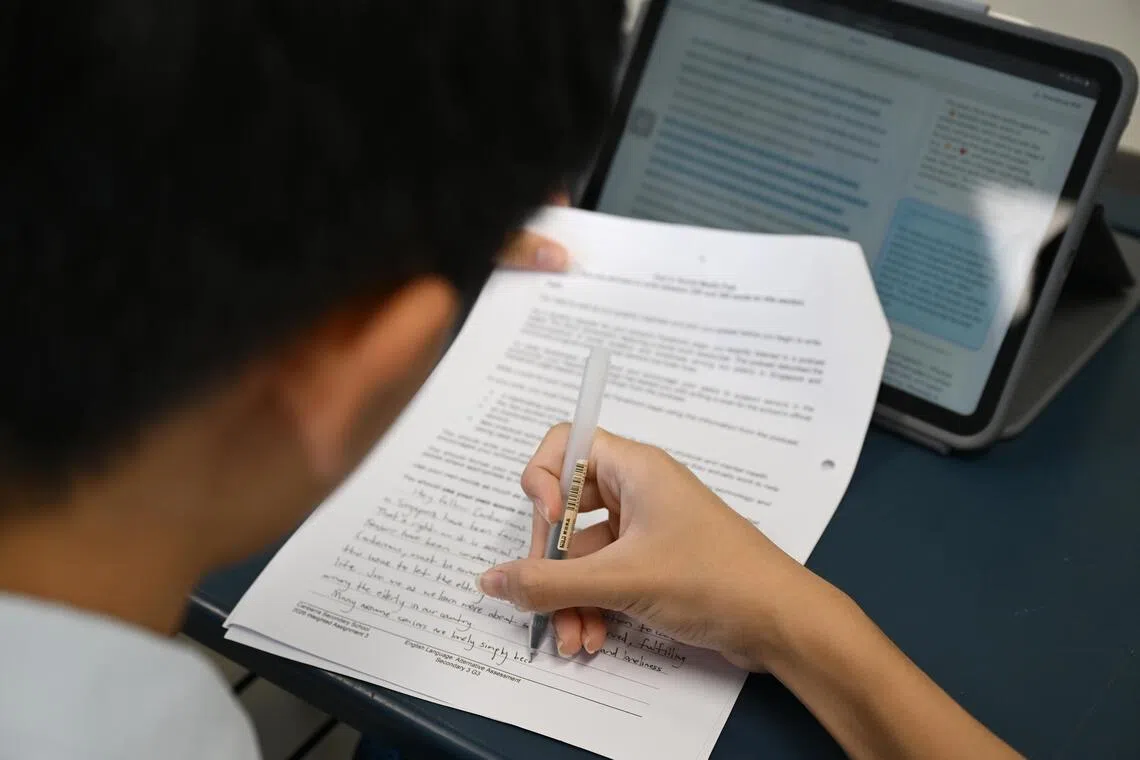
A Canberra Secondary School student using AI-generated feedback from Markly to improve his writing assignment.
ST PHOTO: NG SOR LUAN
Published Sep 05, 2026, 12:00 PM
Updated Sep 05, 2026, 12:00 PM
The Education Ministry's AI tool Markly helps teachers give detailed feedback on geography, English, social studies, and history essays, reducing marking time significantly.
Teachers train Markly with sample scripts, and it provides feedback in the teacher's style, but teachers review all suggestions before sharing with students.
Despite AI support, teachers emphasise human guidance to help students understand feedback and critically evaluate AI-generated content for learning effectiveness.
SINGAPORE - Geography teachers in secondary schools and junior colleges can now use an AI-powered tool developed by the Education Ministry (MOE) to mark students’ written work.
The tool, called Markly, is also being piloted in some secondary schools for English language, social studies and history.
In response to queries from The Straits Times, the MOE said it is gathering feedback from teachers and schools, and will assess the pilot’s outcomes before deciding on how and when Markly will be used.
The ministry said the tool generates feedback for essays and extended responses, so that teachers can focus more on individual student needs. It conceptualised Markly in 2025 as part of efforts to support teachers in providing formative feedback on students’ written assignments. Such feedback is meant to guide them during the learning process.
“Teachers review, edit or reject Markly’s suggestions before any feedback is provided to students, and remain responsible for all feedback shared,” said an MOE spokesperson.
Ghazali Abdul Wahab, 52, Canberra Secondary School’s lead teacher for English, who is involved in the pilot, said Markly has made it more feasible for him to give multiple rounds of feedback during the term.
In a Secondary 3 lesson observed by ST on Aug 17, Ghazali’s students were refining a draft of their situational writing assignment, using feedback from Markly. The tool groups feedback by content and language use.
For content, it highlights what students have done well and suggests how they can improve, such as crafting a more engaging introduction or explaining a point without making sweeping statements.
It also flags language errors in spelling, grammar, punctuation, and sentence structure. It can also explain the type of error and guide students towards correcting it.
The students were already on their sixth draft of a social media post, having completed their first draft just two weeks earlier.
“To mark through all those scripts across six rounds would take practically a whole term. But by using AI to assist with feedback, we can get the entire process writing package done in just three weeks,” Ghazali said, adding that the marking workload would have been immense for a teacher to handle manually.
But using Markly does not mean the teacher is removed from the process.
Before deploying it, Ghazali has to “train” the tool . He first marks three to five student scripts in detail, which are then fed i nto the system so it can learn his marking style and feedback.
“When students read (the feedback), it feels like I am talking directly to them.”
Ghazali said his foray into educational technology began during the Covid-19 pandemic, when circuit breaker measures required teachers to use platforms like ZOOM to conduct lessons from home.
Having experimented with various tools, he can now use AI to design different parts of the lesson package.
With his team of teachers, they used AI to draft a script, convert it into an audio podcast, and even gave speakers realistic Singaporean accents.
Students used an AI-designed graphic organiser to extract information they needed from the podcast to start on their first draft. Ghazali also used AI to tweak a lesson’s difficulty levels to suit students at different levels.
Canberra Secondary School’s lead teacher for English Ghazali Abdul Wahab said Markly has made it more feasible for him to give multiple rounds of feedback during the term. ST PHOTO: NG SOR LUAN
Canberra Secondary School’s lead teacher for English Ghazali Abdul Wahab said Markly has made it more feasible for him to give multiple rounds of feedback during the term.
Although Markly can award grades, Ghazali has opted not to use this feature.
“I want them (students) to focus on using the feedback to improve their work, and not dwell on how well or poorly they did,” he said, adding that he would grade their final draft at the end, without AI.
His student Chloe Loh, 15, said despite what Markly can do, she still values Ghazali’s input.
“Sometimes the AI uses more complicated terms in its feedback. But Mr Ghazali knows what my weak spots are, explains in a way that I actually understand,” she said.
Ghazali’s student Chloe Loh said that despite what Markly can do, she still values his input. ST PHOTO: NG SOR LUAN
Ghazali’s student Chloe Loh said that despite what Markly can do, she still values his input.
Looking ahead, Ghazali wants to expand his AI skills and explore vibe coding - using AI tools to build applications without manual coding.
He hopes to create custom educational games for students who need more practice in areas they struggle with, like tenses or vocabulary.
Despite his enthusiasm for digital tools, Ghazali said they can never replace a human teacher.
Said Ghazali: “Since students can now get content from AI tools, I’m facilitating to help them discern whether the content is legitimate, authentic, real, or just fake. This is important for the future world of work that they’re going into.”
“Experience and human connection are what ensure the learning actually sticks.”
Elisha Tushara is a correspondent at The Straits Times, specialising in Singapore’s education landscape.
AI/artificial intelligence
Education and schools
Ministry of Education
堪培拉一名中学学生利用Markly提供的AI生成的反馈来改进他的写作作业。
圣徒照片:吴索銮
发布于 2026 年 9 月 5 日 下午 12:00
更新于2026年9月5日中午12:00
教育部的人工智能工具 Markly 可以帮助教师对地理、英语、社会研究和历史论文提供详细的反馈,从而大大减少批改时间。
教师使用示例脚本训练 Markly,Markly 会以教师的风格提供反馈,但教师会在与学生分享之前审查所有建议。
尽管人工智能提供了支持,但教师们仍然强调人工指导,以帮助学生理解反馈并批判性地评估人工智能生成的内容,从而提高学习效果。
新加坡——中学和初级学院的地理教师现在可以使用教育部开发的人工智能工具来批改学生的书面作业。
这款名为 Markly 的工具目前正在一些中学进行试点,用于英语、社会研究和历史课程。
针对《海峡时报》的询问,教育部表示正在收集教师和学校的反馈意见,并将评估试点结果,然后再决定如何以及何时使用 Markly。
教育部表示,该工具能够为作文和长篇回答生成反馈,以便教师能够更专注于满足学生的个性化需求。Markly 的构思始于 2025 年,旨在帮助教师为学生的书面作业提供形成性反馈。此类反馈旨在指导学生的学习过程。
教育部发言人表示:“教师在向学生提供任何反馈之前,都会审查、修改或拒绝马克利的建议,并对所有分享的反馈负责。”
52 岁的加扎利·阿卜杜勒·瓦哈卜是堪培拉中学的英语首席教师,他参与了这项试点项目。他说,Markly 让他能够在学期中进行多轮反馈变得更加可行。
8月17日,《海峡时报》记者旁听了一节中三课程,加扎利老师的学生正在根据Markly提供的反馈修改情景写作作业的草稿。该工具会将反馈按内容和语言使用情况进行分类。
内容方面,它突出了学生做得好的地方,并提出了他们可以改进的地方,例如撰写更引人入胜的引言或在不做出笼统陈述的情况下解释某个观点。
它还能标记拼写、语法、标点和句子结构方面的语言错误。此外,它还能解释错误类型,并指导学生如何改正。
这些学生在两周前才完成了第一稿,而现在他们已经修改到了社交媒体帖子的第六稿。
“要批改完六轮的所有试卷,几乎需要一整个学期。但借助人工智能辅助反馈,我们只需三周就能完成整个流程的写作评估,”加扎利说道,并补充说,如果由老师手动批改,工作量将非常巨大。
但是使用 Markly 并不意味着教师会被排除在教学过程之外。
在正式部署之前,加扎利需要对工具进行“训练”。他首先会详细批改三到五份学生的作业,然后将这些批改结果输入系统,以便系统学习他的批改风格和反馈方式。
“学生们读到(反馈)时,感觉就像我在直接和他们对话一样。”
加扎利表示,他涉足教育技术领域始于新冠疫情期间,当时的阻断措施要求教师使用 ZOOM 等平台在家授课。
在尝试过各种工具之后,他现在可以利用人工智能来设计课程包的不同部分。
在他的教师团队的帮助下,他们利用人工智能编写了脚本,将其转换为音频播客,甚至还赋予了说话者逼真的新加坡口音。
学生们使用人工智能设计的图形组织工具,从播客中提取所需信息,开始撰写初稿。加扎利也利用人工智能调整课程难度,以适应不同水平的学生。
堪培拉中学英语主讲教师加扎利·阿卜杜勒·瓦哈卜表示,马克利的教学方法让他能够在学期内进行多轮反馈,这变得更加可行。(海峡时报照片:吴淑銮)
堪培拉中学英语首席教师加扎利·阿卜杜勒·瓦哈卜表示,Markly 让他能够在学期中进行多轮反馈变得更加可行。
尽管 Markly 可以给出评分,但 Ghazali 选择不使用此功能。
“我希望他们(学生)专注于利用反馈来改进他们的作品,而不是纠结于他们做得好还是不好,”他说,并补充说,他会在最后给他们的最终稿评分,而不会使用人工智能。
他的学生 Chloe Loh 今年 15 岁,她说尽管 Markly 能力很强,但她仍然重视 Ghazali 的意见。
“有时候人工智能会在反馈中使用更复杂的术语。但加扎利先生知道我的弱点在哪里,他会用我能理解的方式进行解释,”她说。
加扎利的学生克洛伊·洛表示,尽管马克利能力有限,她仍然重视他的意见。(海峡时报照片:吴淑銮)
加扎利的学生克洛伊·洛表示,尽管马克利能力有限,但她仍然重视他的意见。
展望未来,Ghazali 希望拓展他的 AI 技能,并探索 vibe 编码——使用 AI 工具构建应用程序而无需手动编码。
他希望为那些在时态或词汇等薄弱环节需要更多练习的学生创建定制的教育游戏。
尽管加扎利对数字工具充满热情,但他表示这些工具永远无法取代人类教师。
加扎利说:“既然学生现在可以从人工智能工具中获取内容,我正在帮助他们辨别这些内容是合法、真实、可信还是虚假的。这对他们未来即将进入的职场至关重要。”
“经验和人际交往才是确保学习真正有效的关键。”
Elisha Tushara 是《海峡时报》的记者,专门报道新加坡的教育领域。
人工智能
教育和学校
教育部