‘Unlock your DNA’: More young S’poreans taking up dialect classes“解锁你的DNA”:越来越多的新加坡年轻人开始学习方言
Food, music, intergenerational activities and role-playing make dialect learning fun. Read more at straitstimes.com.
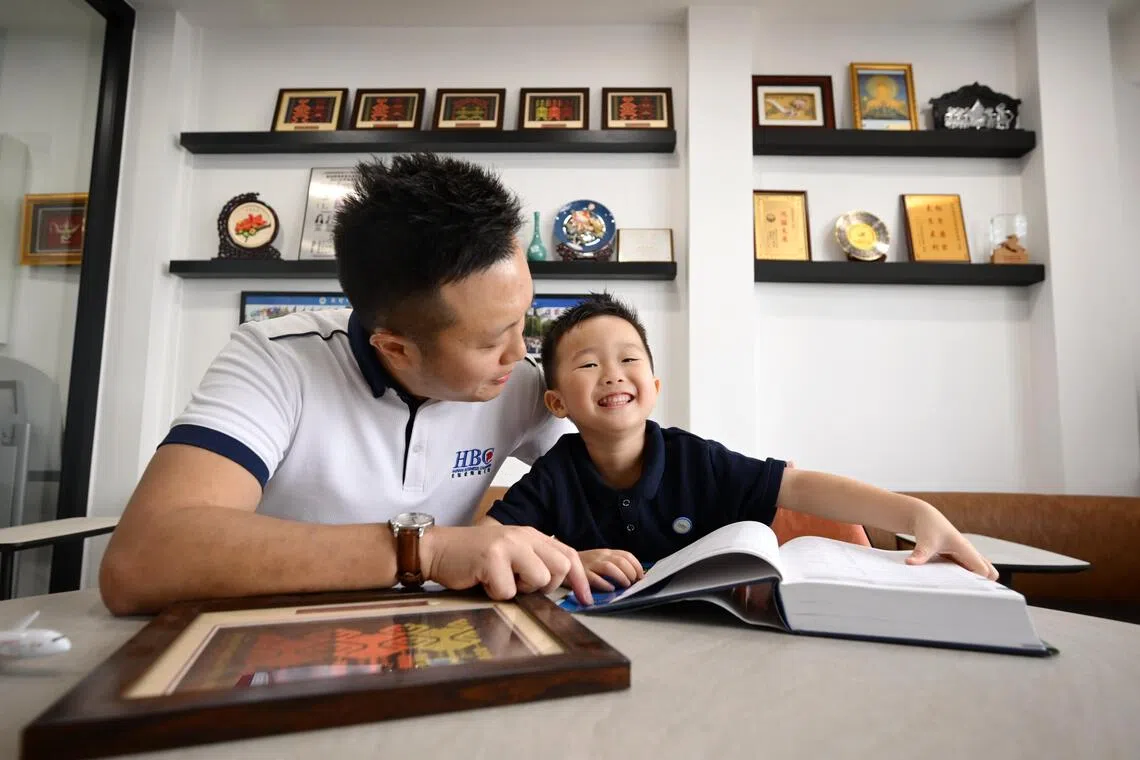
Eldred Wee and his son Eden learn about Hainanese language and culture at the Hainan Business Chamber.
ST PHOTO: NG SOR LUAN
Published Sep 05, 2026, 12:00 PM
Updated Sep 05, 2026, 12:00 PM
More Singaporeans are learning Chinese dialects to reconnect with their heritage and strengthen family bonds.
Clan associations report rising enrolments in dialect classes, with creative, fun methods used to make learning engaging and culturally rich.
The government supports dialect learning alongside Mandarin, promoting cultural roots and local Chinese identity through various activities and programmes.
SINGAPORE – When Eldred Wee started learning Hainanese at the Hainan Hwee Kuan in December 2025, the 34-year-old had practically no grasp of the language despite both his parents’ strong fluency.
His parents, who are both Hainanese, divorced when he was around nine, and he grew up speaking English with his mother.
“My dialect and culture were never handed to me. I am choosing it as an adult, for myself and for my son, to rebuild a generational link that was broken,” said the entrepreneur.
Wee wants his four-year-old son, Eden, to also know Hainanese. At home, he makes it a point to use simple Hainanese phrases like “boh gai dit” (“thank you”).
“My motivation is identity, intergenerational bonding and belonging,” he said.
The film Dear You may have sparked renewed interest in Teochew and dialects in general, but clan associations across Singapore told The Straits Times their dialect classes have become more popular in recent years.
Learners, who used to be mainly middle-aged and older, have become much younger, with many in their 20s to 40s.
Teacher Henry Lau conducting a Cantonese class in Kong Chow Wui Koon on Aug 31. The cultural association’s advanced Cantonese classes doubled in size between 2022 and 2026. ST PHOTO: ARIFFIN JAMAR
Teacher Henry Lau conducting a Cantonese class in Kong Chow Wui Koon on Aug 31. The cultural association’s advanced Cantonese classes doubled in size between 2022 and 2026.
ST PHOTO: ARIFFIN JAMAR
For instance, Kong Chow Wui Koon’s (KCWK) advanced Cantonese class sizes doubled between 2022 and 2026, while the Singapore Hokkien Huay Kuan (SHHK) Cultural Academy has seen participation for its Hokkien classes jump about 15 per cent over the past three years.
Meanwhile, Char Yong (Dabu) Association started its Hakka class in April, with 19 students. Its second run has been expanded to 26 students, and there are three people on the waiting list.
Veteran radio newscaster Nigel Lim, who has been teaching Teochew at the Teochew Poit Ip Huay Kuan since 2003, noted the rising enrolment and the clear demographic shift.
“China has grown stronger, and more are seeking roots. Many are realising that speaking their dialect helps them connect with overseas relatives and even Chinese business partners,” he said.
For 20-year-old Joshua Loh, it was a Hakka song sung by a musician in a Shanghai cafe that inspired him to take up lessons at the Char Yong (Dabu) Association in 2026.
Hakka instructors Wong Lee Foon (left, in red) and Wong Chin Fee (right) at the front of a Hakka class at Char Yong (Dabu) Association on Aug 29. PHOTO: CHAR YONG (DABU) ASSOCIATION
Hakka instructors Wong Lee Foon (left, in red) and Wong Chin Fee (right) at the front of a Hakka class at Char Yong (Dabu) Association on Aug 29.
PHOTO: CHAR YONG (DABU) ASSOCIATION
“He told me something that really stuck: If you speak Hakka, you unlock your DNA. Learning Hakka has given me a sense of grounding, and I hope more young people get to experience that too,” said the polytechnic student.
He also hopes this can strengthen his relationship with his grandparents, whom he visits every other week.
“They would correct me if my pronunciation was different from what they grew up with,” he said. “It has become a nice bonding ritual between us.”
Accessible routes to cultural roots
Lim, the Teochew instructor, said the Government’s recent easing of its policy on dialect content is actually good for Singaporeans’ use of Mandarin.
In his Mandarin speech at the National Day Rally on Aug 23, Prime Minister Lawrence Wong announced that there would no longer be a cap on the number of screenings of dialect films, as long as a Mandarin-dubbed version is available.
He also spotlighted clan associations’ efforts to promote dialects here through classes and cultural activities, and said the Government will continue to support these efforts.
While the Government previously discouraged dialects to streamline communication across diverse Chinese groups, Lim believes dialects have the ability to unify, rather than fragment.
“Learning a Chinese dialect can actually boost one’s Mandarin, as mastering a dialect’s complex tones and structures makes Mandarin easier to grasp,” he added.
There are also students like Tan Song Ya, whose interest in Cantopop and Hong Kong dramas prompted her to enrol in a Cantonese class at KCWK in July.
“Perhaps I should be learning my own dialect, Hokkien, after this,” said the 34-year-old engineer, who grew up speaking English and Mandarin.
A budding interest in one’s dialect can also become an abiding interest in Chinese history and culture, noted Kong Chow Cultural Centre head and Cantonese instructor Wong Chee Meng.
“For the class in Chinese history and culture, many students enjoy learning classical poetry, especially Tang poetry, in Cantonese, because the richness in rhymes and tonal patterns often cannot be replicated in Mandarin,” he noted.
Clan associations here said they are experimenting with different ways to build on this momentum of interest in dialects.
For instance, the central plot device of Dear You is qiaopi, which were letters sent home by overseas Chinese along with remittance money. The letters were written with Chinese ink and traditional script, which flowed vertically from top to bottom.
SHHK has since incorporated this into its dialect programmes. It also organises intergenerational activities where youth and seniors are grouped together to make traditional food such as bak chang (glutinous rice dumplings), and learn classic Hokkien songs together, said its marketing manager Jeremiah Soh.
Beyond conversational Hokkien lessons, Jeremiah Soh of Singapore Hokkien Huay Kuan Cultural Academy incorporates intergenerational activities through music and movement. PHOTO: SINGAPORE HOKKIEN HUAY KUAN CULTURAL ACADEMY
Beyond conversational Hokkien lessons, Jeremiah Soh of Singapore Hokkien Huay Kuan Cultural Academy incorporates intergenerational activities through music and movement.
PHOTO: SINGAPORE HOKKIEN HUAY KUAN CULTURAL ACADEMY
Tapping into Singaporeans’ gastronomic obsessions, many of the lessons also touch on the dishes unique to each dialect group.
“Food is especially effective because it brings people together. We discuss dishes such as Hainanese chicken rice, kaya and yi bua , a Hainanese glutinous rice snack,” said Hou Wenxue, a teacher at Hainan Hwee Kuan. “These dishes give students a way to understand the history and environment behind the culture.”
Meanwhile, KCWK’s elementary-level Cantonese class focuses on phrases for real-life situations, such as ordering food in a restaurant.
Lim said dialects also offer a stress-free way to access and appreciate one’s culture and traditions, given that there are no exams.
“There are also no strict standards to follow, as Singapore’s dialects are not ‘pure’ and have been influenced by other languages here.”
Hakka instructor Wong Chin Fee agreed.
“Even in Dabu county, there are variations of the same Hakka dialect,” he said. “I always tell my students: Just speak up and don’t be afraid of making mistakes.”
Students told ST that besides tapping on food, music and pop culture, what will sustain interest in dialects here is having more opportunities to use these languages in daily life.
This can include having more events where everyone attempts to speak in the same dialect, whether they are karaoke and movie nights or cooking classes.
“If dialect becomes something that we encounter more naturally in our everyday lives, I think more young people would be curious enough to give it a try,” said polytechnic student Alexis Foo, 18, who is learning Hakka.
“Sometimes, preserving a culture starts simply by making it easier for people to participate in it.”
Chin Soo Fang is senior correspondent at The Straits Times, covering a wide range of topics including community, politics, social issues, consumer, culture and heritage.
魏艾德和他的儿子伊登在海南商会学习海南语和海南文化。
圣徒照片:吴索銮
发布于 2026 年 9 月 5 日 下午 12:00
更新于2026年9月5日中午12:00
越来越多的新加坡人学习汉语方言,以重新与他们的文化遗产建立联系,并加强家庭纽带。
氏族协会报告称,方言课程的报名人数不断增加,他们采用富有创意、趣味盎然的教学方法,使学习变得引人入胜,并富含文化内涵。
政府支持方言学习与普通话学习并重,通过各种活动和项目弘扬文化根源和本土中华认同。
新加坡——2025年12月,34岁的Eldred Wee开始在海南慧馆学习海南语时,尽管他的父母都能说一口流利的海南语,但他对这门语言却几乎一窍不通。
他的父母都是海南人,在他九岁左右离婚,他从小就和母亲说英语。
这位企业家说:“我的方言和文化并非与生俱来。我作为一个成年人,为了我自己,也为了我的儿子,选择保留它们,以重建一段已经断裂的代际联系。”
Wee希望他四岁的儿子Eden也能懂海南话。在家,他会特意使用一些简单的海南语短语,比如“boh gai dit”(谢谢)。
他说:“我的动机是身份认同、代际联系和归属感。”
电影《亲爱的你》或许重新燃起了人们对潮州话和方言的兴趣,但新加坡各地的宗亲协会告诉《海峡时报》,他们的方言课程近年来变得越来越受欢迎。
过去学习者主要以中老年人为主,而现在学习者群体年轻化了很多,许多学习者年龄在 20 多岁到 40 多岁之间。
8月31日,刘老师在江州会馆教授粤语课。该文化协会的高级粤语班在2022年至2026年间规模翻了一番。(海峡时报摄影:阿里芬·贾马尔)
8月31日,刘老师在江州会馆教授粤语课。该文化协会的高级粤语班在2022年至2026年间规模翻了一番。
圣路易斯照片:阿里芬·贾马尔
例如,江周汇群(KCWK)高级粤语班的人数在 2022 年至 2026 年间翻了一番,而新加坡福建会馆(SHHK)文化学院的福建话课程参与人数在过去三年中增长了约 15%。
与此同时,查永(大步)协会于4月开设了客家话班,首期招收了19名学生。第二期班已扩招至26名学生,另有3人在候补名单上。
资深电台新闻播音员林乃杰自 2003 年起就在潮州百业会馆教授潮州话,他注意到入学人数不断增加,人口结构也发生了明显变化。
他说:“中国国力日益增强,越来越多的人希望扎根于此。许多人意识到,说自己的方言有助于他们与海外亲属甚至中国商业伙伴建立联系。”
对于 20 岁的 Joshua Loh 来说,2026 年上海一家咖啡馆里一位音乐家演唱的一首客家歌曲激发了他进入查永(大步)协会学习的灵感。
8月29日,客家话教师黄丽芬(左,穿红色衣服)和黄振菲(右)在查永(大步)协会的客家话课堂上。照片:查永(大步)协会
8 月 29 日,客家话教师黄利芬(左,穿红色衣服)和黄振菲(右)在查永(大步)协会的客家话课堂前排。
照片:CHAR YONG(DABU)协会
“他跟我说过一句话,我印象非常深刻:如果你会说客家话,就能解锁你的DNA。学习客家话让我感到踏实,我希望更多的年轻人也能有这种体验,”这位理工科学生说道。
他还希望这能加强他与祖父母的关系,他每隔一周都会去看望他们。
他说:“如果我的发音和他们从小听到的不一样,他们就会纠正我。这已经成为我们之间一种很好的增进感情的方式。”
通往文化根源的便捷途径
潮州话教师林表示,政府最近放宽方言内容政策实际上有利于新加坡人使用华语。
8月23日,总理黄循财在国庆群众大会上用普通话发表讲话,宣布只要有普通话配音版本,方言电影的放映次数将不再设限。
他还重点介绍了宗族协会通过课程和文化活动在本地推广方言所做的努力,并表示政府将继续支持这些努力。
虽然政府此前不鼓励使用方言,以简化不同华人群体之间的沟通,但林先生认为方言具有团结而非分裂的作用。
“学习汉语方言实际上可以提高普通话水平,因为掌握方言复杂的声调和结构会让普通话更容易掌握,”他补充道。
还有像谭松雅这样的学生,她对粤语流行音乐和香港电视剧的兴趣促使她在7月份报名参加了KCWK的粤语课程。
“或许我应该学学自己的方言——福建话,”这位34岁的工程师说道,他从小就说英语和普通话。
孔州文化中心主任兼粤语教师黄志明指出,对本方言萌生的兴趣也可能发展成为对中国历史和文化的持久兴趣。
他指出:“在中国历史文化课上,很多学生喜欢学习粤语古典诗歌,尤其是唐诗,因为粤语韵律和音调的丰富性往往无法复制。”
当地宗族协会表示,他们正在尝试不同的方法来利用人们对方言的这股兴趣势头。
例如,《亲爱的你》的核心情节元素是“滝皮”,即海外华人随汇款寄回家的信件。这些信件用中国墨水和传统书法书写,字迹自上而下竖写。
福建会馆已将此纳入其方言课程。其市场经理苏杰明表示,会馆还会组织代际交流活动,让年轻人和老年人一起制作肉粽等传统美食,并共同学习经典的福建歌曲。
除了福建话会话课程外,新加坡福建会馆文化学院的苏杰瑞还通过音乐和舞蹈等活动,促进代际交流。图片:新加坡福建会馆文化学院
除了福建话会话课程外,新加坡福建会馆文化学院的苏杰瑞还通过音乐和肢体活动融入了代际交流活动。
照片:新加坡福建会馆文化学院
课程迎合了新加坡人对美食的痴迷,许多课程还涉及每个方言群体特有的菜肴。
“食物尤其有效,因为它能拉近人与人之间的距离。我们会讨论海南鸡饭、咖椰酱和糯米糕(一种海南糯米点心)等菜肴,”海南惠官学校的老师侯文雪说。“这些菜肴能让学生了解其背后的历史和文化环境。”
与此同时,KCWK 的初级粤语课程侧重于真实生活情境中的短语,例如在餐厅点餐。
林表示,方言也提供了一种轻松的方式来了解和欣赏自己的文化和传统,因为没有考试。
“新加坡的方言并不‘纯正’,而是受到了其他语言的影响,因此也没有严格的标准可循。”
客家老师黄振菲表示同意。
“即使在大埔县,同一种客家方言也有不同的变体,”他说。“我总是告诉我的学生:大胆说出来,不要害怕犯错。”
学生们告诉《海峡时报》,除了利用食物、音乐和流行文化之外,要想在这里保持人们对方言的兴趣,就必须在日常生活中提供更多使用这些语言的机会。
这可以包括举办更多让大家尝试用同一种方言交流的活动,无论是卡拉OK之夜、电影之夜还是烹饪课。
“如果方言在我们日常生活中变得更加自然地出现,我认为会有更多年轻人出于好奇心去尝试一下,”18岁的理工学院学生Alexis Foo说道,他正在学习客家话。
“有时候,保护一种文化,首先要做的就是让人们更容易参与其中。”
Chin Soo Fang 是《海峡时报》的资深记者,报道范围广泛,包括社区、政治、社会问题、消费者、文化和遗产等话题。