Nearly $50m given to about 8,000 severely disabled Singaporeans in 6 years under ElderFund在过去六年里,新加坡长者基金向约8000名重度残疾的新加坡人发放了近5000万美元的补助。
Nearly 8,000 lower-income Singaporeans with severe disability received close to $50 million in ElderFund payouts since 2020. Read more at straitstimes.com.
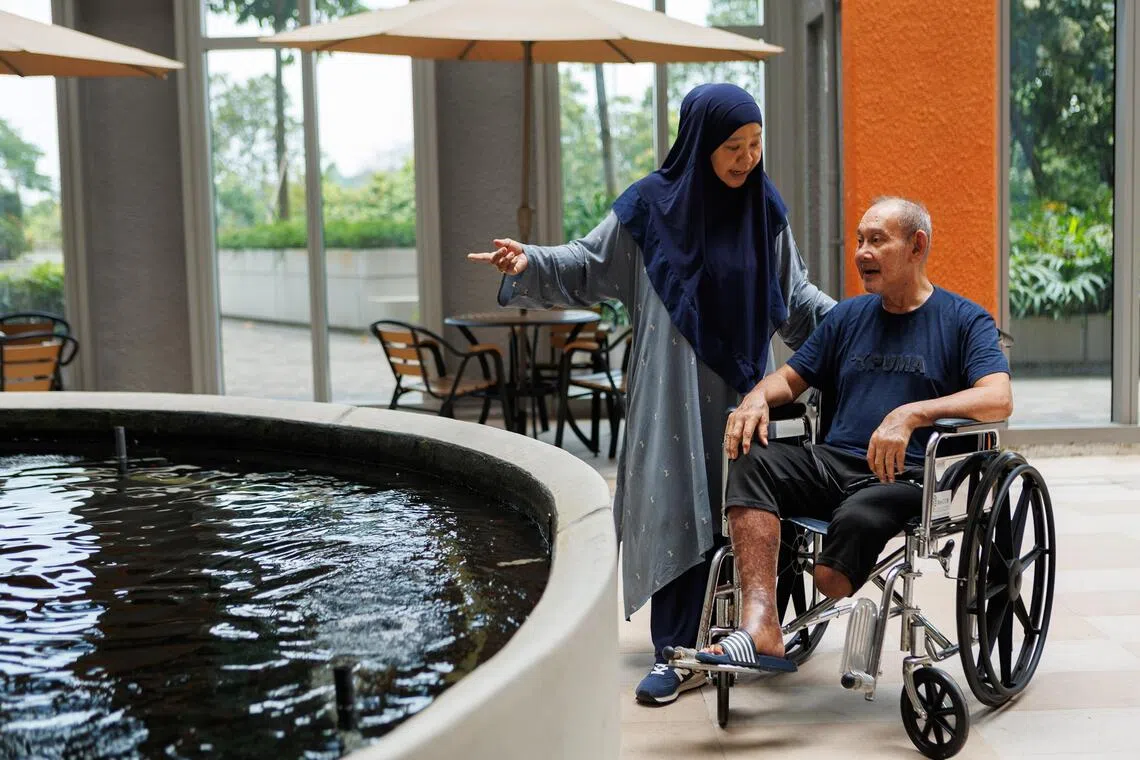
Ren Ci @ Woodlands resident Jumadi Sayap (right), 71, who has dementia, with his niece Hazwani Mohamad, 52. She uses $200 from her uncle’s MediSave account each month under the MediSave Care scheme to offset the nursing home’s fees.
Published Oct 05, 2026, 05:10 AM
Updated Oct 05, 2026, 05:10 AM
About 8,000 lower-income Singaporeans with severe disability have received nearly $50 million through the ElderFund scheme since 2020, providing monthly payouts of $150 or $250.
ElderFund supports those excluded from other schemes like CareShield Life and ElderShield, offering a safety net for long-term severe disability beyond six years.
The MediSave Care scheme also helps disabled individuals withdraw up to $200 monthly for care costs, with increasing uptake and ongoing reviews to balance immediate needs and future savings.
SINGAPORE – Nearly 8,000 lower-income Singaporeans who are severely disabled have received close to $50 million for their long-term care needs under a government social safety net scheme.
Since the launch of ElderFund in 2020, the amount of payouts and number of claimants have increased every year.
In the first year, $1.3 million was paid out to 777 claimants, which then grew to $4.3 million for 1,772 claimants in the following year.
In the subsequent three years from 2022 to 2024, the payouts continued to grow, to $6.2 million, $8.5 million and $10.3 million, respectively. The number of claimants also grew by an average of 900 each year.
In 2025, $11.9 million was paid out to 5,083 claimants, and within the first six months of 2026, $6.4 million was paid out to 4,836 claimants.
As at June 30, 2026, 7,973 claimants have received over $48.9 million in ElderFund payouts, the Ministry of Health (MOH) told The Straits Times. This is the first time ElderFund figures have been released.
“ElderFund is important as a safety net for lower-income older adults who have limited MediSave and savings, including those from older cohorts who do not have the lifelong coverage provided by CareShield Life,” said Cynthia Chen, an associate professor with the National University of Singapore’s Saw Swee Hock School of Public Health (SSHSPH).
The scheme is for Singaporeans aged 30 and older who require full assistance with at least three of the six basic daily activities, such as feeding, dressing, using the toilet, and walking or moving around.
To qualify, their per capita household income (PCHI) cannot exceed $2,600 each month, and their MediSave balances must be below $10,000.
They receive a payout of $150 or $250 each month depending on their household income, for as long as they remain eligible for the payouts.
Those whose monthly PCHI does not exceed $1,500 receive $250, while those with more than $1,500 get $150. MOH said most beneficiaries received $250.
ElderFund is aimed at supporting those who are severely disabled but do not or no longer qualify for other national schemes for long-term care such as CareShield Life, ElderShield, and the Interim Disability Assistance Programme for the Elderly (IDAPE).
These include people who have maxed out their payouts under ElderShield and IDAPE, which both have a maximum payout period of six years, but they continue to require financial assistance because of their disabilities.
The increase in ElderFund payouts and claimants is not unexpected as more people may develop severe disability and require long-term care with an ageing population, said Chen.
She noted that earlier schemes, such as ElderShield, cap payouts at six years, but more older adults may live with severe disability beyond this period.
A 2018 report by the ElderShield Review Committee stated that three in 10 severely disabled residents could remain in severe disability for 10 years or more.
CareShield Life was introduced in 2020 to replace ElderShield for those born in 1980 or later. It was also made compulsory for those aged 30 to 40 to join the scheme, which has higher payouts for life, and hence higher premiums.
Chen, whose research interests include caregiver burden and healthcare financing, said a review of ElderFund would likely be welcomed by lower-income households, particularly given the rising costs of living and care.
However, she said, such financial support should be considered alongside other forms of support, such as the Home Caregiving Grant, which also provides monthly cash payouts of up to $600 to offset caregiving expenses for those with moderate to severe disabilities.
“The broader question is therefore whether the overall package of support remains adequate for lower-income families caring for someone with severe disability, especially when disability persists for many years,” she added.
MOH said the long-term care financing schemes were designed to complement government subsidies and grants, insurance schemes, personal savings and family support.
A spokesman said MOH periodically reviews these schemes. While ElderFund payouts have not been revised since the scheme’s launch, other enhancements have been progressively implemented from 2026.
These include additional cohort-based subsidies to offset long-term care costs for those born in 1969 and earlier, which is the group less likely to be covered by CareShield Life or ElderShield, and hence can qualify for ElderFund.
Similar uptick in MediSave Care withdrawals
There is another government long-term care scheme to support those with severe disability that has also seen a growing uptake over the years.
Under the MediSave Care scheme launched in October 2020, severely disabled Singaporeans and permanent residents aged 30 and above can withdraw up to $200 each month from their own or their spouse’s MediSave account, or both.
MOH told ST the number of applicants making withdrawals has increased from around 600 in 2021 to about 4,300 in 2024, and around 5,900 in 2025.
On average, the withdrawal each year per person was about $1,800.
The withdrawal limit is determined by available MediSave savings – a monthly withdrawal of $50 is allowed for those with savings of $5,000 to $9,999, while those with at least $20,000 MediSave savings can withdraw the maximum $200 each month.
MOH said the minimum $5,000 balance requirement and a monthly $200 withdrawal limit are necessary to ensure the applicant has sufficient funds for other medical expenses, such as hospitalisation or MediShield Life premiums.
Jumadi Sayap (left) currently resides in the Ren Ci @ Woodlands nursing home, where his daily needs are taken care of by the staff, such as junior community care associate Rajni Bala (right). ST PHOTO: SARAH LEE
Jumadi Sayap (left) currently resides in the Ren Ci @ Woodlands nursing home, where his daily needs are taken care of by the staff, such as junior community care associate Rajni Bala (right).
Chen from SSHSPH said those with severe disability often have recurring expenses such as adult diapers, nutritional supplements and wound-care supplies, which MediSave Care withdrawals can help defray.
However, any review of the scheme has to balance immediate needs with the need to preserve sufficient MediSave for future healthcare needs, she said, adding that withdrawing MediSave savings also means forgoing the higher interest rates which the savings could earn.
MediSave Care has been helpful for 71-year-old Jumadi Sayap, who has dementia and currently resides in Ren Ci @ Woodlands nursing home.
His niece and main caregiver, Hazwani Mohamad, is glad that she can use $200 from her uncle’s MediSave account each month to offset the nursing home fees. It means she needs to fork out just $100.
Hazwani, 52, is a homemaker with three children and also looks after Jumadi’s 44-year-old son Muhammad Akmal Jamadi, who has intellectual disability and works as a rubbish collector.
She has to plan her finances well as she is also taking care of Akmal’s living expenses and medical needs .
“Hence, it will be good if we can use more MediSave to pay the nursing home fees. In this way, it is possible for Akmal to save up more for his own future needs,” said Hazwani.
71 岁的 Ren Ci @ Woodlands 居民 Jumadi Sayap(右)患有痴呆症,与他 52 岁的侄女 Hazwani Mohamad 合影。她每月从叔叔的保健储蓄账户中取出 200 美元,通过保健储蓄护理计划来抵消疗养院的费用。
发布于 2026 年 10 月 5 日上午 5:10
更新于2026年10月5日 上午5:10
自 2020 年以来,约有 8,000 名低收入的重度残疾新加坡人通过 ElderFund 计划获得了近 5000 万美元的补助,每月可领取 150 或 250 美元。
ElderFund 为那些被排除在 CareShield Life 和 ElderShield 等其他计划之外的人提供支持,为超过六年的长期严重残疾提供安全保障。
MediSave Care计划还帮助残疾人士每月提取高达200美元用于护理费用,该计划的参与人数不断增加,并且会持续进行审查,以平衡眼前的需求和未来的储蓄。
新加坡——根据政府的社会安全网计划,近 8000 名低收入的重度残疾人士已获得近 5000 万美元的长期护理费用。
自 2020 年 ElderFund 启动以来,每年的赔付金额和索赔人数都在增加。
第一年,向 777 名索赔人支付了 130 万美元,第二年,向 1772 名索赔人支付了 430 万美元。
在随后的三年(2022年至2024年)中,赔付金额持续增长,分别达到620万美元、850万美元和1030万美元。索赔人数也平均每年增加900人。
2025 年,向 5,083 名索赔人支付了 1190 万美元;2026 年上半年,向 4,836 名索赔人支付了 640 万美元。
截至2026年6月30日,新加坡卫生部向《海峡时报》透露,已有7973名申领者领取了超过4890万新元的乐龄基金(ElderFund)赔付金。这是乐龄基金首次公布相关数据。
“乐龄基金对于低收入老年人来说非常重要,因为它能为那些医疗储蓄和积蓄有限的老年人提供安全保障,包括那些没有终身护理保险(CareShield Life)保障的老年人群体,”新加坡国立大学苏瑞福公共卫生学院(SSHSPH)副教授陈欣怡(Cynthia Chen)表示。
该计划面向 30 岁及以上的新加坡公民,他们需要在六项基本日常活动中的至少三项(例如吃饭、穿衣、上厕所和行走或四处走动)获得全面帮助。
要符合资格,他们的家庭人均收入(PCHI)每月不得超过 2,600 美元,并且他们的 MediSave 余额必须低于 10,000 美元。
根据家庭收入情况,他们每月可获得 150 美元或 250 美元的补助,只要他们符合领取补助的条件即可。
每月个人健康保险金(PCHI)不超过1500美元的人可获得250美元,超过1500美元的人可获得150美元。卫生部表示,大多数受益人获得了250美元。
ElderFund 旨在帮助那些重度残疾但不再符合其他国家长期护理计划(如 CareShield Life、ElderShield 和老年人临时残疾援助计划 (IDAPE))资格的人。
其中包括已经领取了 ElderShield 和 IDAPE 最高赔付额的人,这两项福利的最长赔付期均为六年,但他们仍然因为残疾而需要经济援助。
陈先生表示,随着人口老龄化,越来越多的人可能出现严重残疾并需要长期护理,因此老年基金的赔付和索赔人数增加并不出乎意料。
她指出,早期的计划,如乐龄健保计划,将赔付期限限制在六年,但更多的老年人可能会在超过这个期限后仍然患有严重的残疾。
2018 年,乐龄健保审查委员会的一份报告指出,十分之三的重度残疾居民可能会持续重度残疾 10 年或更长时间。
2020年推出的CareShield Life计划取代了ElderShield计划,适用于1980年及以后出生的人士。该计划也强制要求30至40岁的人士加入,其终身赔付额更高,因此保费也更高。
陈的研究兴趣包括照护者负担和医疗保健融资,他表示,对老年基金的审查可能会受到低收入家庭的欢迎,尤其是在生活和护理成本不断上涨的情况下。
不过,她表示,这种经济援助应该与其他形式的援助结合起来考虑,例如居家护理补助金,该补助金每月提供高达 600 美元的现金补贴,以抵消中度至重度残疾人士的护理费用。
她补充说:“因此,更广泛的问题是,对于照顾重度残疾人士的低收入家庭来说,尤其是当残疾持续多年时,整体支持方案是否仍然足够。”
卫生部表示,长期护理融资计划旨在补充政府补贴和拨款、保险计划、个人储蓄和家庭支持。
卫生部发言人表示,卫生部会定期审查这些计划。虽然乐龄基金的支付金额自该计划推出以来一直未作调整,但其他改进措施已从2026年起逐步实施。
这些措施包括为 1969 年及以前出生的人提供额外的基于群体的补贴,以抵消长期护理费用。这些群体不太可能获得终身护保或乐龄护保,因此有资格获得乐龄基金。
类似情况也出现在 MediSave Care 取款中
政府还有另一项长期护理计划,旨在帮助重度残疾人士,该计划近年来也越来越受欢迎。
根据 2020 年 10 月推出的 MediSave Care 计划,30 岁及以上的重度残疾新加坡公民和永久居民每月可从自己或配偶的 MediSave 账户中,或两者中,提取高达 200 新元。
卫生部告诉《海峡时报》,申请撤回申请的人数已从 2021 年的约 600 人增加到 2024 年的约 4300 人,2025 年的约 5900 人。
平均而言,每人每年提取的金额约为 1800 美元。
提款限额取决于可用的保健储蓄——储蓄在 5,000 美元至 9,999 美元之间的人每月可提取 50 美元,而保健储蓄至少有 20,000 美元的人每月可提取最高 200 美元。
卫生部表示,最低 5000 美元的余额要求和每月 200 美元的取款限额是为了确保申请人有足够的资金支付其他医疗费用,例如住院费用或终身健保计划保费。
朱马迪·萨亚普(左)目前居住在兀兰仁慈疗养院,他的日常生活由工作人员照料,例如初级社区护理员拉杰尼·巴拉(右)。(海峡时报摄影:莎拉·李)
Jumadi Sayap(左)目前居住在 Ren Ci @ Woodlands 疗养院,他的日常需求由工作人员照顾,例如初级社区护理助理 Rajni Bala(右)。
SSHSPH 的 Chen 表示,重度残疾人士经常需要支付成人尿布、营养补充剂和伤口护理用品等费用,而 MediSave Care 的提款可以帮助支付这些费用。
她表示,任何对该计划的审查都必须在满足当前需求和为未来医疗保健需求保留足够的保健储蓄之间取得平衡,并补充说,提取保健储蓄也意味着放弃储蓄可能获得的更高利息。
MediSave Care 为 71 岁的 Jumadi Sayap 提供了帮助,他患有痴呆症,目前居住在 Ren Ci @ Woodlands 疗养院。
他的侄女兼主要照护者哈兹瓦尼·穆罕默德很高兴她每月可以从叔叔的保健储蓄账户中取出200美元来支付养老院费用。这意味着她只需要支付100美元。
52岁的哈兹瓦尼是一位家庭主妇,育有三个孩子,她还照顾着朱马迪44岁的儿子穆罕默德·阿克马尔·贾马迪,后者患有智力障碍,是一名垃圾收集员。
她必须好好规划自己的财务,因为她还要承担阿克玛尔的生活费和医疗费。
“因此,如果我们能用更多的保健储蓄来支付疗养院费用,那就太好了。这样一来,阿克马尔就能为自己未来的需求攒下更多钱了。”哈兹瓦尼说道。