Haze in Singapore: Air quality falls back in unhealthy range overnight新加坡雾霾:空气质量一夜之间再次降至不健康水平。
Air quality in Singapore fell into the unhealthy range with elevated PM2.5 levels due to haze from southern Sumatra fires and dry conditions continuing. Read more at straitstimes.com.
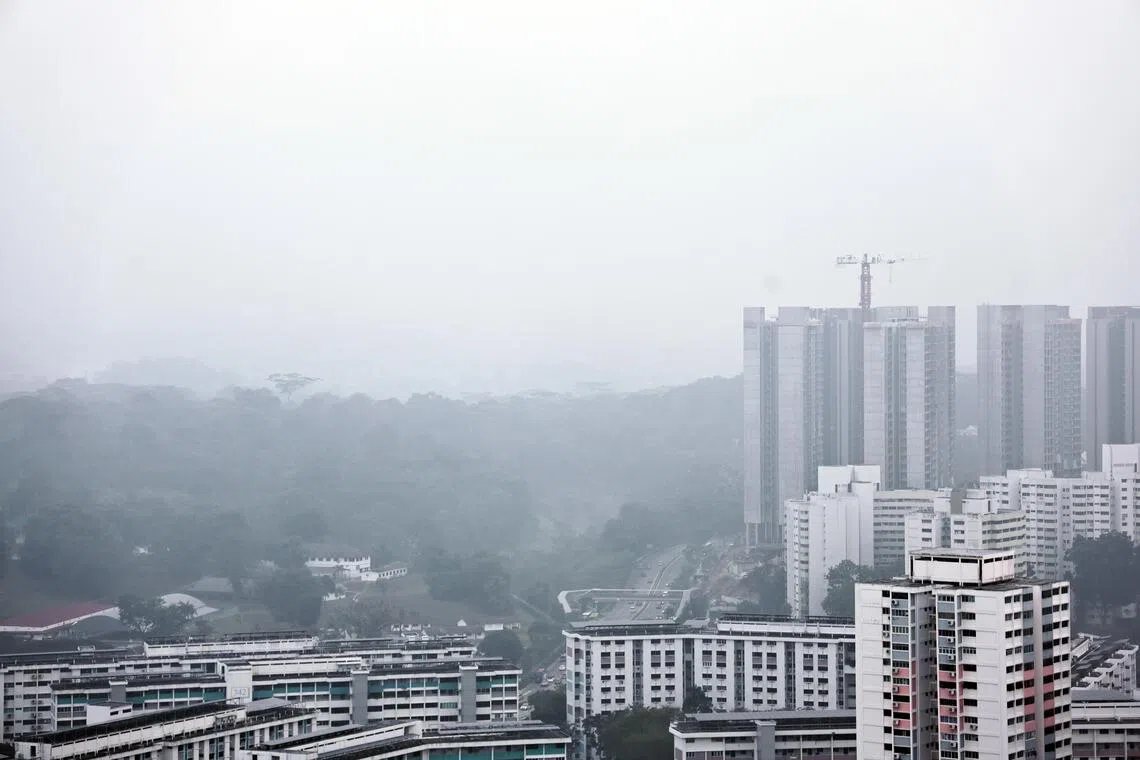
In its daily haze advisory on Oct 4, the National Environment Agency (NEA) said the 24-hour PSI is forecast to be in the “high moderate to low unhealthy” range.
ST PHOTO: KELVIN CHNG
Published Oct 05, 2026, 06:13 AM
Updated Oct 05, 2026, 06:13 AM
SINGAPORE – The air quality in parts of Singapore dipped back into the unhealthy range again early on Oct 5, with the 24-hour PSI reading at 6am in the central region standing at 110 and the west at 102.
PM2.5 readings, which are used as a gauge for immediate activities, were elevated in two of the five regions across Singapore.
The PM2.5 stood at 93 in the central region, and 81 in the west. Readings in north, south, and east were in the normal band, ranging from 49 to 52.
Air quality is considered unhealthy when the 24-hour PSI is in the range of 101 to 200, while an hourly PM2.5 reading between 56 and 150 indicates an elevated concentration of fine particles.
The PSI – a 24-hour rolling average of six key air pollutants and used in planning for outdoor activities the next day – had fluctuated between the moderate and unhealthy range on Oct 4.
It hit a high of 103 at about 3am before falling back to into the 90s where it spent much of the day till 9pm, when it moved briefly into the unhealthy range at 101 before dipping back to 99 at 11pm.
It began its upward trajectory at midnight, moving up to 100 and climbing slowly overnight.
In its daily haze advisory at about 6pm on Oct 4, the National Environment Agency (NEA) said the 24-hour PSI is forecast to be in the high moderate to low unhealthy range for the next 24 hours.
Moderate to dense smoke plumes from southern Sumatra were observed to be drifting towards Singapore and the surrounding region, and smoke haze was observed from fires in Kalimantan.
Dry conditions are forecast to continue over Singapore and the surrounding region on Oct 5. The risk of smoke haze affecting the Republic remains as the prevailing winds are expected to blow from the south-east or south-west.
The PSI crossed into the unhealthy range four weeks ago, hitting 101 in central Singapore on the morning of Sept 4. In the days that followed, readings in the central, eastern and western parts of the island occasionally crossed into the unhealthy range.
The highest reading of the year 164 in central Singapore was recorded on Sept 29.
The developments in September mark the first time since October 2023 that the PSI in Singapore hit unhealthy levels because of haze, with the authorities earlier warning of the risk of haze between June and October as a result of warmer and drier conditions brought on by both El Nino and the Indian Ocean Dipole.
Some experts have predicted that the haze in Singapore this year could last for a longer period due to this year’s “Godzilla” El Nino event, which could reduce rainfall and result in higher temperatures over October-November, compared with non-El Nino years.
During non-El Nino years, the dry south-west monsoon season usually tapers off by September, and the start of the rainy north-east monsoon season tends to set in around late November.
The Meteorological Service Singapore (MSS) told The Straits Times that El Nino events, particularly strong ones, tend to delay the retreat of the dry season for much of the southern ASEAN region and that the MSS, is expecting a transition only during late October or early November for Singapore, later than in the previous two years.
国家环境局 (NEA) 在 10 月 4 日发布的每日雾霾预警中表示,预计 24 小时空气污染指数 (PSI) 将处于“高、中、低、不健康”的范围内。
《海峡时报》摄影:KELVIN CHNG
发布于 2026 年 10 月 5 日上午 6:13
更新于2026年10月5日 上午6:13
新加坡——10月5日清晨,新加坡部分地区的空气质量再次降至不健康水平,中部地区早上6点的24小时PSI读数为110,西部地区为102。
PM2.5 读数(用作衡量当前活动的一个指标)在新加坡五个地区中的两个地区偏高。
中部地区的PM2.5浓度为93,西部地区为81。北部、南部和东部的读数均在正常范围内,介于49至52之间。
当 24 小时 PSI 值在 101 至 200 之间时,空气质量被认为是不健康的;而每小时 PM2.5 读数在 56 至 150 之间则表明细颗粒物浓度升高。
10 月 4 日,PSI(六种主要空气污染物的 24 小时滚动平均值,用于规划第二天的户外活动)在中等和不健康范围内波动。
凌晨 3 点左右,气温达到 103 度的峰值,之后回落到 90 多度,并在此温度范围内维持了一整天,直到晚上 9 点。晚上 9 点,气温短暂地达到了不健康的 101 度,然后在晚上 11 点回落到 99 度。
它从午夜开始上升,升至 100,并在夜间缓慢攀升。
10 月 4 日下午 6 点左右,国家环境局 (NEA) 在其每日雾霾预警中表示,预计未来 24 小时内,24 小时空气污染指数 (PSI) 将处于高、中、低不健康范围。
据观察,来自苏门答腊南部的中等至浓重的烟柱正向新加坡及其周边地区飘移,同时加里曼丹的火灾也产生了烟雾。
预计10月5日新加坡及其周边地区将持续干燥天气。由于盛行风向预计为东南风或西南风,新加坡仍存在烟雾影响的风险。
四周前,新加坡空气污染指数(PSI)进入不健康范围,9月4日上午,新加坡中部地区的PSI达到101。在接下来的几天里,该岛中部、东部和西部地区的读数偶尔也会进入不健康范围。
新加坡中部地区今年最高读数为164,出现在9月29日。
9 月份的情况标志着自 2023 年 10 月以来,新加坡的空气污染指数 (PSI) 首次因雾霾达到不健康水平。此前,当局曾警告称,由于厄尔尼诺现象和印度洋偶极子现象带来的气候变暖和干燥,6 月至 10 月期间存在雾霾风险。
一些专家预测,由于今年的“哥斯拉”厄尔尼诺现象,新加坡今年的雾霾可能会持续更长时间,与非厄尔尼诺年份相比,这可能会减少降雨量,并导致 10 月至 11 月气温升高。
在非厄尔尼诺年份,干燥的西南季风季节通常在 9 月份逐渐结束,而多雨的东北季风季节往往在 11 月下旬左右开始。
新加坡气象局 (MSS) 告诉《海峡时报》,厄尔尼诺现象,尤其是强厄尔尼诺现象,往往会推迟东盟南部大部分地区旱季的结束,MSS 预计新加坡的旱季过渡期要到 10 月下旬或 11 月初才会到来,比前两年要晚。